
How to Use AI to Write Your Blog (Without Looking Like a Robot)
The fear most bloggers have about AI writing tools is real: what if the post sounds like it was produced by a machine? What if readers can tell? What if Google penalises it? Understanding how to use AI to write your blog can help alleviate these concerns.
Understanding how to use AI to write your blog can greatly enhance your efficiency and creativity.
When bloggers learn how to use AI to write your blog, they can overcome the fear of generic content.
This guide shows you how to use AI to write your blog more effectively and creatively.
By knowing how to use AI to write your blog, you can produce high-quality articles faster.
When utilized correctly, here’s how to use AI to write your blog while maintaining originality.
These are legitimate concerns. AI-generated content — the kind published directly without significant human editing — does tend to feel generic, slightly formal, and strangely confident about things it gets wrong. Readers notice. Google notices.
But AI-assisted content is different. When a blogger with genuine expertise uses AI to handle the mechanics of writing — structure, drafts, grammar checks — while adding their own knowledge, voice, and experience throughout, the result is better content produced in less time.
Learning how to use AI to write your blog effectively can set you apart from others.
This guide shows you exactly how to do that.
Knowing how to use AI to write your blog helps in crafting unique narratives.
To enhance your posts, it’s vital to understand how to use AI to write your blog.
When you learn how to use AI to write your blog, the writing process becomes more efficient.
Grasping how to use AI to write your blog means you can focus more on creativity.
Take the time to understand how to use AI to write your blog seamlessly and effectively.
Here’s how to use AI to write your blog in a way that engages your audience.
Utilizing how to use AI to write your blog can significantly boost your content quality.
It’s essential to know how to use AI to write your blog while maintaining your voice.
Content that shows how to use AI to write your blog will be more appealing to readers.
Before implementing how to use AI to write your blog, consider your unique perspective.
Think through how to use AI to write your blog to create engaging content.
Reflect on how to use AI to write your blog before generating content.
Understanding how to use AI to write your blog is key to successful posts.
This guide shows you exactly how to use AI to write your blog effectively and maintain your unique voice.
Affiliate disclosure: This post contains affiliate links. If you buy through them, I may earn a small commission at no extra cost to you.
TL;DR
How to Use AI to Write Your Blog Effectively
- AI-generated content and AI-assisted content are fundamentally different — one replaces your thinking, the other speeds up your writing.
- The key to not sounding like a robot is adding specific personal experience at every stage.
- Use AI for outlines, drafts, and grammar checking — not for recommendations or opinions.
- Read every AI draft aloud before publishing — robotic-sounding paragraphs are obvious when spoken.
- The golden rule: if AI could have written this without knowing you existed, rewrite it
The Difference Between AI-Generated and AI-Assisted Content
By learning how to use AI to write your blog, you streamline your writing process.
Mastering how to use AI to write your blog opens new avenues for creativity.
Ultimately, learning how to use AI to write your blog leads to more impactful content.
AI-generated content is what you get when you type “write me a 1,500-word blog post about the best garden tools for seniors” and publish the result with minimal editing. It tends to be: accurate in a general sense, structured in a predictable way, written in a confident tone that masks its lack of real experience, and completely indistinguishable from a thousand other posts on the same topic.
AI-assisted content is what you get when a blogger with genuine expertise uses AI to speed up the drafting and editing process, then adds their specific knowledge, genuine opinions, and personal voice throughout. It sounds like a real person because it is — AI just helped with the mechanics.
This method illustrates how to use AI to write your blog while incorporating personal insights.
Remember, knowing how to use AI to write your blog effectively is a valuable skill.
The distinction matters because readers and search engines reward the second and increasingly ignore the first.
Step 1: Do Your Thinking Before Touching AI
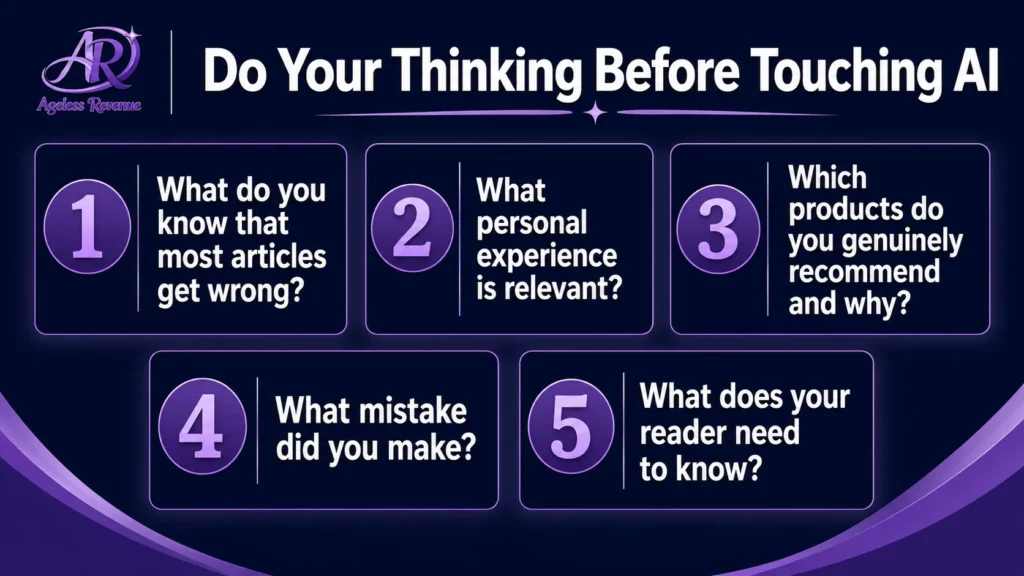
The most important step in producing AI-assisted content that sounds human is to do your thinking before you open any AI tool.
Spend 10 minutes writing down:
- What is the one thing you know about this topic that most articles get wrong or ignore?
- What specific personal experience do you have that is relevant?
- Which products, tools, or approaches do you genuinely recommend and why?
- What mistake did you make that your reader might make too?
- What does your specific reader need to know that they probably do not know?
These notes are your raw material. They are what make your post different from every other post on the same topic. AI cannot generate them. If you skip this step and go straight to AI, you will get a competent-sounding post that could have been written about anyone, for anyone, by anyone.
Step 2: Use AI for Structure and Drafting
With your notes in hand, give ChatGPT or Claude your topic, your key points, and your keyword. Ask for an outline first — not a full draft.
Example prompt:
“I am writing a blog post for retiree gardeners about the best lightweight trowels for adults with arthritic hands. My key points are: why handle grip matters more than blade material, the three trowels I have personally tested over the past year, what to avoid (thin handles, no wrist support), and where to buy. Please write a blog post outline with 5 main sections and suggested subheadings.”
Review the outline. Adjust it to match what you actually want to say. Then use it to draft the post — either writing each section yourself using the outline as a guide, or asking AI to draft each section based on your specific points and then rewriting it in your voice.
Step 3: Add Yourself to Every Section
This is the step that prevents your post from sounding like a robot.
Go through the AI draft section by section and look for places to add:
Personal experience: “After trying four different trowels over the past year, the one I keep reaching for is…” This is something only you can write.
Specific opinions: “The most common advice online is to look for stainless steel blades, but in my experience, the blade material matters far less than the handle grip.” This shows you have an opinion, not just information.
Honest negatives: “The main drawback of this trowel is the blade flexes slightly under heavy soil, which bothered me at first, but I have gotten used to it.” Honest negatives build far more trust than relentless positivity.
Direct address: “If you have been gardening for decades and your hands are not what they used to be, you know exactly what I mean.” This reminds the reader that a real person is writing to them.
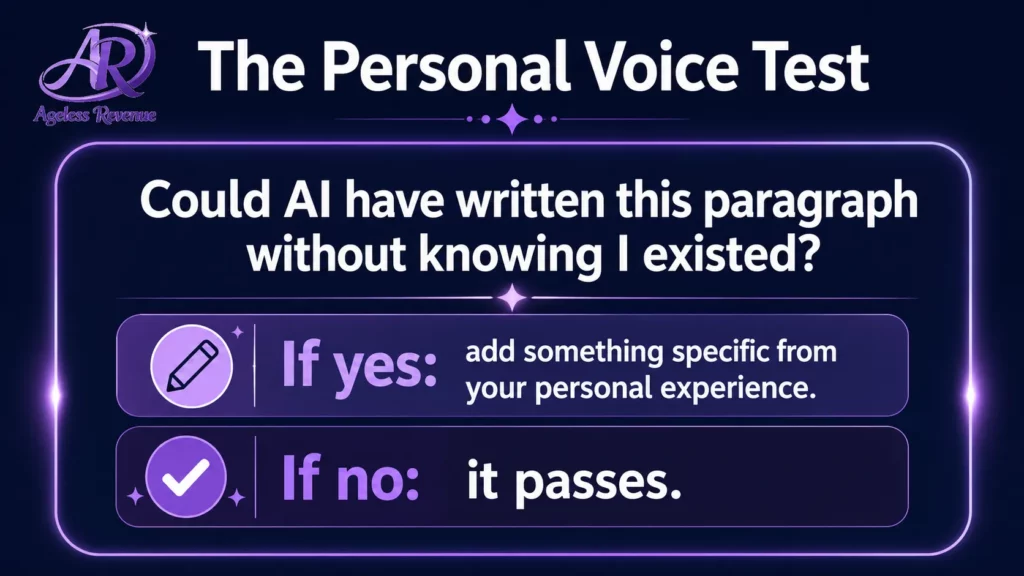
A useful test: for every paragraph, ask “Could AI have written this without knowing I existed?” If yes, add something specific to you — a detail from your experience, an opinion you hold, something only someone who has actually done this would know.
Step 4: Rewrite Anything That Sounds Robotic
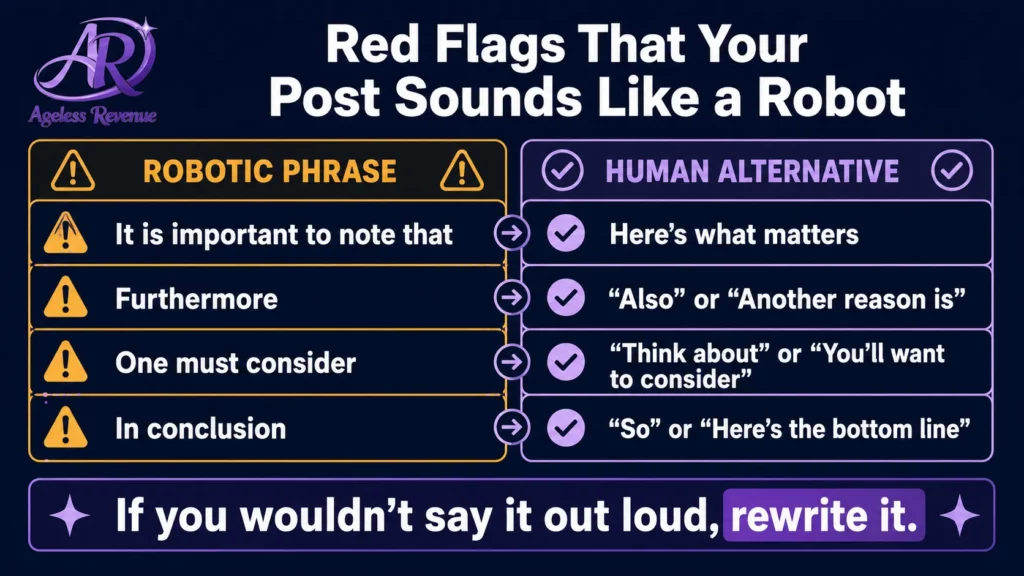
Read the finished draft aloud. This is the most reliable test for AI-sounding content. Robotic prose is obvious when spoken in a way it is not when read silently.
Red flags to listen for:
Overly formal sentence structures: “It is important to note that…” / “One must consider…” / “There are several factors that contribute to…” — replace these with direct statements: “Note that…” / “Consider…” / “Three things matter here…”
Hedging everything: AI tends to hedge constantly to avoid being wrong. “This may be useful for some people in certain situations.” Replace with a direct opinion: “This is particularly useful if you garden in heavy clay soil.”
Generic transitions: “In conclusion…” / “Furthermore…” / “It is worth mentioning that…” — these sound like a school essay, not a blog post.
Absent personality: If a paragraph could be from any website about any gardening tool, it needs more of you in it.
Step 5: Use Grammarly for the Final Check
After you have added your voice and rewritten the robotic sections, run the post through Grammarly for a grammar and clarity check. Accept corrections for grammar errors. Be selective about style suggestions — some make your writing sound less personal, which defeats the purpose.
The Grammarly browser extension works directly in your WordPress editor, so there is no need to copy and paste anywhere.
What AI Should Never Write For You
Your product recommendations. The affiliate content that converts is specific and personal. “I have been using this for six months,s and here is what I actually think” earns trust. “This product has received positive reviews from many users” does not. Write your own recommendations based on your actual experience.
Your opinion on controversial topics. AI avoids taking clear positions. Your readers want to know what you think. If you believe one approach is better than another, say so directly.
Your personal stories. AI can write a plausible-sounding anecdote, but readers can usually detect fabricated stories. Use real experiences — even brief ones — rather than AI-generated ones.
Your affiliate disclosures. These must be written by you, placed correctly, and be accurate. AI tools do not know which links in your post are affiliate links.
A Practical Example
To improve your content, practice how to use AI to write your blog with authenticity.
This guide offers insights on how to use AI to write your blog for better results.
Ultimately, the goal is to master how to use AI to write your blog with confidence.
Now that you know how to use AI to write your blog, start implementing these strategies!
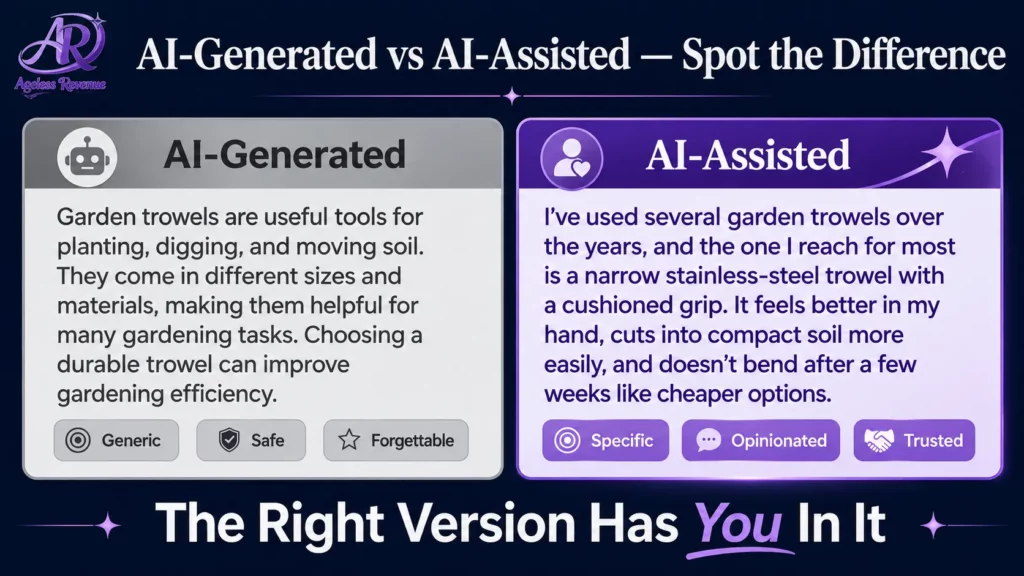
Here is the difference between AI-generated and AI-assisted content for the same topic.
AI-generated (published as-is): “Garden trowels are essential tools for any gardener. When choosing a garden trowel, there are several important factors to consider, including the material of the blade, the length of the handle, and the overall ergonomics of the design. For seniors with arthritis, it is particularly important to choose a trowel with a comfortable grip.”
AI-assisted (with personal experience added): “After three seasons of gardening with increasingly stiff fingers, I have tried more trowels than I care to count. The blade material turned out to matter far less than I expected. What actually made the difference was the handle — specifically, whether it gave my palm enough surface area to grip without my fingers having to do all the work.”
The second version is no longer. It is just specific and personal. That specificity is what readers trust and what AI cannot provide on its own.
Frequently Asked Questions
Will Google penalise my blog if I use AI to help write posts?
Google evaluates content on whether it is helpful and demonstrates genuine expertise and experience — not on whether AI tools were used in the writing process. AI-assisted content from a knowledgeable blogger who adds real experience and genuine opinions performs well. AI-generated content with no human expertise or original perspective does not.
How much of a blog post should I write myself versus using AI?
There is no fixed ratio. The right approach is: write all the ideas, experiences, opinions, and specific recommendations yourself; use AI for structure, draft sentences, and editing mechanics. Some bloggers write the entire first draft themselves and use AI only for editing. Others use AI for the initial draft and rewrite heavily. Both work well.
What is the fastest way to stop sounding like a robot?
Read every post aloud before publishing. This identifies robotic-sounding sections in a way that silent reading does not. The other reliable method is the specificity test: for every paragraph, ask, “Could AI have written this without knowing I existed?” If yes, add something specific from your personal experience.
Do I need to tell readers I used AI tools?
There is no legal requirement to disclose AI tool use (unlike affiliate links, which must always be disclosed). If readers ask about your process, being transparent is the better choice. The FTC disclosure requirements apply to material connections to products, not to writing tools.
Your Next Step
Choose your next blog post topic. Before opening any AI tool, spend 10 minutes writing down your specific experience with the topic, one thing you believe that most articles get wrong, and the product or approach you would genuinely recommend.
Then open ChatGPT and give it those points as a prompt. You now have a draft built on your real knowledge rather than generic information.
For a full overview of all the AI tools worth using as a retiree blogger, read Best AI Tools for Retiree Bloggers.
For a structured path with training, community support, and tools included, try Wealthy Affiliate free →
This post contains affiliate links. If you buy through them, I may earn a small commission at no extra cost to you.