

How Affiliate Blog Monetization Actually Works (2026)
Plenty of guides explain how to start a blog. Far fewer explain what actually happens financially once it is running — which programs pay, how income compounds, and what a realistic monthly income looks like at each stage. This guide fills that gap by detailing how affiliate blog monetization works.
Affiliate disclosure: This post contains affiliate links. If you buy through them, I may earn a small commission at no extra cost to you.
TL;DR
Understanding How Affiliate Blog Monetization Works
- Affiliate commissions are the primary income source for most niche blogs — display ads like AdSense are a distant secondary option
- Commission structures vary widely: one-time percentages, flat fees, or recurring monthly payments
- Realistic income progression: $0-50/month in months 1-3, $50-300/month in months 4-9, $300+ in month 10 onward for consistent publishers
- Diversify across two or three complementary affiliate programs rather than relying on just one
- Income compounds — posts from month one continue earning well into year two and beyond
The Income Sources Available to a Retiree Affiliate Blogger
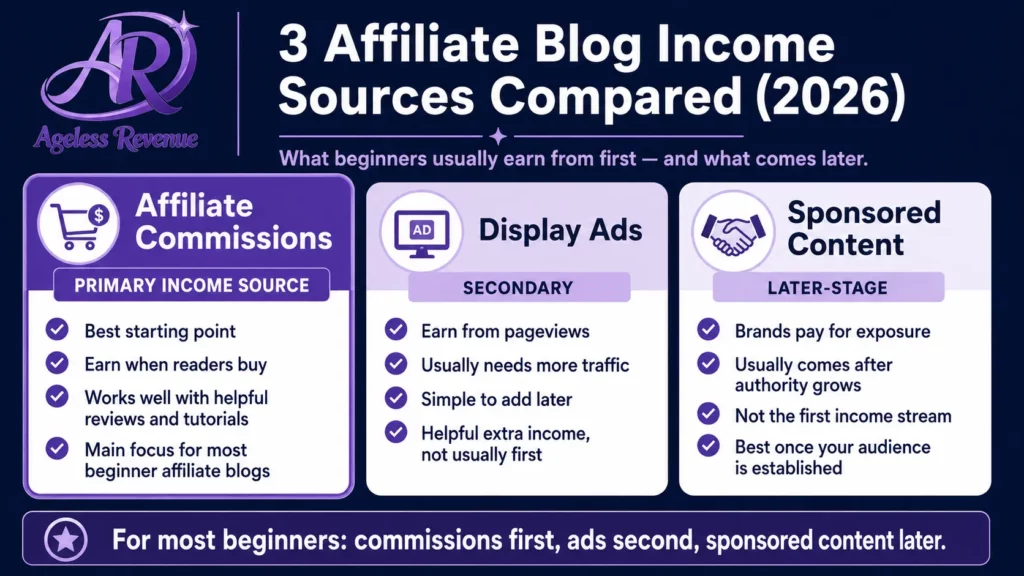
Affiliate commissions are the core model and should be your primary focus. You recommend a product, a reader buys through your tracked link, you earn a percentage or flat fee.
Display advertising (AdSense and similar) places ads on your site that pay based on impressions or clicks. This requires significant traffic volume — generally tens of thousands of monthly visitors — before it produces meaningful income, and it pays a fraction of what a well-placed affiliate recommendation earns per visitor. For a new or mid-sized retiree blog, affiliate commissions are almost always the better use of your time and content.
Sponsored content — brands paying directly for a mention or review — becomes available once you have an established audience, typically well into year two or beyond. Not a realistic income source for a new blog.
For the first one to two years, affiliate commissions should be essentially your entire monetisation strategy. Everything else is a later-stage addition, not a starting point.
How Affiliate Commission Structures Actually Work
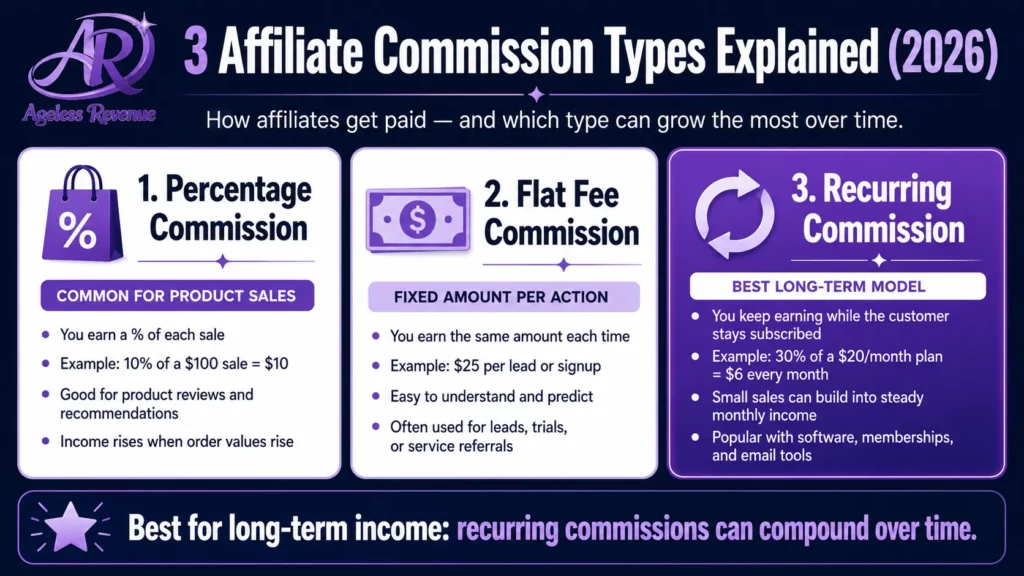
Percentage commissions are the most common — Amazon Associates pays 1-10% depending on category, specialty programs often pay 15-40%. A $50 product at 20% commission earns you $10 per sale.
Flat-fee commissions pay a fixed amount regardless of the purchase price, common with software trials, subscription sign-ups, or lead-generation offers. These can be lucrative for products with a long sales cycle that converts well from genuine content.
Recurring commissions pay you every month the customer remains subscribed — common with software-as-a-service products. These compound the most powerfully over time: a single sale today can produce income for years, as long as the customer stays subscribed.
A sustainable affiliate income strategy usually combines all three: a primary percentage-based program covering your core niche products (often Amazon Associates, given the breadth of inventory), one or two specialty programs with higher commission rates for your most-recommended products, and ideally at least one recurring-commission product if a relevant one exists in your niche.
A Realistic Monthly Income Timeline
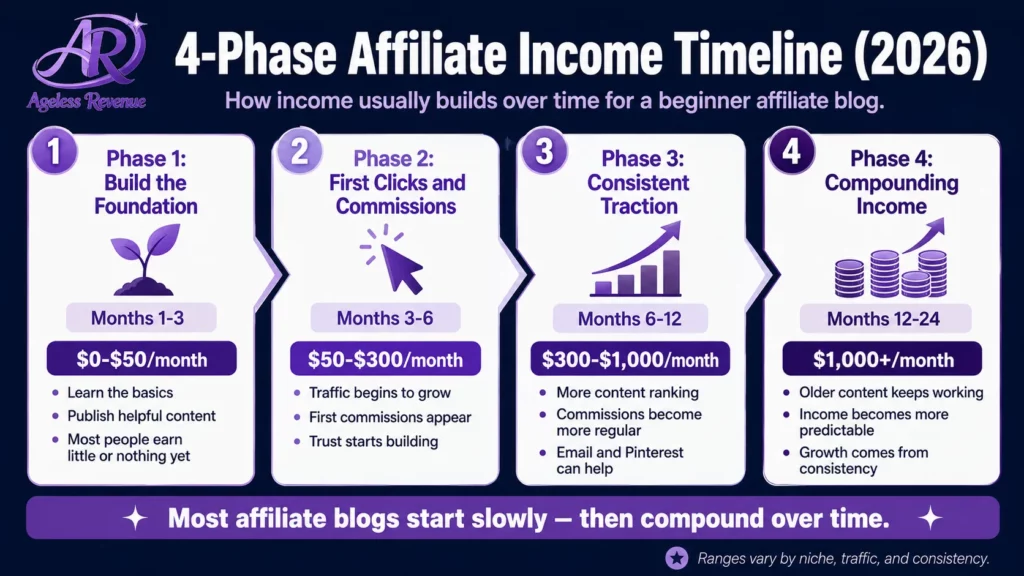
This reflects what consistent, weekly-publishing retiree bloggers in a focused niche tend to experience — not best-case outliers, not worst-case failures.
Months 1-3: typically $0-50 per month. Your first few posts are published, programs are approved, and your first tracked clicks start appearing. Most of this period produces no income at all, which is normal and not a sign of failure.
Months 4-6: typically $50-150 per month. Organic search traffic begins arriving for your specific, long-tail keywords. Pinterest, if you have been consistent, starts sending meaningful clicks. Your library of content has grown enough that readers are finding multiple relevant posts per visit.
Months 7-9: typically $150-300 per month. Earlier posts continue earning while new posts add to the total. This is where the compounding effect of consistent publishing starts becoming visible month over month.
Month 10 onward: $300+ per month becomes realistic for bloggers who have published consistently and targeted their content well, with continued growth as the content library and search authority expand. Some bloggers significantly exceed this; others take longer. The variance depends heavily on niche competitiveness, consistency, and content quality — but this range reflects what steady, methodical effort tends to produce.
These numbers describe consistent effort in a reasonably chosen niche. A niche with very low search demand, or publishing that stops and starts erratically, will produce a slower and less predictable curve.
Why Income Compounds Rather Than Growing Linearly
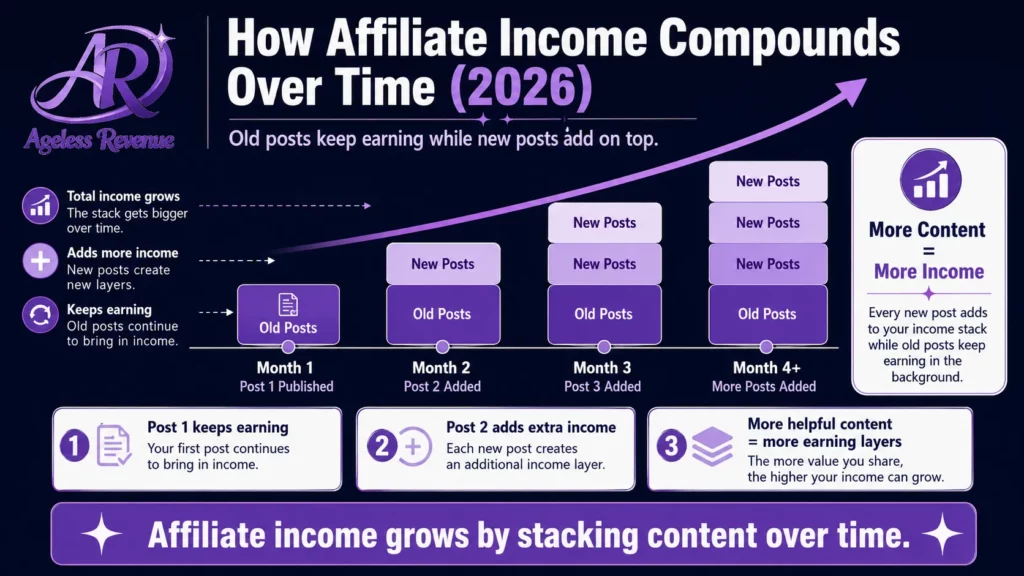
A blog post you publish in month one does not stop earning once month two begins. If it ranks well and continues attracting search traffic, it keeps generating clicks and commissions indefinitely — often for years, with only occasional updates needed to keep it current.
This is why monthly income tends to accelerate rather than grow at a flat rate. In month three, you might have three posts earning a small amount each. In month nine, you might have twenty-five posts, most of them still earning, plus newer ones beginning to contribute. The total compounds because old content keeps working while new content adds on top.
This is also why consistency matters more than any individual post’s quality. A blogger who publishes one excellent post per week for a year has fifty-two assets working simultaneously. A blogger who publishes in occasional bursts has gaps where nothing new is being added to that compounding base.
How to Choose Which Affiliate Programs to Join
Start with Amazon Associates. It is the easiest program to get approved for, covers an enormous range of products across virtually every niche, and gives you a reliable baseline while you build out your content library.
Add one affiliate network. ShareASale or Impact let you apply to hundreds of individual brand programs from a single dashboard, simplifying the application process significantly as you discover which specific products you want to recommend.
Add specialty programs as you identify them. As you write content and research products, you will encounter specific brands with their own affiliate programs, often paying considerably more than Amazon’s standard rates. Apply to these as they become relevant to your specific content.
A reasonable target is two to four active programs by month six — enough diversity that no single program’s policy change or commission cut significantly damages your income, without so many that managing the links becomes a chore.
Frequently Asked Questions
Is AdSense worth adding to an affiliate blog?
Generally not as a primary strategy. AdSense requires substantial traffic to produce meaningful income and pays far less per visitor than well-placed affiliate links. Most successful niche affiliate blogs either skip display ads entirely or add them only once traffic is very high, as a secondary income layer rather than the main one.
How many affiliate programs should I be part of?
Two to four well-chosen programs is a reasonable target for an established blog. More than that typically adds management overhead without proportional income benefit, unless your niche genuinely spans many distinct product categories.
Why is my income lower than these timeline estimates?
Niche competitiveness, publishing consistency, and content quality all affect where you land within these ranges. A highly competitive niche or inconsistent publishing schedule will produce a slower curve than the typical estimates above. Review your keyword targeting and publishing frequency before assuming something is fundamentally wrong.
Does income ever plateau?
It can, particularly if publishing slows or stops. Continued growth requires continued content creation — the compounding effect comes from consistently adding new earning assets, not from a fixed library of old posts growing indefinitely on their own.
Your Next Step
If you have not yet applied to Amazon Associates, do that once you have two to three live posts. If you are already earning, review your current programs and identify one specialty program in your niche that might offer better commission rates than your current setup.
For the complete guide to getting started with affiliate marketing as a retiree, read Getting Started With Affiliate Marketing as a Retiree.
For a structured path with training on monetisation strategy built in, try Wealthy Affiliate free →
This post contains affiliate links. If you buy through them, I may earn a small commission at no extra cost to you.