
Email Marketing for Affiliate Revenue — How to Build a List That Earns
There is one thing that distinguishes email marketing for affiliate revenue from every other email marketing for affiliate revenue channel: you own it.
A Pinterest account can be suspended. A Facebook group can be shut down. Google can update its algorithm and halve your search traffic overnight. None of those things can happen to your email marketing for affiliate revenue list. It lives in a platform you pay for, contains subscribers who explicitly chose to hear from you, and generates income whether or not any external platform decides to cooperate with you this week.
For the Ageless Revenue audience, email has another advantage that rarely gets mentioned: you already know how to use it. Writing a helpful, personal email to people who want to hear from you is something most adults have been doing for years. The affiliate marketing layer — recommending a product you genuinely believe in, with a link — adds almost nothing to the complexity.
For the Ageless Revenue audience, email marketing for affiliate revenue has another advantage that rarely gets mentioned: you already know how to use it.
This guide covers everything you need to go from zero subscribers to a functioning email marketing for affiliate revenue list that earns affiliate commissions.
This guide will show you the benefits of email marketing for affiliate revenue as a powerful tool to boost your income through email marketing for affiliate revenue strategies.
For a broader view of how email marketing for affiliate revenue fits alongside other non-blog affiliate channels, read our guide to affiliate marketing without a website.
Affiliate disclosure: This post contains affiliate links. If you purchase through one of our links, we may earn a commission at no extra cost to you through email marketing for affiliate revenue.
Understanding email marketing for affiliate revenue is crucial as it outperforms other channels.
Email marketing for affiliate revenue — a game changer that you can’t afford to ignore.
This guide covers everything you need to go from zero subscribers to a functioning email list that earns affiliate commissions. No blog required. No technical background required.
The statistics tell a clear story about email marketing for affiliate revenue. Average email open rates across industries sit between 30% and 40%.
Email marketing for affiliate revenue does not have that problem.
The ROI comparison for email marketing for affiliate revenue is equally stark.
For affiliate marketing specifically, email marketing for affiliate revenue works because of trust.
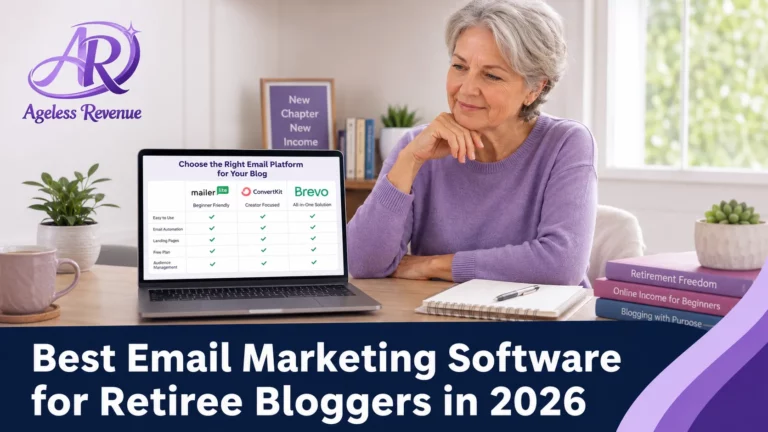
Choosing an email marketing for affiliate revenue platform requires careful consideration.
The most important thing to check before choosing an email marketing for affiliate revenue platform is whether its terms of service allow affiliate marketing links in emails.
MailerLite is the clear recommendation for most beginners looking into email marketing for affiliate revenue.
Beehiiv is a newer platform specifically designed for newsletter publishing and email marketing for affiliate revenue.
ConvertKit (now Kit) is widely used by content creators for email marketing for affiliate revenue.
Mailchimp is the most widely known email platform, but it is not ideal for email marketing for affiliate revenue.
The practical recommendation for email marketing for affiliate revenue: start with MailerLite.
Building your email marketing for affiliate revenue list from zero will be a rewarding experience.
Starting from zero subscribers in email marketing for affiliate revenue is psychologically harder than the practical work actually is.
Step 1: Create a lead magnet for email marketing for affiliate revenue.
A lead magnet is a free resource you offer in exchange for an email address in your email marketing for affiliate revenue strategy.
Ten lead magnet ideas for the Ageless Revenue niche focused on email marketing for affiliate revenue:
This guide will show you the benefits of email marketing for affiliate revenue as a powerful tool to boost your income.
For a broader view of how email fits alongside other non-blog affiliate channels, read our guide to affiliate marketing without a website. For the complete picture of building affiliate income online, the Ageless Revenue complete guide maps all the pieces together.
Affiliate disclosure: This post contains affiliate links. If you purchase through one of our links, we may earn a commission at no extra cost to you.
Why Email Outperforms Social and SEO for Affiliate Marketing
Email Marketing for Affiliate Revenue — A Game Changer
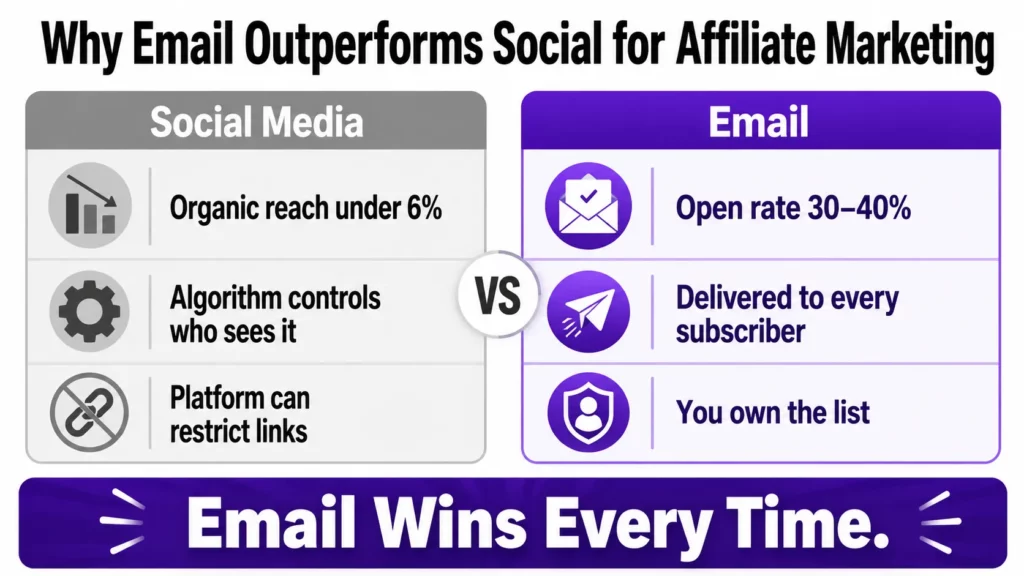
The statistics tell a clear story. Average email open rates across industries sit between 30% and 40%. The average organic reach of a Facebook post — meaning the percentage of your followers who actually see it — is under 6%. Instagram is similar. Even on a good day, social media shows your content to a small fraction of the people who said they wanted to see it.
Email does not have that problem. When you send an email, it arrives in every subscriber’s inbox. Whether they open it is up to them — but the delivery is not filtered, throttled, or deprioritised by an algorithm trying to sell you advertising.
The ROI comparison is equally stark. Email marketing consistently generates a higher return on investment than any other digital channel — commonly cited at $36–42 for every $1 spent. That figure reflects the combination of low cost, high deliverability, and the personal relationship that a well-run email list creates over time.
For affiliate marketing specifically, email works because of trust. A recommendation in an email from someone a subscriber has chosen to hear from, in a format that feels personal and direct, converts at a fundamentally different rate than a banner ad or a social post. The subscriber has already demonstrated that they value your perspective by giving you their email address. That pre-existing trust is the most valuable asset in affiliate marketing.
Choosing an Email Marketing Platform
The most important thing to check before choosing an email platform is whether its terms of service allow affiliate marketing links in emails. Several popular platforms restrict or prohibit affiliate links — a fact that surprises many beginners who discover it after building a list.
The best lead magnets for email marketing for affiliate revenue are specific, immediately usable, and solve a single clear problem.
Step 2: Set Up Your Sign-Up Page and Form for email marketing for affiliate revenue.
Every email platform for email marketing for affiliate revenue provides a free hosted sign-up page.
The sign-up page for email marketing for affiliate revenue should include: the name of your lead magnet.
Step 3: Promote Your Sign-Up Link through email marketing for affiliate revenue.
This is where most beginners underestimate the work required in email marketing for affiliate revenue.
MailerLite is the clear recommendation for most beginners. It is free up to 1,000 subscribers, has a clean and genuinely beginner-friendly interface, and allows affiliate links in emails (check their current acceptable use policy as terms can change). The automation features available on the free plan are more than sufficient to build a welcome sequence and regular newsletter.
Beehiiv is a newer platform specifically designed for newsletter publishing. Its free tier is generous, the interface is polished, and it has strong growth and referral tools built in. Particularly well suited if your vision is a standalone newsletter rather than a supporting email list for a blog.
ConvertKit (now Kit) is widely used by content creators and has strong automation and tagging capabilities. The free tier is limited to up to 1,000 subscribers with basic features. Worth considering if you plan to sell digital products or courses alongside affiliate marketing, as its integration with creator commerce tools is excellent.
Mailchimp is the most widely known email platform and has the largest user base. However, its terms of service are notably restrictive on affiliate marketing content — it prohibits affiliate marketing that it considers “junk mail,” or that involves “promoting affiliate links,” which is interpreted broadly and has resulted in accounts being suspended. Not recommended for affiliate marketing.
The practical recommendation: start with MailerLite. It handles everything a beginner needs for free, and switching platforms later — while not trivial — is entirely manageable once you have the experience to make an informed choice.
Building Your List From Zero — Your First 100 Subscribers
Starting from zero subscribers is psychologically harder than the practical work actually is. Getting to 100 subscribers from nothing is achievable within the first month if you approach it deliberately.
In email marketing for affiliate revenue, you do not need a blog or an existing audience.
Your first email marketing for affiliate revenue sequence is crucial.
Once someone signs up, what happens next in email marketing for affiliate revenue determines whether they become an engaged reader.
Step 1: Create a Lead Magnet
A welcome sequence in email marketing for affiliate revenue — a series of automated emails sent to every new subscriber.
A lead magnet is a free resource you offer in exchange for an email address. It needs to be genuinely useful to your target reader — specific enough to feel valuable, and relevant enough to the topic of your newsletter that the people who want it are the same people who will benefit from your affiliate recommendations.
The rule governing this sequence in email marketing for affiliate revenue: give three times before you ask once.
After the welcome sequence, move to a regular email marketing for affiliate revenue newsletter cadence.
How to write affiliate emails that feel like recommendations, not ads, in your email marketing for affiliate revenue strategy.
The structure of an affiliate email for email marketing for affiliate revenue is simple once you understand the principle.
Ten lead magnet ideas for the Ageless Revenue niche:
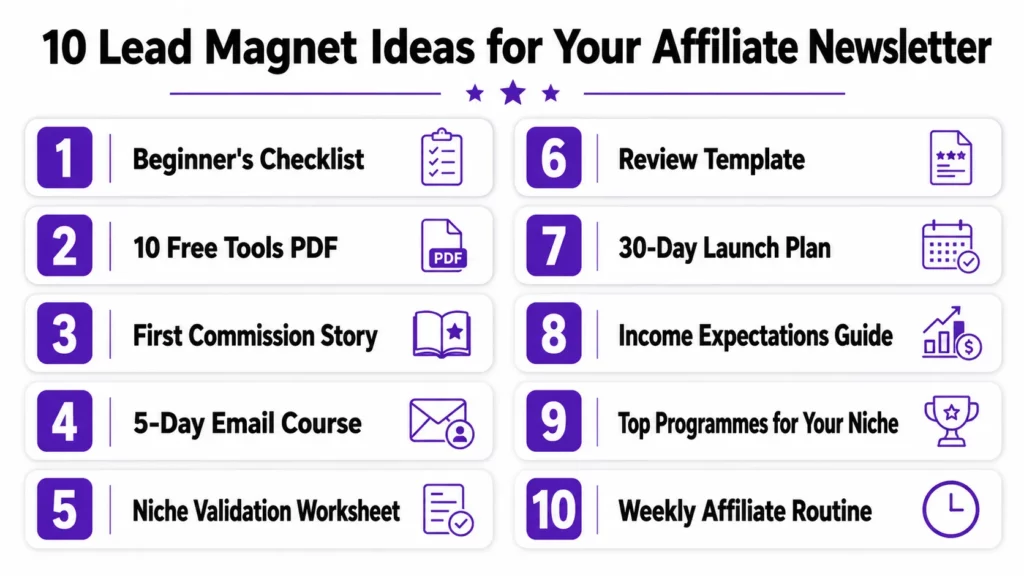
- “The Beginner’s Checklist for Starting Affiliate Marketing” — a one-page printable covering the first 10 steps
- “10 Free Tools Every Affiliate Blogger Needs” — a curated PDF with links and brief descriptions
- “My First Affiliate Commission: What I Did Differently” — a short personal story formatted as a PDF guide
- “The 5-Day Email Course: How to Start Earning From Your Knowledge” — five short emails delivered automatically
- “Niche Validation Worksheet” — a fillable PDF to test any niche idea before committing
- “The Review Template That Converts” — a copyable review structure with fill-in-the-blank prompts
- “30-Day Affiliate Blog Launch Plan” — a printable calendar with daily actions
- “The Honest Guide to Affiliate Marketing Income Expectations” — sets realistic timelines and milestones
- “Top 10 Affiliate Programmes for [Your Niche] With Commission Rates” — highly specific to your audience’s niche
- “The Weekly Affiliate Routine: 5 Hours Per Week to Build Something Real” — a practical time allocation guide
The best lead magnets are specific, immediately usable, and solve a single clear problem. A broad “complete guide to everything” is less effective than a focused checklist or template that a new subscriber can use today.
Step 2: Set Up Your Sign-Up Page and Form
Every email platform recommended above provides a free hosted sign-up page and embeddable sign-up form. No website required — MailerLite’s hosted landing page functionality means you can have a professional sign-up page live within an hour of creating your account.
The sign-up page should include: the name of your lead magnet, a brief description of what it contains and who it helps, and a simple email address capture form. Avoid asking for more information than you need — first name and email address are sufficient and maximise sign-up rates.
Step 3: Promote Your Sign-Up Link
What to avoid in affiliate emails for email marketing for affiliate revenue: deceptive subject lines.
This is where most beginners underestimate the work required. Getting to 100 subscribers does not happen by publishing a sign-up page and waiting. It requires actively putting your sign-up link in front of people who would genuinely benefit from your lead magnet.
Growing beyond 100 subscribers in email marketing for affiliate revenue takes consistent effort.
Email marketing for affiliate revenue has a significant impact on your list growth.
Practical promotion approaches:
- Add your sign-up link to your Pinterest bio and create a pin specifically about your lead magnet
- Share your sign-up link in Facebook groups relevant to your niche, where it is genuinely relevant, and the group rules permit it
- Tell people you know personally — former colleagues, friends with relevant interests, family members who fit your audience profile
- If you have any social media presence at all, add the link to your bio and post about the lead magnet once it launches
- Include a mention of your newsletter in your email signature
You do not need a blog or an existing audience. You need to go where your potential subscribers already are and give them a reason to sign up.
Your First Email Sequence — What to Send and When
Once someone signs up, what happens next determines whether they become an engaged reader or someone who forgets they subscribed within a week.
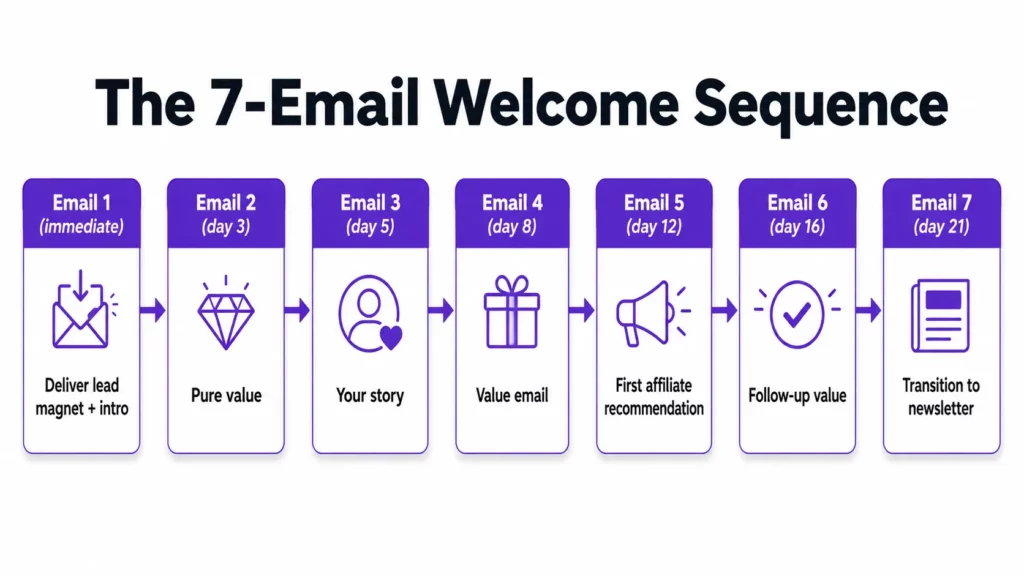
A welcome sequence — a series of automated emails sent to every new subscriber — is the foundation of a well-run email list. Here is a seven-email welcome sequence that builds trust before introducing any affiliate recommendations:
| Timing | Purpose | |
|---|---|---|
| Email 1 | Immediately | Deliver the lead magnet. Introduce yourself briefly and genuinely. Tell them what to expect from future emails. |
| Email 2 | Day 3 | Pure value — a helpful tip, observation, or resource directly relevant to your niche. No promotion. |
| Email 3 | Day 5 | Your story — why you started writing about this topic, what you have learned, what you want to share. Personal and specific. |
| Email 4 | Day 8 | Another value email — answer a common question in your niche. Reference something from the lead magnet if relevant. |
| Email 5 | Day 12 | First soft recommendation — mention a tool, resource, or product that has genuinely helped you, in the context of a problem it solved. Include your affiliate link. |
| Email 6 | Day 16 | Follow-up value — address a question or concern that commonly follows from Email 5’s recommendation. |
| Email 7 | Day 21 | Transition to regular newsletter — tell subscribers what your ongoing email schedule will be and what they can expect going forward. |
The rule governing this sequence: give three times before you ask once. Emails 1–4 are entirely about helping your subscriber. Email 5 introduces an affiliate recommendation only after you have established trust through four consecutive value emails. A subscriber who has received four helpful emails from you is a fundamentally different reader than one receiving a cold pitch.
Frequently asked questions about email marketing for affiliate revenue can clarify your approach.
After the welcome sequence, move to a regular newsletter cadence — weekly or fortnightly. Irregular publishing is the fastest way to lose reader engagement and increase unsubscribe rates.
How to Write Affiliate Emails That Feel Like Recommendations, Not Ads
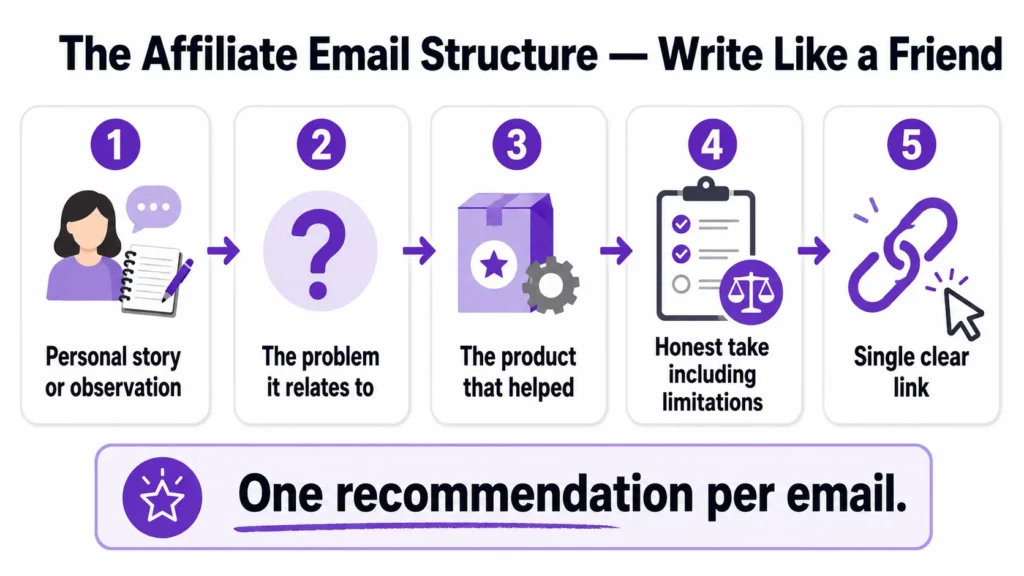
The structure of an affiliate email is simple once you understand the principle: write as if you are telling a trusted friend about something that helped you.
A friend does not lead with a link. A friend tells you a story, identifies the problem they were trying to solve, explains what they found, gives you their honest assessment, including the limitations, and then tells you where to get it if you want it.
That is the exact structure of an effective affiliate email:
1. A short personal story or observation (2–4 sentences) — something true and specific from your own experience that sets the context. Not a manufactured hook, but a real observation that leads naturally into the topic.
2. The problem it relates to (1–2 sentences) — name the issue clearly. Your reader needs to recognise their own situation in what you are describing.
For email marketing for affiliate revenue, the most effective cadence is weekly.
3. The product or tool that helped (3–5 sentences) — explain what it is, what you used it for, and what specifically made it useful. Concrete details, not vague endorsements.
4. Your honest take, including limitations (2–3 sentences) — mention who it is not for, what it does not do well, or what would make someone not need it. This builds more trust than omitting it.
5. The link with a natural call to action — a single clear sentence. “If that sounds like it would help you, you can find it here.” Not “BUY NOW!!! LIMITED TIME!!!”
In conclusion, this post contains affiliate links; if you purchase through one of our links, we may earn a commission at no extra cost to you and it relates to email marketing for affiliate revenue.
What to avoid in affiliate emails:
Subject lines that promise something the email does not deliver. Excessive exclamation marks. Artificial urgency (“offer ends tonight!”) when it does not. Recommending a product you have not used or researched thoroughly. Multiple affiliate links in a single email — one recommendation per email is the most effective approach for building long-term reader trust.
Growing Beyond 100 Subscribers
Once you have your first 100 subscribers and a working welcome sequence, the growth lever is consistency — both in publishing and in improving the quality of what you send.
Content upgrades are one of the most effective growth tools for anyone with a blog. A content upgrade is a bonus resource offered within a specific blog post — a checklist that accompanies a how-to guide, a template that supports a tutorial. Because it is relevant to readers who are already engaged with that specific post, sign-up rates are significantly higher than a generic newsletter promotion. Read our guide on how to start a niche blog for more on integrating email list building into a blog strategy.
Referral mechanics are underused and highly effective for small lists. Ask your most engaged subscribers — those who reply to your emails or click consistently — to forward one email to someone who would genuinely benefit. A personal referral from a trusted contact converts to a new subscriber at a much higher rate than any promotional post.
Consistent schedule matters more than frequency. A weekly email that arrives reliably every Tuesday builds a habit in your readers. An occasional email when you feel inspired does not. Pick a schedule you can sustain and stick to it.
Email Compliance — What You Are Legally Required to Know
Email marketing is regulated, and the requirements are not optional. Two frameworks are most relevant to the Ageless Revenue audience:
GDPR (General Data Protection Regulation) applies to anyone collecting email addresses from EU and UK residents, regardless of where you are based. The key requirements: you must have explicit consent to add someone to your list — pre-ticked boxes do not count. You must tell subscribers clearly what they are signing up for. You must provide an easy way to unsubscribe in every email. You must not share subscriber data with third parties without consent. Every reputable email platform handles the technical side of GDPR compliance (unsubscribe links, data storage) — your job is to ensure you are only adding people who have genuinely opted in.
CAN-SPAM applies to commercial emails sent to US recipients. The headline requirements: do not use deceptive subject lines, include a physical address in every email (a P.O. box is acceptable), and honour unsubscribe requests within 10 business days.
Affiliate disclosure in emails. The FTC’s disclosure requirements apply to email just as they do to blog posts. Any email containing an affiliate link must disclose the relationship clearly. A brief line near the top of the email — “This email contains affiliate links. If you purchase through one, I may earn a commission at no extra cost to you,” — satisfies the requirement.
The practical summary: use a reputable email platform, only add subscribers who opted in deliberately, include an unsubscribe link in every email, disclose affiliate relationships clearly, and do not share your list with anyone.
Frequently Asked Questions
How often should I email my list?
Weekly is the most effective cadence for most affiliate newsletters — frequent enough to stay in subscribers’ minds, infrequent enough that each email feels considered rather than automated. Fortnightly works well if you cannot sustain weekly. Anything less frequent than fortnightly tends to result in subscribers forgetting who you are, which increases unsubscribe rates when your next email arrives. Daily emailing almost always leads to subscriber fatigue unless the content is exceptionally valuable and expected.
Can I use my personal email account instead of an email platform?
Technically, yes, but it is not recommended. Personal email accounts — Gmail, Outlook — are not designed for bulk sending and will quickly be flagged as spam if you send the same email to a list of more than a handful of people. Email marketing platforms handle deliverability, unsubscribe management, compliance features, and analytics — things that a personal account cannot. The free tier of MailerLite covers everything you need at zero cost.
What is a good open rate for a beginner newsletter?
A new email list with engaged subscribers who signed up for a specific lead magnet often achieves open rates of 40–60% in the early stages. As a list grows and ages, open rates tend to settle between 25–40% for a well-maintained newsletter. Below 20% consistently suggests either a list quality issue (subscribers who were not genuinely interested when they signed up) or a subject line and frequency problem. Do not obsess over this metric in the first few months — focus on writing genuinely useful emails, and open rates follow.
How many subscribers do I need before I can earn affiliate commissions from email?
Far fewer than most people expect. A highly engaged list of 200–300 subscribers in a specific niche, receiving well-written affiliate recommendations, can generate meaningful commissions. A larger list of disengaged subscribers who barely open emails generates almost nothing. List quality — built by attracting the right subscribers with a relevant lead magnet and keeping them engaged with consistent value — matters far more than raw subscriber count. First affiliate commissions from email are often earned with lists under 100 subscribers.
Your Next Step
The single most valuable action you can take today is to choose an email platform, create a simple lead magnet, and set up a sign-up page. Those three steps — which together take a few hours — are the entire foundation of an email list that will compound in value for years.
For the best affiliate programmes to promote through your newsletter, read our guide to the best affiliate programmes for beginners.
For a complete picture of how email fits into a broader affiliate marketing strategy across multiple channels, the Ageless Revenue complete guide covers all the pieces together.
This post contains affiliate links. If you purchase through one of our links, we may earn a commission at no extra cost to you. We only recommend products and services we have personally assessed as genuinely useful.