Affiliate Marketing Starter Kit for Beginners (2026)
If affiliate marketing feels overwhelming, you’re not alone — especially in retirement when you want something calm, clear, and low-risk. This starter kit trims the noise so you can launch quickly and learn by doing.
You’ll set up the basics, find beginner-friendly topics, and publish with confidence using small, repeatable checklists. The goal isn’t perfection. It’s momentum — one clear action at a time, week after week.
Affiliate disclosure: This post contains affiliate links. If you buy through them, I may earn a small commission at no extra cost to you. I only recommend products I use or genuinely believe will help you.
TL;DR
This affiliate marketing starter kit for beginners gives you one calm workflow: get your site live, find beginner-friendly topics, and publish one helpful post per week using simple checklists.
- Keep setup light: clean theme, core pages only, SSL on, and a basic SEO plugin
- Use long-tail, beginner-focused keywords and choose just 3 topics to write this month
- Fill a one-page content brief so you never stare at a blank screen
- Run the same SEO and image checklists for every post
- Log each article in a simple tracking sheet (date, URL, next action)
- Follow the 30-day ramp plan: four posts plus small improvements — momentum over perfection
🎁 Get the Free Printable Starter Kit
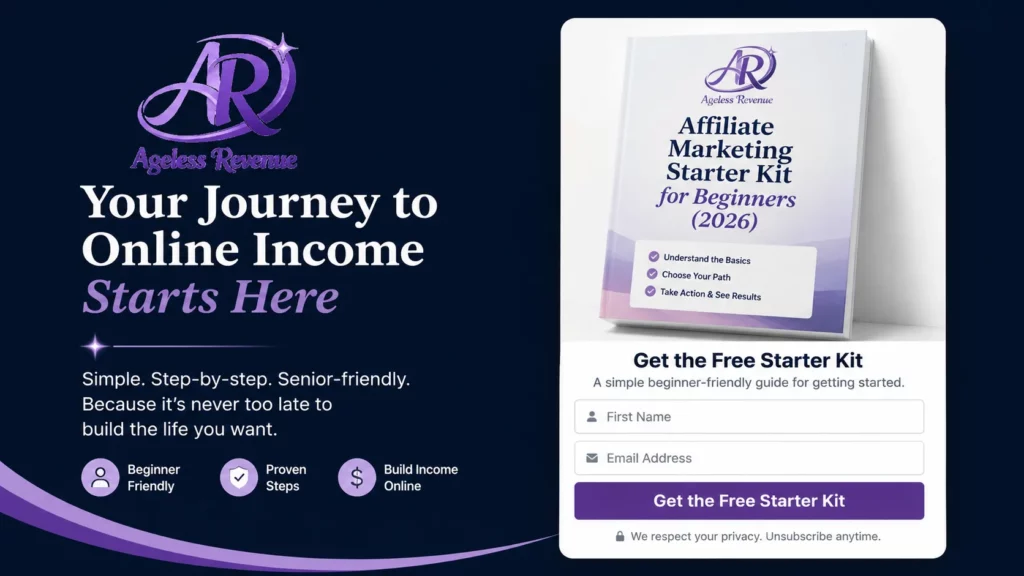
Everything in this article — the checklists, the content brief template, the tracking sheet — is available as a free, printable PDF you can keep beside your laptop while you work.
Enter your email below to get instant access to the full Starter Kit PDF:
[Opt-in form: First Name + Email — “Send Me the Free Starter Kit”]
No spam. One helpful email per week. Unsubscribe any time.
Already have it? Download the Starter Kit PDF directly →
If You’re Brand New, Start With These (Optional)
These guides help you see how this starter kit fits into your bigger path:
- Getting Started With Affiliate Marketing as a Retiree
- How to Build Your First Affiliate Website
- 14 Wealthy Affiliate Training Tips to Get Results Faster
- How to Validate Your Online Business Idea
What’s in the Affiliate Marketing Starter Kit for Beginners
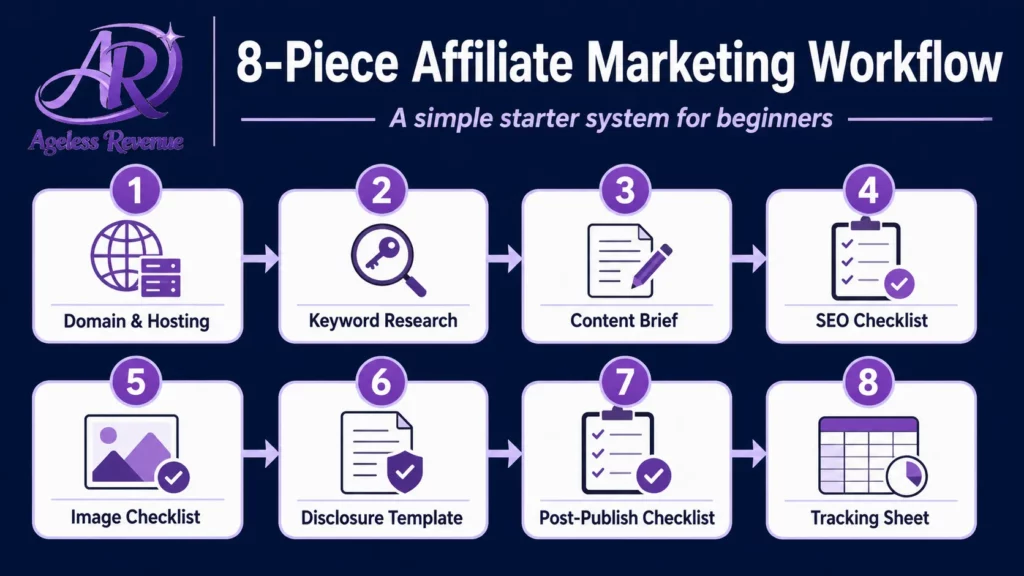
Eight pieces, used in order, form a calm workflow. You can run the whole loop in a single week — even if you only have a few hours.
- Domain & hosting basics — get your site live with SSL and a clean theme
- Keyword research quickstart — collect 10 long-tail topics with clear intent
- Content brief template — a one-page outline so you write faster
- On-page SEO checklist — a simple pass that boosts clarity and findability
- Image checklist — sizes, ALT text, filenames, compression
- Affiliate disclosure template — short, compliant wording
- Post-publish checklist — internal links, CTA, share, and request feedback
- Tracking sheet — lessons done, posts published, clicks, next ideas
Quick Setup (15–30 Minutes)
Spend no more than half an hour here. Your first goal is “publish something small,” not “build a museum.” You can evolve design later.
- Theme: choose a clean, readable theme (skip sliders and fancy effects)
- Core pages: Home, About, Contact (short and clear is fine)
- Permalinks: set to “Post name” (keep slugs short: 3–5 words)
- Essentials only: SEO plugin, backups, image compression (skip the rest)
- Security & SSL: confirm the lock icon shows (https)
Keyword Research (5-Step Beginner Process)
Start with long-tail phrases (“how to…”, “for beginners”, “best X for Y”). Aim for clarity and usefulness over volume. Ten good topics beat a hundred vague ones.
- Pick your reader: one person with one problem
- List questions they ask: from forums, FAQs, or your own experience (10 items)
- Turn questions into phrases: add “how to,” “best,” “checklist,” “for beginners”
- Check competition: choose results you can improve (clear steps, better structure, better images)
- Choose 3 topics to write this month: simple, helpful, tightly focused
Content Brief Template (Write Faster, Edit Less)
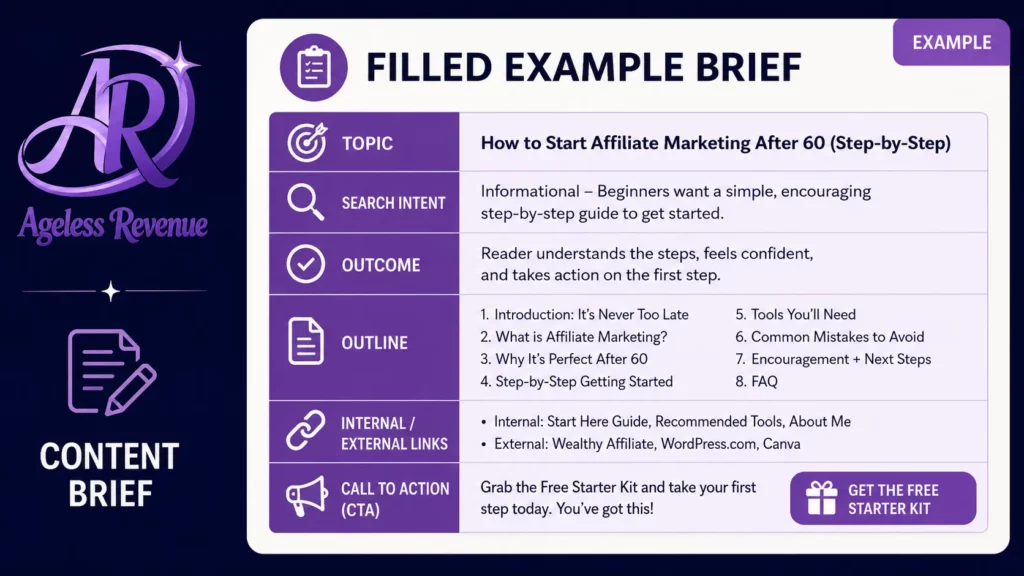
A quick brief prevents blank-screen panic and keeps your post focused.
| Field | What to Write |
|---|---|
| Topic & Reader | One-line problem for one reader |
| Search intent | How-to, comparison, checklist, or gear guide? |
| Outcome | What the reader can do after reading |
| Outline | H2/H3s with 3–5 bullets each |
| Links | 2 internal + 1–2 trustworthy external sources |
| CTA | Newsletter, next tutorial, or starter product |
Example brief (filled in):
- Topic & Reader: “Beginner orchid watering — no more guessing.”
- Search intent: How-to
- Outcome: Reader sets a simple 7-day routine
- Outline: Why orchids die indoors → step-by-step watering → tools that help → FAQs
- Links: Internal — beginner orchid care | External — university extension guide
- CTA: Download a one-page watering checklist; join email tips
On-Page SEO Checklist (Repeat for Every Post)
A quick pass beats perfection.
- H1: includes the focus keyword naturally
- Intro: mention the keyword once in the first 100 words
- H2: include the keyword or close variation once
- Images: descriptive ALT, compressed, sensible filenames
- Links: add 2 internal links + 1 helpful external source
- Slug: short and readable
- Readability: short paragraphs, lists, descriptive subheads
Quick pass example: Title updated? ✅ Intro keyword? ✅ One H2 variation? ✅ Image ALT? ✅ 2 internal links? ✅ Slug short? ✅ Publish.
Image Checklist (Clarity Over Fancy)
- Placement: one featured image plus 1–2 inline images where it helps understanding
- Size: 1200×628 for featured; 1200px wide for inline when possible
- Filenames: short and descriptive (example: orchid-watering-checklist.jpg)
- ALT text: describe what’s shown and why it helps (no keyword stuffing)
- Compression: aim for under ~200 KB when possible
3 Free Tools to Use With This Starter Kit
You don’t need paid tools to start. These three are enough for your first month:
1) Google Docs (or Word) — for your content brief and drafts. Use a simple doc template for every post: title, reader problem, outline, internal links, CTA.
2) Canva Free — for featured images and simple checklists. Create one clean featured-image template you reuse (same font, same layout, same colors).
3) Google Search (and “People Also Ask”) — for topic ideas. Type your topic and look at autocomplete suggestions, “People also ask” questions, and related searches at the bottom. Those are real questions — perfect for beginner content.
Affiliate Disclosure Template
Use this short, compliant wording at the top of any post containing affiliate links:
“Disclosure: This post contains affiliate links. If you click and purchase, I may earn a commission at no extra cost to you. I only recommend products I use or truly believe will help you.”
Post-Publish Checklist (10 Minutes)
- Add 2 internal links from older posts to this new one
- Share once in your main community or social channel (one sentence is enough)
- Ask for one piece of feedback and apply the best suggestion
- Log the post: date, URL, topic, next action
Weekly Workflow (Keep It Light)
- Plan (15 min): choose one topic; fill the brief
- Draft (60–90 min): write 800–1200 words; add 2 internal + 1 external link
- Publish (15–20 min): run SEO + image checklist; add disclosure
- Share (10 min): one community OR one email mention
- Improve (15 min): add a FAQ, checklist, or clearer step
Tracking Sheet Columns (Simple)
Date | Post/URL | Topic | Internal Links Added | Shares | Comments | Next Action
30-Day Ramp Plan (1 Month to Momentum)
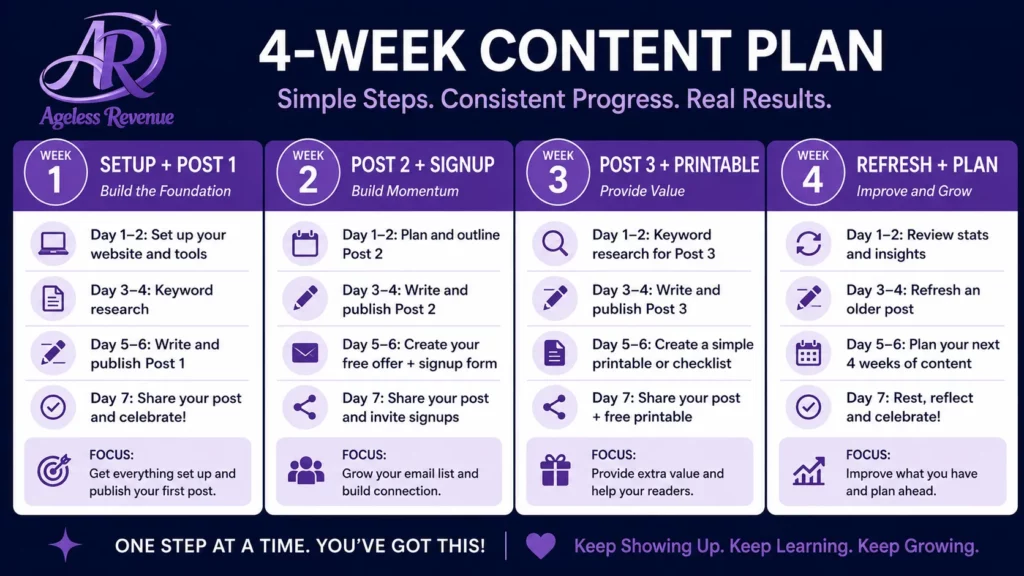
- Week 1: quick setup, 10 topics, publish Post #1, share once
- Week 2: publish Post #2, add an email signup, request feedback
- Week 3: publish Post #3, create a one-page printable/checklist
- Week 4: refresh internal links, improve your best post, plan next month
Frequently Asked Questions
Do I need paid tools to start?
No. Start with free tools. Upgrade only when you hit a clear bottleneck — time, speed, or tracking.
How many posts per week should I publish?
One is enough. Consistency beats bursts.
What if I’m not a writer?
Use the brief. Write like you speak. Read it aloud once. Publish.
How soon will I see results?
Expect a learning month first. Track tiny wins — posts shipped, comments, email signups — and keep going.
What should I publish first?
Start with “how-to” or “checklist” posts for beginners. They are easier to write and easier to rank than product reviews at the beginning.
Conclusion
You don’t have to do everything at once. If you choose one small routine — pick a topic, fill the brief, write one helpful post, run the checklists — you’ll build momentum without overwhelm.
Momentum is what turns a starter kit into results.
Want the Printable Version and Calm Next Steps?
Download the Free Starter Kit (PDFs) — grab the beginner-friendly PDFs so you can follow the steps without hunting for instructions.
[Opt-in form: First Name + Email — “Send Me the Free Starter Kit”]
No spam. One helpful email per week. Unsubscribe any time.
Already subscribed? Go straight to the Starter Kit PDF →
Want training, hosting, and tools in one place? If you want a guided platform that matches this calm, step-by-step approach, start free with Wealthy Affiliate →
This post contains affiliate links. If you buy through them, I may earn a small commission at no extra cost to you.