
How to Validate Your Online Business Idea: A Step-by-Step Guide
Test your idea lightly before you invest heavily.
What “validation” means: a short, low-cost test to see if real people show interest — clicks, sign-ups, replies — before you spend time or money building the full thing.
If you are brand new here, start with Getting Started With Affiliate Marketing as a Retiree, grab the free Starter Kit, and speed up your graphics with this Canva workflow.
Affiliate disclosure: This post contains affiliate links. If you buy through them, I may earn a small commission at no extra cost to you.
What You’ll Do to Validate Your Online Business Idea (Today) – How to Validate Your Online Business Idea
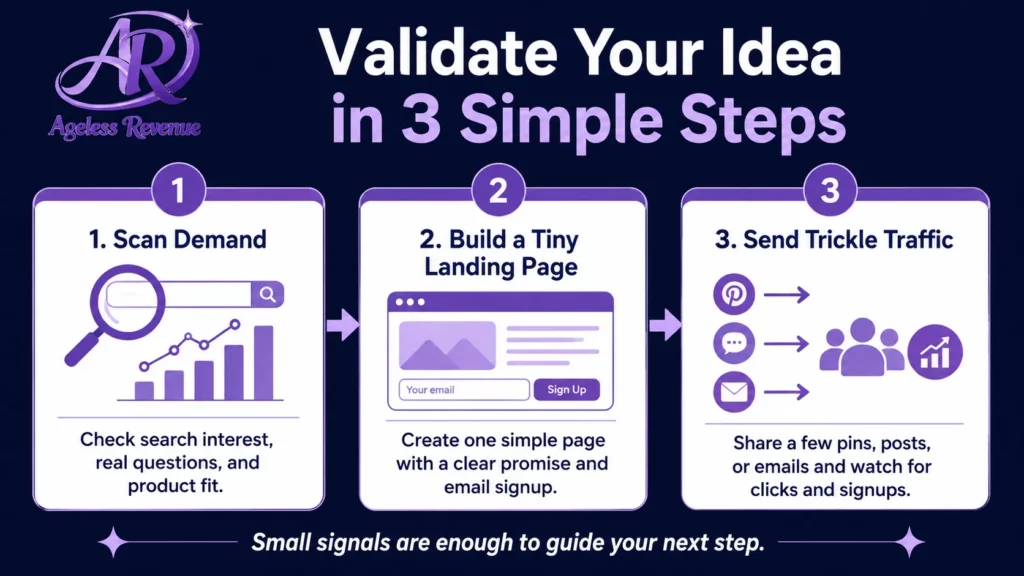
- Scan demand quickly (forums, groups, search trends, similar offers)
- Create a tiny landing page (one clear promise + one action)
- Bring a trickle of targeted visitors and watch simple numbers
TL;DR — Validate Your Online Business Idea
To validate your online business idea, you run a short, low-cost test to see if real people click, sign up, or reply before you invest heavily. The basics are simple: confirm demand, create a tiny landing page with one clear promise, and bring a trickle of targeted traffic. Use what you learn to decide whether to proceed, refine the idea, or pivot to a better fit before you spend months building.
Your goal is a calm, repeatable process: light research, tiny tests, and clear go/no-go decisions that save time, money, and stress. From idea to tiny test to a clear go/no-go decision.
To make each of these steps easier, you can pair this guide with a few related resources:
- The Best Ways to Conduct Market Research for Your Online Business — deepen the demand checks you do in Step 1
- Online Business Plan Template: Simple 1-Page Guide — capture your validated idea on a single page you can revisit
Validating your business idea is like a safety net for your entrepreneurial dreams. It helps ensure your idea is exciting and makes sense to potential customers. The stakes are high, and taking the time to validate can save you from investing in an idea that won’t work.
Avoiding common startup pitfalls starts with doing your homework. Many small businesses fail because they jump into execution without a solid plan. Validation can highlight potential problems before they become significant issues.
Thinking long-term is key. Early validation of your idea builds a strong path to sustainable success. It’s not just about getting started — it’s about maintaining momentum and growing over time. This preventive measure sets you up for fewer surprises and aligns your business with market needs.
Analyzing Your Idea With Market Research
Market research is your magnifying glass, letting you see what consumers want and need. Online surveys are a fantastic tool for gathering data directly from potential customers. The feedback you gather from these surveys helps you understand whether there’s genuine interest or just mild curiosity.
Pinpointing your target audience is like having the secret recipe for success. Knowing who your audience is — defined by their demographics, interests, and behaviours — helps tailor your products or services to meet their needs. Without this knowledge, you’re playing a game without knowing the rules.
Keeping an eye on the competition isn’t about sizing up who you’re against. It’s about learning what they’re doing right and where they might be dropping the ball. Dive into competitor analysis to find gaps in the market where your idea can shine.
SEO isn’t just a tool for bloggers or marketers — it’s a window into market demand and trends. By understanding what people are searching for, you can align your product or service with what is in high demand. This insight is invaluable when fine-tuning your business concept to ensure it’s what the market craves.
If you want a more detailed walkthrough of the research part of validation, especially for calm, retiree-friendly businesses, read The Best Ways to Conduct Market Research for Your Online Business alongside this validation guide so your tiny tests are based on real questions, real searches, and real competitors — not guesswork.
Creating a Minimum Viable Product (MVP)
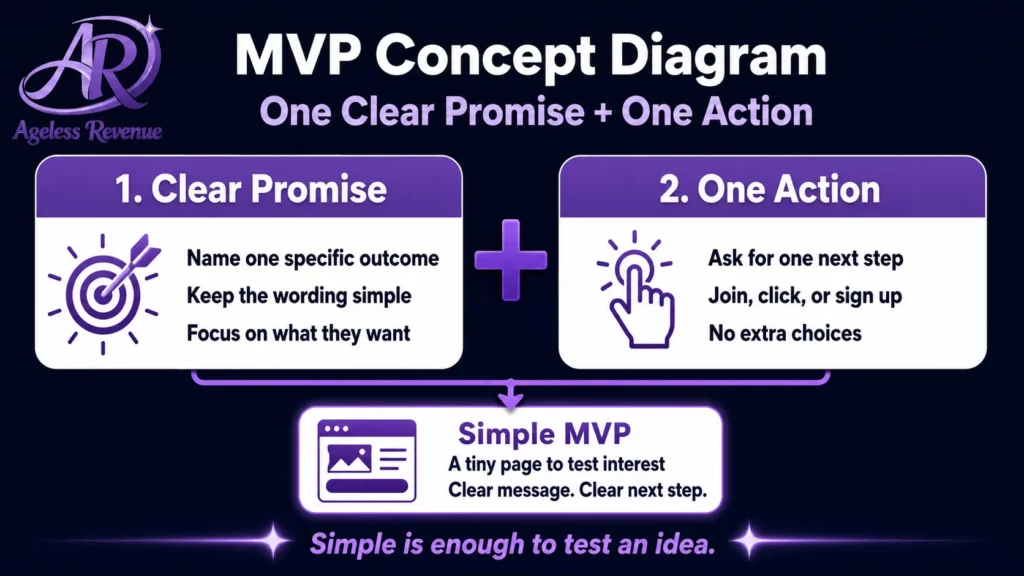
One clear promise plus one action beats long sales pages.
Building a Minimum Viable Product, or MVP, is like constructing a model of your future success. It’s a simplified version of your idea, stripped to its core features, allowing you to test the waters without diving headfirst. The purpose of an MVP is to prove concepts and gather insights. Before you go all in, you want to see if the basic version of your product sparks interest and desire among users — it’s essential for catching any red flags and making improvements early on.
Set clear objectives and key performance indicators (KPIs) to ensure your MVP is on point. Defining what success looks like helps you stay focused and measure progress effectively.
Once your MVP is live, product feedback is your treasure chest of information. Listen to the users, iterate rapidly, and ensure the final product evolves based on real user input.
Striking a balance between quality and cost efficiency in MVP development is crucial. You want something that showcases your idea without burning through too many resources.
Building a Community and Leveraging Feedback
Engaging content can be the key to building a community around your business idea. People love to connect over shared interests, and the content you share should reflect what matters to your audience. This content becomes a conversation starter, inviting people to engage and share their thoughts.
Social media is your playground for interaction and feedback. Use these platforms to reach out to your potential customers, listen to their experiences, and watch your idea come to life through their eyes.
Early adopters are not just early consumers — they’re allies in validation. They offer genuine insights and help spread the word when they believe in what you’re promising. Engage them, value their input, and they could become your most vocal advocates.
Community feedback is like a compass, helping you adjust your course. As you gather opinions and insights, tweak and refine your ideas.
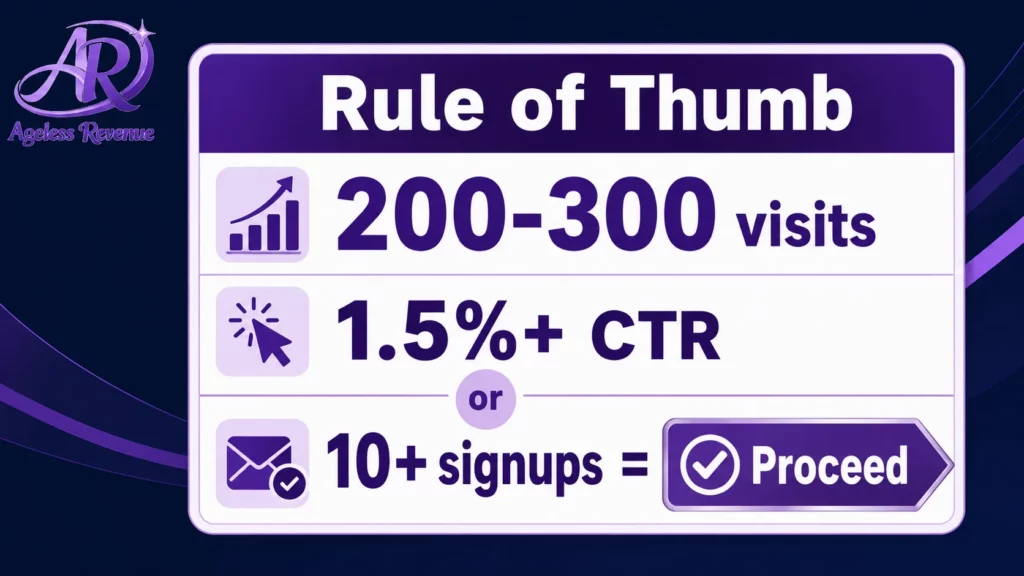
Rule of thumb: after roughly 200–300 targeted visits, if your landing page gets 1.5% or more clicks on the CTA, or 10+ sign-ups, proceed. If not, refine the promise or audience and retest.
Once you have run a few tiny tests and watched how people respond, these guides will help you decide what to do next:
- Online Business Plan Template: Simple 1-Page Guide — capture your best idea, audience, and offer on one page
- From “What’s a Niche?” to First Sale: A 90-Day Step-by-Step Guide — stretch your validation momentum into your first online income
Frequently Asked Questions
What’s the simplest way to validate my online business idea?
Start with one tiny test: create a simple landing page with one clear promise, send a small number of targeted visitors, and watch whether people click or sign up. You do not need a full product or complex funnel to see early signals.
How much traffic do I need for a useful validation test?
A good starting point is 200–300 targeted visits. That is enough to see whether anyone responds to your promise. If no one clicks or signs up, treat it as feedback on your message or audience, not a failure of you as a person.
How long should a validation test run?
Most small tests can run for one to two weeks. The goal is to gather clear signals quickly, then decide whether to refine the idea, adjust the promise, or move on to a better-fitting concept.
What if I’m not very technical?
You do not need advanced tech skills to validate your online business idea. You can use simple tools like WordPress, Carrd, or Notion for a landing page, and basic email forms or surveys to collect responses. Focus on clarity, not complexity.
Use Validation as a Safety Net, Not a Stress Test
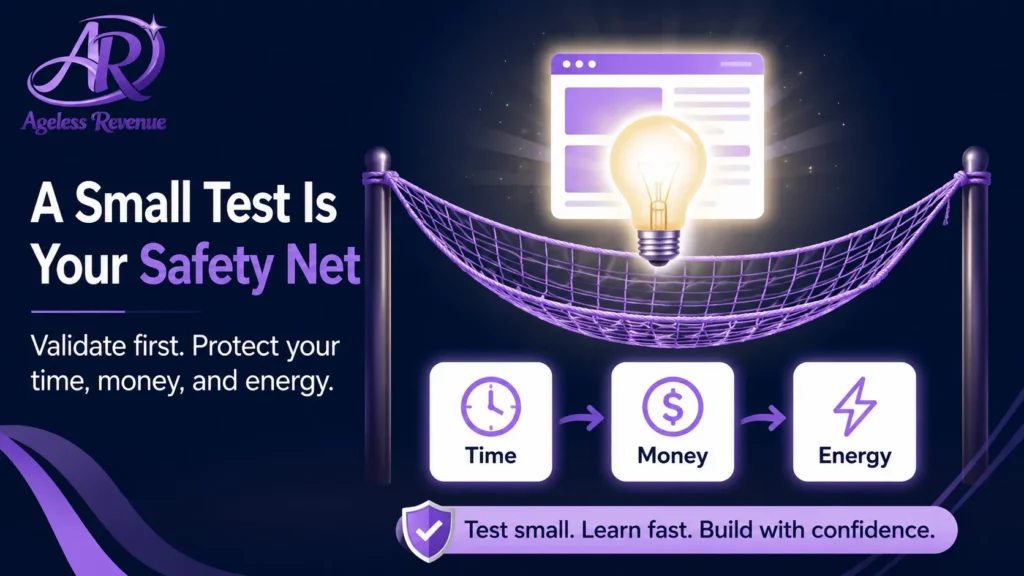
When you validate your online business idea with small, honest tests, you protect your time, energy, and savings. You trade guesswork for simple evidence and turn “I hope this works” into “I can see real people responding.”
Do light market research so you know who you are helping and what they have already tried. Create a tiny landing page with one clear promise and one clear action. Send a small stream of targeted visitors and watch what they actually do.
You do not need a perfect idea to begin. You just need a clear next test and the courage to learn from the results.
If you would like a printable checklist to use alongside this guide, download my free Affiliate Marketing Starter Kit for Beginners. It helps you move from idea to niche, from tiny test to simple plan, without overwhelm.
For a structured platform with built-in tools to test and build your idea, try Wealthy Affiliate free →
This post contains affiliate links. If you buy through them, I may earn a small commission at no extra cost to you.





Thank you for this clear and practical guide! As someone just stepping into the world of online business, I found your step-by-step approach to validating an idea incredibly helpful. The emphasis on market research, creating an MVP, and building a community really resonated with me.
I especially appreciated the reminder that validation isn’t just a one-time task but an ongoing process to align with market needs. The idea of using SEO to gauge demand was an eye-opener—it’s a tool I hadn’t considered beyond content creation.
A few questions came to mind as I read:
1. For someone with limited resources, what would you suggest as the most cost-effective way to conduct initial market research?
2. When building an MVP, how do you determine which features are essential and which can wait?
3. Do you have tips for engaging early adopters, especially when starting with a small or non-existent audience?
Thank you again for sharing your insights. I’m excited to apply these steps to my own business journey!
✅ Affiliate Market Research Checklist (Free & Low-Cost Tools)
1. Keyword & Trend Research
▢ Use Google Trends to identify interest over time
▢ Use Google Keyword Planner (free with a Google Ads account) to check search volumes
▢ Use Ubersuggest (free tier) for keyword ideas and SEO difficulty
2. Audience & Problem Research
▢ Explore Reddit (e.g., r/AskReddit, r/BuyItForLife, r/Productivity) for recurring questions
▢ Search Quora for common problems and product discussions
▢ Join 3–5 Facebook groups in your niche to observe audience behavior
3. Competitor Analysis
▢ Google search top keywords in your niche and list the top affiliate sites
▢ Use SimilarWeb or SEO Minion to analyze their traffic sources and keywords
▢ Take notes on how they structure content and what products they promote
4. Product & Review Research
▢ Go to Amazon and read 3–5 top product reviews in your niche
▢ Identify pain points, language patterns, and common complaints
▢ Search for affiliate programs for these products (e.g., Amazon Associates, ShareASale)
5. Direct Feedback
▢ Create a simple Google Form with 3–5 questions about the niche
▢ Share in Facebook groups or subreddits (when allowed)
▢ Ask: “What’s your biggest struggle with [topic]?” or “What products have helped you most?”
6. Content Research
▢ Search YouTube for niche keywords and sort by “most viewed.”
▢ Check TikTok or Instagram Reels for short-form content performance
▢ Note what topics or products go viral and why
For the NVP question, see below
MVP Feature Prioritization Worksheet
Use this worksheet to determine which features are essential for your Minimum Viable Product (MVP), and which can wait until later iterations.
1. Define Your Core Problem & User
What problem are you solving?
________________________________________
Who is your primary user?
________________________________________
2. Map the User Journey
List the most straightforward steps your user takes to achieve value:
Step 1: ________________________________________
Step 2: ________________________________________
Step 3: ________________________________________
3. Prioritize Using the MoSCoW Method
Must Have:
• ________________________________________
• ________________________________________
Should Have:
• ________________________________________
• ________________________________________
Could Have:
• ________________________________________
• ________________________________________
Won’t Have (now):
• ________________________________________
• ________________________________________
4. Validate the Idea
Which feature(s) help validate the idea or test assumptions?
• ________________________________________
• ________________________________________
5. Identify & Prioritize Risky Assumptions
What assumptions are you testing?
• ________________________________________
• ________________________________________
6. Early User Feedback
List feedback or insights from initial user conversations:
• ________________________________________
• ________________________________________
✅ MVP Readiness Checklist
▢ Solves ONE clear problem
▢ Has ONE clear user type
▢ Only includes ‘Must Haves’ from MoSCoW
▢ Tests the riskiest assumption
▢ Can be built quickly (1–4 weeks)
Here’s a focused set of practical tips to help you get traction:
Tips to Attract and Engage Early Adopters
1. Solve a Real Pain Point (Even for One Person)
Start narrow: identify one group with a burning problem.
You don’t need scale — you need urgency.
Craft your message around their frustration, not your product.
Instead of “a better content tool,” say “finally fix the hours you waste editing affiliate content.”
2. Show Up Where They Hang Out
Join Facebook groups, Reddit, Discord servers, Twitter/X, or niche forums.
Engage authentically: answer questions, give advice, don’t immediately pitch.
Drop helpful content or tools and say, “I’m building something that solves this. Do you want to try it?”
3. Offer Personal Help or Access
Give them something valuable in return for feedback:
“You’ll get lifetime access if you test this early version.”
Or: “I’ll personally help set it up for you.”
This makes early users feel like insiders, not guinea pigs.
4. Build in Public
Share your progress (even small wins) on Twitter, LinkedIn, Indie Hackers, etc.
Show sketches, mockups, and decisions, and ask for feedback.
Be human, not polished.
People support creators they relate to more than finished products they can’t connect with.
5. Use a Landing Page with a Waitlist
Create a simple landing page using tools like Carrd or Notion.
Focus the message on the pain, the promise, and a clear CTA:
“Join early access” or “Be first to test.”
Add urgency:
“Only 20 early testers get personal onboarding.”
6. Cold Outreach — But with Empathy
Email or DM 10–20 people you’ve seen post about the problem you solve.
Be honest and short:
“I saw you mention struggling with [problem] — I’m building something tiny to fix it. Want early access?”
7. Celebrate Your Early Users
Publicly thank testers.
Share wins from their feedback.
Make them feel like co-creators — they’ll stay loyal.
Really enjoyed this guide—it breaks down the whole process of validating a business idea in a way that actually feels doable. So many people jump into launching without testing their concept first, and this article is a great reminder of why that’s a risky move. I liked the tips on talking to your potential audience and using small-scale tests before going all in. Super helpful for anyone trying to figure out if their idea has legs. Thanks for sharing!
Thank you so much for your thoughtful feedback! I’m really glad the guide helped make the validation process feel approachable—that was exactly the goal. You’re absolutely right: skipping validation is one of the most common (and costly) mistakes new entrepreneurs make.
Talking to your audience and running small tests can reveal so much early on, and it’s great to hear that it resonated with you. Wishing you all the best as you move forward with your own ideas—excited to see where they take you!
Warmly,
Gila