

Market Research for Your Online Business (Beginner-Friendly)
Doing market research for your online business doesn’t have to be technical or expensive. The goal is simple: learn what people really want, the words they use, and the gaps your offer can fill. With a light process you can repeat, you’ll avoid guessing, save money, and make clearer decisions about content, products, and pricing.
Affiliate disclosure: This post contains affiliate links. If you buy through them, I may earn a small commission at no extra cost to you.
TL;DR — Market Research for Your Online Business
Market research for your online business is simply learning what people want, the words they use, and the gaps your offer can fill.
- Start with free tools: Google Search, People Also Ask, product reviews, groups, short surveys, and a few quick interviews
- Use what you find to shape your content, offers, pricing, and tiny tests instead of guessing
- Your goal is a light process you can repeat: a few research blocks each month that keep you close to your audience and give you clearer decisions
- Four wins: clarity, demand signals, better offers, confident decisions
Your Simple Plan (Free First, Upgrade Later)
Start with free tools and real conversations. Use Google, product reviews, forums, and a short survey to collect signals. If you hit limits, add one paid tool at a time. Keep notes in a single doc or spreadsheet so patterns are easy to spot.
Expect your first pass to take 5–7 short sessions (30–45 minutes each) across a week.
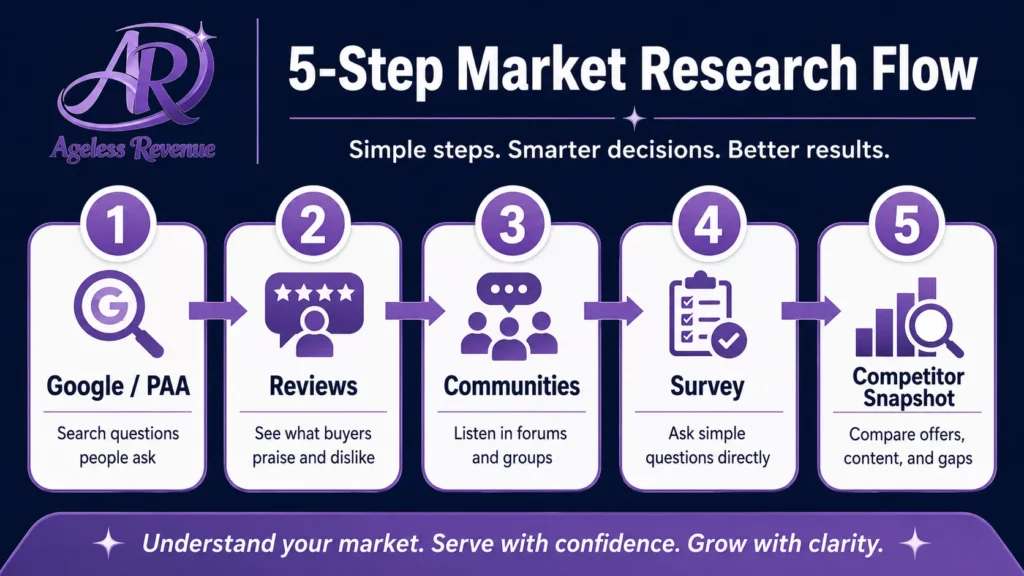
At-a-glance toolkit: Google Search + People Also Ask, product review pages, Reddit/Quora/Facebook groups, Google Forms, simple call notes, and a one-page competitor snapshot. Optional later: a lightweight keyword tool if you want numbers.
Step 1: Mine Google Search and “People Also Ask”
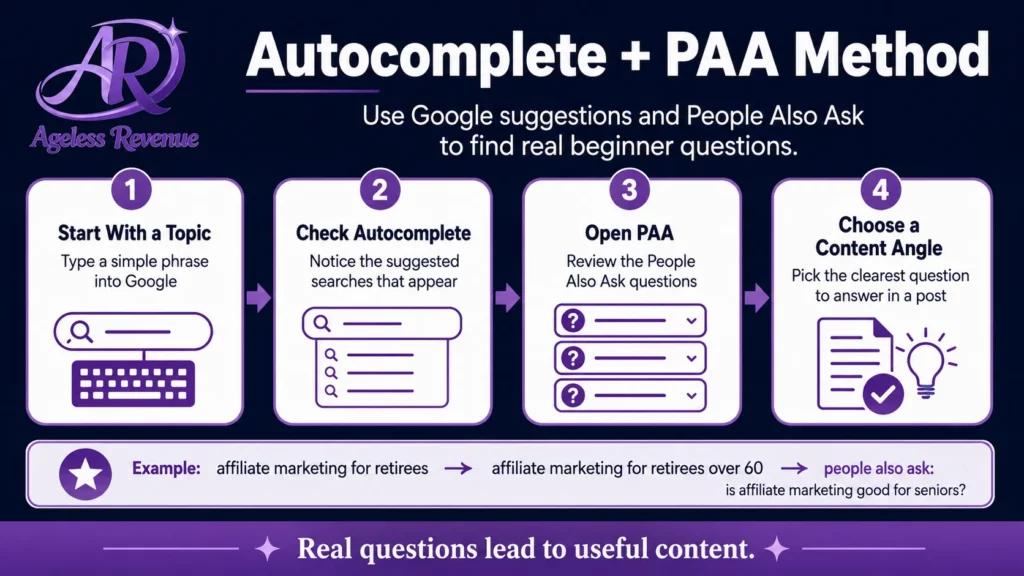
Type your core topic into Google and scan results like a detective. Note headlines, the People Also Ask questions, and the kinds of posts that rank (how-tos, comparisons, reviews). These show the exact problems people have and the language they use. Questions reveal research paths and content ideas.
Do this: collect 15–25 real questions. Group them by theme (setup, cost, pains, alternatives). These become your content outlines and your survey/interview prompts.
Worked example (retiree scenario): imagine you’re exploring “gentle home fitness for seniors.” Questions you might capture: “How to start low-impact exercise at 70?”, “Best equipment for tiny apartments?”, “How many minutes is safe to begin?” These become a starter cluster: a main guide, two how-tos, and one comparison (e.g., mini stepper vs. walking pad).
Step 2: Mine Product and Service Reviews
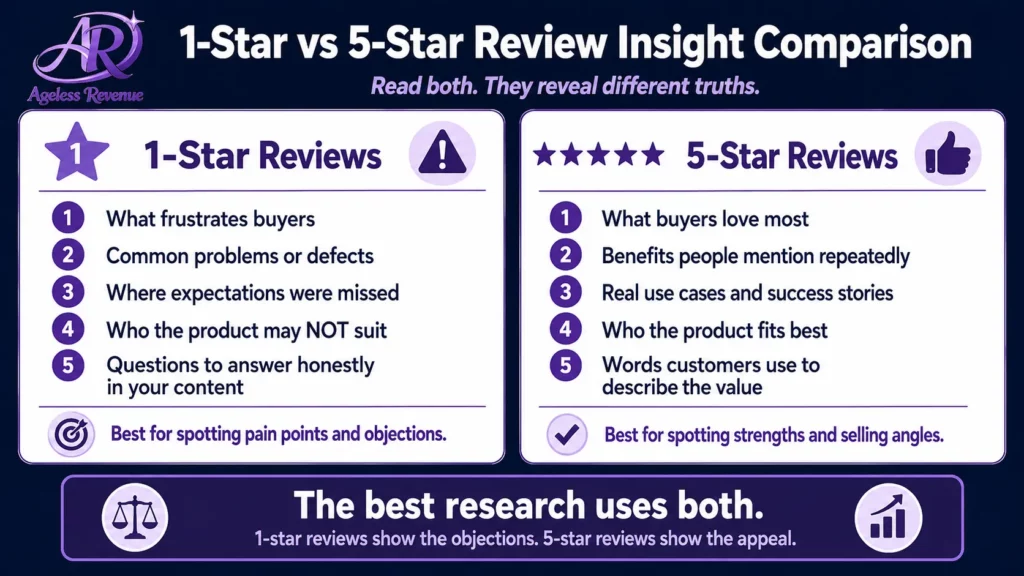
Reviews on Amazon, app stores, Etsy, or competitor sites are gold. Look for repeating phrases like “I wish…”, “It’s confusing…”, “The best part is…”. Copy short quotes into your notes. These help you speak in the customer’s voice and decide what to include or avoid in your offer.
Direct quotes = honest pains and desired outcomes.
Do this: read the 1-star and 5-star reviews for two or three competing products in your niche. The 1-star reviews tell you what to fix or avoid. The 5-star reviews tell you what to emphasise.
Step 3: Listen in Communities
Search Reddit, Quora, and Facebook groups for your topic. Read the questions people are actually asking, not the polished marketing copy on company websites. Real conversations reveal real confusion, real frustration, and real desire — the exact raw material for content that genuinely helps.
Do this: join two or three relevant groups. Spend 15 minutes a week reading rather than posting at first. Note recurring questions and the exact phrases people use to describe their problem.
Step 4: Run a Short Survey or a Few Quick Interviews
A five-question Google Form sent to your email list, or three short conversations with people in your target audience, tells you more than hours of guessing. Ask what they have already tried, what frustrated them about it, and what result they actually want.
Do this: keep the survey under five questions. Offer a small thank-you (a checklist or discount) to improve response rates.
Step 5: Build a One-Page Competitor Snapshot
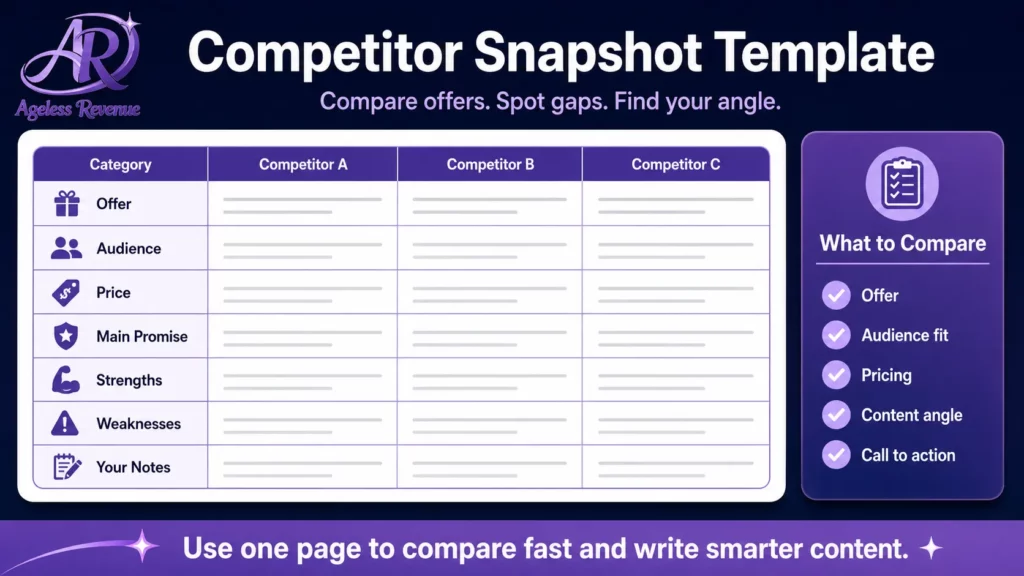
List three to five competitors. For each, note their main offer, their price, and the one thing reviewers consistently praise or complain about. This single page becomes your reference point whenever you are deciding what to write about or how to position your own recommendations.
Putting It All Together
Once you have collected questions, quotes, community themes, survey answers, and your competitor snapshot, look for patterns. The same question appearing in three different sources is a strong signal — that is content worth creating, or a gap worth filling with the right product recommendation.
Repeat this process lightly every month. You do not need to redo all five steps every time — even one fresh research block per month keeps you close to your audience and prevents your content from drifting away from what readers actually want.
Frequently Asked Questions
How much does market research cost to start?
Nothing. Google Search, “People Also Ask,” product reviews, Reddit, Quora, and Facebook groups are all free. A simple Google Form for surveys is also free. You only need to consider a paid keyword tool once you have outgrown what the free methods provide.
How long does a full research pass take?
Most beginners complete a first pass in 5–7 short sessions of 30–45 minutes each, spread across a week. After that, monthly top-ups of 1–2 sessions are usually enough to stay current.
What if I don’t get many survey responses?
Three to five thoughtful responses, or even three short conversations, are often enough to reveal patterns. Quality of insight matters more than sample size at this stage.
Do I need a paid tool to do this properly?
No. The free methods in this guide are sufficient for most retiree affiliate bloggers in their first year. A paid keyword tool can add precise search volume numbers later, but it is optional, not required.
Your Next Step
Pick one step from this guide and do it this week. The Google autocomplete and “People Also Ask” method takes ten minutes and often produces your next three blog post ideas immediately.
For the complete guide to building your affiliate blog around what you learn, read Getting Started With Affiliate Marketing as a Retiree.
For a structured path with training, keyword tools, and a supportive community, try Wealthy Affiliate free →
This post contains affiliate links. If you buy through them, I may earn a small commission at no extra cost to you.






Hi Gila,
Initially I did not see the main article when loading your page . However I did locate your most recent post “Mind Mapping For Successful Business Idea Generation” by accessing the side menu..
I liked the fact that you mentioned concepts such as enhances creativity and idea generation, helps to visualize complex thoughts and spot connections. This really is a great way to break down barriers and boost team participation and collaboration – and also allows for solo Flexible use. I’ve encountered instances where using this method helped some of the people I worked with see the bigger picture and was non confrontational. Your conversational tone is easy to understand and follow and you point out reasons why this could be a benefit to help brain fog when needing t look at something through new eyes.. Your personal experiences and recommendations.
Your topic rings true to someone always who’s always looking to get new ideas on business and products. What you could have done was to break up the content as 3 individual posts. As you said, sometimes it becomes overwhelming with ideas starting to take a life on their own . Overall you do show a balanced view on how Mind Maps can help and it does work when applied.
Hi Drew,
Thank you for taking the time to share such detailed feedback—I really appreciate it! I’m glad you were able to find the article through the side menu and that the content resonated with you. Mind mapping truly is a powerful yet flexible tool, and it’s great to hear you’ve seen its impact firsthand, especially in team settings where collaboration and clarity can make all the difference.
You’re absolutely right—breaking the content into a series of shorter, focused posts is a great idea. It could definitely help reduce overwhelm and give each concept the space it deserves. I’ll keep that in mind for future updates—thank you for the thoughtful suggestion!
It’s always encouraging to hear from others who are actively seeking new ideas and tools to stay inspired. Thanks again for reading and sharing your perspective!
Warmly,
Gila
This piece beautifully explores the awakening of inner vision as more than just a concept—it feels like a spiritual invitation. I love how it ties self-reflection, meditation, and energy alignment into a path for deeper clarity and purpose. It made me reflect on how much we overlook our inner guidance in daily life. Have you noticed a shift in your intuition or awareness since starting this kind of inner work?
Hi Kiersti,
Thank you so much for your thoughtful comment! I’m really glad you resonated with the piece. It’s amazing how much we often overlook the power of our inner guidance in the hustle of daily life. Self-reflection and meditation can truly open us up to deeper clarity and a stronger sense of purpose.
As for your question, yes, I’ve definitely noticed shifts in my intuition since incorporating more inner work into my routine. It’s like a quiet, yet powerful, knowing that emerges when you create space for it. The more I connect with that, the clearer the path becomes, not just for personal growth, but also in business decisions.
I’m so happy this piece sparked that reflection for you, and I hope you continue to explore and embrace your inner guidance!
Best,
Gila