

How to Do Keyword Research for Your Retiree Affiliate Blog (Beginner’s Guide 2026)
Keyword research for a retiree affiliate blog is the step most beginner bloggers either skip entirely or overthink. The reality is simpler than most guides make it sound. Using keyword research for a retiree affiliate blog can significantly enhance your blogging strategy. Remember, keyword research for a retiree affiliate blog is essential for creating optimized content. Additionally, keyword research for a retiree affiliate blog plays a crucial role in ensuring your posts resonate with your target audience. Consistent keyword research for a retiree affiliate blog helps identify relevant topics that can drive engagement and traffic.
A keyword is simply a phrase someone types into Google. Keyword research means finding the specific phrases your ideal readers type, checking that those phrases are worth writing about (enough people search for them, and competition is manageable), and then building your content around them.
When engaging in keyword research for a retiree affiliate blog, it’s vital to focus on long-tail keywords that resonate with the audience’s specific interests.
For effective growth, make keyword research for a retiree affiliate blog your routine, allowing you to stay informed on trends and audience preferences.
Keyword research for a retiree affiliate blog not only identifies popular topics but also uncovers the needs of your audience, allowing you to create content that truly serves them.
By utilizing keyword research for a retiree affiliate blog, you can tap into new content ideas that align with audience needs.
Effective keyword research for a retiree affiliate blog is fundamental to understanding what your readers are searching for and delivering value through your content.
Moreover, strategic keyword research for a retiree affiliate blog can lead to improved search rankings and visibility in search engine results.
Incorporating keyword research for a retiree affiliate blog into your strategy can lead to increased traffic and higher conversions.
Your journey in affiliate blogging will be enhanced by continuous keyword research for a retiree affiliate blog.
Regularly revisiting your keyword research for a retiree affiliate blog ensures your content remains fresh and relevant to your audience’s evolving interests.
By understanding keyword research for a retiree affiliate blog, you enhance your ability to engage with your audience effectively.
As you implement keyword research for a retiree affiliate blog, always evaluate the performance of your keywords to refine your approach.
Remember that consistent keyword research for a retiree affiliate blog is vital for adapting to market changes.
Every time you revisit content, conduct keyword research for a retiree affiliate blog to keep it relevant and engaging.
Effective keyword research for a retiree affiliate blog can reveal new opportunities for content creation and audience engagement.
Regularly conduct keyword research for a retiree affiliate blog to stay ahead of your competition.
Utilizing keyword research for a retiree affiliate blog can streamline your content creation process.
Keyword research for a retiree affiliate blog is the foundation for successful content marketing strategies.
The importance of keyword research for a retiree affiliate blog cannot be overstated as it serves as the backbone of effective content marketing.
Focus on thorough keyword research for a retiree affiliate blog to enhance your blog’s visibility.
Consistent keyword research for a retiree affiliate blog allows for better content alignment with audience interests.
Invest time in keyword research for a retiree affiliate blog to create a meaningful connection with your audience.
Make keyword research for a retiree affiliate blog a top priority to maximize your content’s reach.
Continuous keyword research for a retiree affiliate blog drives the growth of your blog’s audience.
Thorough keyword research for a retiree affiliate blog enhances your blogging strategy.
As you evolve your blog, remember that keyword research for a retiree affiliate blog is an essential tool for growth.
Effective keyword research for a retiree affiliate blog ensures you meet audience expectations consistently.
Your approach to keyword research for a retiree affiliate blog should be flexible and adaptive.
Keyword research for a retiree affiliate blog is vital for identifying the right audience for your content.
Prioritize keyword research for a retiree affiliate blog in your planning to optimize your content effectively.
Integrating thorough keyword research for a retiree affiliate blog into your content planning will lead to better engagement metrics over time.
Utilize keyword research for a retiree affiliate blog to shape your content for maximum impact.
Stay updated with the latest trends through ongoing keyword research for a retiree affiliate blog to ensure your content remains relevant.
Your content’s success hinges on effective keyword research for a retiree affiliate blog.
Effective keyword research for a retiree affiliate blog can significantly enhance your ability to connect with an audience that shares your interests.
Keyword research for a retiree affiliate blog leads to improved audience engagement and traffic.
Keyword research for a retiree affiliate blog is a journey that pays off in the long run.
Focus on thorough keyword research for a retiree affiliate blog to ensure content relevance.
Master keyword research for a retiree affiliate blog to enhance your blogging effectiveness.
Keyword research for a retiree affiliate blog is essential for driving targeted traffic to your blog.
Keep refining your keyword research for a retiree affiliate blog to adapt to changing trends.
Regular keyword research for a retiree affiliate blog is critical for sustained success.
Finally, adapt your strategies based on insights from keyword research for a retiree affiliate blog to stay relevant and effective.
Using keyword research for a retiree affiliate blog effectively will enhance your content strategy.
Keyword research for a retiree affiliate blog guides you in making data-driven decisions.
Each piece of content should reflect the insights gained from keyword research for a retiree affiliate blog to maximize impact.
Grow your blog through effective keyword research for a retiree affiliate blog.
Incorporate your findings from keyword research for a retiree affiliate blog into your marketing strategies to drive better results.
Emphasize keyword research for a retiree affiliate blog to enhance your content creation approach.
Keyword research for a retiree affiliate blog is not just essential for content but also pivotal in determining your overall blogging strategy.
Keyword research for a retiree affiliate blog is vital for discovering your audience’s interests.
Implementing keyword research for a retiree affiliate blog effectively can improve your blog’s performance.
Take advantage of keyword research for a retiree affiliate blog to align your content with user intent.
Keyword research for a retiree affiliate blog is the primary step in attracting your ideal audience.
Focus on keyword research for a retiree affiliate blog to ensure relevancy in your topics.
Utilizing comprehensive keyword research for a retiree affiliate blog will not only shape your content but also define your niche.
Keyword research for a retiree affiliate blog not only aids in content creation but also helps in identifying potential partnerships and collaboration opportunities.
When you conduct keyword research for a retiree affiliate blog, focus on specific phrases and variations that resonate with your target audience.
Effective keyword research for a retiree affiliate blog provides insights into your audience’s preferences.
By following effective keyword research for a retiree affiliate blog, you can ensure your content attracts the right readers looking for relevant information.
Ultimately, effective keyword research for a retiree affiliate blog helps you understand what your audience is searching for, leading to better engagement.
This enables you to refine your content strategy through careful keyword research for a retiree affiliate blog.
Prioritizing keyword research for a retiree affiliate blog allows you to stay ahead of trends and adapt your content accordingly.
By embracing effective keyword research for a retiree affiliate blog, you can better tailor your content to address the needs of your readers.
Conduct thorough keyword research for a retiree affiliate blog to maximize the relevance of your content.
Remember, conducting keyword research for a retiree affiliate blog is a vital step toward achieving your blogging goals.
Effective keyword research for a retiree affiliate blog involves locating the right phrases that your audience is searching for, which leads to better traffic and engagement.
Understanding the significance of keyword research for a retiree affiliate blog will greatly benefit your content strategy.
Effective keyword research for a retiree affiliate blog can guide your content creation process to ensure you meet audience expectations.
Keep leveraging keyword research for a retiree affiliate blog to guide your writing and development process effectively.
Ultimately, keyword research for a retiree affiliate blog is about understanding your audience’s needs and creating content that resonates with them.
Utilizing tools for keyword research for a retiree affiliate blog can provide insights into trending topics and audience interests.
Effective keyword research for a retiree affiliate blog ensures you stay ahead in a competitive niche.
Make keyword research for a retiree affiliate blog an integral part of your content strategy to attract targeted traffic.
Keyword research for a retiree affiliate blog is essential for discovering gaps and opportunities in the market.
Ensure that keyword research for a retiree affiliate blog is part of your routine to build a successful blog.
Effective keyword research for a retiree affiliate blog empowers you to connect meaningfully with your readers.
Keep refining your approach to keyword research for a retiree affiliate blog for long-term success.
This ongoing commitment to keyword research for a retiree affiliate blog will pay off in higher reader engagement.
Incorporating insights from keyword research for a retiree affiliate blog into your promotional strategies can yield better results in audience engagement.
Investing in keyword research for a retiree affiliate blog is a critical investment in your blogging journey.
Without consistent keyword research for a retiree affiliate blog, you may miss valuable opportunities.
Your commitment to ongoing keyword research for a retiree affiliate blog will lead to sustained success and audience loyalty.
Make keyword research for a retiree affiliate blog a priority for effective content marketing.
With well-executed keyword research for a retiree affiliate blog, your content can resonate with your audience.
By emphasizing keyword research for a retiree affiliate blog, you can ensure that your content resonates with your readers’ interests.
Effective keyword research for a retiree affiliate blog will lead to higher conversions and engagement.
Ultimately, your success depends on thorough keyword research for a retiree affiliate blog.
Keyword research for a retiree affiliate blog is a journey that evolves with your blogging experience.
With proper keyword research for a retiree affiliate blog, you can identify and fill gaps in the current content landscape.
Mastering keyword research for a retiree affiliate blog will enable you to stand out in your niche.
Good keyword research for a retiree affiliate blog leads to more effective and targeted content.
Regularly incorporate keyword research for a retiree affiliate blog to enhance your audience engagement.
With strong keyword research for a retiree affiliate blog, you can tap into your audience’s needs effectively.
Utilizing keyword research for a retiree affiliate blog will help you stay relevant in a rapidly changing landscape.
Keyword research for a retiree affiliate blog is not just a one-time effort; it should be a continuous process.
Incorporating keyword research for a retiree affiliate blog will set a solid foundation for your content strategy.
As you explore keyword research for the retiree affiliate blog, focus on phrases that will attract your ideal reader.
This guide shows you exactly how to do that — using free tools and a straightforward process that suits the pace and approach of a retiree blogger.
This guide focuses on keyword research for a retiree affiliate blog, showing you exactly how to do that — using free tools and a straightforward process that suits the pace and approach of a retiree blogger.
By focusing your keyword research for a retiree affiliate blog on audience intent, you can create content that truly resonates and drives action.
This is why keyword research for a retiree affiliate blog is essential for achieving success in your blogging efforts.
Affiliate disclosure: This post contains affiliate links. If you buy through them, I may earn a small commission at no extra cost to you.
TL;DR
Understanding Keyword Research for Retiree Affiliate Blog
- A keyword is a phrase your readers type into Google — target these precisely in your blog posts.
- Long-tail keywords (3–5 words, specific) are the right target for new blogs — less competition, higher intent.
- Google’s own free tools (Search bar autocomplete, Keyword Planner, Search Console) are sufficient for beginners.
- Write every blog post around one specific keyword phrase — not a broad topic.
- The goal is not just traffic but the right traffic — readers who are looking for exactly what you have written.
- Check your keyword results in Google Search Console monthly to see which posts are ranking.
What Keyword Research Actually Does for Your Blog
Without keyword research, writing a blog post is guesswork. You write about what interests you and hope the right readers find it.
With keyword research, you write about what real people are actively searching for — in the exact words they use — which means Google can match your content to those searches and send you targeted traffic.
The difference matters enormously for affiliate income. A reader who arrived at your post by searching “best lightweight garden trowel for arthritic hands” is already looking for a product recommendation. A reader who arrived because they follow your blog on social media is browsing. The first reader converts into affiliate commissions far more reliably than the second.
By conducting thorough keyword research for the retiree affiliate blog, you can tap into the interests of your audience.
Your keyword strategy must include keyword research for the retiree affiliate blog to ensure you are on track with trending topics.
When done correctly, keyword research for a retiree affiliate blog leads you to monetize your content effectively.
It’s essential to understand how keyword research for a retiree affiliate blog can influence your content’s visibility.
Using keyword research for a retiree affiliate blog can give you a competitive edge over other bloggers.
Remember that keyword research for a retiree affiliate blog is not just about generating traffic, but attracting the right audience.
The Right Kind of Keywords: Long-Tail Over Short-Tail
With effective keyword research for a retiree affiliate blog, you can ensure your content is both relevant and search engine friendly.
Stay informed about your audience’s needs through consistent keyword research for a retiree affiliate blog to ensure relevance.
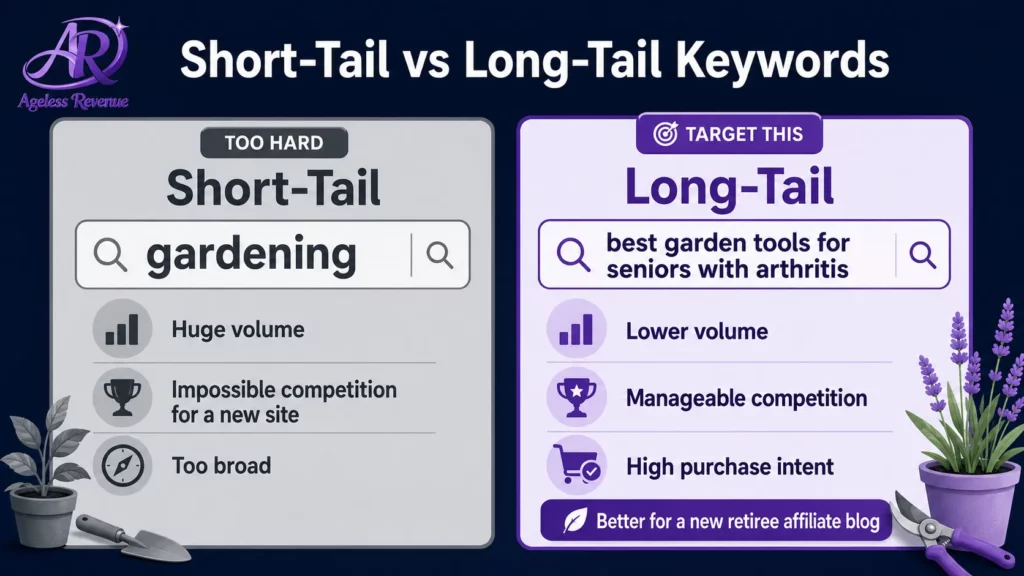
All keywords exist on a spectrum from broad (short-tail) to specific (long-tail).
Short-tail keywords are broad, single or double-word phrases: “gardening,” “affiliate marketing,” “recipes,” “tablets.” These have enormous search volume but also enormous competition. A new blog cannot realistically rank for these terms against established sites with years of authority.
Long-tail keywords are specific, three-to-five-word phrases: “best garden tools for seniors with arthritis,” “how to start affiliate marketing after 60,” “simple healthy recipes for one person,” “best tablet for elderly beginners.” These have lower search volume individually, but significantly less competition — and critically, the people searching for them have much clearer intent.
Conducting keyword research for the retiree affiliate blog is crucial for content optimization and engagement.
Through diligent keyword research for a retiree affiliate blog, you’ll cultivate a loyal community around your content.
Mastering keyword research for a retiree affiliate blog will set you apart in a crowded niche.
Keyword research for the retiree affiliate blog helps you identify gaps in the market that you can fill with your expertise.
Ultimately, keyword research for the retiree affiliate blog will guide your entire content creation process.
Each time you write a post, remember the importance of keyword research for the retiree affiliate blog.
Keyword research for the retiree affiliate blog is a process that evolves as your blog grows.
For a new retiree affiliate blog, long-tail keywords are the right target for two reasons. First, you can realistically rank for them. Second, the readers who find you through a specific search are far more likely to be interested in your exact content — and your affiliate recommendations.
Tool 1: Google Search Bar Autocomplete — Free and Immediate
Master the art of keyword research for a retiree affiliate blog to enhance your blogging strategy and drive targeted traffic.
As you refine your strategy, keyword research for the retiree affiliate blog should remain a top priority.
By focusing on keyword research for the retiree affiliate blog, you’ll enhance your chances of success.
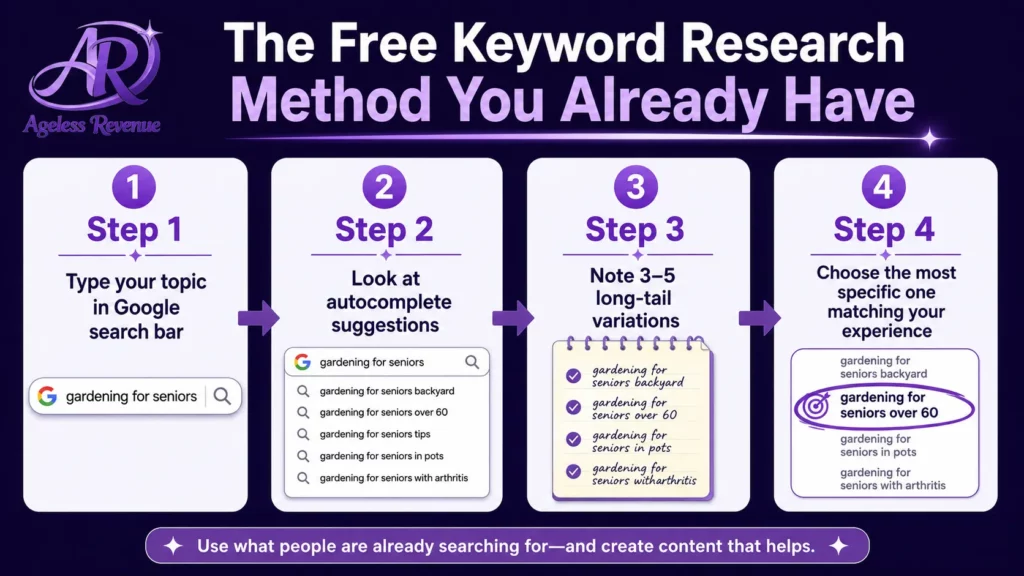
The fastest and most practical keyword research tool available is the one you use every day. Type your topic into the Google search bar and look at the autocomplete suggestions before pressing Enter.
These suggestions are phrases that real people are actively searching for right now. They are not generated by an algorithm — they are drawn from actual search behaviour.
Try it: type “best garden tools for,” and Google will suggest completions like “best garden tools for seniors,” “best garden tools for beginners,” “best garden tools for arthritic hands,” “best garden tools for raised beds.” Each of these is a long-tail keyword worth considering for a blog post.
Type your suggestion as a question too: “How do seniors garden?” will surface different completions with different search intent. Look at the “People also ask” box that appears in search results — each question there is another potential keyword.
Remember, keyword research for a retiree affiliate blog is the backbone of effective content marketing.
It’s essential to keep refining your approach to keyword research for the retiree affiliate blog.
Keyword research for the retiree affiliate blog is an ongoing journey that requires attention and dedication.
Stay committed to your keyword research for the retiree affiliate blog to witness growth in your audience engagement.
Investing time in keyword research for the retiree affiliate blog is a small price to pay for long-term success.
This takes two minutes per topic and costs nothing.
Tool 2: Google Keyword Planner — Free Search Volume Data
Make keyword research for the retiree affiliate blog a habit to ensure you are always on top of your game.
Google Keyword Planner (free with any Google account, no need to run ads) shows you how many people search for a specific phrase each month and how competitive it is.
Access it at ads.google.com/home/tools/keyword-planner/.
Enter your keyword phrase and look at two numbers:
Average monthly searches: the estimated number of searches per month globally. For a new affiliate blog targeting a specific niche, aim for keywords with 100–1,000 monthly searches. Higher volume means more competition. Lower volume means less potential traffic. This range is achievable for a new site and represents real audience interest.
The insights gained from keyword research for the retiree affiliate blog will help you stay relevant in your niche.
Ultimately, keyword research for retiree affiliate blog leads to content that drives meaningful connections with your audience.
Competition: shown as Low, Medium, or High. This refers to the competitiveness of the keyword for Google Ads (paid search), not for organic rankings — but it is a useful proxy. Low competition keywords are generally easier for new sites to rank for organically.
Tool 3: Jaaxy — The Built-In Tool Inside Wealthy Affiliate
If you use Wealthy Affiliate for training and hosting, Jaaxy is included as part of your membership. Jaaxy is a dedicated keyword research tool that shows the specific metrics most useful for affiliate bloggers:
QSR (Quoted Search Results): the number of pages competing directly for this exact phrase. A QSR under 100 indicates low competition. A QSR under 50 is ideal for a new blog.
Monthly searches: similar to Google Keyword Planner’s data, but often more accurate for niche topics.
SEO score: a combined score from 1–100. Above 80 indicates a strong opportunity for a new site.
For Wealthy Affiliate members, Jaaxy is the most practical keyword research tool because it is built directly into the platform where you are already working.
Tool 4: Google Search Console — See What Is Already Working
Once your blog has been publishing for a few months, Google Search Console (free) becomes your most valuable keyword research tool — because it shows you which keyword phrases Google is already surfacing your posts for.
Go to Performance → Search Results. You will see which queries (search phrases) are generating impressions (your post appearing in results) and clicks. This data tells you two important things:
First, which of your posts are already ranking for their target keywords? Celebrate these — they are working.
Second, which keywords are generating impressions but few clicks? This means Google is serving your post for that search, but something about your title or meta description is not compelling enough to generate clicks. Often, a more specific or intriguing title fixes this.
How to Choose a Keyword Before Writing a Post
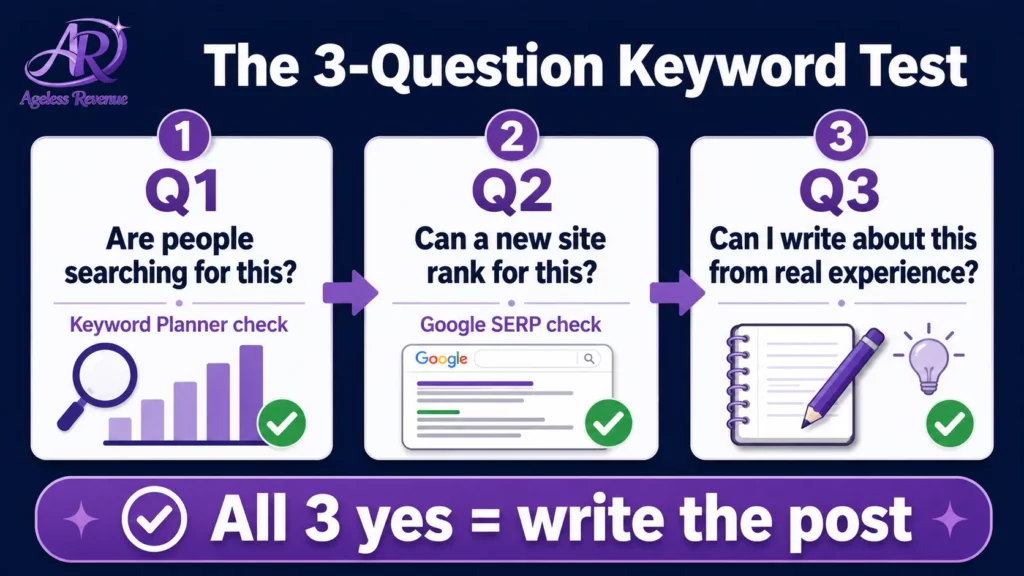
Before writing any post, run your keyword idea through this simple three-question test:
Question 1: Are people actually searching for this? Check the Google Search bar autocomplete and Google Keyword Planner. If you cannot find the phrase or variations of it generating at least 100 monthly searches, either the niche is too obscure, or you need to rephrase the keyword.
Question 2: Can a new site realistically rank for this? Search Google for your exact keyword phrase. Look at the first page results. If the top results are all from major established sites (NHS, WebMD, Amazon, large newspapers), that keyword is too competitive for a new blog. If you see smaller personal blogs or niche sites ranking, you have a chance.
Question 3: Does this match something I can write about with real experience? The best keywords for an affiliate blogger are ones where your personal experience with the topic or product gives you something to say that nobody else has said. A keyword you can answer from genuine knowledge will produce better content than one you are researching from scratch.
All three, yes? Write the post.
How to Use a Keyword Once You Have Chosen It
Keyword research for the retiree affiliate blog should always be tailored to your specific audience and their needs.
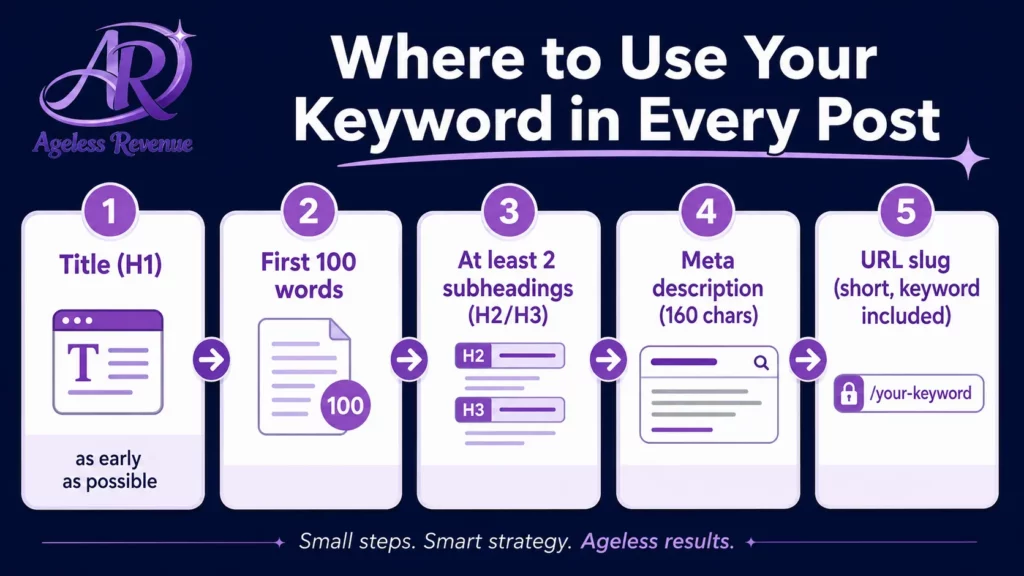
A keyword only helps if you use it in the right places. For each post:
Title (H1): Include your exact keyword phrase, as close to the beginning as possible. “Best Lightweight Garden Trowels for Seniors With Arthritis” is better than “My Favourite Gardening Tools for Older Adults.”
First 100 words: Use your keyword naturally in the opening paragraph. Google gives extra weight to keywords that appear early.
At least two subheadings (H2/H3): Include your keyword or close variations in subheadings throughout the post.
Meta description: The 150–160-character description that appears under your title in search results. Include your exact keyword. Write it to entice clicks, not just to include the keyword.
URL slug: Keep it short and include your keyword. /best-garden-trowels-seniors-arthritis/ is better than /my-top-picks-for-the-garden/.
Do not stuff your keyword in unnaturally — Google penalises forced keyword repetition. Use it where it fits naturally and use related phrases throughout.
A Simple Monthly Keyword Research Routine
Before writing each post (10 minutes): Type your topic into the Google Search bar autocomplete. Note 3–5 long-tail variations. Check the best one in Google Keyword Planner for the monthly search volume. Search Google for the phrase and assess competition. Choose the phrase that balances reasonable search volume with achievable competition.
Once per month (15 minutes): Open Google Search Console → Performance → Search Results. Look at your top 20 queries by impressions. Identify any posts with high impressions and low click-through rate (under 3%). Update the title and meta description of the lowest-performing one to be more specific and compelling.
Frequently Asked Questions
Do I need to pay for a keyword research tool?
No. Google’s free tools — Search bar autocomplete, Keyword Planner, and Search Console — are sufficient for most retiree bloggers, especially in the first year. Paid tools like Ahrefs or SEMrush add depth, useful for advanced SE, but are not necessary when starting out.
How many keywords should I target per blog post?
One primary keyword per post. Write the post around that keyword. Related phrases and variations will appear naturally as you write about the topic thoroughly — you do not need to force them in. One focused keyword produces better results than trying to rank for multiple terms with one post.
Should my keyword appear in my blog post title exactly as it is searched?
As close as possible, yes. An exact match or a very close variation in the title helps Google match your post to that search query. You can adjust slightly for readability — “Best Lightweight Garden Trowels for Seniors With Arthritis” works whether the exact keyword is “garden trowels for seniors arthritis” or “best trowels for arthritic hands.”
What if I write a post and it never ranks?
Check Search Console to see if the post is generating any impressions. If it appears in results but with very few clicks, the title or meta description may need improving. If it generates no impressions at all, the keyword may be too competitive, or the post may need more internal links from other posts on your site pointing to it.
Your Next Step
Before writing your next blog post, spend 10 minutes on keyword research using the Google Search bar autocomplete method. Type your topic, note the autocomplete suggestions, pick the most specific one that matches your personal experience, and build the post around it.
For tracking how your keyword-targeted posts perform over time, read Google Analytics for Retiree Bloggers.
For a complete training path with Jaaxy keyword research included, try Wealthy Affiliate free →
This post contains affiliate links. If you buy through them, I may earn a small commission at no extra cost to you.