

Best Free Tools for Affiliate Marketing Beginners (Honest Starter Stack)
The best tools for affiliate marketing beginners are not what most guides suggest — you do not need to spend hundreds of dollars to get started. The honest truth is that the complete beginner stack — everything you need to go from zero to a live blog with affiliate links and basic SEO — costs between $3 and $8 per month for the first few months, and that is mostly just hosting. The best tools for affiliate marketing beginners will help you maximize your efforts.
Everything else in this guide is either entirely free or has a free tier that covers everything a new affiliate site needs. This is not a roundup of every tool that has an affiliate programme. It is the minimal, purposeful stack that gets you to “publishing content with affiliate links” as quickly and cheaply as possible.
When you are looking for the best tools for affiliate marketing beginners, consider the features that will help you succeed and grow.
The best tools for affiliate marketing beginners are crucial in making your journey smoother.
The best tools for affiliate marketing beginners are not the most powerful ones — they are the ones that get out of the way and let you focus on the only thing that actually matters in the first six months: publishing good content consistently.
For a full guide to setting up your first blog, read our step-by-step guide on how to start a niche blog for affiliate marketing. For the complete picture of building affiliate income from scratch, the Ageless Revenue complete guide maps all the pieces together.
Affiliate disclosure: This post contains affiliate links. If you purchase through one of our links, we may earn a commission at no extra cost to you. Every tool here is recommended because it genuinely suits beginners, not because of the commission.
The Minimal Stack — The Only Tools You Actually Need to Start
Essential Resources: The Best Tools for Affiliate Marketing Beginners
Each of these tools has been selected for their importance among the best tools for affiliate marketing beginners.
To ensure you have the best tools for affiliate marketing beginners, start with these essential resources.
Focusing on the best tools for affiliate marketing beginners can greatly simplify your setup process.
The right hosting choice is one of the best tools for affiliate marketing beginners.
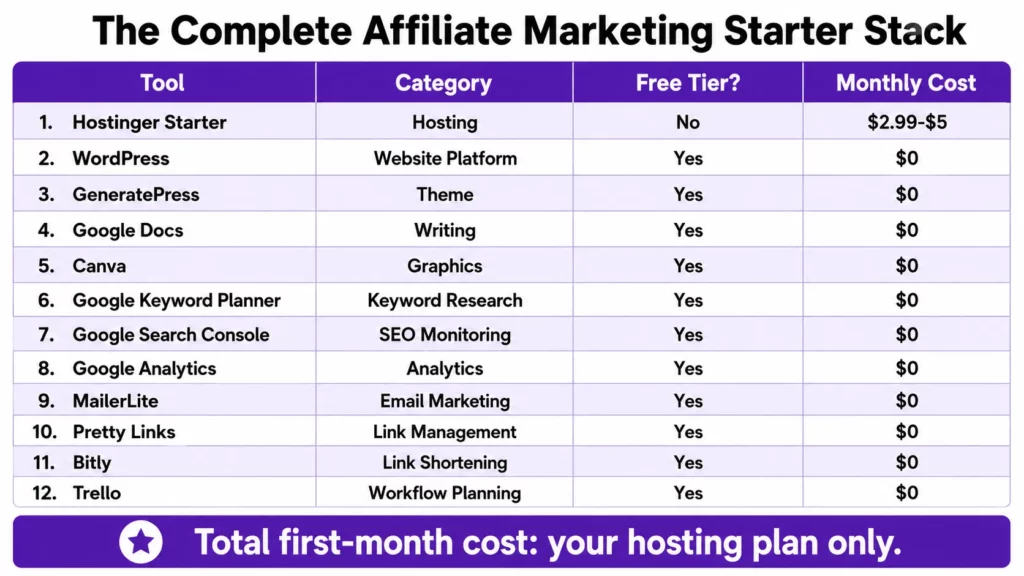
Before going into detail on each category, here is the complete starter stack in plain terms. If you are overwhelmed by the length of any tools roundup you have read, start here:
SiteGround is among the best tools for affiliate marketing beginners.
Using Hostinger is also recommended as one of the best tools for affiliate marketing beginners.
Bluehost is highlighted as one of the best tools for affiliate marketing beginners.
| Tool | Category | Free tier? | Monthly cost |
|---|---|---|---|
| SiteGround / Hostinger / Bluehost | Hosting | No | $3–8/month |
| WordPress.org | Website platform | Free | $0 |
| Astra or Kadence | Theme | Yes | $0 |
| RankMath or Yoast SEO | SEO plugin | Yes | $0 |
| Google Search Console | SEO tracking | Yes | $0 |
| Ubersuggest | Keyword research | Yes (limited) | $0 |
| Google Docs | Content writing | Yes | $0 |
| Pretty Links (free tier) | Link management | Yes | $0 |
| MailerLite | Email marketing | Yes (to 1,000 subs) | $0 |
| Google Analytics 4 | Traffic analytics | Yes | $0 |
| Amazon Associates | Affiliate network | Free to join | $0 |
| ShareASale or Impact | Affiliate network | Free to join | $0 |
Choosing the best tools for affiliate marketing beginners involves determining your specific needs.
Total first-month cost: your hosting plan. Everything else is free. That is the honest starting point.
Hosting and Website Tools
Your hosting and website platform are the foundation of everything else. These are the only tools you genuinely need to pay for at the start.
Keyword research tools are also among the best tools for affiliate marketing beginners.
Web hosting. Three hosts consistently work well for beginner affiliate blogs:
SiteGround offers the best combination of performance, support quality, and beginner experience of any host in this price range. Their support team is responsive and genuinely helpful — an important consideration when you are setting things up for the first time and something inevitably goes wrong. Plans start at approximately $3–4 per month on introductory pricing.
Utilizing Google Search Console is essential among the best tools for affiliate marketing beginners.
Google Keyword Planner stands out as one of the best tools for affiliate marketing beginners.
Ubersuggest remains one of the best tools for affiliate marketing beginners for its user-friendly interface.
For content creators, AnswerThePublic is listed among the best tools for affiliate marketing beginners.
Hostinger is the most affordable option, with entry plans under $3 per month. Performance is solid for new sites with low traffic, and the dashboard is designed with complete beginners in mind. The right choice if the budget is the primary constraint.
Choosing the right content writing tools is also essential for the best tools for affiliate marketing beginners.
Bluehost is officially recommended by WordPress.org and has the most streamlined beginner onboarding of any major host. Plans start at approximately $3–4 per month. The one-click WordPress installation is genuinely one click.
All three handle one-click WordPress installation, automatic backups, and sufficient performance for a new blog. Choose based on budget and which interface feels most approachable to you.
Google Docs is a top pick among the best tools for affiliate marketing beginners.
WordPress.org. Free, open-source, and the platform used by over 40% of all websites on the internet. It is the standard for affiliate marketing blogs for a reason: full ownership of your content, access to thousands of plugins, and the flexibility to monetise in any way you choose. For a full setup walkthrough, read our guide on how to start a niche blog for affiliate marketing.
Grammarly is another vital option among the best tools for affiliate marketing beginners.
The Hemingway Editor serves as an excellent tool among the best tools for affiliate marketing beginners.
Using Pretty Links is a practical choice and ranks among the best tools for affiliate marketing beginners.
Theme. A WordPress theme controls how your blog looks. For a new affiliate site, speed and simplicity matter more than design sophistication. Two themes with excellent free tiers:
Astra is the most widely used lightweight WordPress theme and the most beginner-friendly. Fast, clean, and compatible with all major page builders. The free version is entirely sufficient for a starting affiliate blog.
ThirstyAffiliates is a premium choice among the best tools for affiliate marketing beginners.
Kadence is a strong alternative with a slightly more polished default design. Similarly fast, similarly beginner-friendly. Both are worth trying — install one, and if you prefer the other, switching themes takes under ten minutes.
Keyword Research and SEO Tools
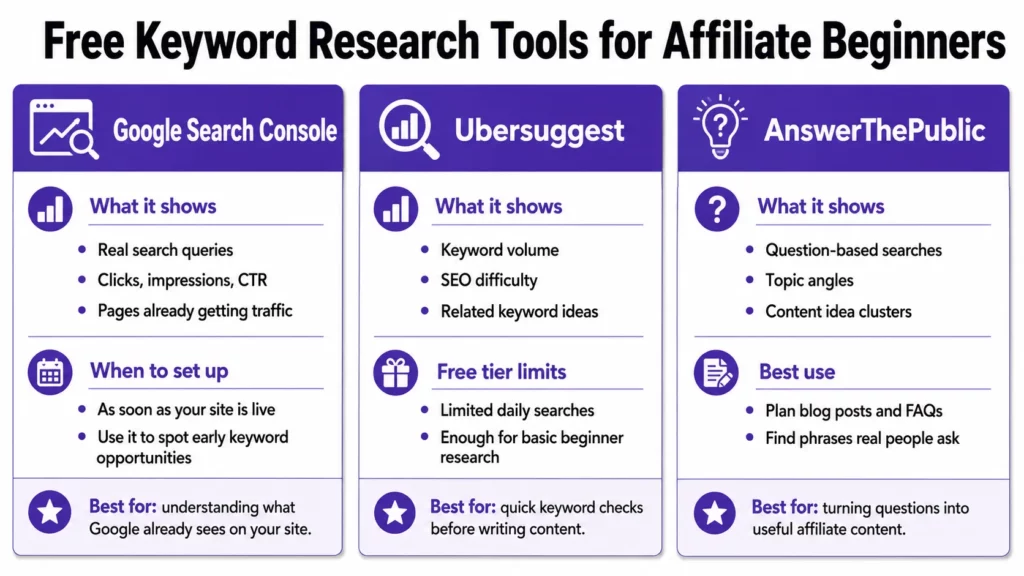
These tools help you find the right topics to write about — ones that real people are searching for and that a new site has a realistic chance of ranking for.
Google Search Console is the single most important free tool for any affiliate blogger. It shows you which searches are bringing people to your site, which pages are receiving impressions, and any technical issues Google has detected. Set it up on day one and check it weekly once you have been publishing for a month or two. Completely free, no limitations.
ConvertKit also ranks as one of the best tools for affiliate marketing beginners.
Google Keyword Planner requires a free Google Ads account, but no ad spend. It provides monthly search volume data directly from Google’s own index — the most accurate free keyword volume source available. The interface is not the most intuitive for non-advertisers, but the data is reliable.
Email marketing is also key; MailerLite is one of the best tools for affiliate marketing beginners.
Beehiiv can be a strong contender among the best tools for affiliate marketing beginners.
Ubersuggest is the most beginner-friendly keyword research tool available with a meaningful free tier. It provides keyword volume, SEO difficulty scores, competitor content analysis, and content ideas in a clean interface. The free tier limits the number of searches per day, but this is sufficient for the publishing pace of a new blog. For a detailed guide to using keyword research in your affiliate content strategy, read our guide to SEO for affiliate marketing beginners.
AnswerThePublic maps the questions people ask around any topic. Particularly useful for finding long-tail, question-based content ideas — “which walking boots are best for plantar fasciitis?” — that match how real people search. The free version allows a limited number of searches per day, which is enough for generating a week’s worth of content ideas in a single session.
What to avoid spending money on too early: Ahrefs ($99/month), SEMrush ($119/month), and Moz ($99/month) are genuinely powerful tools — but they are designed for established sites with significant traffic and the complexity to justify their cost. Using them on a site with twenty posts and a few hundred monthly visitors is like buying a professional kitchen for someone learning to boil pasta. Revisit these after you have thirty or more posts and a growing audience.
Content Writing Tools
These tools support the actual writing process. None of them needs to cost anything.
Google Docs is free, auto-saves to the cloud, is accessible from any device, and handles everything a blog writer needs. No subscription required. Write your drafts here, then copy them into WordPress when ready.
Grammarly’s free tier checks spelling, grammar, and basic tone issues as you write. The free version catches the vast majority of errors that matter. The paid version adds style suggestions and readability scores — useful but not necessary at the beginner stage.
Hemingway Editor is a free web tool where you paste your draft, and it highlights complex sentences, passive voice, and readability issues. Particularly useful for anyone whose professional background involved formal or technical writing — it helps calibrate the conversational tone that works best for affiliate content.
A note on AI writing tools. Tools like ChatGPT and Claude are useful for research, outlining, and generating first drafts to react to. They are not useful for producing the finished content that earns affiliate commissions. Readers trust content that sounds like a specific, knowledgeable person — and AI-generated content is increasingly easy to identify. Use these tools as research assistants and thinking partners, not as ghostwriters for your final published content.
Affiliate Link Management Tools
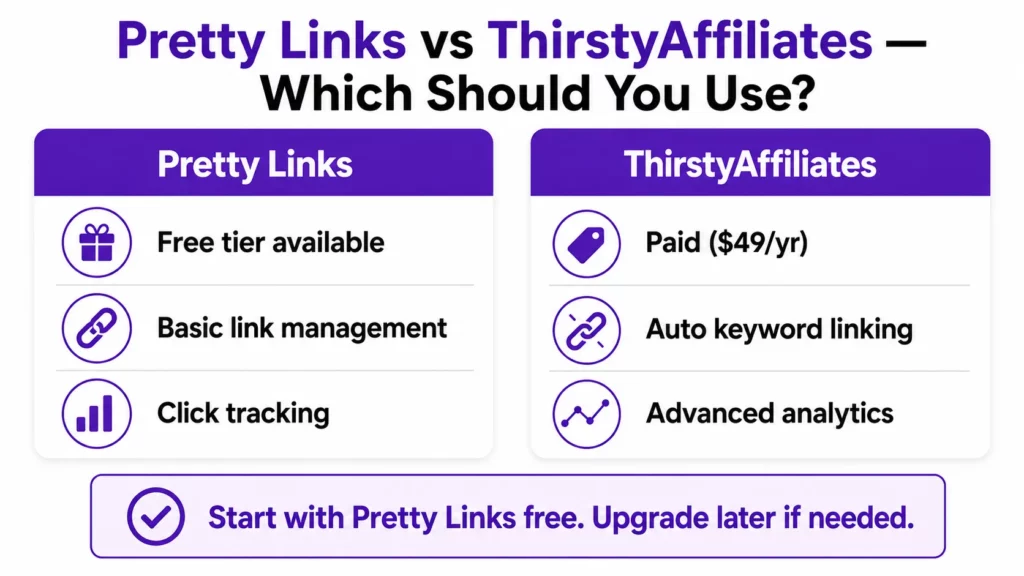
Raw affiliate URLs are long, ugly, and fragile — if a programme changes its URL structure, every link you have placed stops working. An affiliate link manager solves this by letting you create clean, branded short links that redirect to your affiliate URLs and can be updated in one place if anything changes.
Pretty Links is the standard free solution. It lives inside WordPress and lets you create links like yoursite.com/go/amazon or yoursite.com/go/mailerlite. The free tier handles everything a beginner needs — link creation, basic click tracking, and centralised management. If Amazon changes its URL structure, you update one link in Pretty Links and every post on your site is automatically fixed.
As you consider your options, remember to focus on the best tools for affiliate marketing beginners.
ThirstyAffiliates is the main paid alternative, starting at around $49 per year. It adds features like automatic keyword linking (automatically turning mentions of a product into affiliate links throughout your content), geographic redirection, and more detailed analytics. Worth considering in year two once your site has enough content to benefit from automated link insertion, but unnecessary at the start.
What is link cloaking? When you use Pretty Links to redirect yoursite.com/go/amazon to your actual affiliate URL, that is called link cloaking. It makes links look cleaner, makes them easier to update, and — importantly — signals to readers that the link goes somewhere they can predict. A clean branded link is more likely to be clicked than a raw affiliate URL containing dozens of parameters and tracking codes.
Email Marketing Tools
Building an email list from day one is one of the highest-return activities available to a new affiliate marketer. The tools required are free to start.
MailerLite is the top recommendation for beginners. Free up to 1,000 subscribers, allows affiliate links in emails, has a clean interface, and includes a hosted landing page builder for your sign-up page — no website required for that part. For a full guide to building an affiliate email list from zero, read our guide to email marketing for affiliate revenue.
The best tools for affiliate marketing beginners will greatly influence your success.
Beehiiv is a newer platform designed specifically for newsletter publishing. The free tier is generous, the design is clean, and the built-in referral and growth tools are excellent. Worth considering if your vision is a standalone newsletter rather than an email list attached to a blog.
To summarize, the best tools for affiliate marketing beginners are crucial for your success.
ConvertKit / Kit is popular among creators and has strong automation and tagging capabilities. The free tier is limited but functional. Worth considering if you plan to sell digital products or courses alongside affiliate marketing, as its commerce integration is the strongest of the three.
Consider all of these aspects when evaluating the best tools for affiliate marketing beginners.
Your journey with the best tools for affiliate marketing beginners is just beginning.
As you grow, the best tools for affiliate marketing beginners will evolve with you.
One critical note: avoid Mailchimp for affiliate marketing. Its terms of service prohibit affiliate marketing links in a way that is broadly interpreted and has resulted in account suspensions for legitimate affiliate bloggers. This is the most common avoidable mistake new affiliate email marketers make.
Analytics and Tracking Tools
You need to know what is working. Two tools handle everything at the beginner stage.
Google Analytics 4 is free and shows you how many people are visiting your site, which pages they read, how long they stay, and where they came from. Set it up in your second or third month once you have enough content to generate meaningful data. Trying to interpret analytics on a site with fewer than five posts and no organic traffic produces noise rather than insight.
Your affiliate network dashboards. Amazon Associates, ShareASale, Impact, and every other major affiliate programme have a built-in dashboard showing your clicks, conversions, and earnings per link. Before adding any third-party tracking tool, learn to read these dashboards well. They tell you exactly which content is generating commission, which is the most actionable data you have.
Tools to Skip for Now
These tools appear frequently in affiliate marketing content and are genuinely useful at scale — but they add cost and complexity before you have the volume to benefit from them.
Social media scheduling tools (Buffer, Hootsuite, Later): unnecessary when you are posting manually to one or two platforms. Automation adds value when you are managing a consistent, multi-platform social presence. In the first year, manual posting is fine.
Paid keyword tools (Ahrefs, SEMrush, Moz): as noted above, the free tools cover everything a new site needs. Revisit after six months and thirty or more posts.
Landing page builders (ClickFunnels, Leadpages, Unbounce): your blog already is a landing page for your affiliate content. Standalone landing page builders solve a problem you do not yet have.
Canva Pro: the free tier of Canva handles every graphic a new blog needs — featured images, Pinterest pins, social graphics. The paid tier adds stock photos, resizing, and brand kit features. None of these are necessary until you are producing content at a significant scale.
Your Total Monthly Cost at Each Stage
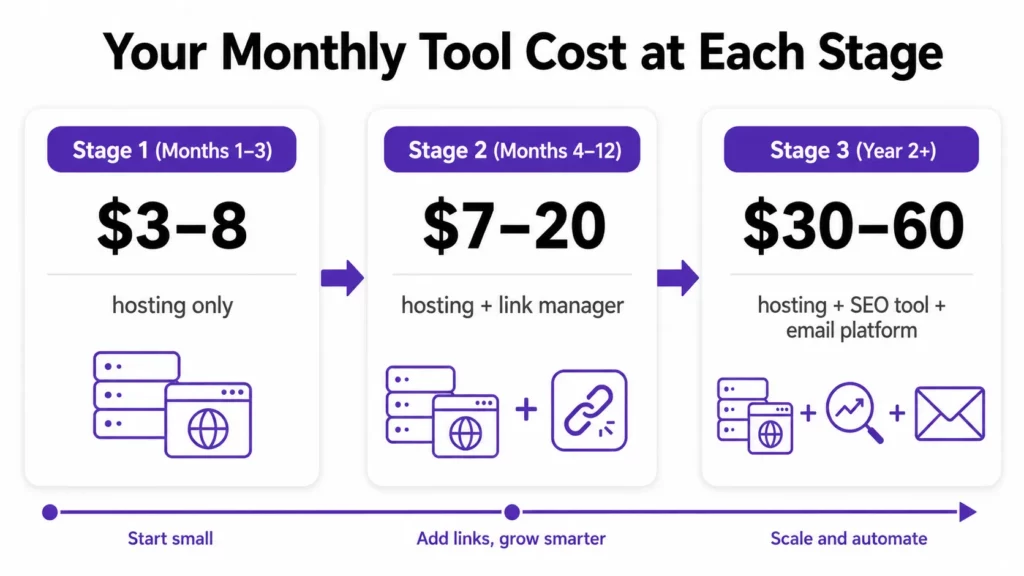
| Stage | Timeframe | What you are paying for | Monthly cost |
|---|---|---|---|
| Getting started | Months 1–3 | Hosting only | $3–8 |
| Building | Months 4–12 | Hosting + optional Pretty Links Pro or ThirstyAffiliates | $7–20 |
| Growing | Year 2+ | Hosting + one paid SEO tool + email platform (as list grows past free tier) | $30–60 |
The most important thing about this cost progression: you are not committing to any of the year-two costs now. You add paid tools when their value is demonstrably worth their cost — when your site has the traffic and revenue to justify them.
Frequently Asked Questions
Do I need all these tools before I start?
No. The absolute minimum to publish your first affiliate post is hosting, WordPress, a free theme, and one affiliate programme account. The full starter stack in this guide is what you build toward over the first two to three months, not what you need on day one. Start with hosting and WordPress. Add the SEO plugin before your first post. Add keyword research tools when you are planning your second or third post. Add email tools in month two or three.
Are there any tools I should definitely pay for from the start?
Only one: web hosting. Everything else has a functional free tier sufficient for a beginner site. If your budget allows one paid upgrade early on, WP Rocket (a caching and performance plugin at around $59 per year) makes a meaningful difference to site speed, which affects both user experience and SEO rankings. It is not essential, but it is the one paid tool that delivers clear, measurable value from day one.
Can I use my phone to run an affiliate blog?
Partially. The WordPress mobile app handles basic publishing, editing, and reviewing your analytics. Keyword research and serious editing work are significantly more difficult on a phone screen. The honest answer is that a laptop or desktop computer makes the work meaningfully easier, and if you are serious about building an affiliate income, that investment is worth making. If you currently only have a phone, start there — it is workable — but treat a laptop as a priority purchase when your situation allows.
Your Next Step
The best tools for affiliate marketing beginners are the ones you actually use consistently. Start with the minimal stack, learn each tool before adding the next, and resist the temptation to solve problems you do not yet have with tools you do not yet need.
For the SEO side of getting your content found, read our guide to SEO for affiliate marketing beginners.
For the complete affiliate marketing journey from first post to functioning income, the Ageless Revenue complete guide covers all the pieces together.
This post contains affiliate links. If you purchase through one of our links, we may earn a commission at no extra cost to you. Every tool here is recommended because it genuinely suits beginners, not because of the commission.