
Content Planning Beginner Guide: Create Your 30-Day Blog Launch Strategy
You’ve chosen your niche. You’ve researched your keywords. You’ve set up WordPress. Now comes the moment many new bloggers dread: staring at a blank screen, wondering “What do I write about?”
Here’s the truth: content planning isn’t about having everything figured out. It’s about creating a simple roadmap that keeps you moving forward when motivation dips, inspiration runs dry, or life gets busy.
Understanding the Content Planning Beginner Guide
This content planning beginner guide walks you through creating your first 30 days of content — the foundation that every successful affiliate blog is built on. No overwhelm. No complicated spreadsheets. Just a straightforward system that helps you publish consistently, serve your readers, and build momentum toward your first affiliate commissions.
In 2026, successful bloggers aren’t the ones with perfect content calendars stretching months ahead. They’re the ones who plan just enough to keep moving, stay flexible enough to adapt, and authentic enough to connect with real people facing real problems. Let’s build your 30-day content plan together.
Affiliate disclosure: This post contains affiliate links. If you buy through them, I may earn a small commission at no extra cost to you.
TL;DR — Quick Takeaways
- Your first 10–15 posts create your foundation — quality beats quantity every time
- The 3-pillar content framework: educational posts (60%), product reviews (30%), personal stories (10%)
- Wealthy Affiliate’s Site Content platform provides AI writing assistance and content planning tools, alongside free options like Google Sheets
- 30-day launch strategy works — one post every 2–3 days builds momentum without overwhelm
- Content planning takes 2–3 hours using free tools like Google Sheets, Trello, or Notion
- Real experience trumps perfect writing — your authentic voice matters more than fancy language
Why this works in 2026: Search engines reward consistent, helpful content that answers real questions. Your decades of life experience give you unique insights that AI-generated content can’t replicate. Authenticity wins.
Why Content Planning Matters for New Retiree Bloggers
You wouldn’t build a house without blueprints. Your blog deserves the same thoughtful planning.
Here’s what happens without a content plan: you stare at blank screens, unsure what to write. Posts feel random and disconnected. You lose motivation after 2–3 articles. Readers can’t find what they need. Google doesn’t understand your site’s focus.
Here’s what happens with a simple content plan: you always know what to write next. Posts build on each other logically. Momentum carries you through tough days. Readers see you as an organised expert. Search engines reward your clear structure.
The truth: planning 30 days of content takes just one afternoon. That small investment saves you hours of frustration and builds confidence for the long haul.
For the complete overview of getting started, read Getting Started With Affiliate Marketing as a Retiree.
The 3-Pillar Content Framework Every Beginner Needs

Forget complicated content matrices. Your first 30 days follow a simple 3-pillar framework.
Pillar 1: Educational Posts (60% of Your Content)
What they are: how-to guides, tutorials, and problem-solving articles that help your audience.
Why they matter: these posts bring in search traffic from Google, build your credibility as a helpful resource, answer the questions your audience is asking, and create natural opportunities to mention products.
Examples for different niches:
- Gardening blog: “10 Screen-Free Activities for Grandkids Ages 3-7”
- Travel blog: “How to Plan Your First Solo Cruise in Your 60s”
- Hobby blog: “Beginner’s Guide to Watercolor Painting Supplies Under $50”
Your first month: create 6–8 educational posts covering the most common questions in your niche.
Pillar 2: Product Reviews (30% of Your Content)
What they are: honest evaluations of products or services your audience needs.
Why they matter: these posts generate affiliate commissions, help readers make informed buying decisions, target “buyer intent” keywords, and build trust through transparent recommendations.
Examples for different niches:
- Gardening blog: “Fiskars Pruning Shears Review: Worth It After 2 Years of Use”
- Travel blog: “Samsonite Carry-On Review: Perfect for Senior Travelers?”
- Hobby blog: “Winsor & Newton vs. Budget Watercolors: An Honest Comparison”
Your first month: create 3–4 product reviews for items you’ve actually used and can recommend honestly.
Pillar 3: Personal Stories (10% of Your Content)
What they are: your journey, mistakes, lessons learned, and personal insights.
Why they matter: these posts connect emotionally with readers, showcase your authentic personality, build loyal community members, and differentiate yourself from generic AI content.
Examples for different niches:
- Gardening blog: “How I Killed My First 12 Tomato Plants (And What I Learned).”
- Travel blog: “My First Solo Trip at 62: Terrified and Thrilled”
- Hobby blog: “Why I Started Painting After Retirement (And You Should Too).”
Your first month: create 1–2 personal story posts that explain why you started this journey.
The magic ratio: 60% educational + 30% reviews + 10% personal = a well-rounded blog that serves readers and earns income.
Your 30-Day Content Launch Strategy (Step-by-Step)
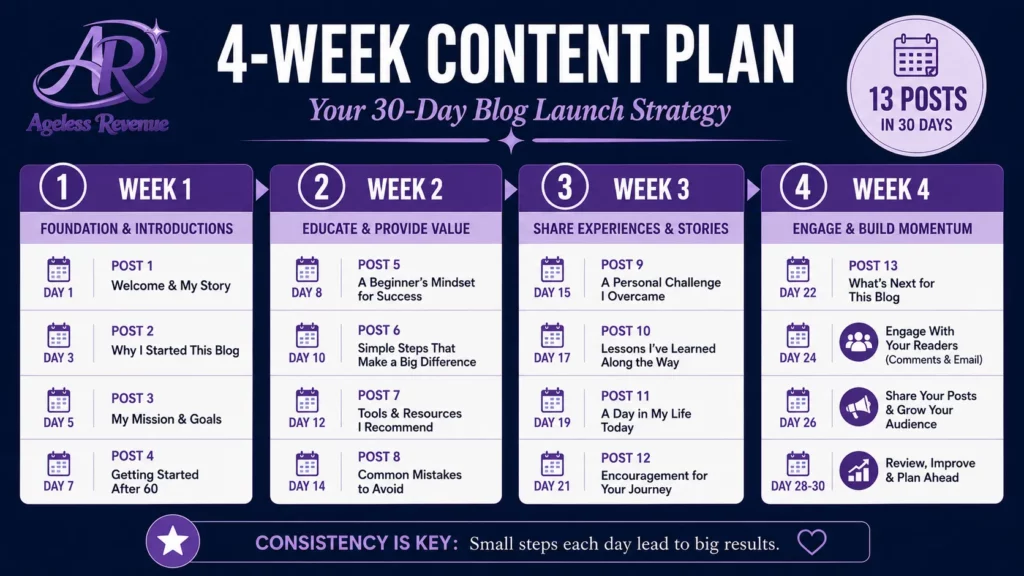
Here’s your exact roadmap for the first month. No guesswork required.
Week 1: Foundation Posts (Posts 1–3)
Post 1 — Your “Start Here” Guide. Educational. A comprehensive beginner’s guide to your main topic (e.g., “Complete Guide to Container Gardening for Beginners”). Goal: show Google and readers what your site is about. Length: 1,500–2,000 words.
Post 2 — Your Personal Story. Personal. Why you started this blog and who you want to help (e.g., “How I Went From Black Thumb to Balcony Garden in 6 Months”). Goal: connect with readers on a human level. Length: 800–1,200 words.
Post 3 — First Product Review. Review. A product you genuinely use and love (e.g., “Why I Recommend These Ergonomic Pruning Shears for Seniors”). Goal: start building affiliate revenue potential. Length: 1,200–1,800 words.
Week 2: Build Depth (Posts 4–6)
Post 4 — Problem-Solving How-To. Educational. Answer a specific problem your audience faces (e.g., “How to Fix Yellow Leaves on Tomato Plants: 5 Common Causes”). Length: 1,000–1,500 words.
Post 5 — Comparison Review. Review. Compare 2–3 similar products (e.g., “Best Potting Soil for Vegetables: 3 Options Tested”). Length: 1,500–2,000 words.
Post 6 — Quick Tips List. Educational. A listicle addressing multiple mini-topics (e.g., “10 Container Gardening Mistakes Every Beginner Makes”). Length: 1,200–1,600 words.
Week 3: Add Variety (Posts 7–10)
Post 7 — Seasonal or Timely Guide. Educational. Something relevant to the current season or trending topic (e.g, “Spring Planting Guide: What to Grow Now”). Length: 1,500–2,000 words.
Post 8 — Tools and Resources Roundup. Review. Multiple products in one category (e.g., “7 Essential Tools Every Container Gardener Needs”). Length: 2,000–2,500 words.
Post 9 — Advanced Tutorial. Educational. Take readers to the next level (e.g., “How to Build a Self-Watering Container System”). Length: 1,800–2,200 words.
Post 10 — FAQ Post. Educational. Answer 10–15 common questions (e.g., “Container Gardening FAQ: 15 Questions Answered”). Length: 1,500–2,000 words.
Week 4: Round It Out (Posts 11–13)
Post 11 — Case Study or Success Story. Personal. Share a specific win or lesson learned (e.g, “How I Grew 20 Tomatoes in One Container: Full Timeline”). Length: 1,200–1,800 words.
Post 12 — “Best Of” Buyer’s Guide. Review. Comprehensive guide to the best products in a category (e.g., “Best Container Vegetables for Beginners: Top 12 Picks”). Length: 2,500–3,000 words.
Post 13 — Troubleshooting Guide. Educational. Help readers solve common problems (e.g., “Container Garden Not Producing? 8 Fixes That Work”). Length: 1,500–2,000 words.
By day 30, you’ll have: 13 solid blog posts (10–13 is realistic for beginners), a mix of educational content, reviews, and personal stories, multiple entry points for Google search traffic, several opportunities for affiliate commissions, and the confidence and momentum to keep going.
How to Actually Plan Your Content (The Simple System)
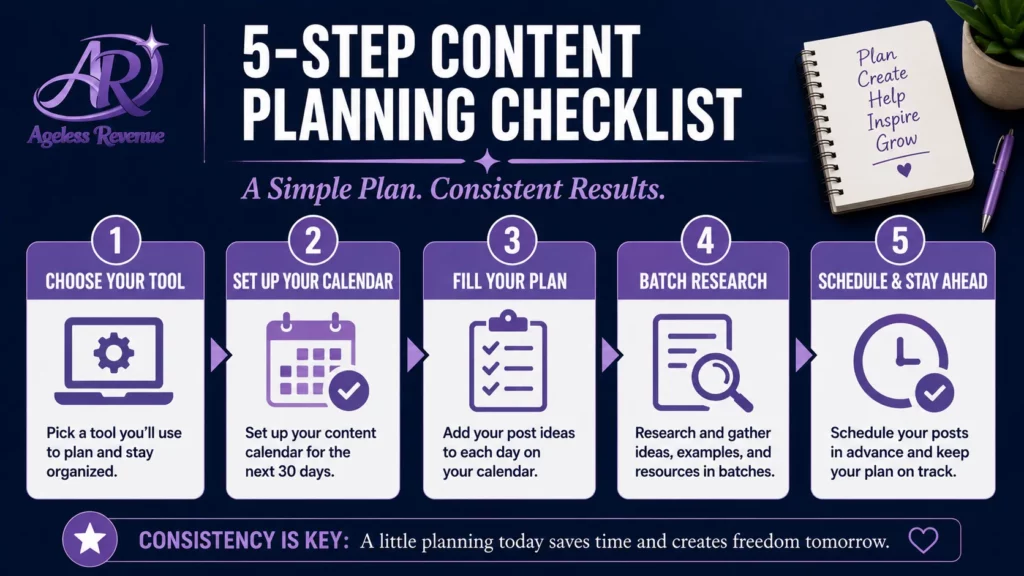
Step 1 — Choose your planning tool (5 minutes). Pick one of these: Google Sheets (simple spreadsheet, accessible anywhere), Trello (visual cards you can drag and drop), Notion (all-in-one workspace with templates), or Wealthy Affiliate’s Site Content platform (built-in content planner with AI assistance). My recommendation for beginners: start with Google Sheets. It’s familiar, simple, and you can always upgrade later.
Step 2 — Create your content calendar (30 minutes). Open your chosen tool and create these columns: Post Number, Publish Date (every 2–3 days), Post Title (working title, can change), Content Type (Educational, Review, or Personal), Target Keyword, Status (Idea, Outlined, Written, Published), and Notes.
Step 3 — Fill in your 30-day plan (90 minutes). Use the Week 1–4 framework above and adapt it to your niche. For each post slot: write a working title, assign a content type (60% educational, 30% review, 10% personal), add the keyword you’re targeting, and set a realistic publish date. Don’t overthink it. Your titles will evolve as you write. The goal is to have a roadmap, not a perfect plan.
Step 4 — Batch your research (45 minutes). For each post in your plan: Google the topic and see what’s already ranking, note 3–5 key points you want to cover, and bookmark any helpful resources in your Notes column. This prevents analysis paralysis when you sit down to write — you’ll have a starting point ready.
Step 5 — Set your weekly writing schedule (15 minutes). Reality check: You need 2–4 hours to write each post (1,500–2,000 words) when you’re new. Block out specific times: write 1 post every Monday, Wednesday, Friday (6 hours/week), or write 2 posts every weekend (4–6 hours/week), or write 1 hour daily, completing 1–2 posts per week. Choose what fits your schedule. Consistency beats intensity.
Content Planning Tools and Resources for 2026
Free planning tools: Google Sheets (simple spreadsheet planning), Trello (visual, card-based planning), Notion (all-in-one workspace with templates), Google Calendar (blocking writing time and deadline reminders).
Content research tools: AnswerThePublic (find questions people are asking about your topic, 5 free searches/day), Google Trends (see if topics are trending up or down), Reddit (search your niche subreddit for real questions), Amazon reviews (read customer reviews to find pain points and questions).
AI writing assistants (optional): ChatGPT free plan (outlining posts, brainstorming ideas, overcoming writer’s block), Grammarly free plan (catching spelling and grammar errors, improving clarity), Hemingway Editor (simplifying complex sentences, improving readability).
Important: Use AI as a helpful assistant, not a replacement for your authentic voice and experience. Readers can easily identify generic AI content. For a deeper look at this balance, read How to Use AI to Write Your Blog Without Sounding Like a Robot.
Common Content Planning Mistakes (And How to Avoid Them)
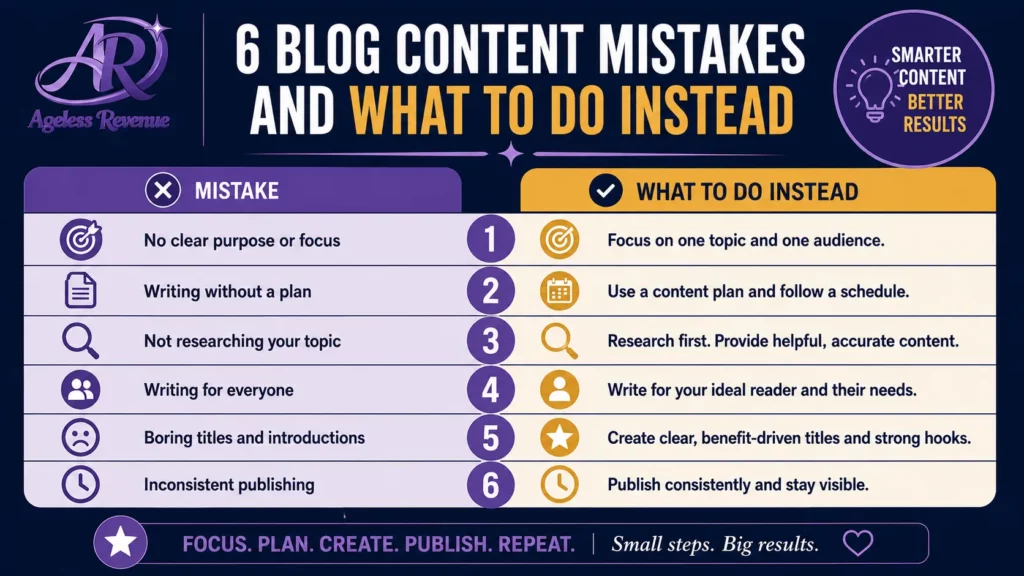
Mistake #1: Planning too much, writing too little. The problem: you spend weeks perfecting your 6-month content calendar, but never publish Post #1. The fix: plan your first 30 days in detail. Sketch the next 60 days loosely. Everything beyond 90 days is just rough ideas. Focus on writing, not planning.
Mistake #2: Copying competitor topics exactly. The problem: you find a successful blog and copy its exact post titles without adding your unique angle. The fix: use competitor research for inspiration, then ask “what can I add from my experience? What angle are they missing?” Your unique perspective is your advantage.
Mistake #3: Ignoring your actual experience. The problem: you plan to write about topics you’ve never tried because they “seem popular.” The fix: start with what you know. Your authentic experience in year one beats generic research on topics you’ve never touched. Readers can tell when expertise isn’t genuine.
Mistake #4: All educational, no reviews (or vice versa). The problem: you plan 30 educational posts and zero reviews, or 20 reviews and no helpful content. The fix: stick to the 60/30/10 ratio. This balance serves readers and builds income.
Mistake #5: Setting unrealistic publishing schedules. The problem: you commit to publishing daily when you’ve never written a blog post before. The fix: start with 2–3 posts per week maximum. It’s better to publish consistently for 3 months than burn out in 3 weeks.
Mistake #6: Planning but never reviewing. The problem: you create a beautiful 30-day plan, then never check back to see what’s working. The fix: at the end of each week, glance at your tracking sheet — which posts got the most traffic or engagement? Adjust the next week’s topics based on what you learn, rather than sticking rigidly to the original plan.
Frequently Asked Questions
How many posts do I need before I see results?
Most retiree bloggers start seeing initial search traffic with 10–15 published posts, assuming each one targets a specific keyword and follows the 60/30/10 content mix. Volume matters less than consistency and quality.
Should I write educational posts or product reviews first?
Start with one of each in your first week. An educational “start here” guide establishes your site’s focus for Google and readers, while an early product review begins building your affiliate income potential from day one.
What if I run out of content ideas after 30 days?
Your monthly review process — checking which posts performed best — naturally generates new ideas. Readers’ comments and questions, seasonal topics, and deeper dives into your best-performing post topics are all reliable sources for month two and beyond.
Do I need to follow the 60/30/10 ratio exactly?
No. It is a useful starting guideline, not a strict rule. Some niches naturally lean more heavily toward reviews or educational content. Use the ratio as a check — if you notice you have written 10 reviews and no educational posts, that is worth correcting.
Your Next Step
Open a free Google Sheet right now and create the seven columns listed in Step 2 above. Spend the next hour filling in your first week of posts using the framework in this guide. That single hour of planning will carry you through your first seven days without ever wondering what to write next.
For a complete path with content planning tools, AI writing assistance, and training built in, try Wealthy Affiliate free →
This post contains affiliate links. If you buy through them, I may earn a small commission at no extra cost to you.