

SEO Basics for Affiliate Marketing Beginners — Get Found on Google Without Paid Ads
SEO. Three letters that manage to sound simultaneously technical, expensive, and vaguely mysterious. If you have spent any time reading about affiliate marketing, you have encountered the term constantly — and probably wondered how much of it you actually need to understand before you can build something useful.
Understanding SEO for affiliate marketing beginners is crucial for success in the competitive online landscape. SEO for affiliate marketing beginners can help you attract the right audience and improve your conversion rates.
The honest answer: less than you think. The 20% of SEO that drives 80% of results for a new affiliate blog is entirely learnable by anyone willing to apply it consistently. No technical background required. No expensive tools. No specialist to hire.
When you start your journey with SEO for affiliate marketing beginners, focus on implementing effective strategies that yield results over time.
With the right approach to SEO for affiliate marketing beginners, you can significantly enhance your blog’s visibility.
To achieve success, SEO for affiliate marketing beginners requires the application of best practices and continuous learning.
Understanding SEO for affiliate marketing beginners is essential for driving traffic and increasing conversions.
This guide covers the SEO basics that matter for a beginner affiliate marketer — what keywords are and how to find the right ones, how to optimise a single blog post before you publish it, how to write content that Google actually wants to rank, and how long the whole process realistically takes. It does not cover technical SEO audits, advanced link building campaigns, or anything that requires more than a free tool and thirty minutes per post.
For context on how SEO fits into the wider picture of building affiliate income, the Ageless Revenue complete guide covers all the pieces together. If you have not yet set up your blog, the guide to how to start a niche blog for affiliate marketing covers that first step.
Affiliate disclosure: This post contains affiliate links. If you purchase through one of our links, we may earn a commission at no extra cost to you.
As you dive deeper into SEO for affiliate marketing beginners, you’ll discover the importance of keyword research and content optimization.
Remember, SEO for affiliate marketing beginners is not just about content; it’s about delivering value to your readers.
What Is SEO and Why Does It Matter for Affiliate Marketing?
Implementing SEO for affiliate marketing beginners can lead to sustainable growth and an increase in affiliate income.
For anyone serious about their online business, mastering SEO for affiliate marketing beginners is a necessity.
Essential SEO Strategies for Affiliate Marketing Beginners
SEO for Affiliate Marketing Beginners: Key Considerations
SEO — Search Engine Optimisation — is the practice of making your content easy for Google to find, understand, and recommend to people who are searching for it. That is the whole definition. Everything else is details.
For affiliate marketing specifically, SEO matters more than social media for one fundamental reason: search traffic is high-intent. A person who opens Instagram is browsing passively — they are not necessarily looking for anything in particular. A person who types “best walking boots for wide feet review” into Google is actively looking for exactly that. They are close to a purchasing decision. When your content appears in front of that search, and it is genuinely useful, they click. When they trust your recommendation, they buy through your affiliate link.
Social media can build an audience and supplement traffic, but it requires constant, frequent posting to maintain visibility in an algorithm that works against you. SEO for affiliate marketing, by contrast, compounds: a well-optimised post published today can attract the same high-intent readers three years from now, without any additional effort on your part.
That compounding is the reason consistent SEO effort — even at a beginner level — eventually produces the kind of income that feels passive.
Utilizing effective SEO for affiliate marketing beginners strategies will help you stand out in a crowded market.
Incorporating SEO for affiliate marketing beginners principles in your content creation process is vital to success.
As you learn about SEO for affiliate marketing beginners, remember to focus on targeted keywords that attract your ideal audience.
How Google Decides What to Rank
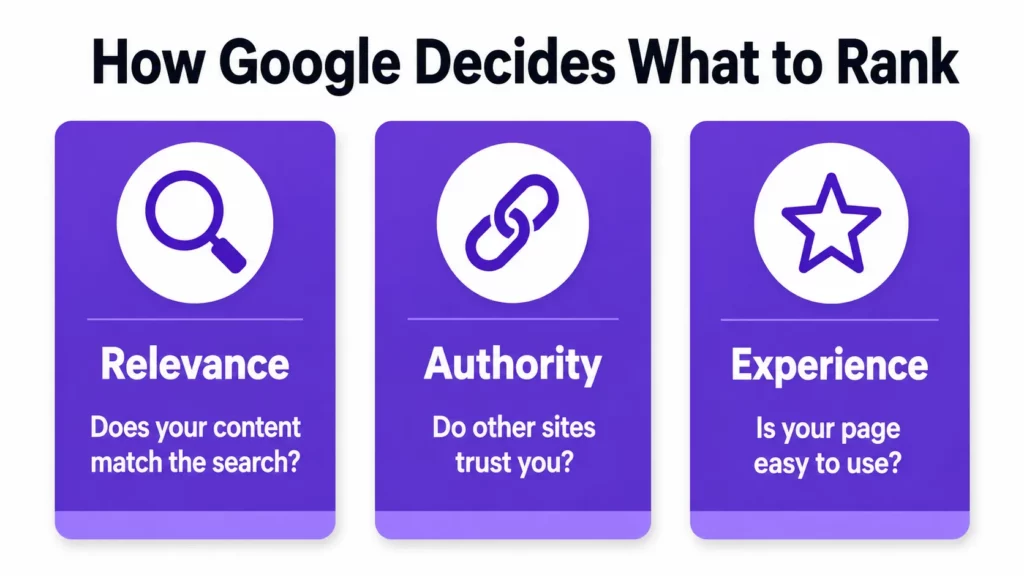
Understanding this — even at a simplified level — changes how you approach every piece of content you create.
Google uses hundreds of signals to rank content, but for a beginner affiliate marketer, three factors cover the vast majority of what you can actually influence:
Relevance. Does your content match what the person searched for? This is about using the right words in the right places — having the search term in your title, your headings, and naturally throughout your text. It also means covering the topic thoroughly enough that a reader who finds your post gets a complete answer, not a fragment of one.
SEO for affiliate marketing beginners involves not only keyword selection but also understanding user intent.
Authority. Do other sites trust you enough to link to your content? When another website links to your post, Google reads that as a signal that your content is worth recommending. New sites have very little authority — this is why new blogs rank slowly, even with good content. Authority builds over time as you publish more, attract more readers, and earn more links.
Experience. Is your page easy and pleasant to use? Google measures signals like how quickly your page loads, whether it works properly on a mobile phone, and whether visitors stay and read or immediately click back to the search results (which signals that your content did not satisfy their search). A slow, cluttered, or confusing page loses ranking points regardless of how well-written the content is.
For a beginner, the practical implication is straightforward: write thorough, honest content on a fast-loading site that clearly matches what people are searching for, and publish it consistently. That is the core of SEO for affiliate marketing.
Keyword Research — The Most Important SEO Skill for Beginners
A keyword is simply the word or phrase someone types into Google. “Best knee support for gardening” is a keyword. “How to start container gardening on a balcony” is a keyword. Understanding what keywords your potential readers are using — and choosing the right ones to target with your content — is the single most important SEO skill for a beginner affiliate marketer.
What the Numbers Mean
When you research a keyword, you will typically see two measurements:
Search volume is the approximate number of times per month that a phrase is searched. A keyword with 5,000 monthly searches sounds attractive, but competition for those searches is fierce. A keyword with 300 monthly searches may seem modest, but if 300 highly motivated people search for it each month and your post is the one they find, that is 300 potential affiliate link clicks from a single piece of content.
Keyword difficulty (or competition) is an estimate of how hard it would be to rank on the first page of Google for that term. New sites with little authority cannot realistically compete for high-difficulty keywords. The beginner strategy is to target low-difficulty, lower-volume keywords — often called long-tail keywords — where a new site has a genuine chance of appearing in the first few results.
The Beginner Keyword Strategy
Target long-tail keywords with:
- Monthly search volume between 100 and 1,500
- Low to medium difficulty score
- Clear purchase or decision intent (words like “best,” “review,” “vs,” “for seniors,” “for beginners”)
These searches have fewer competitors and attract readers who are closer to making a decision, which means they are more likely to click on an affiliate link and buy.
A Worked Example: Finding a Keyword for a Walking Shoe Review
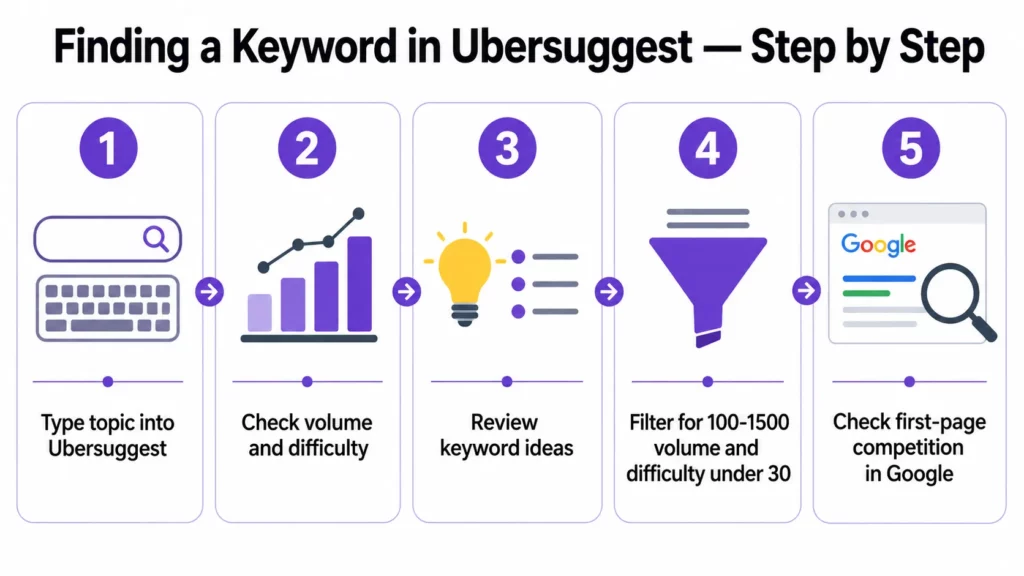
Suppose your niche is footwear and comfort for older adults. You want to write a product review. Here is how you would find a keyword to target using Ubersuggest (free):
By focusing on SEO for affiliate marketing beginners, you can create valuable content that meets the needs of searchers.
- Open Ubersuggest and type “walking shoes for wide feet” into the search bar.
- Look at the keyword overview: monthly search volume, SEO difficulty score, and paid difficulty.
- Scroll down to the keyword ideas section. You will see variations like “best walking shoes for wide feet,” “wide width walking shoes for women,” and “comfortable walking shoes for wide feet seniors.”
- Look for terms with at least 100 monthly searches and a low SEO difficulty score (under 30 for a new site). “Comfortable walking shoes for older women with wide feet” might show 200 monthly searches and an SEO difficulty of 18 — a realistic target for a new affiliate blog.
- Check what is already ranking for that term. Open a private browser window and search for the phrase in Google. If the first page is full of large retailer sites and major publications, the competition may still be too strong. If you see smaller blogs and independent review sites in the results, you have found a realistic opportunity.
That keyword becomes the focus of your post. You write a thorough review of two or three wide-fit walking shoes for older women, use the keyword naturally in your title, headings, and throughout the text, and publish a post that genuinely answers what the searcher is looking for.
Free Keyword Research Tools
Google Keyword Planner — requires a free Google Ads account, but does not require you to spend anything. Provides monthly search volume ranges and competition data directly from Google’s own data.
Ubersuggest — generous free tier with keyword volume, SEO difficulty scores, competitor analysis, and content ideas. The most beginner-friendly keyword tool available.
AnswerThePublic — shows the questions people are asking around any topic, organised visually. Excellent for finding question-based content ideas (“which walking shoes are best for plantar fasciitis?”) that match how real people search.
Google Search Console — not a keyword research tool exactly, but after you have published content, it shows you which searches are bringing people to your site. Once you have been publishing for a few months, this becomes your most valuable source of keyword intelligence.
On-Page SEO — How to Optimise a Single Blog Post
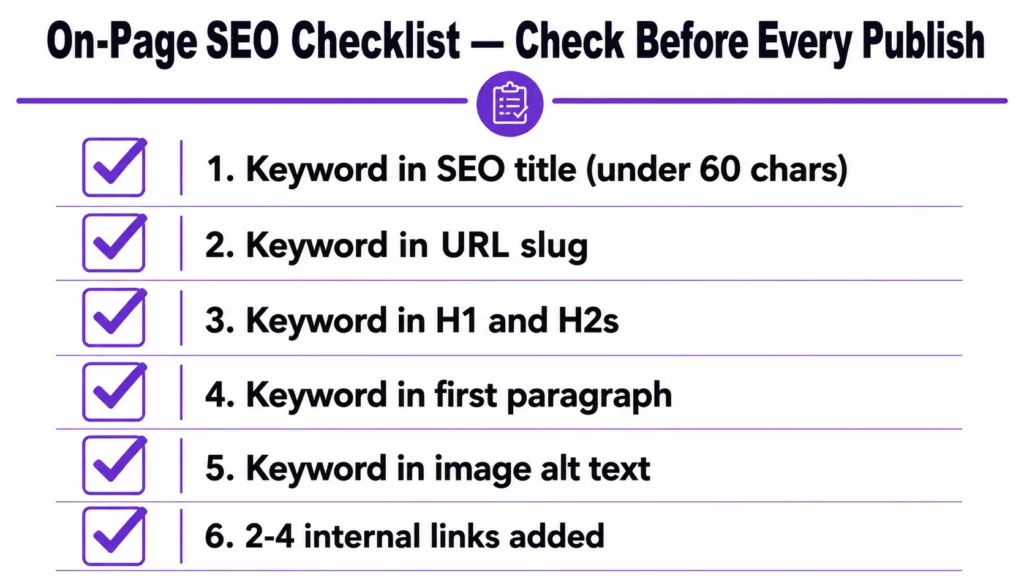
On-page SEO refers to the optimisation of individual blog posts — the things you control directly on your own page. A plugin like RankMath or Yoast SEO (both free) will guide you through these checks for every post you publish.
Apply this six-point checklist to every post before you hit publish:
1. Title tag (SEO title). Include your target keyword near the beginning of your SEO title. Keep it under 60 characters so it displays fully in Google’s search results. For a product review: “[Product Name] Review: [Key Benefit] ([Year])”.
2. URL slug. Use a short, clean URL that includes your keyword. /comfortable-walking-shoes-wide-feet-seniors is better than /post-147 or a long, hyphenated description. Once a post is published and indexed, avoid changing the URL — broken links damage both your user experience and your SEO.
3. H1 and H2 headings. Your H1 (main page title) should contain your target keyword. Your H2 subheadings should include related terms and question variations naturally — not forced repetition of the exact keyword, but relevant phrases that cover the topic thoroughly.
4. First paragraph. Include your target keyword in the first 50–100 words of the post. This signals clearly to Google what the page is about from the very beginning.
5. Image alt text. Every image you upload should have a descriptive alt text — a short text description of what the image shows. Include your keyword naturally in the alt text of your featured image. This helps Google understand your images and contributes to overall page relevance.
6. Internal links. Link to other relevant posts on your site from within the text. Internal linking helps readers find related content and helps Google understand the structure and topical focus of your site. Aim for two to four internal links per post to relevant pages you have already published.
If your RankMath or Yoast panel is showing green signals on all six of these elements, your on-page SEO is solid. Do not chase a perfect score obsessively — a good post that genuinely helps readers will always outperform a mechanically optimised post that does not.
How to Write Content Google Actually Wants to Rank
The most important thing to understand about Google’s ranking criteria is that it starts with the searcher, not the website. Google’s job is to show the searcher the most useful, relevant, and trustworthy result for their query. Your job is to be that result.
Satisfy search intent first. Before writing a word, open a private browser and search for the keyword you are targeting. Look at what Google is currently ranking on the first page. Are the results product reviews? Comparison guides? How-to articles? Step-by-step tutorials? The format that Google is already rewarding for that search is the format you should use. If the first page is full of product review articles and you write a general informational post, you are working against the algorithm rather than with it.
Cover the topic thoroughly. Thin content — posts under 800 words that skim the surface of a topic — rarely rank for competitive search terms. This does not mean padding your content with filler to hit a word count. It means covering the genuine questions your reader has about the topic, including questions they might not have explicitly asked. A review of wide-fit walking shoes should address comfort, durability, sizing accuracy, return policy, and who the shoe is not suitable for — not just list the specifications.
Update posts every 6–12 months. A post about the “best walking shoes of 2023” that has not been updated since then will gradually lose ranking to fresher content that covers 2025 and 2026 options. Set a reminder to review and refresh your most important posts at least once a year. Update the year in the title, add new product options, remove discontinued products, and check that all affiliate links still work.
For a guide to writing affiliate reviews that satisfy both readers and search engines simultaneously, read our guide on how to write affiliate product reviews that convert.
Link Building for Beginners — What It Is and How to Start
Link building is the process of earning links from other websites pointing to yours. Each link from a credible external site is a signal to Google that your content is worth recommending — and sites with more high-quality inbound links consistently outrank those with fewer.
For a new affiliate site, link building is a long game. You are unlikely to earn significant external links in your first three to six months, and that is normal. Focus first on publishing genuinely useful content. Links come more naturally as your content improves and your audience grows.
Beginner-friendly link building approaches:
Guest posts on small blogs in your niche. Writing a guest article for another blog in a related niche — not a direct competitor — earns you a link back to your site. The blog does not need to be large. A link from a genuine, relevant site is more valuable than a link from a large but unrelated one.
Being included in roundup posts. Many bloggers publish “best resources for X” or “top blogs about Y” articles. When your content genuinely deserves to be on that list, reaching out to the author to mention your post is a legitimate and effective link building approach. Focus on genuinely contributing something useful rather than simply asking to be included.
Creating genuinely useful resources. An original checklist, a comparison tool, a data-backed guide, or a genuinely comprehensive reference resource naturally attracts links from other bloggers who find it useful. The best link building strategy for a beginner is simply to publish something better and more specific than what currently exists on the topic.
What to avoid: buying links from link farms or link brokers, participating in link exchange schemes where you link to sites purely in exchange for links back, and using private blog networks (PBNs). These tactics violate Google’s Webmaster Guidelines and can result in significant ranking penalties or removal from search results entirely.
SEO Myths to Ignore
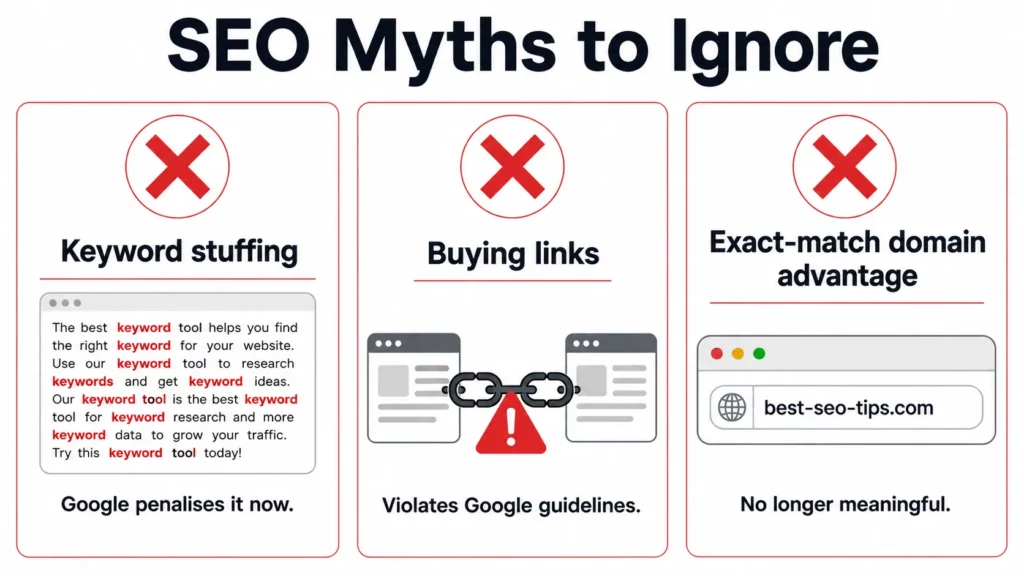
As you read more about SEO, you will encounter advice that ranges from outdated to actively harmful. Here are three myths worth dismissing immediately:
“Use your keyword as many times as possible.” Keyword stuffing — repeating a target keyword unnaturally throughout a post — was an SEO tactic in 2005. Google’s algorithms now actively penalise it. Use your keyword naturally where it fits; write for the reader, not the algorithm.
“An exact-match domain will help you rank.” Buying a domain like walking-shoes-for-wide-feet.com does not give you a meaningful ranking advantage. Domain relevance matters far less than the quality and consistency of your content.
To leverage SEO for affiliate marketing beginners effectively, ensure your content is optimized for readability and engagement.
“You need to post every day to rank.” Frequency matters less than quality and consistency. Two thorough, well-researched posts per week will outperform seven thin, rushed posts. Publish at a pace that allows you to write well.
Free SEO Tools Every Beginner Should Know
Google Search Console is the single most important free tool for any affiliate blogger. It shows you which search queries are bringing people to your site, which pages are receiving the most impressions and clicks, and any technical issues Google has detected on your site. Set it up on day one and check it weekly once you have been publishing for a month or two.
Google Keyword Planner requires a free Google Ads account, but no ad spend. It provides monthly search volume data directly from Google’s index and is the most accurate free keyword volume source available.
Ubersuggest offers keyword volume, SEO difficulty scores, competitor analysis, and content ideas in a clean, beginner-friendly interface. The free tier is generous enough for a new affiliate blogger.
AnswerThePublic maps the questions people ask around any topic, organised by question type (who, what, when, where, why, how). Excellent for finding content ideas that match real search behaviour.
RankMath or Yoast SEO (WordPress plugins, both free) — these are not external tools but on-site plugins. Install one, not both. They analyse every post you publish against on-page SEO best practices and show you clearly what to improve before you publish.
For a broader guide to the tools that support a new affiliate site across all categories — not just SEO — read our guide to the best free and low-cost tools for beginner affiliate marketers.
How Long Does SEO Actually Take?
The honest answer: longer than most people expect, and shorter than most people fear once they understand the timeline.
New sites typically begin to see meaningful organic search traffic between six and twelve months after starting to publish consistently. This is not a sign that something is wrong — it is simply how long Google takes to index, evaluate, and rank new content from a new domain.
The first three months are often almost entirely quiet. Months four through six typically bring first glimpses of traffic on your best posts. Months six through twelve are where compounding begins to be visible — older posts start climbing, and new posts rank faster because your domain has built some authority.
With persistence and the right techniques, SEO for affiliate marketing beginners can lead to long-term success.
What to do during the quiet phase: keep publishing. Do not obsess over traffic dashboards in the first three months — the data is too sparse to act on meaningfully. Focus on producing your best work consistently, applying the on-page SEO checklist to every post, and building internal links between your growing library of content.
By applying the strategies associated with SEO for affiliate marketing beginners, you can enhance your online presence.
Commit to learning and implementing SEO for affiliate marketing beginners to achieve your blogging goals.
As you progress in your understanding of SEO for affiliate marketing beginners, adapt your strategies to changing algorithms.
In summary, mastering SEO for affiliate marketing beginners will set you on a path to online success.
The one thing that reliably delays results is stopping. The affiliate blogs that fail at SEO are almost always the ones that published fifteen posts, saw minimal traffic, and gave up. The ones that succeed are the ones that kept going to post thirty, forty, fifty — at which point the compound effect becomes unmistakably real.
Frequently Asked Questions
Do I need to pay for SEO tools?
No, not at the beginner stage. Google Search Console, Google Keyword Planner, Ubersuggest’s free tier, and AnswerThePublic’s free searches are sufficient to research keywords, track performance, and optimise posts for the first twelve months of an affiliate blog. Paid tools like Ahrefs and SEMrush are powerful but unnecessary until your site is generating enough income to justify the monthly cost.
Can I do SEO myself, or do I need to hire someone?
For a beginner affiliate blog, you can absolutely do it yourself. The on-page SEO fundamentals in this guide, applied consistently, are what most professional SEO consultants do for small sites. Hiring an SEO specialist makes sense when you are scaling an established site with significant traffic — not when you are starting.
How many keywords should I use in a post?
One primary keyword per post, with naturally occurring related terms throughout. Targeting multiple competing keywords in a single post dilutes focus. Write one thorough post around one specific keyword, and create separate posts for related terms that deserve their own dedicated coverage.
What is a meta description, and does it affect rankings?
A meta description is the two-line summary that appears below your page title in Google search results. It does not directly affect where you rank — Google does not use it as a ranking signal. But it does affect whether people click on your result. A well-written meta description that accurately describes your content and includes your keyword will generate more clicks from the same ranking position, which indirectly benefits your SEO over time.
Your Next Step
The most effective way to apply everything in this guide is to open your next draft post and work through the six-point on-page SEO checklist before you publish. It takes ten minutes per post and ensures you are not leaving basic optimisation undone.
For the practical side of writing content that both readers and Google find valuable, our guide to how to write affiliate product reviews that convert covers the content craft in detail.
And for the complete picture of how SEO fits into your overall affiliate marketing strategy, the Ageless Revenue complete guide maps all the pieces together.
This post contains affiliate links. If you purchase through one of our links, we may earn a commission at no extra cost to you. We only recommend products and services we have personally assessed as genuinely useful.