

The Complete Guide to Affiliate Marketing for Retirees (2026)
The complete guide to affiliate marketing for retirees is one of the most realistic ways to build online income in retirement — even if you have no tech background, no extra money to spend, and no idea where to start.
The model itself is simple: you share products and services you genuinely believe in, and when someone buys through your link, you earn a commission. There is no inventory, no customer service calls, and no warehouse. It mostly comes down to writing genuinely helpful content and letting that content work for you over time.
This page is the central hub for everything Ageless Revenue has written on affiliate marketing — organised so you can find exactly what you need, whether you are starting from nothing or already a few months in.
Affiliate Disclosure: This post contains affiliate links. If you buy through them, I may earn a small commission at no extra cost to you.
🎁 Free: The Affiliate Marketing Starter Kit
Checklists, templates, and a calm step-by-step plan to go with every guide on this page. Get the Free Kit →
Quick Summary: What This Guide Covers
Complete Guide to Affiliate Marketing for Retirees
- How affiliate marketing works and why it suits retirees
- How to choose and validate a niche you can write about for years
- How to build your first site, create content, and join programs
- What a realistic 90-day timeline looks like
- Links to every detailed guide so you can go deeper on any step
What Is Affiliate Marketing and Why Does It Suit Retirees?
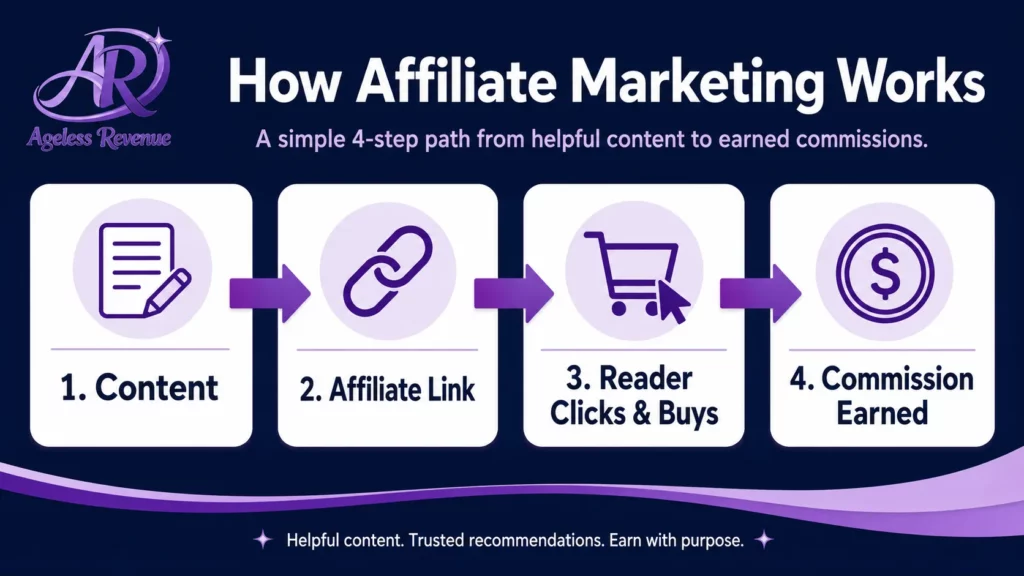
Affiliate marketing is simple at its core: you write helpful content about products or services, include a special tracked link, and when someone buys through that link, you earn a commission. The merchant handles everything else — the product, the fulfilment, the customer service.
It suits retirees particularly well for four reasons. First, you work at your own pace — there are no deadlines, no boss, and no shift requirements. Second, decades of real life experience make you a more credible recommender than most young bloggers. Third, the startup costs are low — a domain, hosting, and WordPress total roughly $15–20 per month. Fourth, the income compounds: posts you write today can earn commissions for years.
The honest caveat: affiliate marketing takes several months of consistent effort before meaningful income appears. Anyone promising fast results is not being straight with you. The retirees who build something lasting treat it like a garden — plant, water, and wait with patience.
Read Next: Getting Started With Affiliate Marketing as a Retiree — the complete beginner overview, what it costs, and a realistic timeline to your first commission.
Understanding How It Actually Works
Here is the basic flow in plain English. You publish a helpful article — a product review, a how-to guide, a comparison. Inside that article, you include affiliate links. When a reader clicks one and buys within the program’s cookie window (anywhere from 24 hours to 90 days), the sale is tracked back to you, and you receive a commission.
Commission rates vary widely. Amazon Associates pays 1–10% depending on the product category. Specialty programs often pay 15–40%. Software and subscription programs sometimes pay recurring monthly commissions as long as the customer stays subscribed — which can compound significantly over time.
You are not in sales. You are a trusted guide helping someone find the right solution. The best affiliate content never feels pushy — it feels useful.
Read Next: How Affiliate Marketing Tracking and Commissions Actually Work — a plain-English breakdown of tracking, cookies, commissions, and the players involved.
Step 1 — Choose and Validate a Niche That Fits Your Life
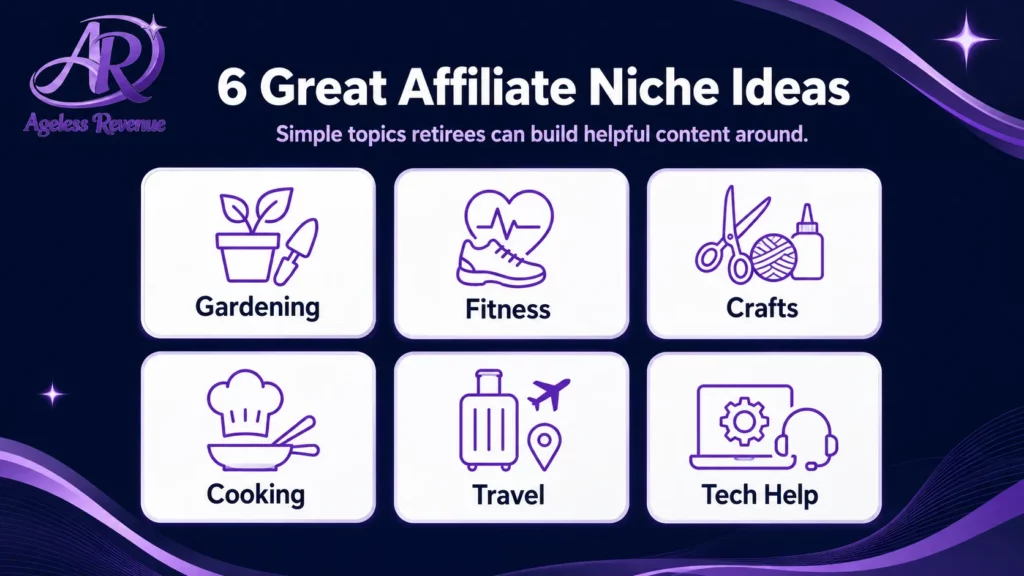
A niche is simply the main topic of your site. The best niches for retirees sit at the intersection of three things: something you know from personal experience, something people are actively searching for, and something with products or services you can honestly recommend.
Common strong niches for retirees include accessible gardening, gentle fitness for seniors, beginner crafts, simple cooking for one or two, travel comfort and mobility, home office tools, healthy aging, and helping other beginners navigate technology. The best niche is not the most profitable one — it is the one you will still want to write about in month six.
Before committing, validate your idea. Search Google for your topic. Are there existing blogs? Are there products with hundreds of reviews on Amazon? Are there affiliate programs for relevant brands? If yes to all three, you have a viable niche.
Read Next: How to Choose and Validate Your Affiliate Niche — test any niche idea in under an hour before investing months of effort.
Step 2 — Build a Simple Website You Control
Your website is your home base. Everything you build — your content, your affiliate links, your email subscribers — lives here. Unlike social media profiles that can be changed or suspended by a platform at any time, your website is yours.
You need three things: a domain name ($10–15 per year), hosting ($5–15 per month), and WordPress (free). Most beginner-friendly hosts offer one-click WordPress installation. Choose a clean, lightweight theme — GeneratePress is excellent and is what Ageless Revenue uses. Then create your essential pages: About, Contact, and Affiliate Disclosure.
Do not try to make it perfect before publishing. A simple, clean site with three helpful posts is better than a beautifully designed site with nothing on it. You can improve the design later. Content is what brings readers and commissions.
Read Next: How to Build Your First Affiliate Website — domain, hosting, WordPress, theme, and essential pages, a calm walkthrough for complete beginners.
Step 3 — Write Content That Earns Trust
Content is the engine of an affiliate blog. Your articles help readers make decisions — which product to buy, which approach to take, which tool to use. When you help someone make a good decision, they trust you. When they trust you, they click your links and buy.
The three most effective content types for affiliate bloggers are product reviews (honest, specific, including who the product is not for), comparison articles (A vs B, with clear differences), and how-to guides (step-by-step, with the tools needed mentioned naturally along the way).
Write in short paragraphs. Use subheadings. Add a clear recommendation — readers need to know what you actually suggest, not just a list of options. And always include your affiliate disclosure near the top of every post. Transparency builds trust rather than breaking it.
Read Next: How to Write Affiliate Product Reviews That Actually Convert — structure, honesty, and the specific details that earn reader trust and clicks.
Step 4 — Join Affiliate Programs and Add Your Links
Once you have two or three posts published, you are ready to apply to affiliate programs. Most programs only require that you have a live website with genuine content and a completed About page — they are not looking for thousands of visitors.
Start with Amazon Associates — it is the easiest to get approved for and gives you access to millions of products immediately. Add one affiliate network, such as ShareASale or Impact, which lets you apply to hundreds of brand programs from a single account. As your traffic grows, add specialty programs with higher commission rates.
Place links where they feel natural — near a product name, inside a recommendation box, and once near the conclusion. Use ThirstyAffiliates or Pretty Links to manage your links from one place, making them easy to update if a program changes its URLs.
Read Next: Best Affiliate Programs for Beginners (No Blog Needed) — what to apply to first and how approval actually works.
What a Realistic 90-Day Timeline Looks Like
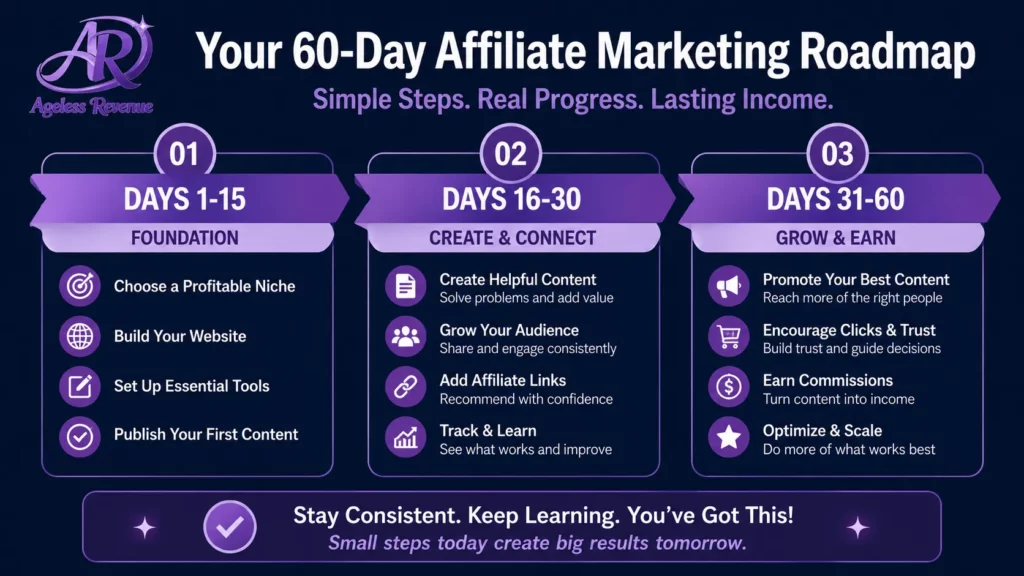
Most consistent beginners see their first affiliate clicks within two to four weeks of publishing and their first commission within one to three months. Building a reliable monthly income typically takes six to twelve months of consistent publishing.
Days 1–15: Choose niche, set up site, publish first 3 posts. Days 16–30: Apply to programs, add links, and first Pinterest pins. Days 31–60: Publish weekly, improve content, first clicks appear
Read Next: How Affiliate Blog Monetization Actually Works — a realistic, honest look at the income timeline and how to know if you are on track.
Do You Need a Training Platform to Get Started?
You can learn affiliate marketing by piecing together free resources — YouTube videos, blog posts, and trial and error. Many people do. But for retirees who want a structured path with support built in, a training platform can save months of confusion.
The platform I recommend to retirees is Wealthy Affiliate. It combines step-by-step training, website hosting, a keyword research tool, and a supportive community of over 2 million members — all in one place. There is a free starter account that lets you try before committing to anything paid.
It is not the only option, and it is not right for everyone. But if you want structure, guidance, and community rather than building everything from scratch alone, it is worth exploring.
★ Gila Recommends: Wealthy Affiliate Review 2026: Honest Pros, Cons & Pricing — my full honest review, what it does well, what it does not, and whether it is worth the cost.
Common Mistakes and How to Avoid Them
The most common mistake among new affiliate bloggers is trying to do too many things at once — five different tools, three different traffic sources, constant niche-switching. Simpler is almost always better, especially in the first six months.
Other frequent mistakes include choosing a niche purely for profit without genuine interest (which leads to burnout), hiding the affiliate disclosure at the bottom of posts (which risks FTC compliance and reader trust), adding links before building enough content to get approved by programs, and stopping after a few weeks because there is no income yet.
The retirees who succeed at affiliate marketing are not the ones who move fastest. They are the ones who keep showing up consistently month after month, improving a little each week.
Read Next: Affiliate Marketing Mistakes: 10 Costly Errors Beginners Must Avoid — a practical checklist of exactly what to sidestep.
All Guides in This Series
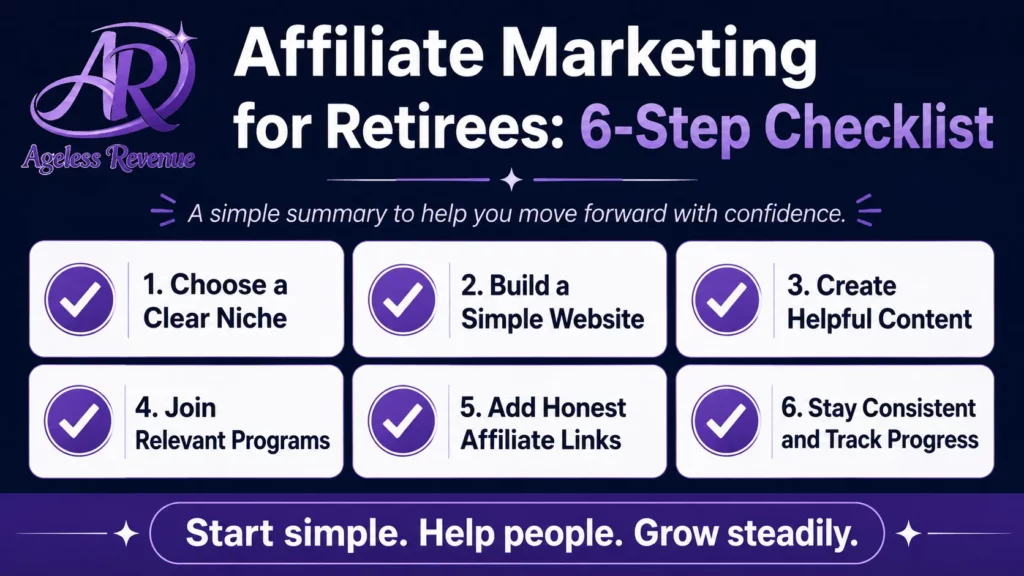
Use this list as your roadmap. Work through them in order if you are starting from zero, or jump to whichever section matches where you are right now.
Getting Started
- Getting Started With Affiliate Marketing as a Retiree — complete beginner overview + realistic timeline
- What Affiliate Marketing Actually Is — How Tracking and Commissions Work — plain-English mechanics
- Affiliate Marketing Strategy: The Complete Guide for Retirees Who Want to Build It Right — the thinking behind the decisions, not just the steps
- Starting Affiliate Marketing With No Experience: Your 14-Day Action Plan
- Affiliate Marketing Starter Kit for Beginners
- From “What’s a Niche?” to First Sale: A 90-Day Step-by-Step Guide
Niche & Planning
- How to Choose and Validate Your Affiliate Niche
- How to Validate Your Online Business Idea
- Online Business Plan for Retirees (full guide) or the simple 1-page template if you want the quick version
Website
- How to Build Your First Affiliate Website — domain, hosting, WordPress, step-by-step
Content & Programs
- How to Write Affiliate Product Reviews That Actually Convert
- Best Affiliate Programs for Beginners (No Blog Needed)
- Best Passive Income Affiliate Programs for Retirees Over 60
- Affiliate Marketing Without a Blog — 7 Channels That Actually Work
Mistakes & Income
- Affiliate Marketing Mistakes: 10 Costly Errors Beginners Must Avoid
- How Affiliate Blog Monetization Actually Works
Frequently Asked Questions
Is affiliate marketing too late to start after 60?
No. Age is an advantage in affiliate marketing, not a barrier. Readers trust recommendations from people who have genuine life experience. A 65-year-old writing about accessible gardening, healthy cooking for two, or technology that actually helps older adults has far more credibility than a 25-year-old writing about the same topics. The only thing that matters is consistency and helpfulness.
How much does it cost to start?
The main costs are a domain name ($10–15 per year) and hosting ($5–15 per month). WordPress, Canva for graphics, ChatGPT for writing assistance, and MailerLite for email are all free to start. Total monthly cost for a professional affiliate blog: approximately $15–20 per month.
Do I need technical skills?
No coding is required. WordPress handles the technical side through a simple visual editor. Canva is drag-and-drop. Most beginner retirees feel comfortable with the basics within a few weeks. The learning curve is real but not steep — patience and a willingness to follow clear steps are all you need.
What is the difference between affiliate marketing and MLM?
Affiliate marketing and multi-level marketing are fundamentally different. With affiliate marketing, you earn a commission by recommending other companies’ products to readers. There is no recruitment, no downline, and no requirement to purchase or stock anything yourself. Affiliate marketing is a legitimate business model used by millions of bloggers worldwide — it is not MLM.
Ready to Take Your First Step?
Download the free Starter Kit — checklists, templates, and a calm plan that matches every guide on this page. Download Free Starter Kit →
Or Start Free with Wealthy Affiliate →
This post contains affiliate links. If you buy through them, I may earn a small commission at no extra cost to you.