

How Affiliate Marketing Tracking and Commissions Actually Work (Plain-English Guide)
You have probably heard the phrase “affiliate marketing” and thought you understood it — recommend a product, someone buys it, you earn money. Simple enough. But when you actually sign up for your first affiliate program and start placing links, questions appear fast, especially regarding how affiliate marketing tracking and commissions work.
Understanding how affiliate marketing tracking and commissions work is crucial for success in this field.
How does the company know the sale came from you? What happens if someone clicks your link on Monday but only buys on Thursday? Why did one of your clicks earn a commission and another identical click did not? What is the difference between a cookie and a tracking ID? Why does Amazon pay different percentages for different product types?
By mastering how affiliate marketing tracking and commissions work, you can enhance your strategy and drive more sales.
This guide answers all of those questions. It is specifically about the mechanics — how the tracking, attribution, cookie windows, commission structures, and payment systems actually work underneath the surface. Understanding this will make you a significantly better affiliate marketer because you will stop guessing and start making deliberate decisions.
If you are brand new and want the big-picture overview first — what affiliate marketing is, how to choose a niche, and how to get started — read Getting Started With Affiliate Marketing as a Retiree before this article. Come back here once you are ready to understand exactly how the money flows.
Affiliate disclosure: This post contains affiliate links. If you buy through them, I may earn a small commission at no extra cost to you.
TL;DR
Understanding How Affiliate Marketing Tracking and Commissions Work
- When someone clicks your affiliate link, a unique tracking ID is stored on their device — usually as a cookie — so the program knows to credit you if they buy
- Every program has a cookie window (anywhere from 24 hours to 90 days or more) — purchases must happen within this window to count as your commission
- Commission structures vary widely: percentage of sale, flat fee per sale, per lead, or per free trial. Understanding these helps you pick the right programs
- Affiliate networks (like ShareASale, Impact, and CJ) act as middlemen between you and hundreds of brands — one account, many programs, centralised payments
- Most programs pay monthly, on a net-30 or net-60 basis, after a returns window has passed
- EPC (earnings per click) is the most useful number to track — it tells you how well a particular program converts your traffic into income
How the Click-to-Commission Chain Works
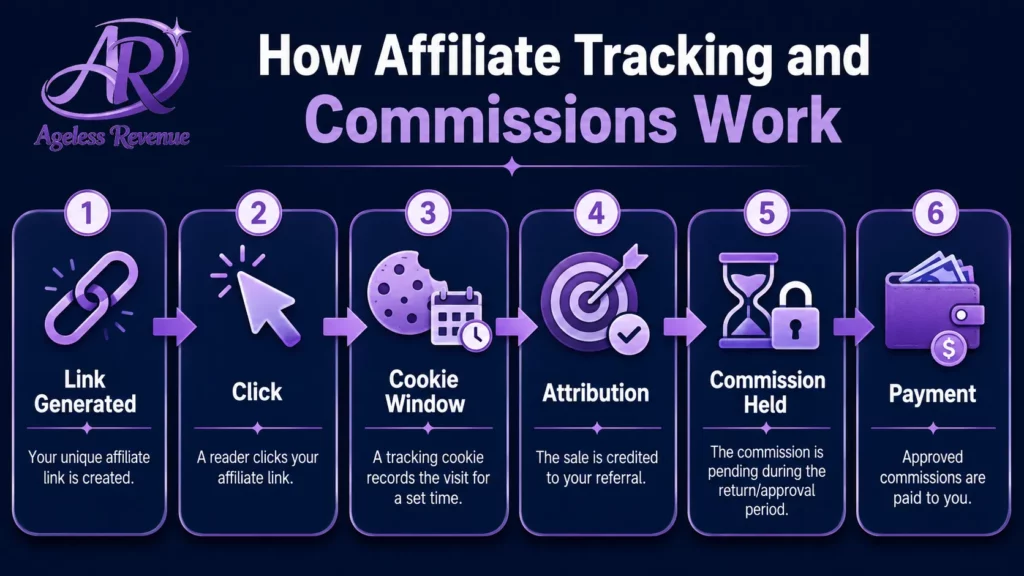
Every affiliate sale follows the same chain of events. Understanding each step helps you troubleshoot why some clicks convert and others do not.
Step 1 — Your affiliate link is generated. When you join an affiliate program, you are assigned a unique affiliate ID — a short code that identifies you within that program. Every link you create for that program includes this ID embedded in the URL. For example, a standard Amazon Associates link looks something like this: amazon.com/dp/B0XXXXXXX?tag=yourid-20. The tag=yourid-20 part is your affiliate ID. Every time that link is clicked, Amazon’s system reads that tag and knows to associate that visit with your account.
Step 2 — Your reader clicks the link. When a reader clicks your affiliate link, they are taken to the product page on the merchant’s website. At the same moment, the merchant’s tracking system does two things: it records the visit as coming from your affiliate ID, and it stores a small file called a cookie on the reader’s browser. That cookie is a tiny piece of data that sits quietly on the reader’s device and essentially says “this person arrived here through affiliate ID yourid-20.” It stays there until it expires or is manually deleted.
Step 3 — The cookie window begins. Every program sets a cookie window — also called the attribution window or cookie duration. This is the period during which a purchase must happen for you to receive credit. If the program has a 30-day cookie window and your reader buys on day 15, you earn the commission. If they buy on day 31, the cookie has expired, and you earn nothing from that sale, even though you were the one who introduced them to the product.
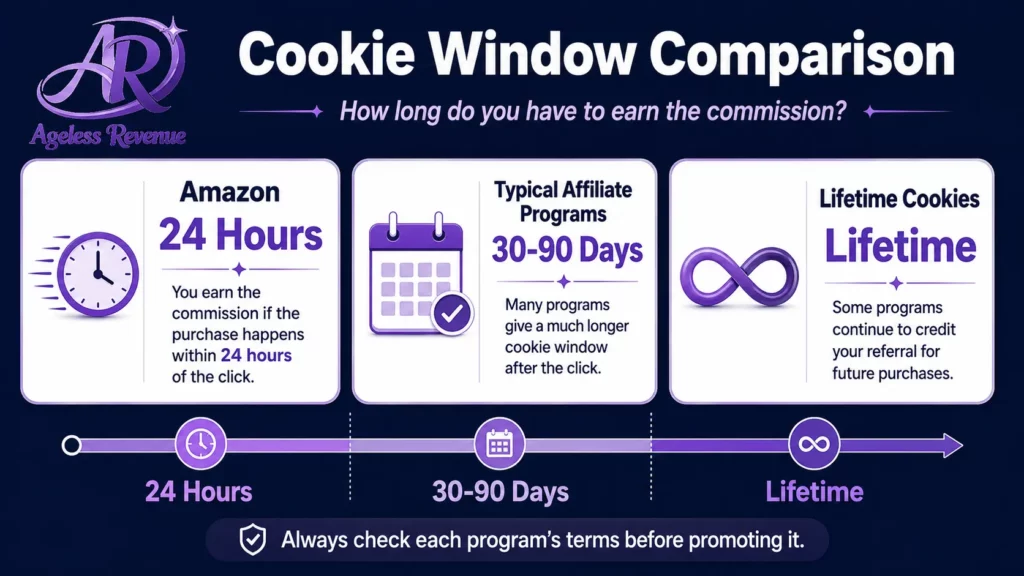
Cookie windows vary enormously between programs. Amazon Associates has a 24-hour window for most products — one of the shortest in the industry. Many other programs offer 30, 60, or 90-day windows. Some specialty programs offer lifetime cookies, meaning you earn a commission any time that customer ever buys, even months or years later. This is one of the most important numbers to check when evaluating a new affiliate program. A program paying 5% commission with a 90-day window will often outperform one paying 10% with a 24-hour window, because more of your referred visitors have time to make their decision.
Step 4 — The purchase is attributed. When your reader completes a purchase, the merchant’s system checks whether an active affiliate cookie exists on their browser. If it does, the sale is attributed to the affiliate whose ID is recorded in that cookie — which is you.
There are a few situations that can disrupt attribution. If your reader clears their browser cookies between clicking your link and buying, the tracking is lost. If they use a different browser or device to complete the purchase, the cookie from the original browser does not carry across. If another affiliate’s link is clicked after yours, some programs will credit the last click (known as last-click attribution) rather than yours.
Most major programs use last-click attribution, which means if your reader clicks your link on Monday but then clicks a competitor affiliate’s link on Wednesday and buys on Wednesday, the other affiliate gets the commission. This is the most common reason affiliates lose sales they should have earned. It is not something you can control directly, but knowing about it helps you understand your analytics.
Step 5 — The commission is recorded and held. Once a sale is attributed to you, the commission is recorded in your affiliate dashboard as a pending earning. It does not become payable immediately. Most programs hold commissions for a returns period — typically 30 to 60 days — to account for the possibility that the customer returns the product. If a return happens during this window, the commission is reversed. After the returns window closes, the commission is marked as locked and added to your upcoming payment.
Step 6 — Payment is issued. Most programs pay on a net-30 or net-60 basis — meaning commissions earned in one month are paid 30 or 60 days after the end of that month. Most programs have a minimum payment threshold (commonly $10 to $100) that you must reach before a payment is issued. Payment methods typically include direct bank transfer, PayPal, or cheque.
Cookie Types — What Is Actually Tracking You
Not all affiliate tracking uses traditional browser cookies. Understanding the different methods helps you know why tracking can sometimes fail.
Browser cookies (most common). The standard method. A small file is stored in your reader’s browser. Works reliably as long as the reader uses the same browser and device and has not cleared their cookies. This is how Amazon Associates, ShareASale, Impact, and most major programs track.
URL parameter tracking. Some programs embed your affiliate ID directly in the URL and pass it through the checkout process without relying on cookies. This is more reliable in some circumstances but depends on the merchant’s checkout system preserving the parameter throughout the purchase.
First-party cookies. Increasingly, programs are moving to first-party cookies set by the merchant’s own domain rather than third-party cookies. These are less likely to be blocked by browser privacy settings, which is important as browsers continue to restrict third-party cookie tracking.
Server-side tracking. More sophisticated programs use server-to-server tracking that does not depend on the reader’s browser at all. The tracking happens at the infrastructure level, making it highly reliable. This is common in premium affiliate networks.
Commission Structures Explained
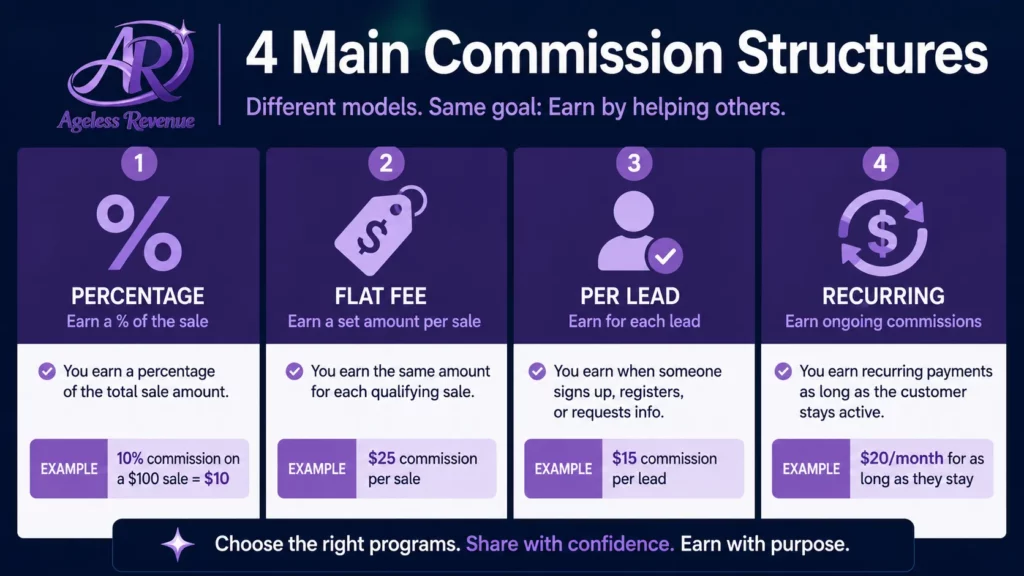
Not all affiliate programs pay the same way. Knowing the different structures helps you calculate which programs are actually worth your time.
Percentage of sales (most common). You earn a fixed percentage of whatever the customer pays. Amazon Associates pays between 1% and 10%, depending on the product category. Many direct brand programs pay 10% to 30%. Wealthy Affiliate and other recurring subscription programs can pay up to 50% or more.
The key variable is not just the percentage but the average order value. A 3% commission on a $200 product earns you $6. A 20% commission on a $15 product earns you $3. The percentage headline number is only half the story.
Flat fee per sale. You earn a fixed dollar amount regardless of the purchase price. Common in software, SaaS tools, and online courses. For example, a program might pay $50 flat for every customer you refer regardless of which pricing plan they choose.
Per lead or per action. You earn a commission when a referred visitor takes a specific action — filling in a form, starting a free trial, or submitting an email address — even without making a purchase. These programs are called CPA (cost per action) programs. They often convert at a higher rate than purchase-based programs because the barrier for the reader is lower.
Recurring commissions. Some programs — particularly software subscriptions and membership platforms — pay you a commission every month for as long as the customer you referred continues to pay. These are the most valuable commission structures for building a long-term income, because one referral can generate commissions for months or years.
Wealthy Affiliate’s affiliate program works this way, which is one of the reasons it is a strong recommendation for retiree bloggers building sustainable income. You can read my full Wealthy Affiliate review for the complete breakdown of pricing and commissions.
Affiliate Networks vs Direct Programs
When you are building your affiliate portfolio, you will encounter two types of programs: those run directly by brands and those hosted on affiliate networks. Understanding the difference helps you manage your links and payments more efficiently.
Direct programs. The brand runs its own affiliate program in-house. You apply directly on their website, get links directly from them, and are paid directly by them. Amazon Associates is the most well-known example. Some direct programs have highly competitive terms because there is no network fee. The downside is that you need separate logins and payment arrangements for every program you join.
Affiliate networks. A network acts as a middleman between affiliates and multiple brands. You create one account on the network, then apply to individual brand programs within it. Your clicks, commissions, and payments from all those brands are centralised in one dashboard. The major networks worth knowing as a retiree blogger are ShareASale (broad range of niches, beginner-friendly interface), Impact (used by many premium brands, strong tracking), CJ Affiliate (formerly Commission Junction, one of the oldest networks), and Rakuten Advertising. Joining one or two of these alongside Amazon Associates covers the vast majority of products you might want to recommend.
Which to use when. Start with Amazon Associates for the broad product catalogue — it is the easiest approval to get and your readers already trust the brand. Then join one network (ShareASale or Impact are both beginner-friendly) and apply to two or three brands in your niche. This gives you enough variety without being overwhelming.
Reading Your Affiliate Dashboard
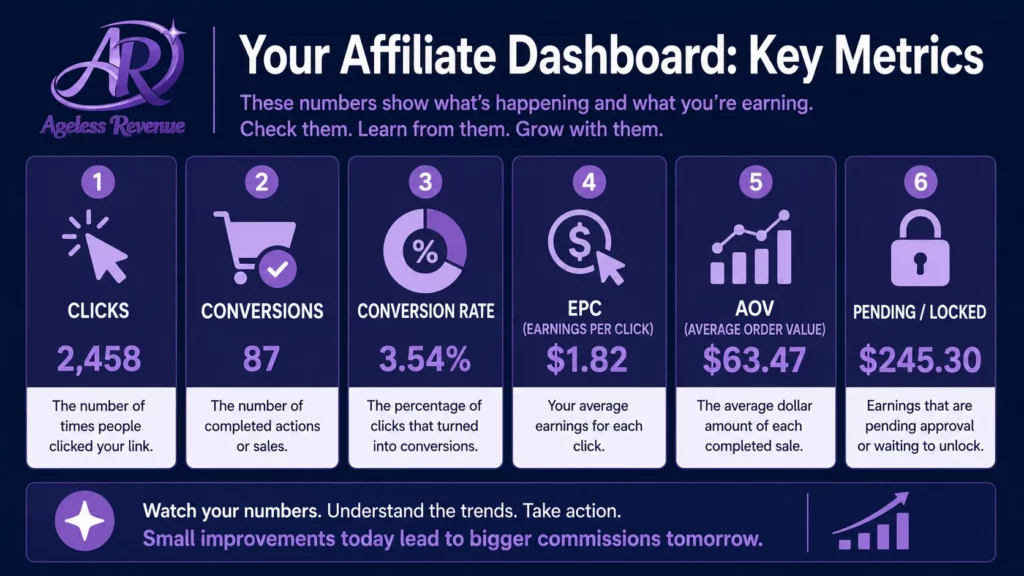
Once you are live and generating clicks, your affiliate dashboard becomes your most important tool. Here are the key numbers and what they mean.
Clicks. The number of times your affiliate links have been clicked. This tells you how much raw traffic you are sending to merchant sites. If clicks are low, the issue is usually in your content — either not enough traffic to your blog, or your links are not prominent or compelling enough.
Conversions. The number of clicks that resulted in a tracked purchase. If you have many clicks but few conversions, the issue is usually on the merchant side (price, product quality, landing page) or in your audience targeting (sending the wrong readers to the offer).
Conversion rate. Conversions divided by clicks, expressed as a percentage. A healthy affiliate conversion rate varies by niche and product type, but anything between 1% and 5% is generally considered reasonable. Very high-converting offers can reach 10% or more.
EPC (earnings per click). Your total earnings divided by your total clicks. This is the single most useful number for comparing performance across programs. If Program A earns you $0.50 EPC and Program B earns $0.08 EPC for similar audiences, you should prioritise Program A. EPC accounts for both conversion rate and commission amount in a single comparable figure.
Average order value (AOV). The average amount customers spend per transaction. Higher AOV means your percentage commissions translate into larger dollar amounts per sale.
Pending vs locked earnings. Pending commissions are within the returns window and can still be reversed. Locked commissions have passed the returns window and are confirmed for your next payment.
Why Some Clicks Do Not Earn Commissions
This is one of the most frustrating experiences for new affiliates: a click happens, but no commission follows. The most common causes are an expired cookie window, the reader clearing their cookies before purchasing, last-click attribution crediting a different affiliate, an ad blocker preventing the tracking script from loading, or the customer returning the product within the returns window.
None of these mean your content failed. They are simply part of how the tracking infrastructure works, and understanding them prevents you from misreading your own performance.
Frequently Asked Questions
Why didn’t I get a commission even though someone clicked my link?
The most common reasons are an expired cookie window, the cookie being cleared before purchase, last-click attribution crediting a different affiliate who was clicked more recently, or an ad blocker preventing the tracking from registering at all.
What is a cookie window and why does it matter?
A cookie window is the period during which a purchase must happen for you to receive credit for referring that customer. It ranges from 24 hours (Amazon Associates) to 90 days or more depending on the program. A longer cookie window generally means more of your referred visitors have time to convert.
What is EPC and why should I track it?
EPC stands for earnings per click — your total earnings divided by total clicks for a given program. It is the most useful single number for comparing which affiliate programs are actually worth your time, because it accounts for both commission rate and conversion rate together.
Should I join an affiliate network or apply directly to brands?
Start with Amazon Associates directly, since it covers the broadest range of products with the easiest approval. Then join one affiliate network like ShareASale or Impact to access multiple brand programs through a single account and dashboard.
Your Next Step
Once you understand how tracking and commissions actually work, review your current affiliate links and check the cookie window for each program you have joined. Programs with longer cookie windows and recurring commission structures are generally worth prioritising in your content.
For a complete breakdown of one recurring-commission program worth considering, read my Wealthy Affiliate review, or start free with Wealthy Affiliate →
This post contains affiliate links. If you buy through them, I may earn a small commission at no extra cost to you.
Gila, I love the home page and your Table of Contents. You are providing lots of information to site visitors. The progress infographic stands out very well and is very eye-catching with the colors. The step-by-step guide is very useful and will help your visitors learn a lot about affiliate marketing. Your steps to keep in mind are good ones for beginning affiliate marketers. Your use of colorful and informative infographics is great. I really like your site and it looks full of good helpful information. Best wishes. – Shirley
Hi Shirley,
Thank you so much for your kind words and thoughtful feedback! I’m really glad you enjoyed the layout and found the Table of Contents and infographics helpful—those elements were designed to make the learning process as clear and engaging as possible, especially for those just starting out with affiliate marketing.
It means a lot to hear that the step-by-step guide and tips resonated with you. I truly want this site to be a supportive and informative space for beginners, so your encouragement really keeps me motivated.
Wishing you all the best on your own journey, and thanks again for taking the time to share your thoughts!
Warmly,
Gila
Hello Gila!
I absolutely loved this clear and approachable breakdown of affiliate marketing! As someone who has tried their hand at it and stumbled numerous amounts of time, I really appreciated how you explained everything without all the complicated jargon. It can be so overwhelming when you’re first starting out, but your article makes it feel totally doable.
I especially liked your use of real-world examples — I can see how it would really help out others visualize how affiliate marketing fits into everyday online behavior. Have you found one type of affiliate product or niche to be more beginner-friendly than others? And what would you say is the most common mistake new affiliates make when starting out?
Thanks for sharing this helpful and encouraging guide!
Angela M 🙂
Hi Angela,
Thank you so much for your kind words! I’m thrilled to hear that you found the breakdown helpful and easy to follow. It can definitely feel overwhelming at first, so I’m glad the article made things seem more approachable. I always try to keep things simple and relatable, especially with real-world examples, so I’m happy that resonated with you!
As for your questions, when it comes to beginner-friendly niches, I’d say areas like personal finance, health, and lifestyle are often great starting points. These niches have a large audience and plenty of products to promote, plus there’s a lot of information available to help you learn. But the key is finding something you’re genuinely interested in—your passion will come through in your content!
The most common mistake I see new affiliates make is not choosing a niche or product that aligns with their audience’s needs or interests. They might pick something purely for its profitability without thinking about whether it connects with the audience they’re trying to reach.
Thanks again for the thoughtful comment, Angela! I’m excited to see you on your affiliate marketing journey. Let me know if you ever need more tips or help along the way!
Best,
Gila