
Last Updated on 4 months ago by Gila
Keyword research is the heartbeat of effective SEO. It’s the essential foundational step that dictates your entire content strategy, ensuring that every piece of content you create acts as a magnet for your ideal audience. It is the disciplined process of identifying the exact words, phrases, and questions people type into search engines when seeking the products, services, or information you provide.
Whether you’re a burgeoning blogger or a CMO overseeing a large digital strategy, mastering this concept is non-negotiable for driving the right, high-value traffic to your site. Without solid keyword research, your SEO efforts are akin to firing arrows in the dark—you might hit something, but success will be accidental and impossible to scale.
TL;DR: Keyword research is the roadmap of your SEO. Focus on search intent, realistic competition, and high-value long-tail topics instead of chasing every big, shiny keyword.
- Start with seed ideas from your niche, audience problems, and real phrases people already use.
- Use tools (like Jaaxy, Semrush, or Ahrefs) to check volume, difficulty/QSR, and commercial value.
- Filter by search intent so each keyword is matched with the right content type and depth.
- Look for long-tail phrases with clear intent and manageable competition for quicker, safer wins.
- Map each primary keyword to one URL, with supporting “cluster” posts to avoid cannibalization.
- Revisit your keyword set regularly as rankings, competition, and search behavior change over time.
The Power of Focus: The 80/20 Rule in SEO
The Pareto Principle, or the 80/20 rule, holds profound relevance here: 80% of your SEO success may stem from focusing your effort on the 20% of keywords that truly matter. These are not necessarily the terms with the highest search volume, but rather the terms that promise the highest conversion rate, the most relevant traffic, and the quickest path to ranking success.
Your success hinges directly on the terms you choose to target. Choosing the wrong keywords—those with massive volume but low relevance, or high difficulty and no immediate business value—can drain resources and yield poor results. Strategic keyword research sets the stage for a cohesive, profitable plan that aligns with your wider business goals and keeps your site on the search engines’ good side.
Aligning Keyword Strategy with E-E-A-T
Modern search engines, especially Google, heavily prioritize content that demonstrates E-E-A-T: Experience, Expertise, Authoritativeness, and Trustworthiness. Your keyword strategy must be built with these principles in mind.
- Experience & Expertise: When you target niche, complex, or highly specific long-tail keywords, you signal that you possess deep knowledge in a specific subject, validating your expertise.
- Authoritativeness: Ranking for important, mid-to-high-difficulty keywords and earning links for them confirms your authoritativeness in your industry.
- Trustworthiness: Targeting YMYL (Your Money or Your Life) keywords requires exceptional E-E-A-T, proven through clear authorship, factual accuracy, and reliable sourcing.
Aligning your chosen keywords with topics where you can genuinely demonstrate superior E-E-A-T encourages search engines to see your content as credible and valuable.
Key Concepts: Principles and Tools for Effective Research
To successfully navigate the world of keywords, you must understand the underlying principles and utilize the correct tools.
The Three C’s of Modern Keyword Research
Keyword research must move beyond simple volume and competition metrics to focus on holistic content creation:
- Content: The actual resource (blog post, video, product page) that you create. It must be 10x better than the competition.
- Context: This refers to Search Intent. Why did the user type the keyword? Is it to buy something, learn something, or navigate to a specific site? The content must match the intent.
- Connections: The ecosystem surrounding the content, including internal links, backlinks (covered in your first pillar article), and social shares, which elevate the authority of your content.
Without the proper context and connections, even the highest-quality content might get lost on the vast internet.

Once you understand the “big picture” of keyword research, the next step is turning those keywords into helpful content.
- Affiliate Marketing 101 for Retirees: Step-by-Step Guide – See how clear, beginner-friendly content can be built around well-chosen keywords.
- How to Create Engaging Content That Converts for Affiliate Sales – Turn keyword ideas into articles that actually earn clicks and commissions.
- Best AI Tools for Blogging: Boost Efficiency, SEO and Engagement – Use AI tools to speed up research, outlining, and optimization without losing your voice.
Essential Tools of the Trade: Featuring Jaaxy
Reliable tools are your eyes and ears in the digital marketplace, helping you move beyond guesswork. While robust platforms like Semrush and Ahrefs offer comprehensive data, specialized tools like Jaaxy are exceptional for targeted research, especially for those in affiliate or niche marketing.
| Tool Category | Tool Examples | Core Function in Keyword Research |
| Niche & Affiliate Focus | Jaaxy | Rapidly identifying high-traffic, low-competition keywords (QSR) and assessing niche opportunities. Ideal for finding profitable, long-tail terms quickly. |
| All-in-One Platforms | Semrush, Ahrefs, Moz Pro | Comprehensive analysis of keyword difficulty, search volume, competitor rankings, and organic traffic value. Essential for data-driven decisions. |
| Free Tools | Google Keyword Planner, Google Search Console | Planner provides ad-focused volume estimates. Search Console shows keywords you already rank for and your current organic performance. |
| Idea Generation | Google Search (Autosuggest & PAA), AnswerThePublic | Uncovering related queries, long-tail questions, and user intent insights directly from Google’s suggestions and ‘People Also Ask’ (PAA) boxes. |
Spotlight on Jaaxy (Wealthy Affiliate Tool)
Jaaxy distinguishes itself by providing fast, actionable metrics focused on finding “Quick Wins.” Its core function relies on calculating the Quoted Search Results (QSR), which tells you the exact number of competing websites ranking for that keyword. This metric is often easier for beginners and niche site owners to use than the complex difficulty scores of larger tools.
A core strategy using Jaaxy is to prioritize keywords with:
- High Traffic: Monthly search volume above 50.
- Low Competition (QSR): A QSR below 100 often indicates a great opportunity to rank quickly, particularly for long-tail phrases.
By focusing on these metrics, Jaaxy helps you avoid high-difficulty battles and identify overlooked keywords that contribute to rapid traffic growth and demonstrate niche expertise, fulfilling the Expertise component of E-E-A-T.
Using Jaaxy through Wealthy Affiliate and want a calm, guided way to put those keywords to work?
- Wealthy Affiliate Review 2025: Tools, Training & Community for Retirees – See exactly how WA, Jaaxy, and the website tools fit together for beginners.
- Getting Started with Wealthy Affiliate: Beginner’s Guide – Follow a step-by-step path to turn keyword ideas into a real site.
- From “What’s a Niche?” to First Sale: My 90-Day Beginner Success Story – See how consistent keyword-driven content can lead to that first affiliate commission.
Understanding Search Intent: The Ultimate Filter
The single most critical concept in modern keyword research is Search Intent. It asks: What is the user trying to achieve?
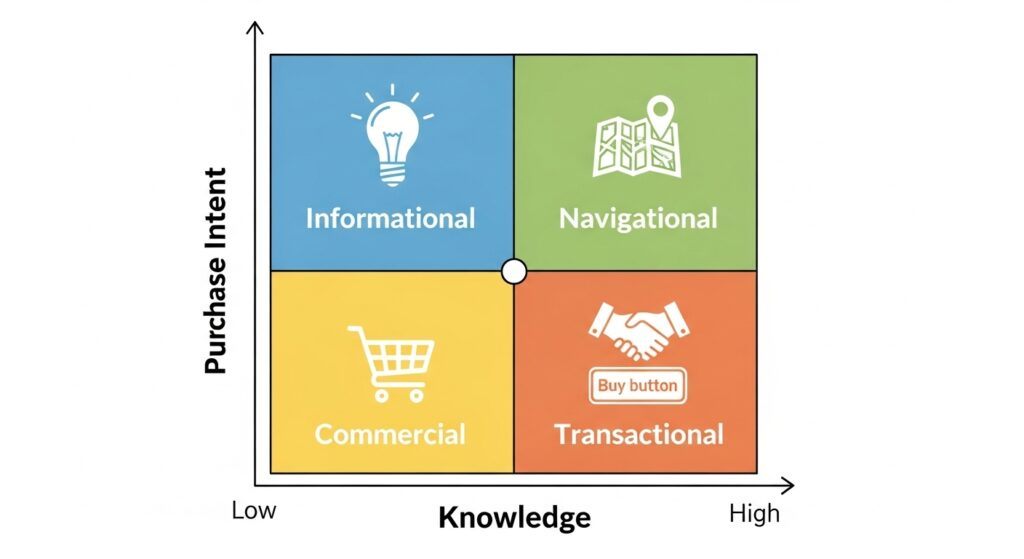
There are four primary categories of search intent:
- Informational: The user is seeking knowledge or answers (“How to conduct keyword research,” “What is E-E-A-T?”).
- Content Match: Blog posts, guides, tutorials, resource pages.
- Navigational: The user is trying to get to a specific website or location (“HubSpot keyword tool,” “Amazon login”).
- Content Match: The homepage or a specific branded page.
- Commercial Investigation: The user is researching products or services before buying (“Best SEO software 2025,” “Semrush vs. Ahrefs review”).
- Content Match: Product reviews, comparison articles, detailed buyer guides.
- Transactional: The user is ready to buy or take immediate action (“Buy keyword research guide,” “SEO course discount”).
- Content Match: Product pages, pricing pages, sign-up forms.
Maximum SEO Impact is achieved when your content’s format and structure perfectly align with the determined search intent of the targeted keyword.
Step-by-Step Guide: Conducting Impactful Keyword Research
Conducting effective keyword research is a systematic process. By following these steps, you ensure you capture both high-volume opportunities and high-converting niche terms.
Phase 1: Brainstorming and Seed List Generation
Finding the right keywords starts with aligning them to your specific SEO and business goals.
- Define Your Niche and Offerings: Start with a broad list of “seed” terms related to your core products, services, or topics. (Example: For a bakery, seed terms are bread, sourdough, baking classes, gluten-free).
- Think Like Your Audience (Empathy Mapping): What problem does your audience need solving? Focus on pain points rather than features. (Example: Instead of targeting online SEO tool, target how to rank higher on Google).
- Utilize Google Suggest and PAA: Type your seed keywords into Google and record the autosuggestions and the “People Also Ask” questions. These are real, high-volume queries.
Phase 2: Data Gathering and Analysis
Move the brainstormed list into your SEO tool (Semrush, Ahrefs, Jaaxy, etc.) to apply quantifiable metrics.
- Analyze Key Metrics: For each keyword, gather the following:
- Search Volume (SV): The average number of monthly searches.
- Keyword Difficulty (KD) / QSR: Use the appropriate competition metric. Jaaxy’s QSR is particularly useful here for quickly filtering out phrases that are too competitive.
- Cost Per Click (CPC): (Even for organic) This indicates the commercial value of the keyword.
- Filter by Intent: Crucially, determine the search intent. Discard or deprioritize keywords whose intent you cannot fulfill effectively.
- Identify Long-Tail Opportunities: Look for longer, more specific phrases (4+ words) that usually have lower volume but much higher conversion rates due to clear, niche intent. Jaaxy is specifically designed to rapidly find these high-converting, low-QSR long-tail keywords. (Example: best yeast for no-knead sourdough bread).
Phase 3: Competitive Landscape Analysis
You can’t choose the right battlegrounds without knowing your enemy.
- Identify Top Competitors: Find 3–5 websites that consistently rank on Page 1 for your most important seed keywords.
- Reverse Engineer Their Backlinks: Use your SEO tool to see the keywords for which your competitors are gaining the most organic traffic and ranking well.
- The “Keyword Gap” Strategy: Use the Gap Analysis feature in your tool to identify keywords where your competitors rank highly, but you don’t rank at all. These represent immediate opportunities to steal traffic.
- Evaluate SERP Landscape: For the keywords you plan to target, manually examine the Search Engine Results Page (SERP). What type of content ranks? If only video content ranks, you need to produce a video, not a blog post. This is the final check for matching intent.
Phase 4: Prioritization and Mapping
Not all keywords are created equal. You need a system to prioritize where to spend your content resources.
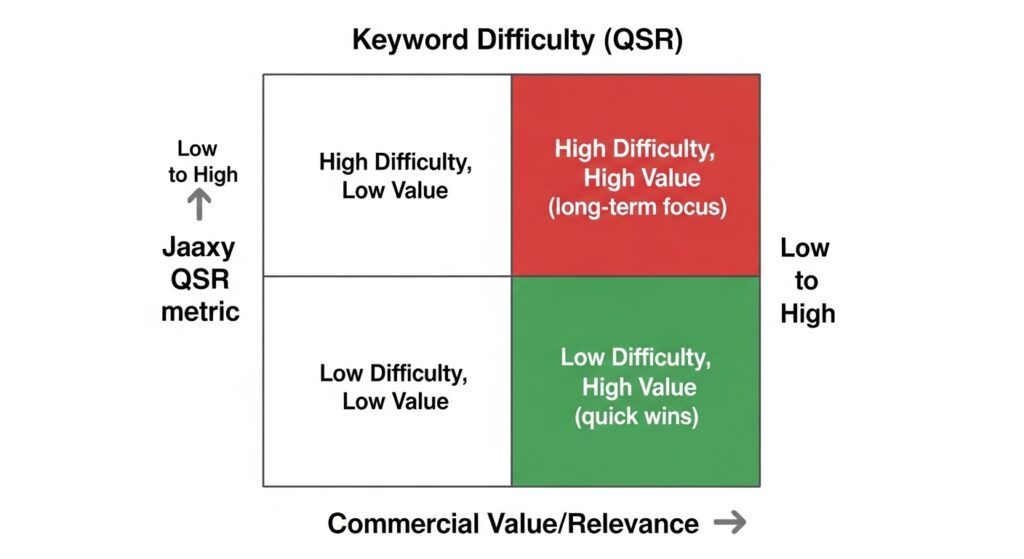
- The Priority Matrix: Prioritize keywords that are:
- High Relevance + High Commercial Value (Target immediately)
- Medium Volume + Low Difficulty (or Low QSR via Jaaxy) (Quick wins)
- High Volume + High Difficulty (Long-term, pillar content focus)
- Content Mapping: Map each prioritized keyword to a specific piece of content (new or existing). Avoid keyword cannibalization by ensuring each URL targets a distinct search intent and primary keyword.
- Cluster Strategy: Organize related keywords into Topic Clusters. Create one comprehensive Pillar Page that targets the broad, high-volume term, and then numerous Cluster Pages that target long-tail variations, all internally linking back to the Pillar. This structure demonstrates expertise and organizes your site authority.
Ready to turn your keyword map into a real content and traffic plan?
- Online Business Trends 2025: 10 You Can’t Ignore – Use trends plus keyword insights to decide which topics deserve pillar pages.
- Effective Landing Page Strategies for Email Capture (The 5-Part Formula) – Connect your SEO traffic to focused landing pages that actually capture emails.
- Email List Growth Strategies: How to Build an Email List Effectively in 2025 – Turn that search traffic into long-term relationships via your email list.
Real-World Applications and Advanced Strategies
Integrating keyword research into your broader SEO strategy is like assembling a puzzle where keywords are the pieces that create the big picture of your digital presence.
1. Content Agendas Built on Keyword Insights
A keyword strategy shouldn’t just be a list; it should be a working calendar.
- Audit Existing Content: Use Google Search Console to find content that ranks on Page 2 or 3. Find relevant keywords to add to these pages to give them a ranking boost.
- The Seasonal Calendar: Identify keywords with seasonal spikes (e.g., summer vacation deals, year-end tax guide). Plan content 2-3 months in advance to allow time for indexing and ranking.
- Create “Hub-and-Spoke” Content: For your Pillar Article on Link Building, your Hub-and-Spoke (or Cluster) pages would target keywords like ethical outreach methods (Spoke 1), tools for backlink analysis (Spoke 2), and broken link building template (Spoke 3).
2. Targeting Featured Snippets and PAA Boxes
The “zero click” search result (the Featured Snippet) is highly valuable.
- Format Answers: Look for keywords where a Featured Snippet is already present (usually informational intent). Format your content to directly answer the query in the snippet’s format (e.g., a list, table, or a concise 40-word paragraph).
- Use Question Keywords: Specifically target the exact phrasing used in the “People Also Ask” (PAA) boxes. Answering these questions directly in an FAQ section (like the one below!) can help you win multiple positions on the SERP.
3. Voice Search and Long-Tail Keywords
Voice search and AI-driven queries (e.g., via conversational interfaces) are making long-tail, conversational keywords more critical than ever.
- Conversational Phrasing: Users speak differently than they type. Keywords shift from best coffee maker to where can I buy the best budget coffee maker near me?
- Location Focus: Local businesses must integrate geographic terms and “near me” phrasing.
- Action Keywords: Focus on keywords containing verbs like how to, why do, when is, and can I. This is where tools like Jaaxy, which easily identify long-tail phrases, provide a competitive advantage.
4. Monitoring and Adjusting for Sustainability
SEO is dynamic. Monitoring and adjusting your strategies based on real-time performance metrics is non-negotiable.
- Google Search Console (GSC): Monitor your impressions (how often your content is seen) and Click-Through Rate (CTR). Low CTR on a high-impression keyword suggests you need to rewrite your title tag and meta description to be more compelling.
- Tool-Based Tracking: Track the ranking movement of your 100 most important keywords weekly. Identify pages that are consistently dropping or fluctuating and prioritize them for immediate review and update.
- Content Decay: Revisit and update content that is more than 18 months old, refreshing the statistics, adding new E-E-A-T signals, and looking for new keywords to target.
Challenges and Future Trends in Keyword Research
Navigating the landscape of keyword research isn’t always smooth sailing. Understanding the challenges and embracing future trends ensures your strategy remains effective and sustainable.
Current Challenges
- Deciphering User Intent: The biggest challenge is ambiguity. A keyword like “Tesla” could be Navigational (seeking the company site), Informational (seeking the inventor’s history), or Commercial (seeking the latest model). SERP analysis is the only way to resolve this.
- Rising Keyword Difficulty (KD): As SEO becomes mainstream, competition for commercial keywords is intensifying, forcing strategists to focus on niche long-tail terms and strong E-E-A-T signals to compete. Using specialized tools like Jaaxy to find low-QSR opportunities becomes essential for bypassing the high-difficulty terms.
- The Rise of Zero-Click Searches: With Featured Snippets and direct answers, users often get the information they need without clicking on a result, making it harder to capture traffic unless you win the top SERP real estate.
Future Trends: AI and Semantic Search
AI and machine learning are fundamentally altering how search engines interpret and rank content, calling for new approaches to keyword research.
- Semantic Search: Search engines no longer just look for exact keyword matches; they understand the relationship between words and concepts. Your content must cover the topic holistically, not just repeating the target keyword. Use LSI (Latent Semantic Indexing) keywords—related concepts and synonyms—to demonstrate topic expertise.
- Google’s SGE (Search Generative Experience): AI-powered summaries may reduce clicks on informational content. This drives the need for content that offers unique experience, original data, or transaction—things AI cannot easily replicate.
- Sustainability and Trust: The emphasis on E-E-A-T will only increase. Avoiding quick-fix strategies and focusing on long-term SEO health by creating truly expert-level content ensures you consistently meet both audience expectations and stringent search engine standards.
Helpful External Resources on Keyword Research
- Google Search Central: SEO Starter Guide – Official best practices from Google, including how to think about topics, structure, and relevance.
- Ahrefs: Keyword Research – The Beginner’s Guide – A detailed, practical walkthrough of modern keyword research with examples and metrics.
- Ahrefs: Best Practices for Doing Keyword Research – Step-by-step process for finding, filtering, and grouping keywords using traffic potential and business value.
Conclusion: The Roadmap to Maximum Impact
Keyword research is far more than an initial brainstorming session; it is a continuous, data-driven cycle of discovery, analysis, creation, and refinement. It is the roadmap that connects your business value to audience intent.
By diligently applying the four phases—Brainstorming, Data Analysis, Competitive Review, and Prioritization—and anchoring your efforts in the principles of Search Intent and E-E-A-T, you move beyond merely targeting keywords. Utilizing tools like Jaaxy for identifying quick, profitable wins and comprehensive platforms for large-scale competitive analysis, you begin to own topics, secure authoritative visibility, and achieve the maximum SEO impact possible. This strategic rigor ensures that every piece of content published serves a defined purpose, drives relevant traffic, and contributes directly to your bottom line.
Next Steps: Turn Your Keyword Research into Calm, Consistent Action
Keyword research only pays off when it leads to real content, published at a pace that feels sustainable for you. You don’t need to chase every opportunity at once. Start with a small list of realistic, high-value keywords and build from there.
To help you connect your keyword plan with the rest of your online business, you’re welcome to download my free Affiliate Marketing Starter Kit for Beginners . It’s designed especially for retirees and “ageless” beginners who want a clear, step-by-step path into online income, without overwhelm or hype.
If you’d like structured training, website tools, and a supportive community under one roof, you can also explore Wealthy Affiliate . Many beginners find it reassuring to follow a guided course while they practice keyword research, content creation, and SEO at their own pace.
Choose one small next step you can take this week—updating an old post with better keywords, planning a new pillar article, or building a simple cluster. Over time, these small, steady improvements can add up to real search traffic and meaningful results.
❓ Frequently Asked Questions (FAQ)
Q1: What is “Keyword Cannibalization” and how do I prevent it?
A: Keyword Cannibalization occurs when multiple pages on your own website target the exact same keyword and search intent. This confuses search engines, forcing them to choose which page to rank, often resulting in neither page ranking well.
- Prevention: Use a content map to ensure each primary keyword is assigned to only one URL. If two pages are targeting the same term, combine them into one superior page and use a 301 redirect from the discarded URL to the new, definitive page.
Q2: Should I focus on Short-Tail or Long-Tail Keywords?
A: You need a balanced strategy:
- Short-Tail (Head Terms): High volume, high difficulty, low conversion (e.g., “SEO”). Target these with your highly authoritative Pillar Pages.
- Long-Tail (Specific Phrases): Low volume, low difficulty, high conversion (e.g., “how to conduct keyword research for local SEO”). Target these with specific Cluster/Supporting Pages.A healthy strategy uses long-tail keywords (often best found using Jaaxy’s QSR metric) for quick wins and conversions, while using short-tail keywords to guide your topic clusters and build long-term authority.
Q3: How often should I update my keyword research?
A: Keyword research should be an ongoing process, not a one-time project:
- Annual Audit: Conduct a full competitor and keyword audit every 12–18 months.
- Quarterly Review: Review your high-priority keywords, looking for fluctuations or new intent shifts.
- Continuous Monitoring: Use Google Search Console and SEO tools daily/weekly to monitor the performance of your existing keywords and identify new ranking opportunities.
Q4: What is the “difficulty” score (KD/QSR) in SEO tools, and how should I use it?
A: The Keyword Difficulty (KD) score (or similar metrics like Semrush’s KD) and Jaaxy’s Quoted Search Results (QSR) are estimates of how hard it would be to rank. KD typically measures the backlink authority of ranking pages, while QSR measures the exact number of competing pages.
- Use: As a guide. Focus on terms where the competition metric (KD or QSR) is manageable for your site’s current authority. Aim for QSR below 100 for high-probability quick wins, especially when starting out.
Q5: Can I rank for a keyword without using the exact phrase in the title?
A: Yes, due to Semantic Search. While including the exact phrase is still best practice for clarity and intent matching, search engines now understand the topic and context of your content. If you write a comprehensive, E-E-A-T-focused article about “digital marketing strategy,” Google knows you are relevant for related terms like “online promotion plan” or “internet marketing tactics.” Focus on topic coverage and user value over exact phrase repetition.
Leave a Reply