
Best AI Tools For Blogging: The Ultimate Guide to Content Automation
Blogging has undergone a significant transformation in recent years, largely due to the advent of Artificial Intelligence (AI). What was once a laborious process of ideation, writing, editing, and promotion can now be streamlined and even automated with the right AI tools. For bloggers looking to enhance their efficiency, improve content quality, and expand their reach, understanding and integrating AI tools is no longer optional—it’s essential.
This comprehensive guide explores the best AI tools available for bloggers today, categorized by their primary function, to help you navigate the landscape and select the most suitable solutions for your blogging journey. In this guide, we’ll walk through the best AI tools for blogging and how they fit into a simple content automation stack.
TL;DR: The best AI tools for blogging don’t replace your judgment—they speed up the boring parts of planning, drafting, optimizing, and repurposing, while you stay in charge of voice and strategy.
- Writing & ideation: tools for outlines, drafts, and ideas.
- SEO & research: tools for keywords, content gaps, and on-page checks.
- Editing & quality: tools for grammar, clarity, and tone.
- Repurposing & automation: tools that turn one post into many assets.
- Pick a tiny stack: one main writer, one SEO helper, one editor is enough to start.
The AI Revolution in Blogging
Before diving into specific tools, it’s crucial to understand why AI is so impactful for bloggers. AI excels at processing vast amounts of data, identifying patterns, and generating human-like text, all at speeds impossible for a human. This translates into several key advantages for bloggers:
- Increased Efficiency: Automate repetitive tasks like content research, outlining, and even first drafts, freeing up time for strategic planning and deeper analysis.
- Improved Content Quality: AI can assist with grammar, style, readability, and SEO optimization, leading to more polished and effective content.
- Enhanced Creativity: AI can act as a brainstorming partner, generating new ideas, angles, and even different content formats.
- Wider Reach: AI-powered tools can help optimize content for search engines, analyze audience behavior, and personalize content delivery, ultimately leading to more traffic and engagement.
- Data-Driven Decisions: AI provides insights into what content performs best, who your audience is, and how to better cater to their needs.
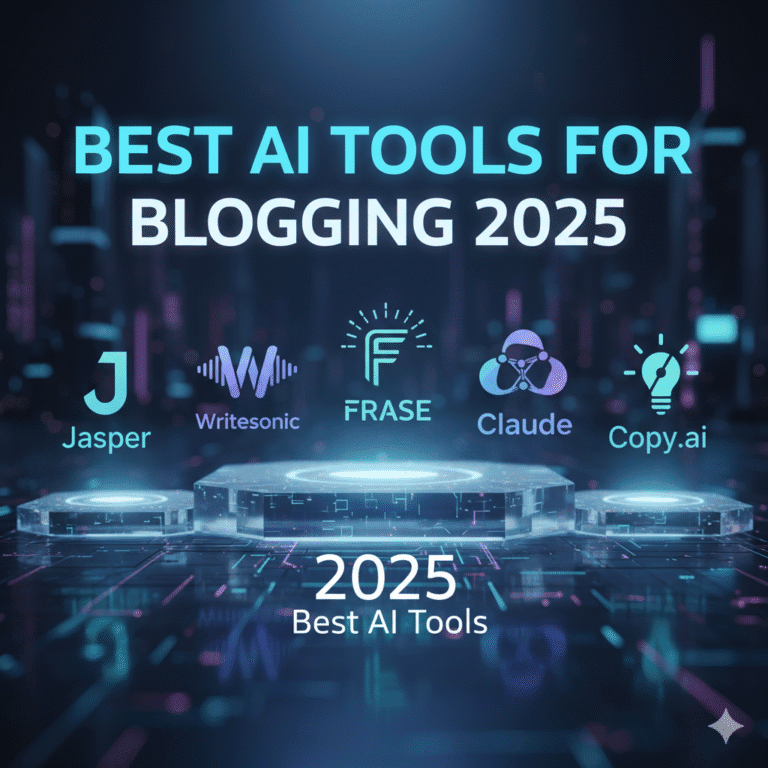
- These AI tools can help you plan topics, draft blog posts, and optimize them for SEO.
Get Clear on Your Blogging Goals Before You Choose AI Tools
AI works best when you know why you’re blogging and who you’re writing for. These guides help you decide what your content should support:
- Pros and Cons of Different Online Business Models (2025 Essential Guide) – Choose a business model that fits your time, energy, and income goals.
- Top 10 Online Business Ideas Perfect For Retirees (2025) – See which online paths make the most sense for your lifestyle.
- Affiliate Marketing 101: Beginner’s Guide for Retirees – Understand how your blog posts can lead to calm, recurring affiliate income.
Now, let’s explore the tools that are driving this revolution.

I. Content Ideation & Research
The blank page is often the biggest hurdle. AI can kickstart your content creation process by helping you brainstorm topics, find trending keywords, and understand what your audience is searching for.
Here are some of the most popular AI tools bloggers use today to write and optimize posts.
1. Jasper (Formerly Jarvis.ai)
- Overview: Jasper is one of the most popular and comprehensive AI writing assistants on the market. While it excels at writing, its “Boss Mode” and “Surfer SEO” integration make it a powerhouse for content ideation and keyword research. You can feed it a brief description, and it can generate dozens of blog post ideas, catchy headlines, and outlines.
- Key Features for Ideation:
- Blog Post Topic Ideas: Generates a list of potential blog post topics based on your niche and a short prompt.
- Content Improver: Takes existing content and suggests ways to make it more engaging or comprehensive, often sparking new angles.
- Keyword Integration (via Surfer SEO): Helps identify high-ranking keywords and integrates them seamlessly into your content planning.
- Why it’s great: Its versatility means you can go from ideation to a fully drafted article within the same ecosystem.
2. Semrush & Ahrefs (AI-powered SEO Tools)
- Overview: While primarily SEO tools, both Semrush and Ahrefs leverage AI algorithms to provide unparalleled insights into keyword research, competitor analysis, and trending topics. They don’t generate ideas in the same way Jasper does, but they provide the data needed to inform your ideation.
- Key Features for Ideation:
- Topic Research Tool (Semrush): Input a broad topic, and Semrush will generate a list of related subtopics, questions, headlines, and content ideas, categorized by engagement and difficulty.
- Keyword Explorer (Ahrefs & Semrush): Discover high-volume, low-difficulty keywords that your target audience is actively searching for, providing a data-driven foundation for your content.
- Content Gap Analysis: Identify keywords your competitors rank for but you don’t, uncovering untapped content opportunities.
- Why they’re great: They provide the empirical data necessary to ensure your ideas have a strong chance of ranking and attracting traffic.
3. AnswerThePublic (Acquired by Neil Patel)
- Overview: This tool visualizes questions, prepositions, comparisons, alphabeticals, and related searches around your keyword. While not explicitly AI, its sophisticated data aggregation and visualization provide a “mind map” of user intent, which is a form of AI-driven insight.
- Key Features for Ideation:
- Question Aggregation: Gathers all the questions people are asking around a specific keyword (e.g., “What is AI?”, “How does AI work?”).
- Prepositional Phrases: Reveals common phrases like “AI for bloggers,” “AI vs. humans,” giving you specific angles.
- Visualizations: Presents data in an intuitive, spoked-wheel format that makes identifying content opportunities easy.
- Why it’s great: It’s fantastic for understanding audience pain points and directly addressing them with your content.
Plug Your Favorite AI Tools Into a Simple SEO Workflow
Once you’ve chosen your main AI writer and SEO helper, these guides show you how to use them in a calm, repeatable way:
- How To Conduct Keyword Research For Maximum SEO Impact: The Definitive 2025 Guide – Pick strong, realistic keywords before you ask AI to draft.
- Mastering Google Analytics for SEO: The Definitive 2025 Performance Guide – Measure which AI-assisted posts deserve updates and promotion.
- Top 5 Link Building Strategies to Radically Improve Your Search Rankings: A 2025 Masterclass – Support your best AI-generated posts with simple link building.
II. Content Creation & Writing
This is where AI truly shines, taking the heavy lifting out of drafting articles, generating summaries, and even crafting compelling ad copy.
1. ChatGPT & GPT-4 (OpenAI)
- Overview: OpenAI’s language models, particularly ChatGPT and the underlying GPT-4 architecture, have revolutionized content creation. These models can understand context, generate coherent and human-like text, summarize articles, write code, and even engage in creative writing.
- Key Features for Writing:
- Article Generation: With specific prompts, it can draft entire blog posts, sections, or even long-form articles.
- Summarization: Condenses lengthy articles or research papers into concise summaries.
- Brainstorming & Outlining: Helps structure your thoughts and create detailed outlines.
- Rewriting & Paraphrasing: Improves clarity, changes tone, or avoids plagiarism by rephrasing sentences and paragraphs.
- Content Expansion: Takes a short idea and expands it into a more detailed paragraph or section.
- Why it’s great: Its versatility and ability to understand complex instructions make it an indispensable tool for any blogger. It’s like having an infinitely knowledgeable co-writer.
2. Jasper (again!)
- Overview: As mentioned earlier, Jasper is a comprehensive AI writing tool. Its “Boss Mode” allows for long-form content generation with more control, making it ideal for drafting entire blog posts.
- Key Features for Writing:
- Long-Form Assistant: Guides you through the process of writing blog posts, articles, and even books.
- Templates: Offers over 50 templates for various content types, including blog post intros, conclusions, feature-to-benefit bridges, and more.
- Commands: Allows you to give direct commands to the AI, such as “Write a paragraph about the benefits of AI in blogging” or “Summarize the above text.”
- Why it’s great: Its user-friendly interface and pre-built templates make it easier for bloggers to get started quickly and produce high-quality content efficiently.
3. Copy.ai
- Overview: While its name suggests copywriting, Copy.ai is highly capable of generating various forms of content, including blog post drafts. It’s known for its ease of use and ability to produce multiple variations of content quickly.
- Key Features for Writing:
- Blog Post Wizard: A guided workflow that helps you generate a blog post from start to finish, including outlines, intro paragraphs, and body sections.
- Freestyle Tool: Allows you to describe any content you need, and the AI will generate options.
- Multiple Tones: You can specify the tone of voice (e.g., witty, professional, empathetic) to match your brand.
- Why it’s great: Excellent for quickly generating multiple content ideas and drafts, especially for bloggers who need variety and speed.
4. Surfer SEO (AI-powered Content Editor)
- Overview: Surfer SEO is more than just a keyword tool; its content editor uses AI to analyze top-ranking content for your target keywords and provides real-time recommendations to optimize your own article. While it doesn’t write the content, it guides you on how to write it effectively for SEO.
- Key Features for Writing/Optimization:
- Content Score: Gives your article a score based on how well it’s optimized compared to competitors.
- Keyword Suggestions: Recommends relevant keywords and phrases to include naturally within your text.
- Structure & Length Recommendations: Advises on optimal word count, heading count, and paragraph count.
- NLP (Natural Language Processing) analysis: Ensures your content covers important entities and topics that Google’s algorithm expects for your target keyword.
- Why it’s great: It bridges the gap between content creation and SEO, ensuring your well-written content actually gets seen.

III. Content Editing & Optimization
Even AI-generated content needs a human touch. These tools help refine, polish, and optimize your articles for readability, grammar, and search engine performance.
1. Grammarly (AI-powered Writing Assistant)
- Overview: Grammarly is a ubiquitous tool for a reason. Its AI algorithms go beyond basic spell-checking to identify grammatical errors, punctuation mistakes, style inconsistencies, and even offer suggestions for improving clarity and conciseness.
- Key Features for Editing:
- Grammar & Spelling Checks: Catches errors traditional spell checkers miss.
- Punctuation Correction: Ensures correct usage of commas, apostrophes, etc.
- Clarity & Concise: Suggests ways to rephrase awkward sentences or remove unnecessary words.
- Tone Detection: Analyzes your writing style and provides feedback on your tone (e.g., confident, informal, appreciative).
- Plagiarism Checker: Compares your text to billions of web pages to identify potential plagiarism.
- Why it’s great: It’s an essential tool for maintaining high editorial standards, regardless of whether your content is human or AI-generated.
2. Hemingway Editor
- Overview: While not strictly “AI” in the generative sense, Hemingway Editor uses sophisticated algorithms to analyze your writing for readability. It highlights complex sentences, passive voice, adverbs, and phrases with simpler alternatives, helping you write bold and clear prose.
- Key Features for Editing:
- Readability Score: Grades your writing based on readability levels.
- Sentence Complexity Highlights: Identifies sentences that are hard to read.
- Passive Voice Detection: Helps you switch to a more active and engaging voice.
- Adverb & Weak Phrase Elimination: Encourages stronger verbs and more direct language.
- Why it’s great: Perfect for ensuring your blog posts are easily digestible and engaging for a broad audience.
3. Rank Math / Yoast SEO (WordPress Plugins with AI Features)
- Overview: For WordPress bloggers, these plugins are indispensable. While their core function is SEO, they increasingly incorporate AI-driven suggestions to optimize individual posts.
- Key Features for Optimization:
- Real-time SEO Analysis: Provides immediate feedback on your content’s SEO performance for your target keyword.
- Keyword Density Check: Helps ensure your focus keyword is used appropriately without stuffing.
- Readability Analysis: Similar to Hemingway, they provide scores and suggestions for improving readability.
- Internal Linking Suggestions (Rank Math): Uses AI to suggest relevant internal links based on your content, improving site structure and user experience.
- Why they’re great: They integrate directly into your blogging platform, providing actionable SEO insights as you write and edit.
Once you’ve chosen your main tool stack, it’s time to connect them into a simple content automation workflow.
Turn Your AI Tool Stack Into a Calm Content & Income System
Your AI tools become far more valuable when they are tied to a simple plan for publishing, repurposing, and monetizing your content:
- AI Content Generation For Blogs: The Complete 7-Step Guide – A full workflow from blank page to published AI-assisted blog post.
- AI-Powered Content Strategies for Bloggers in 2025 – See what to prioritize so you’re not using AI randomly.
- Engaging Content that Converts for Affiliate Sales: Step-by-Step Guide (2025) – Turn your AI-created posts into gentle, high-converting content.
IV. Content Promotion & Marketing
Creating great content is only half the battle; getting it in front of the right audience is just as crucial. AI tools can automate and optimize your promotional efforts.
1. SocialBee / Hootsuite (AI-powered Social Media Management)
- Overview: These platforms streamline social media scheduling and can leverage AI to suggest optimal posting times, analyze content performance, and even curate relevant content.
- Key Features for Promotion:
- Optimal Posting Time Suggestions: AI analyzes your audience’s activity to recommend the best times to post for maximum engagement.
- Content Categorization & Recycling: Helps organize your content and automatically repost evergreen content, extending its lifespan.
- Performance Analytics: Provides insights into which content performs best on which platforms.
- Hashtag Suggestions: AI can suggest relevant and trending hashtags to increase visibility.
- Why they’re great: They automate the repetitive tasks of social media management, ensuring your content reaches a wider audience consistently.
2. Jasper (again, for marketing copy!)
- Overview: Beyond long-form content, Jasper’s templates are excellent for generating marketing copy for social media posts, email newsletters, and ad campaigns.
- Key Features for Promotion:
- Social Media Post Captions: Generates engaging captions for Facebook, Instagram, LinkedIn, and Twitter.
- Email Subject Lines & Body Copy: Crafts compelling email content to drive opens and clicks.
- Google Ads & Facebook Ads Headlines/Descriptions: Creates high-converting ad copy.
- Why it’s great: Ensures your promotional messages are as polished and persuasive as your blog content.
3. ManyChat (AI for Messenger Marketing)
- Overview: ManyChat allows bloggers to build AI-powered chatbots for platforms like Facebook Messenger and Instagram. These chatbots can answer FAQs, deliver content, collect emails, and guide users through your content funnel.
- Key Features for Promotion:
- Automated Content Delivery: Send new blog posts directly to subscribers in Messenger.
- Lead Generation: Use conversational flows to collect email addresses and segment your audience.
- Interactive Q&A: Answer common questions about your blog topics automatically, improving user experience.
- Why it’s great: Creates a direct and interactive channel with your audience, fostering engagement and driving traffic to your blog.
V. Image Generation & Visual Content
Visuals are critical for engaging blog posts. AI is now making it possible to create stunning images and graphics even without design skills.
1. Midjourney / DALL-E 3 (OpenAI) / Stable Diffusion
- Overview: These text-to-image AI models can generate incredibly diverse and high-quality images from simple text prompts. From abstract art to photorealistic scenes, the possibilities are immense.
- Key Features for Visuals:
- Image Generation from Text: Describe what you want, and the AI will create it.
- Style Control: Specify artistic styles (e.g., watercolor, photorealistic, cyberpunk).
- Variations & Iterations: Generate multiple versions of an image and refine them.
- Why they’re great: Allows bloggers to create unique, custom images for their posts, breaking away from stock photo libraries and enhancing brand identity. Imagine illustrating a complex concept with a bespoke AI-generated graphic!

2. Canva (with AI features)
- Overview: Canva has long been a favorite among bloggers for easy graphic design. It’s now integrating AI tools to make design even simpler and more powerful.
- Key Features for Visuals:
- AI-powered Background Remover: Quickly remove backgrounds from images.
- Magic Write (AI Text Generation): Similar to other AI writers, this feature can help generate text for your designs, like headlines or short descriptions.
- Smart Mockups: Automatically place your designs onto mockups like t-shirts, phones, or billboards.
- Why it’s great: Combines intuitive design with AI assistance, perfect for creating stunning featured images, social media graphics, and infographics without needing advanced design software.
VI. Content Personalization & Analytics
Understanding your audience and delivering personalized content can dramatically boost engagement. AI is pivotal here.
1. Google Analytics 4 (GA4) with AI Insights
- Overview: GA4 is Google’s next-generation analytics platform, built with AI and machine learning at its core. It moves beyond traditional page views to focus on user events and behaviors across different platforms.
- Key Features for Personalization/Analytics:
- Predictive Metrics: AI can predict user behavior, such as churn probability or potential revenue, allowing you to engage users proactively.
- Anomaly Detection: Automatically flags unusual trends in your data, helping you quickly identify issues or opportunities.
- Audience Segmentation: AI helps segment your audience based on behavior, enabling more targeted content and marketing.
- Attribution Modeling: Provides a more accurate understanding of which touchpoints (e.g., social media, search) contribute to conversions.
- Why it’s great: Provides deep, AI-driven insights into how users interact with your content, enabling data-informed decisions for content strategy and personalization.
2. OptinMonster (AI-powered Conversion Optimization)
- Overview: OptinMonster helps bloggers convert website visitors into subscribers and customers using pop-ups, slide-ins, and other calls to action. Its AI-powered features optimize when and where these messages appear.
- Key Features for Personalization:
- Exit-Intent® Technology: Uses AI to detect when a visitor is about to leave your site and presents a targeted message (e.g., a newsletter sign-up form).
- Behavior Detection: Triggers campaigns based on how users interact with your site (e.g., after scrolling a certain percentage, after viewing specific pages).
- Geo-Targeting: Personalize campaigns based on a user’s geographical location.
- A/B Testing with AI Insights: Helps determine which variations of your campaigns perform best, with AI assisting in identifying winning combinations.
- Why it’s great: Maximizes your conversion rates by delivering the right message to the right person at the right time, powered by intelligent behavioral analysis.

Ethical Considerations & Best Practices
While AI tools offer immense benefits, it’s crucial to use them responsibly and ethically.
- AI as an Assistant, Not a Replacement: AI should augment your human creativity and expertise, not replace it entirely. Always review, edit, and fact-check AI-generated content.
- Maintain Your Voice: Ensure AI-generated content aligns with your brand’s unique voice and tone. Fine-tune outputs to reflect your personality.
- Fact-Checking is Paramount: AI models can sometimes “hallucinate” or provide inaccurate information. Always verify facts, statistics, and claims.
- Avoid Plagiarism: While AI models are designed to generate original content, always run AI-generated text through a plagiarism checker, especially if you’re pulling from specific sources.
- Transparency: Consider being transparent with your audience about your use of AI tools, especially if a significant portion of your content is AI-assisted. This builds trust.
- Copyright and Ownership: The legal landscape around AI-generated content and copyright is still evolving. Be aware of the terms of service for each tool you use.
- Bias Awareness: AI models are trained on vast datasets, which can sometimes contain biases. Be mindful of potential biases in AI-generated text and strive for inclusive content.
VII. Frequently Asked Questions about AI Blogging Tools
Do I need to pay for multiple AI tools to get good results?
No. Many bloggers do very well with just one main AI writer and one SEO helper. Start with the minimum stack that clearly saves you time. Only add new tools when you can see a specific gap they will fill.
Will using AI tools hurt my rankings in Google?
AI itself does not automatically hurt rankings. What matters is whether your content is helpful, accurate, and genuinely edited by you. Use AI to assist with drafts and ideas, then add your own experience, fact-checking, and structure before you publish.
What should I test first when trying a new AI tool?
Test it on one real blog topic you would actually write about. Ask it for an outline and a short draft, then check: does it understand your niche, does it follow instructions, and how much editing do you need to do?
How do I avoid becoming too dependent on AI tools?
Keep your own skills sharp by sometimes outlining and drafting without AI, and always doing final edits yourself. Think of AI as a helpful assistant, not the author. You stay responsible for the ideas, stories, and final message.
Helpful External Resources on AI Tools & Automation
- Google Search Central – Creating Helpful, Reliable, People-First Content
- OpenAI – Usage Policies and Responsible AI Guidelines
- Semrush – Guide to AI Writing Tools
Use these as neutral reference points while you decide which AI tools truly deserve a place in your blogging stack.
Conclusion: Build a Tiny AI Stack That Serves Your Strategy
The best AI tools for blogging are the ones you actually use. A small stack—a main writer, an SEO helper, and a quality editor—can easily outperform a shelf full of unused subscriptions. Start simple, test with real posts, and let performance guide whether you add or remove tools.
If you’d like printable checklists and calm prompts that pair well with any AI stack, download my free Affiliate Marketing Starter Kit for Beginners. It helps you connect your content automation tools to a realistic affiliate income plan.
And if you want structured training, hosting, and built-in AI tools in one place, you’re welcome to explore Wealthy Affiliate. It’s a beginner-friendly platform where you can practice these tools, learn SEO, and grow your blog step by step with community support.
Pick one AI tool to test this week, run it through your own simple workflow, and see how much lighter writing feels. Then keep what works and calmly let go of the rest.
The goal is not to use every AI tool—it’s to build a small stack that makes your blogging life lighter.
The integration of AI tools into blogging workflows marks a pivotal moment for content creators.
From generating initial ideas to crafting entire articles, optimizing for SEO, creating stunning visuals, and promoting content across channels, AI offers unprecedented efficiency and capabilities.
By strategically incorporating tools like Jasper, ChatGPT, Semrush, Grammarly, Midjourney, and Google Analytics 4, bloggers can elevate their content quality, expand their reach, and dedicate more time to the strategic and creative aspects of their craft. The future of blogging is undeniably intertwined with AI, and those who embrace these powerful tools will be at the forefront of this exciting evolution.