
Affiliate Marketing Strategy: The Complete Guide for Retirees Who Want to Build It Right
Last Updated on 6 days ago by Gila
Most affiliate marketing guides tell you what affiliate marketing is. This one tells you how to build an affiliate marketing strategy that works — the thinking behind the decisions, not just the steps.
The key to a successful affiliate marketing strategy is understanding your audience and providing them with valuable, relevant information. A thoughtful affiliate marketing strategy will enable you to connect with your readers and promote products that genuinely meet their needs.
Ultimately, having a solid affiliate marketing strategy means being intentional about your content and how it aligns with your business objectives.
This affiliate marketing strategy guide will walk you through the essentials of building a sustainable affiliate marketing business.
Understanding the nuances of an effective affiliate marketing strategy is crucial for maximizing your success in this field.
This post will explore the various components that make up a successful affiliate marketing strategy.
There is a difference between knowing what to do and knowing why to do it in that order. Beginners who skip the strategy layer — who pick any niche, publish random content, and join every programme they can find — typically plateau within six months, wondering why nothing is earning. Beginners who build with a clear strategy take longer to start, but they build something that compounds.
This is the pillar guide for the affiliate marketing strategy category on Ageless Revenue. It is designed to be the resource you return to as your knowledge grows — the framework that organises everything else. Use the detailed guides linked throughout to go deeper on any specific piece.
Every successful affiliate marketing strategy should incorporate a clear plan for tracking results and optimizing your efforts.
By focusing on these strategic decisions, you can create a robust affiliate marketing strategy that stands the test of time.
With a strong affiliate marketing strategy, you can leverage your unique insights and experience to build meaningful connections with your audience.
Ultimately, your success hinges on how well you execute your affiliate marketing strategy and adapt to changes in the market.
Choosing the right affiliate programs is a vital component of your affiliate marketing strategy that can greatly impact your revenue potential.
Crafting an effective affiliate marketing strategy requires an understanding of both content creation and consumer behavior.
Every piece of your affiliate marketing strategy should tie back to your overarching goals and objectives.
Consistency is key in your affiliate marketing strategy; it’s essential to publish quality content regularly to build trust with your audience.
Your affiliate marketing strategy should evolve as you gain insights and feedback from your audience.
Investing in tools and resources that support your affiliate marketing strategy is crucial for sustained success.
Ultimately, an effective affiliate marketing strategy will require you to engage with your audience and continuously refine your approach.
The best affiliate marketing strategy is one that aligns with your personal strengths and expertise, making your content authentic.
Using analytics to measure the success of your affiliate marketing strategy can provide valuable insights for future efforts.
Your specific niche will heavily influence the tactics you employ within your affiliate marketing strategy.
The best affiliate marketing strategy is not just about the products but also about the relationships you build with your audience.
At its core, your affiliate marketing strategy must prioritize providing value to your readers above all else.
It’s essential to continuously adapt your affiliate marketing strategy to keep pace with changing audience needs and market dynamics.
By prioritizing quality over quantity, your affiliate marketing strategy can foster loyalty and engagement among your audience.
Your affiliate marketing strategy should include methods for collecting feedback from your audience and using it to refine your approach.
Creating a flexible affiliate marketing strategy allows you to pivot when you encounter new trends or shifts in your audience’s preferences.
Tailoring your affiliate marketing strategy to specific platforms will enhance your ability to connect with your target audience.
Your affiliate marketing strategy should leverage various channels to ensure maximum visibility and reach for your content.
Regularly revisiting and adjusting your affiliate marketing strategy based on performance metrics is crucial for ongoing success.
Ultimately, an effective affiliate marketing strategy is one that evolves and adapts to the specific needs of your audience.
For a broader introduction to what affiliate marketing is and how the model works, read our complete guide to affiliate marketing for retirees first.
Affiliate disclosure: This post contains affiliate links. If you purchase through one of our links, we may earn a commission at no extra cost to you.
What Is Affiliate Marketing Strategy — and Why Does It Matter?
Strategy is the layer between “I want to do affiliate marketing” and “I am publishing content and earning commissions.” It is the set of decisions that determines whether the effort you invest in creating content compounds into a real income stream or dissipates into work that leads nowhere.
Staying up to date with industry trends will enable you to refine your affiliate marketing strategy and stay ahead of the competition.
A successful affiliate marketing strategy is built on a foundation of trust, authenticity, and a genuine desire to help your audience.
As you execute your affiliate marketing strategy, always remember that transparency and honesty are key to earning your audience’s trust.
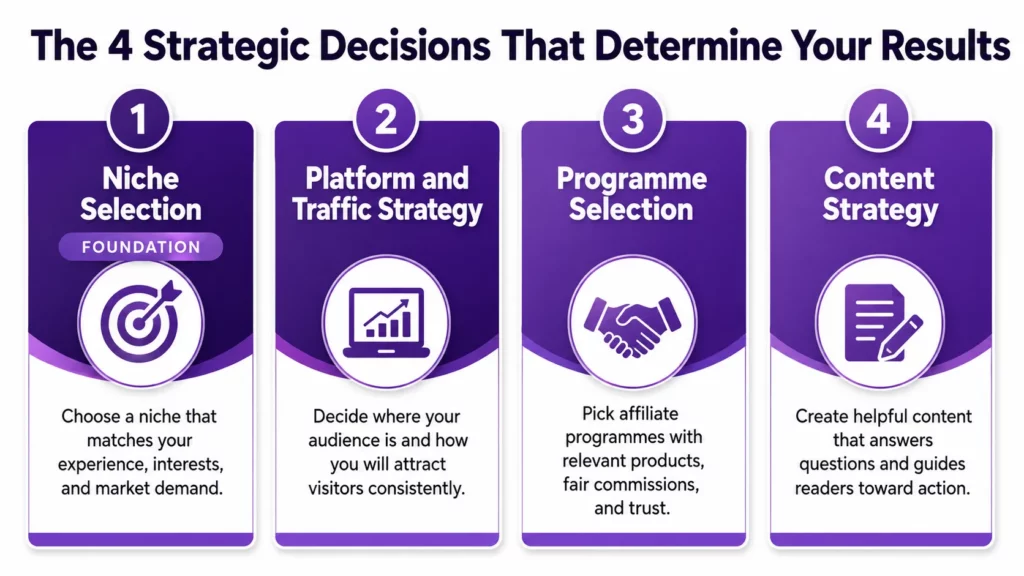
Four strategic decisions determine the trajectory of almost every affiliate marketing site:
Niche selection. The specific topic and audience you build around determines your competition level, your audience quality, your content sustainability, and the quality of affiliate programmes available to you. A well-chosen niche gives you a realistic path to page-one rankings, genuine authority, and high-intent readers. A poorly chosen niche means competing with well-resourced sites you cannot beat, writing about topics you will run out of things to say about, and converting readers who were never going to buy.
Platform and traffic strategy. Where will your content live, and how will your target audience find it? The three primary traffic channels for affiliate marketing — organic search (Google SEO), Pinterest, and email — have fundamentally different timelines, effort requirements, and income trajectories. The right platform combination depends on your niche, your natural communication style, and how you want to spend your time.
Programme selection. The affiliate programmes you join determine your commission rates, your cookie windows, your recurring income potential, and how naturally your recommendations fit your content. Choosing programmes early in the process — before you have built significant content — allows you to create content that positions your recommendations intentionally.
Your affiliate marketing strategy should also consider the importance of ongoing education and skill development in this dynamic field.
In conclusion, an effective affiliate marketing strategy is integral to building a successful online business that thrives.
Content strategy. The types of content you create, the keywords you target, the depth and specificity of your articles, and the internal linking structure between them all determine how quickly Google builds topical authority for your site and how effectively your content converts readers into buyers.
Each of these decisions is covered in depth in the guides below. The following section provides the strategic framework that ties them together.
The Core Strategy: Build Topical Authority in a Defined Niche
Google’s algorithm has become increasingly effective at recognising sites that have genuine depth in a specific topic area and rewarding them with rankings. The technical term is topical authority — the degree to which Google considers your site a trustworthy, comprehensive resource on a particular subject.
Topical authority is built through content breadth and depth in a specific topic area. A site with 30 articles that each thoroughly address a different aspect of the same niche builds topical authority faster than a site with 100 thin articles scattered across multiple topics.
The practical implication: the most effective affiliate marketing strategy in 2026 is to choose a defined niche, build a cluster of interlinked content that covers the full range of questions your target reader has, and add depth and specificity to each piece that demonstrates genuine expertise.
This is not the flashiest strategy. It does not involve viral content, growth hacking, or rapid monetisation. It is a compound-growth model that produces minimal results in the first six months and accelerates results from months twelve to twenty-four onwards.
It suits the Ageless Revenue audience exceptionally well for one straightforward reason: the people most capable of building genuine topical authority are those with genuine depth of knowledge in specific areas. Decades of professional experience, hobby knowledge, or personal expertise in a specific area translate directly into the kind of content that builds topical authority — and that kind of content is becoming increasingly rare and increasingly valuable as generic AI content floods the internet.
By creating an affiliate marketing strategy that aligns with your personal values, you can attract an audience that resonates with your message.
Step 1 — Choose and Validate Your Niche
The most common strategic mistake in affiliate marketing is choosing a niche based on perceived profitability rather than genuine expertise or interest. The second most common is choosing a niche so broad that building topical authority within it is unrealistic for a new site.
A well-chosen affiliate niche sits at the intersection of four criteria: a topic you have genuine knowledge or curiosity about, a defined audience that searches for information in this area, affiliate programmes with relevant products you can honestly recommend, and a competition level where a focused new site has a realistic path to page-one rankings in specific search queries.
The niche validation process — testing an idea against these four criteria before committing months of effort — takes under thirty minutes and prevents one of the most costly mistakes beginners make. For the complete framework, read our guide on how to choose a profitable niche for affiliate marketing.
The sub-niche principle. For a new affiliate site, a narrower niche almost always outperforms a broader one in the first twelve to eighteen months. “Health” is not a niche. “Joint health and mobility for adults over 60” is a niche. The narrower framing reduces competition, defines the audience precisely, and makes every content decision clearer. Once you have built authority in the sub-niche, expanding is straightforward. Starting broad is the harder path.
The experience advantage. The Ageless Revenue audience has a structural advantage in niche selection that most affiliate marketing guides do not acknowledge: real, specific, long-term experience in defined topic areas. A retired physiotherapist writing about joint health has E-E-A-T (Experience, Expertise, Authoritativeness, Trustworthiness) signals that a generalist blogger cannot replicate. A lifelong gardener writing about raised bed gardening for seniors writes from genuine knowledge that no keyword research tool can manufacture. This experience advantage is most powerful in niches where personal experience is highly relevant — health, hobbies, professional skills, travel, and personal finance.
Step 2 — Choose Your Platform and Traffic Strategy
Once your niche is confirmed, the next strategic decision is where your content will live and how your audience will find it. The three primary channels are organic search, Pinterest, and email — and the strongest affiliate marketing strategies use all three, but start with one.
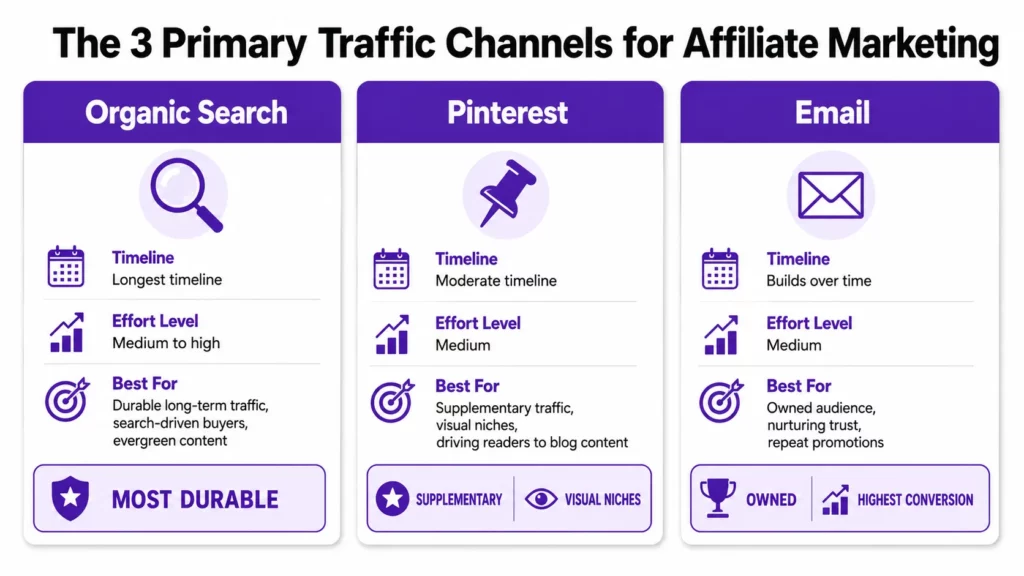
Organic search (blog + Google SEO) is the most durable long-term traffic channel. A well-optimised blog post targeting a specific keyword can attract readers from Google for years after it is published. The trade-off is time: organic search traffic typically takes six to twelve months to build meaningfully for a new site. The investment in SEO-optimised blog content is the highest-return long-term traffic strategy available, but it requires patience during the early phase.
For a practical guide to the SEO fundamentals that matter for an affiliate blog, read our guide to SEO for affiliate marketing beginners.
Pinterest is the most powerful supplementary channel for content-based affiliate marketing — and for many niches, it is the channel that produces first traffic and first commissions while the blog’s organic search rankings are still developing. Pinterest operates as a visual search engine rather than a social network, which means content is discovered by people actively searching for specific topics, not passively scrolling through a feed.
Pinterest works particularly well for niches with strong visual discovery potential: home and garden, food and cooking, health and wellness, crafts, travel, and personal finance. For a complete setup and strategy guide, read our guide to Pinterest for affiliate marketing beginners.
Email is the channel that converts affiliate recommendations at the highest rate of any medium — and unlike search traffic or social traffic, an email list is an asset you own completely. Algorithm changes on Pinterest or Google cannot affect your email list. For a complete guide to building an affiliate email list from zero, read our guide to email marketing for affiliate revenue.
The recommended starting combination: Build your blog as the content foundation, use Pinterest to supplement traffic while search rankings develop, and start building your email list on day one. Add additional channels only after the primary combination is working.
Step 3 — Choose Your Affiliate Programmes Strategically
Most beginners join affiliate programmes reactively — they find a product they want to mention and apply for whatever programme is available. The strategic approach is to choose your primary programmes before you build content and then create content that positions those programmes naturally.
Prioritise recurring commissions. The most powerful passive income structure in affiliate marketing is a recurring commission programme — one that pays every month as long as a referred customer remains subscribed. A single piece of content that generates ten recurring commission referrals generates those commissions every month, without additional work. Identify one or two recurring commission programmes in your niche and build content specifically designed to attract and convert readers who are a good fit for them.
The Wealthy Affiliate opportunity. For any Ageless Revenue reader whose content covers online business, affiliate marketing, blogging, or earning income from home, Wealthy Affiliate’s affiliate programme is among the strongest available. It pays recurring monthly commissions for the lifetime of each referred member — which means a reader who joins through your recommendation and stays subscribed for three years generates three years of monthly commission payments from a single piece of content. The programme is open to all Wealthy Affiliate members. For a full review of the platform, read our Wealthy Affiliate review.
Build programme diversity over time. Starting with one or two programmes is the right approach. Amazon Associates for broad physical product coverage and one specialist programme for your niche is the standard beginner combination. Over time, add programmes as your content library grows and as you identify which topics are attracting your most engaged readers. For a full guide to the best programmes for beginners, read our guide to the best affiliate programmes for beginners.
Step 4 — Build Your Content Strategy
Content is the engine of an affiliate marketing business. Every other element of strategy exists to get the right content in front of the right reader at the right moment.
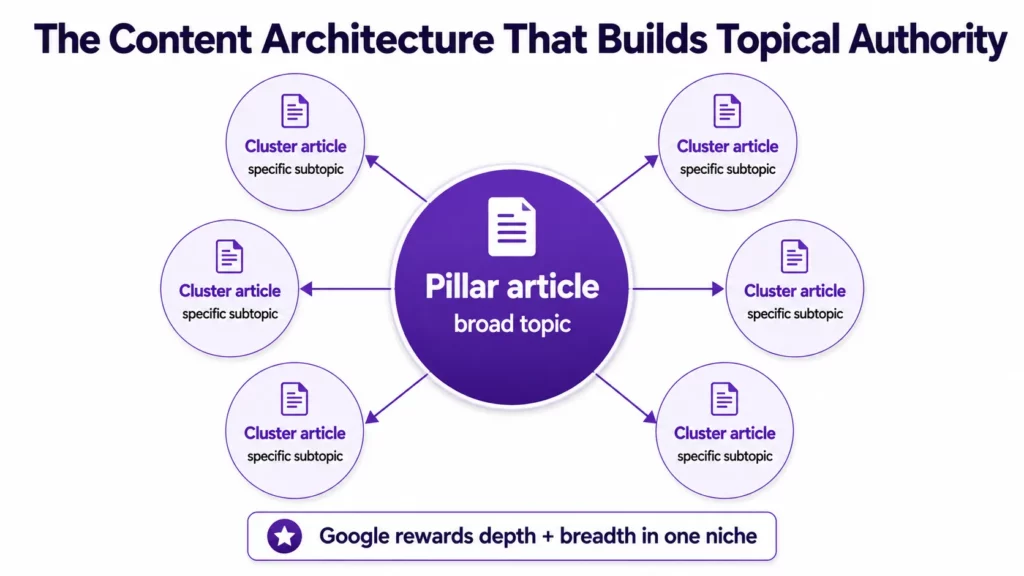
The content pillar model. The most effective content architecture for topical authority is a hub-and-spoke structure. A pillar article covers the broad topic comprehensively. Cluster articles cover specific subtopics in depth, each linking back to the pillar. This structure tells Google that your site has both breadth (the pillar) and depth (the clusters) on a specific topic — the combination that builds topical authority fastest.
This article is an example of a content pillar. The links it contains to more detailed guides on specific aspects of affiliate marketing strategy are the cluster articles that form the spoke structure around it.
The three content types that generate affiliate commissions. Not all content types convert equally for affiliate marketing. Understanding which types attract which readers helps you allocate your content creation effort effectively.
Product reviews and comparisons attract readers who are close to a purchase decision. Someone searching “iHerb vs Vitacost for joint supplements” has already decided to buy — they need help choosing between two options. This content converts at the highest rate of any format because the reader’s purchase intent is highest. Every affiliate site needs a core library of specific product reviews and comparison articles.
How-to guides and tutorials attract readers who are solving a specific problem and need step-by-step guidance. These naturally incorporate product recommendations as the tools needed to complete the process. A guide to setting up a raised bed garden naturally mentions the specific kits, tools, and soil used — each with an affiliate link — without the recommendations feeling forced.
Informational content attracts readers at the research and awareness stage. These pieces build authority, earn internal links from your more commercial content, and attract backlinks from other sites. They convert at lower rates but play an essential role in building topical authority and bringing new readers into your content ecosystem.
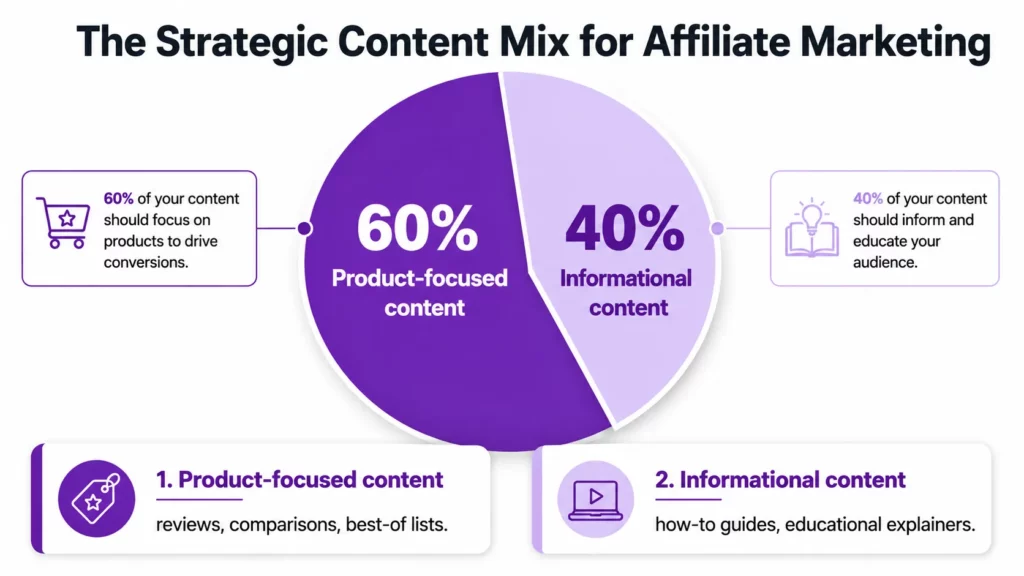
The strategic balance for most affiliate sites is approximately 60% product-focused content (reviews, comparisons, best-of lists) and 40% informational content (how-to guides, educational explainers, problem-solving articles).
Keyword targeting strategy. Every piece of content should be built around a specific keyword that real people are searching for and that your site has a realistic chance of ranking for. The beginner keyword strategy — target long-tail keywords with 100–1,500 monthly searches and low competition — is covered in full in our SEO guide for affiliate marketing beginners.
Writing for trust. The most important content principle in affiliate marketing is this: write to help the reader make a good decision, not to push them toward a specific outcome. Content that honestly addresses who a product is not right for, what the genuine limitations are, and when a reader would be better served by a different option converts better than uniformly positive content — because it builds the reader’s trust that makes the affiliate link worth clicking.
For a detailed structure and fill-in-the-blank template for product reviews specifically, read our guide to how to write affiliate product reviews that convert.
Step 5 — Build Consistent Publishing Habits
Strategy without execution produces nothing. The most common reason affiliate marketing sites fail is not a bad strategy — it is inconsistent execution. Sites that publish one post per month for a year will not build the content library required for meaningful organic traffic. Sites that publish two quality posts per week consistently for twelve months will.
The execution habits that matter most:
Volume in the early phase. In the first six months, the goal is to build a content library large enough for Google to understand your site’s topical focus. This requires consistent publishing — two posts per week is the standard recommendation. The posts do not need to be perfect; they need to be thorough, honest, and targeted at specific keywords.
Quality over quantity as you scale. Once your site has thirty or more posts and organic traffic is beginning to develop, the strategic focus shifts from volume to quality. Improving your best-performing posts — adding more depth, updating information, strengthening internal links — often generates faster results than publishing new posts.
The review and refresh cycle. Affiliate marketing content has a shelf life. Prices change, products are discontinued, and programme terms are updated. Setting a schedule to review and refresh your existing content every six to twelve months maintains the accuracy and relevance that search engines reward.
Tracking what works. Google Search Console shows which posts are attracting impressions and clicks from organic search. Affiliate programme dashboards show which content is generating link clicks and commissions. Reviewing these metrics monthly — not daily, monthly — and creating more content similar to your best performers is the compounding mechanism that accelerates growth from month twelve onwards.
The Tools You Need to Execute This Strategy
The full beginner tool stack — from hosting and WordPress through to SEO plugins, keyword research tools, email platform, and affiliate link management — costs between $3 and $8 per month in the first year. Everything on that list beyond basic hosting has a free tier that covers everything a new affiliate site needs.
For the complete, honest breakdown of what to pay for and what to use for free, read our guide to the best free tools for affiliate marketing beginners.
For retirees who want a structured learning path rather than assembling knowledge from scattered sources, Wealthy Affiliate provides training, hosting, keyword research tools, and a community in one platform. The free Starter account lets you explore the platform without committing to anything paid.
How Long Does This Strategy Take to Produce Results?
The honest answer: six to twelve months of consistent effort before meaningful organic traffic and first commissions. Twelve to twenty-four months to reach a reliable monthly income from affiliate marketing.
This timeline is not a failure of the strategy — it is the nature of compound-growth models. The first twelve months are the investment phase. The returns begin to compound from month twelve onwards, and by month twenty-four, consistent publishers typically have a genuinely growing secondary income stream from content they published months or years earlier.
The people who succeed at affiliate marketing are not the ones who start fastest. They are the ones who keep going past the point — usually around months three to six, when effort is high, and results are minimal — where most beginners stop.
For a full, honest breakdown of the income timeline with month-by-month expectations, read our guide to how long affiliate marketing takes to make money.
Frequently Asked Questions
Is it too late to start affiliate marketing in 2026?
No. The affiliate marketing market is growing, not contracting. The primary change in the landscape — the flood of generic AI-generated content — has made genuinely specific, experience-based content more valuable, not less. Google is actively working to surface content that demonstrates real expertise and an authentic perspective. That is a description of the kind of content the Ageless Revenue audience is best positioned to produce.
How much does it cost to start?
The essential startup costs are a domain ($10–15/year) and hosting ($3–8/month). WordPress and the essential plugins are free. Total first-year cost for a professional affiliate blog: under $100. For a full cost breakdown, read our guide to the best tools for affiliate marketing beginners.
Should I start with a blog or social media?
Start with a blog as your content foundation and use Pinterest to supplement traffic while your search rankings develop. A blog on your own domain is an asset you own — social accounts are not. For a detailed comparison of all the channel options, read our guide to affiliate marketing without a website.
What is the single most important strategic decision?
Niche selection. Everything else — content, SEO, programmes, tools — can be improved or changed relatively easily. Starting in the wrong niche and discovering it six months in is expensive in time and effort. Getting the niche decision right before you build anything else is the highest-return strategic investment you can make.
Your Next Step
The most valuable action from this guide is to make a clear decision on your niche before you do anything else. Read the niche validation guide below, test your idea against the four criteria, and confirm you have a viable niche before investing in any tools or creating any content.
Every other guide linked from this page gives you depth on a specific element of the strategy. Work through them in the order they appear here — niche, platform, programmes, content — and you will be building on a foundation rather than improvising.
The Ageless Revenue complete guide is the right companion to this article — it maps the practical implementation path alongside the strategic framework here.
This post contains affiliate links. If you purchase through one of our links, we may earn a commission at no extra cost to you. We only recommend products and services we have personally assessed as genuinely useful.