
My First Affiliate Sale: What the First 90 Days of Affiliate Marketing Really Felt Like
Affiliate marketing sounded easy when I first discovered it: share the items you already use, get a cut of the sale when people purchase your referral link, and let the process unfold over months with minimal pressure — no boss, no commute, no set hours, no deadlines.
So I tried it. In those first 90 days of affiliate marketing, I found it to be both easier and harder than I expected, in ways I didn’t expect.
This isn’t a plan or a step-by-step tutorial. If you’re seeking a plan, read my complete guide to affiliate marketing for retirees — it walks you through an entire 90-day process and tells you specifically what to do each step of the way.
This journey reflects the reality of the first 90 days of affiliate marketing, filled with challenges and triumphs.
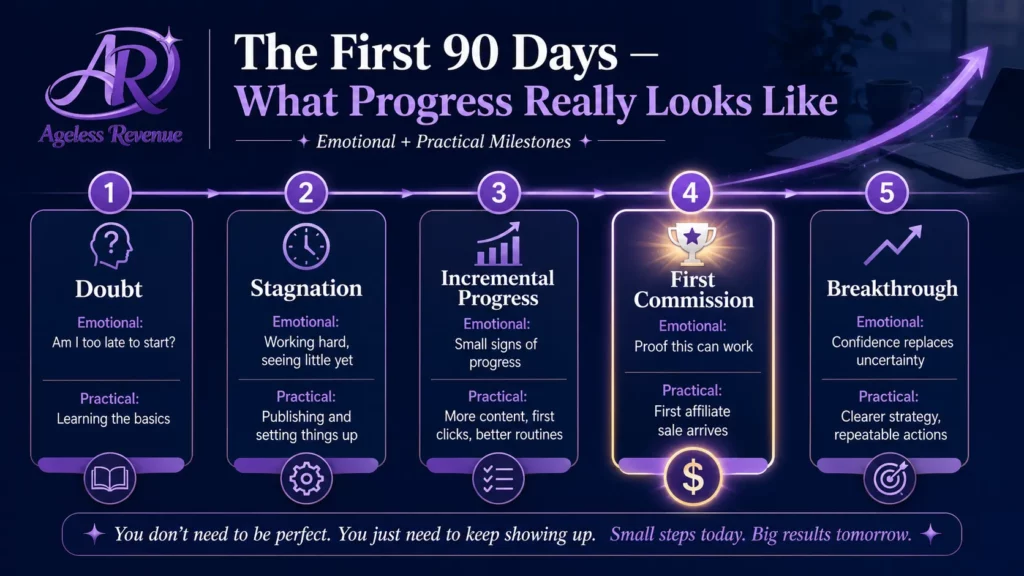
This article is about those 90 days from the inside. It’s what it actually felt like to try to build something with affiliate marketing and watch it grow. It’s the doubt, the stagnation, the incremental progress, and the moment it all made sense.
I’m sharing this because it’s so easy to read a plan and think “no, I can’t do that.” Sometimes what people need to hear is, “yes, but here’s exactly what I went through, and I was able to make it happen.”
Affiliate disclosure: This post contains affiliate links. If you buy through them, I may earn a small commission at no extra cost to you. I only recommend tools I genuinely believe help retirees succeed online.
TL;DR
- The first 90 days of affiliate marketing are not about income — they are about building the habit, the site, and your first library of helpful content.
- The hardest part was not the technology. It was the patience required when nothing visible was happening.
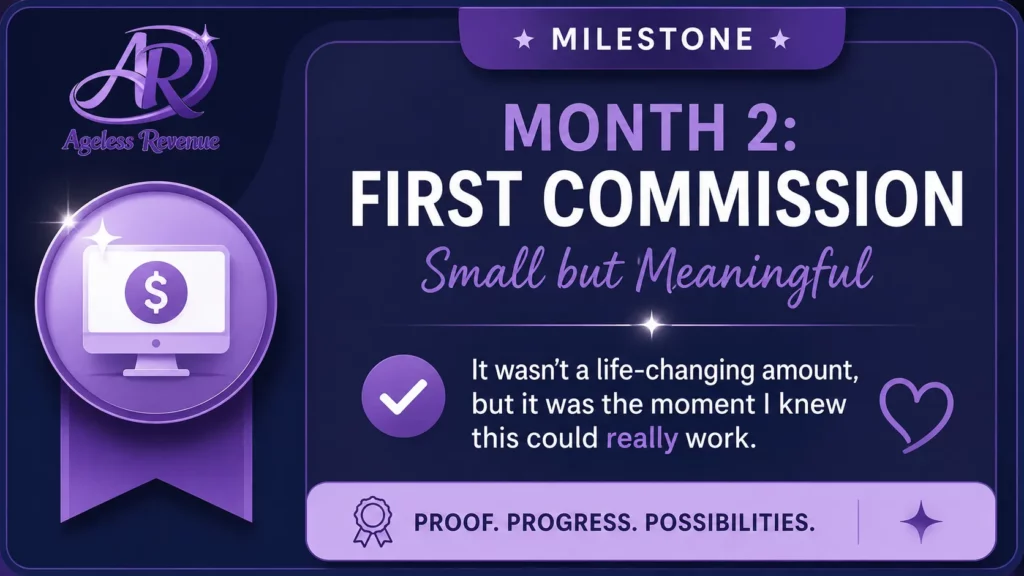
- The first commission arrived in month two — small, but genuinely meaningful.l
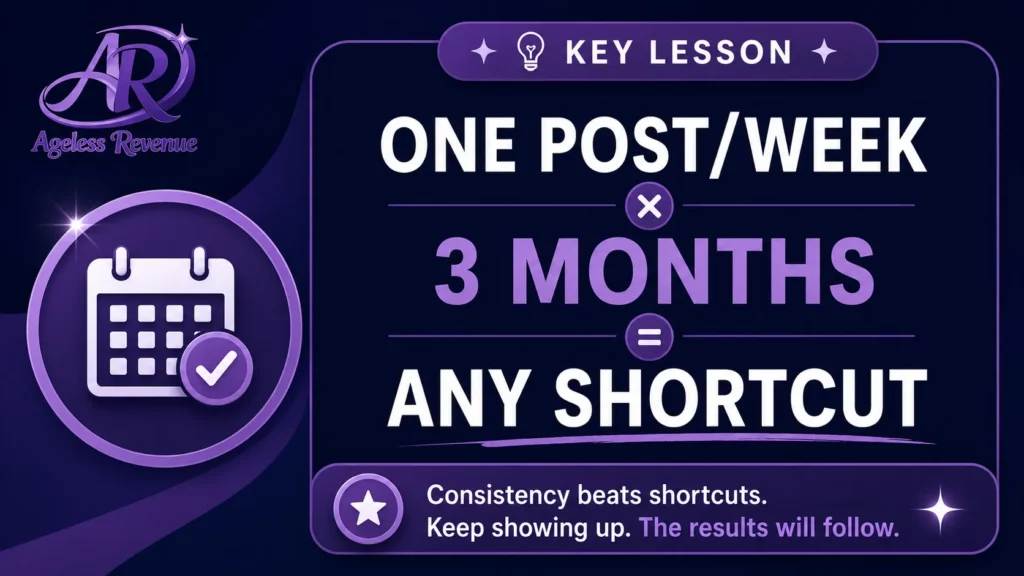
- The biggest lesson: one helpful post per week, sustained for three months, is more powerful than any shortcut
- Everything that felt difficult in the first four weeks felt manageable by week eight
Before I Started: What I Was Afraid Of
I want to be honest about where I started, because I think it matters.
I was not especially confident with technology. I had used email and social media for years, but the idea of building a website, installing plugins, and understanding terms like “niche,” “SEO,” and “affiliate links” felt genuinely intimidating.
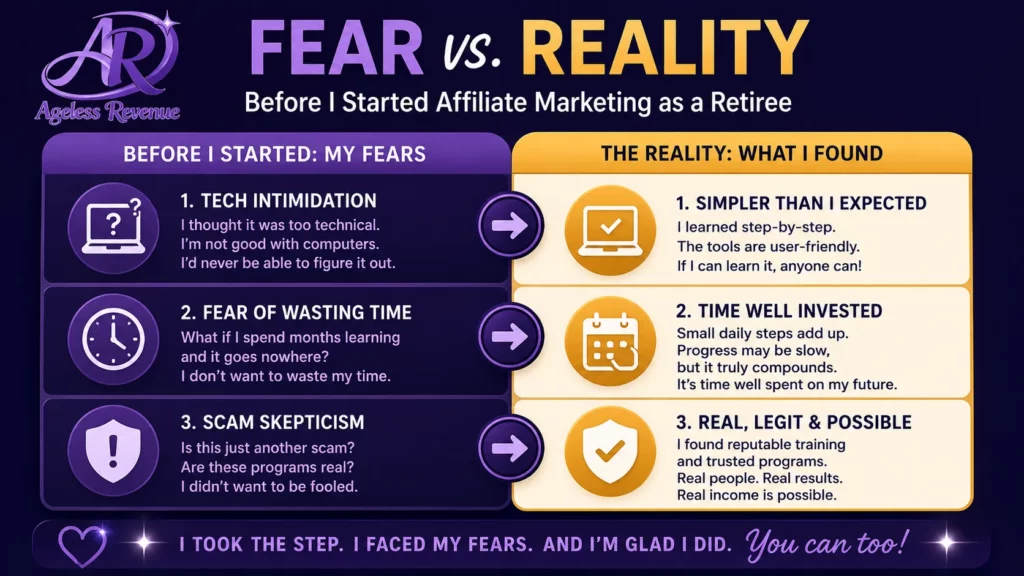
I was also afraid of wasting time. Retirement is precious, and spending weeks on something that turns out to be a scam or a dead end felt like a real risk. I had read enough overpromising headlines to be sceptical.
What finally convinced me to try was finding content that did not promise overnight results — that was honest about the timeline, the effort, and the realistic income expectations. That honesty felt more trustworthy than the flashy alternatives.
So I started. And here is what actually happened.
Days 1 to 7: More Confusing Than Expected
The first week was humbling. I chose my niche — accessible gardening for older adults — because it was something I genuinely knew and cared about. That part felt easy.
The part that did not feel easy was setting up the website. Even with a step-by-step guide open on a second screen, there were moments where the terminology felt foreign, and the number of decisions felt overwhelming. Which hosting provider? Which theme? How do permalinks work? What is an SSL certificate and why does it matter?
I made a decision that helped enormously: I gave myself permission to make imperfect choices and move forward anyway. The theme could be changed later. The domain name did not need to be perfect. The site just needed to exist.
By day 5, I had a live website. It was simple. The design was basic. But it was mine, it was real, and my About page was written in my own voice. That felt significant. More significant than I expected.
What I learned in week one: the technology is less frightening once you are actually inside it. The anticipation of the difficulty is usually worse than the difficulty itself.
Days 8 to 30: The Slow Build
The second and third weeks were the ones nobody warns you about clearly enough.
I was publishing one post per week. Each one took longer than I thought it would — not because the writing was difficult, but because I was learning as I went. How to format a post for readability. How to add images properly. How to link internally between articles. How to write a headline that was clear without being clickbait.
The traffic numbers during this period were almost comedically small. Some days: zero visitors. Other days: three. My sister had visited twice and a friend once, which probably accounted for most of the early numbers.
This is the phase where I understand why most beginners give up. There is nothing to show for your effort yet. The posts are published, but Google has not found them. The affiliate links are in place, but nobody is clicking them. It genuinely feels like shouting into an empty room.
What kept me going was something I read early on: Google treats new sites like new employees. It watches you for a while before it trusts you. The posts I was publishing in weeks two and three were building a track record, not producing immediate results. The results would come — but only to the version of me who was still there when they arrived.
I published five posts in this phase. Each one was better than the last. I could feel myself getting faster and more confident with the writing and the formatting.
What I learned in weeks two to four: consistency during the invisible phase is the whole game. This is where most people quit, which means it is also where the people who stay start to separate themselves.
Days 31 to 60: Things Started Moving
Something shifted in month two. It was not dramatic. I did not wake up one morning to hundreds of visitors. But when I checked Google Search Console, I could see that my posts were beginning to appear in search results — not on page one, but they were there. A few posts were ranking on pages three and four for their target phrases. For a two-month-old site with no backlinks and no social media presence, that felt like real progress.
I joined Amazon Associates during week five, once I had enough content for the application to feel credible. The approval came quickly. I went back through my existing posts and added affiliate links where they fit naturally — not forced into every paragraph, but placed where a reader would genuinely benefit from a specific product recommendation.
I also published my first dedicated product review in this phase: an honest assessment of a specific raised garden bed I had actually used. I wrote about what I liked, what I found annoying, who it would suit, and who should look for something different. It was the most personal piece I had written, and it became one of my best-performing articles. Fifteen clicks on affiliate links in one week. Still no purchases. But fifteen real people had clicked, and that meant the content was working well enough to generate interest.
What I learned in month two: personal, specific, honest content performs better than general overviews. Readers can tell when you have actually used something versus when you are just describing it from a product page.
The First Commission
It arrived on a Tuesday morning in week nine. A small notification in my Amazon Associates dashboard. One sale. A raised garden bed — not the exact one I had reviewed, but a similar one a reader had found through my site and apparently decided to buy.
The commission was $4.73.
I want to be clear about why that felt significant, because $4.73 is objectively a small amount of money. It was significant because it proved the model worked. A real person had found my content, trusted my recommendation enough to click, and spent their own money on something I had suggested. That is not nothing. That is the whole thing, just at the beginning.
I sat with that notification for a few minutes before I did anything else.
Days 61 to 90: Finding the Rhythm
The last third of the first 90 days felt different from everything that came before it. Not dramatically different — the traffic was still modest, the income was still small — but the work had become a rhythm rather than a struggle.
I knew how to write a post efficiently. I knew which types of content my small audience responded to. I knew what to check in my analytics and what to ignore. The platform had stopped feeling foreign and had started feeling like mine.
I published my tenth post in week eleven. I crossed 100 monthly visitors somewhere around day 80. A few email subscribers had signed up through a simple checklist I offered as a download. By day 90, I had earned a total of $31 in affiliate commissions — not a living, not even close, but a real, repeatable number that had grown from zero.
The beginning is slow, and patient, and worth every bit of it.
Ready to Start Your Own 90 Days?
If this story resonated and you want the practical step-by-step version of what to do, read the complete guide to affiliate marketing for retirees. It gives you the full 90-day plan broken down by phase, with specific actions for each stage.
For the day-by-day breakdown of your first week specifically, read Starting Affiliate Marketing With No Experience: Your 14-Day Action Plan — it takes you from nothing to a live site with your first posts published in fourteen days.
When you are ready to start with a structured training platform that gives you everything in one place — training, hosting, tools, and community — open your free Wealthy Affiliate account here → No credit card needed.
Frequently Asked Questions
How long until you see your first affiliate commission?
For most consistent beginners, the first commission arrives around month two — often small, but genuinely meaningful as proof the model works.
Is the first 90 days mostly about income?
No. The first 90 days are mostly about building the habit, the website, and your first library of helpful content. Income follows later as that foundation compounds.
What was the hardest part of the first 90 days?
Not the technology — the patience required when nothing visible was happening yet. Most of the early weeks feel uncertain before momentum becomes visible.
What is the single biggest lesson from the first 90 days?
One helpful post per week, sustained for three months, is more powerful than any shortcut or quick-win tactic.
This post contains affiliate links. If you buy through them, I may earn a small commission at no extra cost to you.