Affiliate Marketing Without a Blog — 7 Channels That Actually Work
Affiliate marketing without a website is not a workaround or a shortcut — for many people it is simply the right starting point. A blog is one route to earning affiliate commissions. It is not the only route, and for people who find the idea of managing a website genuinely off-putting, it is not even the best route. Exploring affiliate marketing without a website offers unique advantages, especially for beginners.
The honest tradeoff is this: when you build an audience on a platform you do not own — Pinterest, YouTube, Facebook, email — you are subject to that platform’s rules and algorithm changes. A blog on your own domain is more resilient long-term. But for a beginner building the skills and confidence to produce helpful content and earn first commissions, starting on a familiar platform is a perfectly sensible decision.
Affiliate marketing without a website allows you to leverage existing platforms and build a following while earning commissions.
Many successful marketers start their journey in affiliate marketing without a website, utilizing social media or email to drive traffic to their offers.
This guide covers seven channels for doing affiliate marketing without a blog, with an honest assessment of each. Two of them — Pinterest and email — are the clear recommendations for most of the Ageless Revenue audience, and you will see why as you read through.
Affiliate marketing without a website can also mean using a link-in-bio tool on social media platforms to direct followers to affiliate products.
For a broader picture of how affiliate marketing fits into building sustainable online income, the Ageless Revenue complete guide covers all the options. If you are already thinking about starting a blog after reading this, our guide to how to start a niche blog for affiliate marketing walks through that path step by step.
Affiliate disclosure: This post contains affiliate links. If you purchase through one of our links, we may earn a commission at no extra cost to you.
By focusing on affiliate marketing without a website, you can reach your target audience where they already spend their time online.
Engaging in affiliate marketing without a website opens up opportunities for earning without the overhead of website maintenance.
Building an audience through affiliate marketing without a website is all about providing value and recommendations that resonate.
Before You Pick a Channel — One Thing to Do First
Many content creators thrive in affiliate marketing without a website by utilizing engaging content on platforms they enjoy.
Before choosing a platform, choose your niche. The platform decision should follow the niche decision, not the other way around.
A niche is the specific topic area you will create content about and the specific audience you will serve. Without a clear niche, your content on any platform will be unfocused, hard to find, and unlikely to attract the kind of engaged audience that clicks affiliate links and buys.
Once you have a niche, let your natural communication style guide the platform choice. If you prefer writing and creating visual content, Pinterest and email are the natural fit. If you are comfortable on camera or enjoy conversation, YouTube or a podcast might suit you better. If you like community interaction, Facebook groups are worth exploring.
The worst reason to choose a platform is “because I already have an account there.” Choose based on where your target audience spends time and how you communicate most naturally.
For a full framework to evaluate and validate a niche idea before committing, read our guide to how to choose a profitable niche for affiliate marketing.
Channel 1 — Pinterest
Beginner difficulty: Low | Best for: product recommendations, guides, comparison content
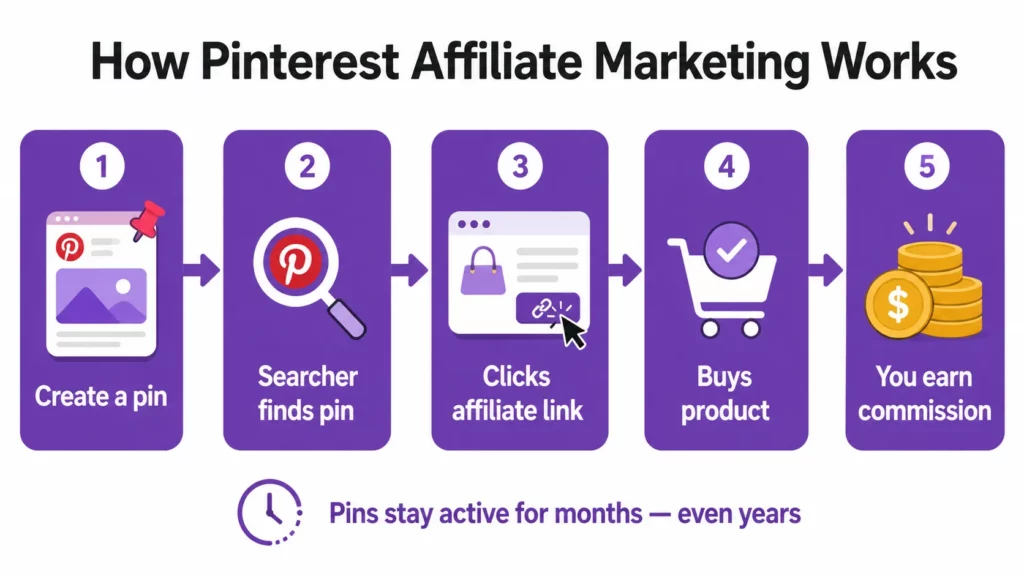
Pinterest is the most underrated affiliate marketing channel for beginners, and for one important reason: it is a search engine, not a social network. When someone opens Pinterest, they are not scrolling through friends’ updates — they are actively searching for ideas, products, and solutions. That search intent is what makes Pinterest exceptional for affiliate marketing.
Unlike Instagram or TikTok, where content disappears from feeds within hours, a Pinterest pin can generate clicks and commissions for months or years after it is published. Pins are indexed by Google as well as by Pinterest’s own search algorithm, which means your content can be found through both platforms simultaneously.
Affiliate marketing without a website can be particularly effective for those who excel in visual storytelling or videos.
Using YouTube for affiliate marketing without a website allows you to create engaging content that can drive significant traffic.
What works on Pinterest for affiliate marketing:
Product roundup pins (“10 best walking boots for wide feet”) perform consistently well because they match exactly how people search on the platform. How-to pins (“how to set up a raised bed garden”) work in hobby niches. Comparison pins (“X vs Y — which is better?”) capture readers who are close to making a purchase decision.
How to add affiliate links on Pinterest:
Pinterest allows direct affiliate links on most pins — you can place your affiliate URL directly in the pin’s destination link field. Some affiliate programs restrict direct pinning; always check individual programme terms. Where direct linking is not permitted, link to a simple landing page or a blog post that contains your affiliate links.
What you need to start: A free Pinterest Business account (converted from personal, or created fresh). Canva’s free tier handles pin design easily. MailerLite is useful for capturing email addresses from Pinterest traffic even before you have a blog.
Pinterest’s affiliate marketing guidelines require disclosure — add a simple “#ad” or “#affiliate” notation to your pin description.
Channel 2 — YouTube
Beginner difficulty: Medium | Best for: product reviews, tutorials, demonstrations
YouTube is the world’s second-largest search engine, and for affiliate marketing it excels in categories where visual demonstration adds genuine value — product reviews, how-to tutorials, unboxing videos, and “best of” comparison lists.
Email newsletters can be a powerful tool in affiliate marketing without a website, allowing you to communicate directly with interested subscribers.
For those involved in affiliate marketing without a website, understanding your audience’s needs is critical for success.
The barrier that puts most people off YouTube is the camera. But the equipment requirements are lower than most people assume: a modern smartphone, decent natural light from a window, and a quiet room are sufficient to produce content people will watch. Many successful affiliate YouTube channels are filmed at a kitchen table or in a garden. Alternatively, voiceover content — where you narrate over screen recordings or images without appearing on camera — is a fully viable format.
How affiliate links work on YouTube:
Your affiliate links go in the video description, below the video. Add them with a brief label (“walking boots I’m wearing in this video →”) and your FTC disclosure (“affiliate link — I may earn a commission at no extra cost to you”). Most affiliate programmes accept YouTube as a promotional channel, but check individual terms before linking.
What drives success on YouTube: Specificity and honesty. A 12-minute review of a specific product — with real usage footage, genuine observations, and a clear final recommendation — will outperform a vague 30-minute “top 10” video every time. The Ageless Revenue audience has a natural advantage here: years of experience with products in your niche make your reviews more credible and more specific than a young generalist’s content.
The main commitment is consistency. YouTube rewards channels that publish regularly, even if each video is modest in production quality.
Channel 3 — Email Newsletter
Facebook groups can enhance your strategy in affiliate marketing without a website by fostering community engagement.
For affiliate marketing without a website, focus on building trust and providing value in every interaction.
Beginner difficulty: Low–Medium | Best for: any niche; especially for audiences who prefer in-depth recommendations
An email newsletter is the affiliate marketing channel with the highest conversion rate of anything on this list — and unlike every other option here, you own your audience completely. An algorithm change on Pinterest or YouTube can cut your traffic overnight. Nobody can take your email list from you.
The mechanism is simple: readers opt in to receive your newsletter (typically in exchange for a free resource — a checklist, a short guide, a curated recommendation list). You send regular emails that share genuinely useful content and, where appropriate, recommend products with your affiliate links. When a reader clicks a link and buys, you earn a commission.
Starting from zero subscribers:
Utilizing platforms like Quora for affiliate marketing without a website allows you to answer questions and provide valuable insights.
Reddit can be a great supplementary channel in affiliate marketing without a website if used thoughtfully and respectfully.
The first subscribers come from wherever your potential audience already is — sharing your sign-up link in Facebook groups relevant to your niche, mentioning your newsletter in your Pinterest bio, telling people you know personally. A simple lead magnet (a free PDF, a short email course, a “top 10 tools” list) converts curious visitors into subscribers far more effectively than a plain “sign up for updates” prompt.
The best free tools to start:
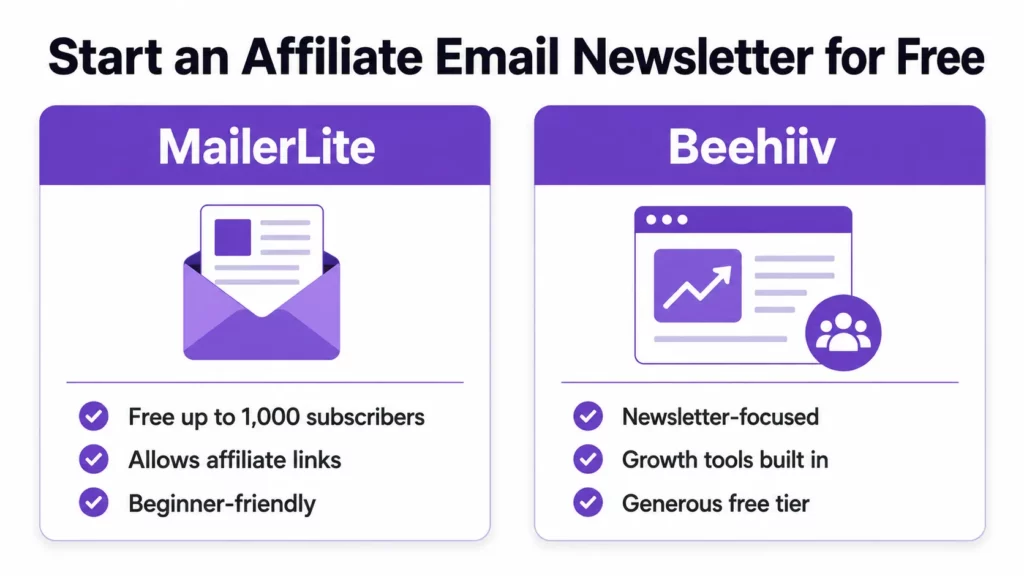
MailerLite is free up to 1,000 subscribers, allows affiliate links in emails (always check current terms), and has a clean, beginner-friendly interface. Beehiiv is a newer option that is particularly well designed for newsletter publishing, with a generous free tier and good growth tools built in.
For a complete guide to building and monetising an email list for affiliate marketing, read our dedicated guide to email marketing for affiliate revenue.
Creating a link-in-bio page is a strategic approach to affiliate marketing without a website, making your links easily accessible.
FTC disclosure in emails: Your disclosure must appear at or near the top of any email containing affiliate links — not buried at the footer.
Channel 4 — Facebook Groups
Beginner difficulty: Low | Best for: community-oriented niches, health/wellness, hobbies, local topics
Facebook groups work differently from the other channels on this list. Rather than publishing content that attracts an audience through search, you are joining or building a community of people with a shared interest — and earning trust through genuine participation before making any recommendations.
Podcasting is another effective method of affiliate marketing without a website, allowing for deep engagement with audiences.
Two approaches:
The first is to join existing Facebook groups in your niche and participate genuinely. Answer questions, share useful information, and build a reputation over weeks and months. When you do recommend a product with an affiliate link, you must disclose the relationship clearly — something like “I use and earn a small commission from this, but I genuinely recommend it because…” Spamming groups with unsolicited affiliate links will get you removed and damage your reputation.
The second approach is to create your own niche group. This takes longer to build but gives you full control and a captive audience for your recommendations. Groups around specific topics — a particular health condition, a specific hobby, a local community interest — can grow to several hundred engaged members within months of consistent, valuable posting.
What the FTC requires in Facebook groups is the same as everywhere else: any material connection to a product you are recommending must be clearly disclosed before the recommendation. This is non-negotiable regardless of the platform.
Channel 5 — Quora and Reddit
Beginner difficulty: Low | Best for: supplementary traffic; niche question-and-answer content
For many, the combination of Pinterest and an email newsletter serves as a powerful strategy in affiliate marketing without a website.
Both platforms are built around questions and answers, which makes them natural environments for affiliate marketing content — in theory. In practice, both require careful, platform-specific approaches.
Ultimately, the best approach to affiliate marketing without a website is to choose channels that align with your skills and interests.
For those who love visual content, Pinterest is an excellent platform for affiliate marketing without a website.
In-depth recommendations through an email newsletter can significantly enhance your affiliate marketing without a website results.
Quora allows affiliate links in answers, but only where they are directly relevant to the question being answered and genuinely add value. Quora’s spam detection is active, and answers that feel promotional rather than helpful are removed. The approach that works: write a thorough, genuinely useful answer to a question in your niche, and include your affiliate link as a natural resource reference rather than the point of the answer. Quality and specificity are rewarded; promotion is penalised.
Reddit is significantly more restrictive. Most subreddits explicitly prohibit affiliate links, and Reddit’s community culture is deeply averse to anything that feels like advertising. Using Reddit for affiliate marketing without a careful, contribution-first approach will result in bans. Where Reddit works is as a traffic source to a landing page or email newsletter that contains your affiliate content — rather than as a direct affiliate link destination.
Both platforms are best treated as supplementary channels rather than primary ones. A well-placed Quora answer can drive consistent traffic for months, but neither platform replaces Pinterest or email as a sustainable affiliate marketing channel without a blog.
Channel 6 — Link-in-Bio Page
With many options available, affiliate marketing without a website can be a rewarding venture for dedicated marketers.
In summary, affiliate marketing without a website is a versatile route that adapts to various personal strengths and preferences.
Overall, affiliate marketing without a website is a viable option that many successful marketers utilize to reach audiences.
Beginner difficulty: Very Low | Best for: Instagram or TikTok users who already have an audience
A link-in-bio page is a single landing page that hosts multiple links — including your affiliate links — accessible from your social media profile bio. Tools like Linktree, Stan.store, and the free tier of Carrd make building one a ten-minute exercise.
This is the lowest-friction affiliate marketing setup possible: no blog, no newsletter, no complex configuration. You direct followers from your social bio to a page with organised affiliate links, and you earn commissions when they click through and buy.
The ceiling here is proportional to your existing social audience. If you already have a meaningful following on Instagram or TikTok in a relevant niche, a link-in-bio page is an immediate way to start monetising. If you are building from zero, the effort invested in growing a social following for this purpose is likely better directed toward Pinterest or email, which generate more durable, search-driven traffic without requiring you to post at social media pace.
Channel 7 — Podcast
Beginner difficulty: Medium | Best for: niche topics with a conversational, in-depth audience
These strategies collectively highlight how affiliate marketing without a website is not only possible but can also be highly lucrative.
Podcasting has grown significantly as a content format, and it suits the Ageless Revenue audience in a specific way: older listeners are disproportionately represented in podcast audiences, and long-form audio content rewards the kind of deep, experience-based knowledge that this audience tends to have.
To conclude, affiliate marketing without a website presents various pathways to success for those who choose to explore them.
Affiliate marketing through a podcast works via two mechanisms: verbal promo codes (“use code GARDEN20 for 20% off at the link in show notes”) and show notes links (a written companion to each episode, published on a simple webpage, that contains your affiliate links).
While each channel has its strengths, the core principle of affiliate marketing without a website remains focused on audience connection.
Getting started: Buzzsprout is the most beginner-friendly podcast hosting platform and has a free tier that covers the basics. Recording equipment can be as simple as a USB microphone ($30–60) and free Audacity software for editing, though a smartphone recording in a quiet room is workable for early episodes.
The main commitment is consistency and length — podcast audiences expect regular new episodes, and the format rewards deeper, longer-form content than most other channels. For someone who enjoys conversation and has a lot to say about a specific topic, podcasting is a genuinely viable affiliate marketing channel without a blog.
Which Channel Should You Start With?
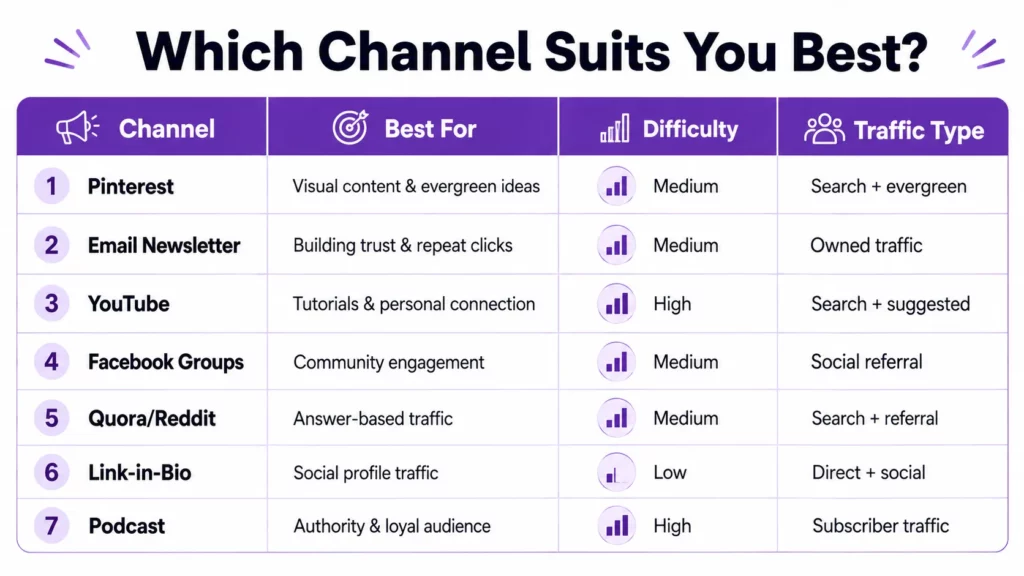
The honest answer depends on how you communicate most naturally. But here is the clearest guidance for the Ageless Revenue audience:
Start with Pinterest if you enjoy writing and creating visual content, your niche has strong product discovery intent (home, garden, health, food, crafts, travel), and you want a channel that generates long-lasting, search-driven traffic without appearing on camera.
Start with an email newsletter if you prefer one-to-one communication, you want to own your audience completely, or your niche is better served by in-depth recommendations than by visual content.
Start with YouTube if you are comfortable on camera, your niche benefits from demonstration (tools, cooking, fitness, tech), and you are willing to commit to regular video production.
For most people reading this guide, Pinterest combined with an email newsletter is the strongest starting combination. Pinterest drives traffic and builds awareness; email captures the most engaged readers and converts them at the highest rate.
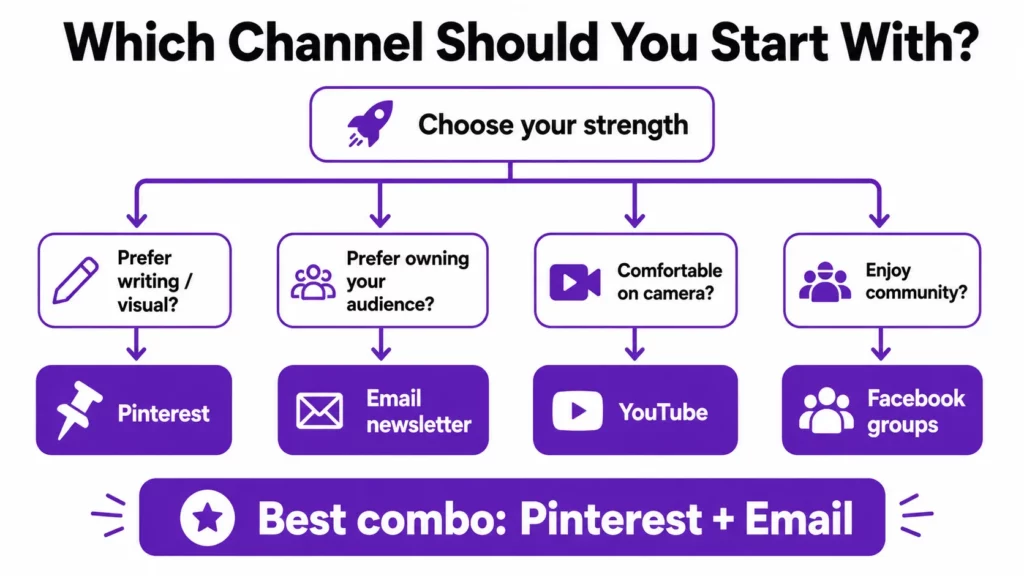
| Channel | Best for | Difficulty | Traffic type |
|---|---|---|---|
| Product discovery niches | Low | Long-lasting, search-driven | |
| Email newsletter | Any niche | Low–Medium | Owned, algorithm-free |
| YouTube | Demonstration niches | Medium | Search-driven, long-lasting |
| Facebook groups | Community niches | Low | Relationship-driven |
| Quora / Reddit | Q&A supplementary | Low | Search-driven, supplementary |
| Link-in-bio | Existing social audience | Very low | Social, follower-dependent |
| Podcast | Conversational, in-depth niches | Medium | Subscription-driven |
Frequently Asked Questions
Do affiliate programmes allow promotion without a website?
Most do, yes — but terms vary by programme. Amazon Associates explicitly accepts social media channels including Pinterest and YouTube. Most networks (ShareASale, Impact, CJ, ClickBank) accept non-blog promotional channels. Always read the individual programme’s promotional methods policy before applying, and list your actual channels honestly in the application. Misrepresenting your promotional methods risks account termination.
Which channel makes the most money?
The channel that earns the most is the one you use most consistently and that best matches your audience’s purchase behaviour. Email newsletters consistently generate the highest conversion rates of any channel. Pinterest generates the most passive, compounding traffic over time. YouTube generates the highest per-view engagement for product-focused content. There is no universal winner — only the channel that fits your niche and communication style best.
Can I use multiple channels at once?
Yes, and eventually you should. But starting with more than two channels simultaneously spreads your effort too thin during the phase when consistency matters most. The practical approach is to start with one primary channel, build a sustainable publishing routine, then add a second channel once the first is established.
Do I need to disclose affiliate links on social media and in emails?
Yes. The FTC’s disclosure requirements apply regardless of platform — social media posts, Pinterest pins, YouTube video descriptions, email newsletters, Facebook group posts, and podcast show notes all require clear disclosure of affiliate relationships. The disclosure must be prominent and easy to understand — not hidden in hashtags, buried at the bottom, or written in language designed to obscure the relationship.
Your Next Step
If Pinterest is your chosen starting point, our guide to Pinterest for affiliate marketing beginners covers the setup and content strategy in detail.
If you are leaning toward an email newsletter, the complete guide to email marketing for affiliate revenue walks through building your list from zero.
For a comparison of the best affiliate programmes that accept non-blog channels, read our guide to the best affiliate programmes for beginners.
And if you have changed your mind and would like to explore starting a blog after all, our guide to how to start a niche blog for affiliate marketing walks through the full setup from scratch.
This post contains affiliate links. If you purchase through one of these links, we may earn a commission at no extra cost to you. We only recommend products and services we have personally assessed as genuinely useful.