

Finding Your Profitable Niche (2026): The Complete Guide for Retirees Over 60
Finding a profitable niche for retirees over 60 in 2026 with a calm step-by-step checklist.
Starting an online business after 60 is absolutely doable — and your niche decision is the biggest lever you control in the beginning. A good niche makes content ideas easier, helps you attract the right readers, and gives you clear products to recommend without sounding “salesy.” A bad niche creates confusion, burnout, and months of effort that don’t convert.
This guide is written for retirees who want a calm, practical, step-by-step way to choose a niche that’s enjoyable and capable of earning in 2026—no jargon overload. No hype. Just a repeatable process you can follow, even if you’re not very tech‑savvy.
Offer: Download the free Starter Kit (printable checklists + a simple weekly plan):
Disclosure: This post may contain affiliate links. If you click and purchase, I may earn a commission at no extra cost to you. I only recommend tools and services I believe are genuinely helpful.
Want the quick version first? Our How to Choose and Validate Your Affiliate Niche guide covers the essentials in about 10 minutes. This guide is the complete, deeper system — with a scoring worksheet, validation exercises, and a full 30-day test plan — for when you’re ready to go further.
TL;DR (2026)
If you want the short version, do this:
- Pick a niche you can write about for months without burnout.
- Choose a clear reader: one person, one problem, one outcome.
- Confirm people spend money in the niche (products, services, subscriptions).
- Validate with proof signals (search demand, communities, products, affiliate programs, content gaps).
- Start with a micro‑niche first; expand later.
- Build a list of at least 30 post ideas before you commit.
- Run a 30‑day niche test and decide with evidence.
- Keep your site offer consistent: Starter Kit.
What a “profitable niche” really means (and what it doesn’t)
A profitable niche is a topic area where people have real problems, search for solutions, and spend money to solve them. That’s it. The goal is not to pick a niche that sounds impressive. The goal is to pick a niche that produces helpful content topics, attracts the right readers, and has products you can recommend ethically.
A profitable niche is not:
- a trend you don’t care about
- a topic that makes you dread writing
- a niche where nobody buys anything
- a niche where you can’t imagine 30 posts
- a niche where you feel uncomfortable recommending products
- a niche where you must constantly chase breaking news
Exploring a Profitable Niche for Retirees
In 2026, retirees often win by being clearer, calmer, and more practical than most content online. Seniors and beginners love simple steps, checklists, and “what to do next.”
Why niche selection matters more than your website theme
It’s tempting to spend weeks picking colors, fonts, and plugins. But niche selection matters more than design because it decides:
- what people search for (traffic potential)
- What you will write (content consistency)
- What can you recommend (monetization options)
- who trusts you (conversion)
A plain site with a great niche can grow. A beautiful site with a confusing niche often stalls. If you want a calm business, choose the niche first, then build around it.
The retiree niche mindset: build a library, not a lottery ticket
Think of your site like a helpful library. Each post is one “book” that answers one real question. Over time, your library grows, your authority grows, and traffic grows steadily.
That’s why niches with lots of beginner questions are powerful. You’re not trying to go viral. You’re trying to be the best answer for a specific person.
Step 1: Start with your retiree advantage (your unfair edge)
Before you look at keywords or competition, start with yourself. You don’t need to “invent” expertise — you need to organize what you already know and what you can learn comfortably.
A quick retiree inventory
Write down anything that fits:
- hobbies you enjoy
- problems you have solved repeatedly
- skills from your career
- life transitions you’ve navigated (downsizing, caregiving, health routines, learning tech, travel planning)
- things friends ask you for help with
Retirees often underestimate how valuable lived experience is. Beginners don’t want perfection. They want someone who understands their situation and explains things patiently.
The “stress level” check
Ask yourself:
- Does this niche feel calm or stressful?
- Would I be comfortable answering beginner questions about it repeatedly?
- Does it require constant updates or drama?
- Can I write about it even in low-energy weeks?
The best niche is one you can keep showing up for, even when you’re tired.
Step 2: Choose one reader, one problem, one outcome
Use this sentence:
I help (who) with (problem) so they can (outcome).
Examples:
- I help retirees start affiliate marketing so they can build extra income with a calm routine.
- I help seniors build strength at home so they can move confidently.
- I help small-space gardeners grow food so they can garden without a yard.
- I help older adults travel comfortably so they can enjoy trips without pain and hassle.
- I help seniors use their iPhones safely so they can avoid scams and stay connected.
If you can’t easily fill that sentence, your niche is too broad.
Why this matters
When you choose one clear reader, your content becomes easier to write and easier to rank. Your headings become more specific, your examples become more relevant, and your recommendations feel more trustworthy.
If your reader is “everyone,” your posts usually become generic. Generic posts struggle to rank and rarely convert.
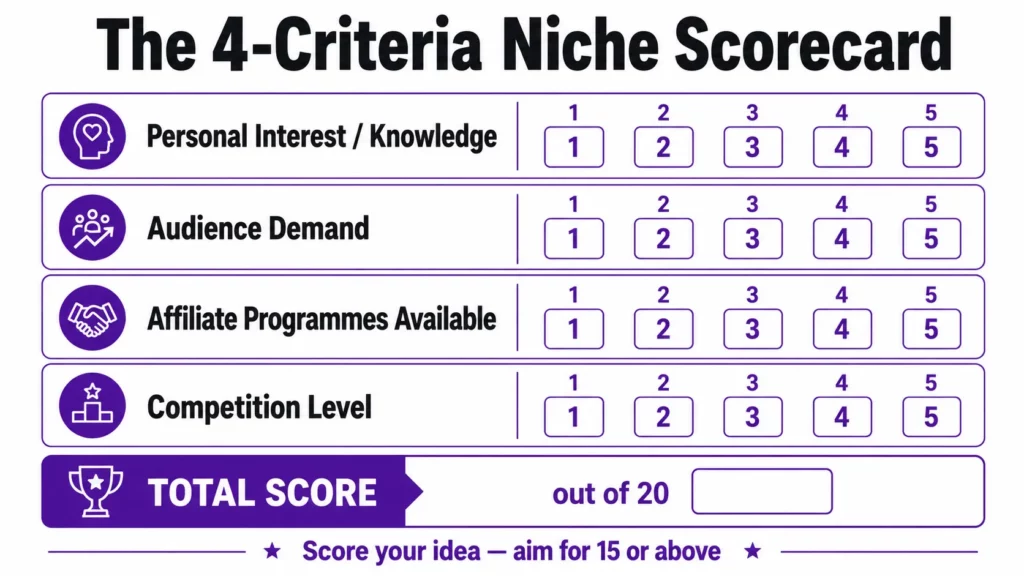
Step 3: The 5 Filters scorecard (your calm niche test)
Niche scorecard for retirees in 2026 using five filters: enjoyment, problem clarity, buyer behavior, content runway, and competition.
Score each category 1–5. Add the total.
- Enjoyment: Can you stick with it?
- Problem clarity: Do questions repeat?
- Buyer behavior: Do people spend money?
- Content runway: Can you list 30+ posts?
- Competition: Can you stand out by being clearer?
How to interpret the score:
- 20–25: strong candidate
- 16–19: workable with a narrower angle
- 15 or below: revise the angle or skip
What “competition” means for retirees
Competition is not your enemy. Competition is proof that people care, and money exists. Your job is not to out-muscle big sites. Your job is to out-clarify them.
Retiree advantage: seniors and beginners often prefer calm guidance over flashy “expert” content.
Step 4: Validate with proof signals (before you commit)
Proof signals checklist for niche validation in 2026: search demand, communities, products, affiliate programs, and content gaps.
Aim for at least 3 proof signals:
- Search demand exists (autocomplete + People Also Ask)
- Active communities exist (Facebook groups, forums, Reddit)
- Real products exist (lots of items people buy)
- Affiliate programs exist (brands + networks)
- Content gaps exist (ranking pages are missing beginner steps)
What search demand looks like
Search demand doesn’t have to be huge. You’re not trying to rank for “fitness” or “gardening.” You’re looking for repeated beginner questions, like:
- best walking shoes for seniors with arch support
- container gardening soil for tomatoes
- How to stop scam calls on iPhone
- Affiliate Marketing for Retirees: Step-by-Step
Repeated questions mean ongoing traffic potential.
A simple “demand in 10 minutes” test
Open Google and type:
- your niche + “for beginners”
- your niche + “for seniors”
- “best” + your niche product category
- your niche + “checklist”
If you immediately see lots of suggestions and People Also Ask questions, you have demand.
Step 4.5: Quick keyword research (free, beginner-friendly)
You do not need paid tools to validate a niche.
Use these methods and write down at least 20 real questions:
- Google autocomplete: type your niche and note suggestions.
- People Also Ask: these questions can be headings or entire posts.
- YouTube autocomplete: if people search it on YouTube, they want to learn it.
- Amazon search + reviews: review headlines reveal real problems.
- Pinterest search (optional): great for visual niches like home, food, crafts, and travel.
If you can gather 20 real questions quickly, your niche has a content runway.
Step 5: Confirm buyer behavior (without guessing)
Buyer behavior is what separates a hobby niche from a profitable niche. You’re looking for signs that people spend money to solve problems.
Look for:
- product variety (many options, not just one)
- product tiers (starter, upgrade, premium)
- repeat purchases (refills, replacements, seasonal supplies)
- services/subscriptions (apps, memberships, coaching)
- “problem urgency” (pain, safety, convenience, time-saving)
The buyer-behavior exercise (10 minutes)
For your niche, find:
- 10 products under $25 (starter)
- 10 products $25–$100 (upgrade)
- 5 products $100+ or subscriptions/services (premium)
If you can do that easily, your niche has monetization depth.
Step 6: Narrow to a micro‑niche (the secret that makes small sites win)
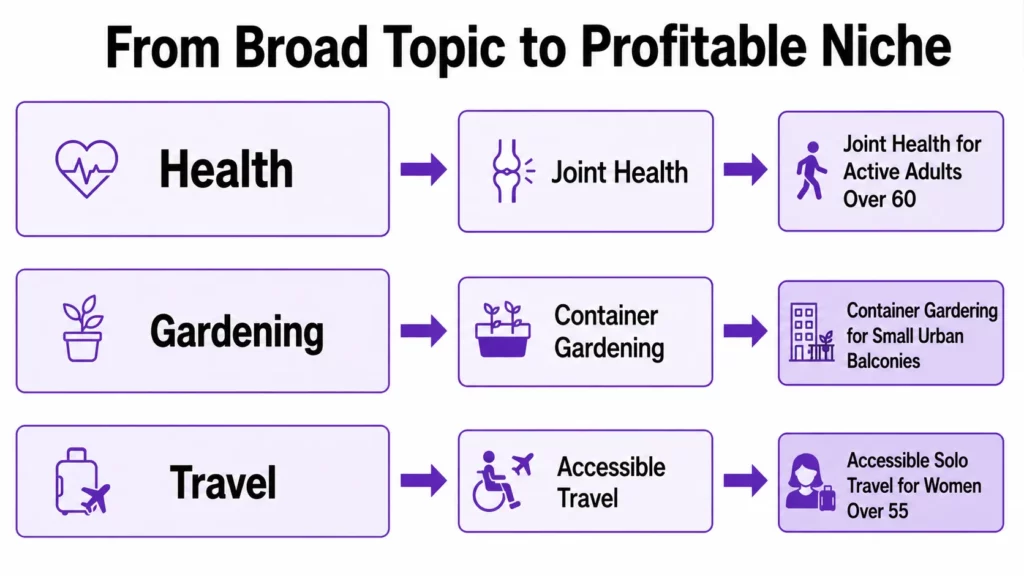
Examples of narrowing big niches to micro-niches for retirees in 2026, such as fitness to low-impact home fitness over 60.
Many beginners choose a niche that’s too big. Then they feel invisible. A better approach is to start narrow, build authority, and expand later.
Big niche → micro‑niche examples:
- Fitness → Low-impact home fitness for beginners over 60
- Gardening → Container gardening for small patios
- Tech → iPhone basics and scam safety for seniors
- Cooking → Easy high‑protein meals for seniors
- Travel → Comfort travel gear for older adults
- Income → Affiliate marketing step‑by‑step for retirees
- Home → Downsizing and decluttering for retirees
Micro‑niches are easier to rank for, easier to write for, and convert better because the reader feels like you’re speaking directly to them.
How narrow is “too narrow”?
Too narrow means you run out of content ideas fast. If you can still generate 40–60 post ideas over time, your micro‑niche is wide enough.
Step 7: Build your monetization map (without sounding salesy)
Create 3 buckets:
- Starter solutions (low cost)
- Upgrades (mid-range)
- Premium/support (high value)
For retirees, “comfort,” “safety,” and “simplicity” are powerful product angles.
Calm rule: recommend what truly helps, explain who it’s for, and don’t overhype. Trust is the strategy.
Step 7.5: How to find affiliate programs step-by-step
Once your niche is chosen, finding affiliate programs is easier than you think.
- List 20 products people buy in your niche.
- Google: “brand name + affiliate program.”
- Check affiliate networks (Impact, ShareASale, CJ).
- Look at competitor “resources” pages for brand ideas (research only).
- Start with beginner-friendly brands your readers already trust.
Don’t chase the highest commission. Chase the best fit for your reader.
Step 8: Create 30 post ideas (before you commit)
If you can’t create 30 post ideas, narrow your niche until you can.
Use post types:
- beginner guide
- checklist
- mistakes to avoid
- best for beginners list
- how‑to tutorial
- troubleshooting guide
- comparison
- buyer guide
- FAQ
- case study/story
- resources page
A retiree-friendly “first 10 posts” plan
If you want a simple start:
- Beginner guide (2026)
- Checklist (what to do first)
- Mistakes to avoid (and fixes)
- Best for beginners (product picks)
- Buyer guide (what to look for)
- How‑to tutorial
- Troubleshooting post
- Comparison post
- FAQ post
- Resources page (your recommended tools)
This plan gives you structure and natural internal links.
Step 8.5: Build content pillars (so your site feels organized)
A content pillar is a big topic that connects many related posts. Most retiree sites do well with the 3 pillars.
Example for “iPhone safety for seniors”:
- Getting started (basic settings, simple steps)
- Staying safe (scams, privacy, security)
- Every day use (photos, texting, helpful apps)
Pillars make it easier to plan, write, and link your posts together.
Step 9: Competition (what to look at and what to ignore)
Big websites exist in every niche. Don’t panic. Look for gaps:
- not written for seniors/beginners
- missing steps
- cluttered
- outdated (not 2026)
- no checklists or examples
- unclear recommendations
Your advantage is clarity.
The 10-minute competition scan
Pick one keyword and open the first 5 results. Ask:
- Is the page easy to read?
- Does it answer quickly?
- Does it include examples?
- Are the steps clear?
- Does it guide next steps?
If you can create a clearer version, you have room to compete.
Step 10: The 30‑day niche test (retiree pace)
30-day niche test plan for retirees in 2026 with weekly steps to publish, validate, and decide.
If you’re unsure, don’t commit for years. Test for 30 days.
Week 1: cornerstone post + Start Here page + Starter Kit link
Week 2: checklist + mistakes + internal links
Week 3: best-for-beginners (3–7 products)
Week 4: improve best post + decide (continue, narrow, pivot)
Step 10.5: The 90‑day follow-through plan (where results start)
Month 2:
- Publish 1 post per week
- Add internal links between related posts
- improve your best post (clarity, headings, examples)
Month 3:
- Publish 1 post per week
- Create a resources page
- refresh titles/meta descriptions on top pages
- Expand one pillar with 3 supporting posts
This is how retiree sites build traction: consistent posts, small improvements, and clear reader focus.
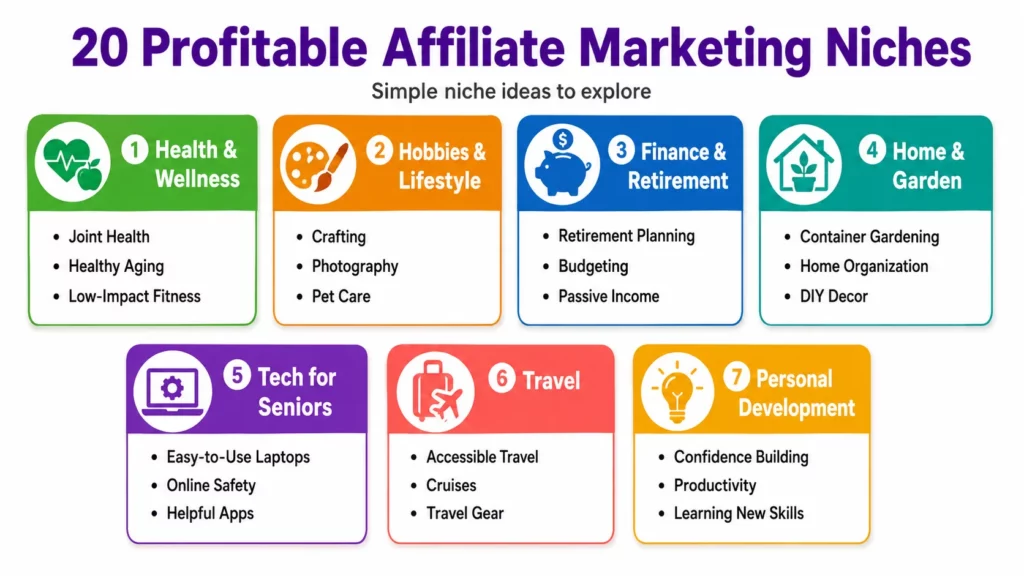
Step 11: 60 niche angle ideas for retirees (2026)
- Low-impact home fitness over 60
- Balance and fall prevention
- Walking routines and gear
- Gentle stretching for seniors
- Beginner yoga for older adults
- Ergonomic gardening tools
- Container gardening for small patios
- Raised bed gardening for seniors
- Indoor herb gardening
- Composting for beginners
- Simple meal prep for seniors
- Easy high-protein meals
- Air fryer recipes for beginners
- Small appliance guides
- Cooking for one or two
- Decluttering for downsizing
- Senior-friendly home organization
- Home safety upgrades
- Comfortable sleep setup
- Back pain-friendly home routines
- iPhone basics for seniors
- Android basics for seniors
- Photo storage and backups
- Scam safety for older adults
- Simple smart home devices
- Learning apps for seniors
- Genealogy for beginners
- Photography for retirees
- Watercolor for beginners
- Knitting/crochet starter kits
- Woodworking safety for beginners
- RV travel comfort tips
- Packing lists for seniors
- Airport walking comfort
- Travel insurance basics
- Budget travel for retirees
- Senior dog care basics
- Cat care for older adults
- Backyard bird feeding
- Beginner aquariums
- Meditation for beginners
- Journaling for seniors
- Home workouts for couples
- Retirement budgeting tools and trackers
- Side income ideas for retirees (non-hype)
- Affiliate marketing for retirees (step-by-step)
- Blogging for beginners over 60
- Writing as a hobby or business
- Craft selling basics
- Print-on-demand basics
- Canva basics for seniors
- Email basics for older adults
- Facebook privacy for seniors
- YouTube learning for beginners
- Simple computer cleanup routines
- Keyboard/mouse comfort gear
- Vision-friendly tech settings
- Hearing-friendly phone settings
- Mobility comfort gear
- Healthy habits tracking for seniors
Step 12: Worked examples (so you can see the process)
Example A: Container gardening for small patios
Micro‑niche: container gardening for retirees with limited space.
Why it works:
- constant beginner questions (soil, water, sunlight, pests)
- clear product needs (containers, soil, tools)
- Lots of “best for beginners” opportunities
Starter post ideas:
- Container gardening for beginners (2026)
- Patio gardening checklist: what to buy first
- 10 container gardening mistakes (and fixes)
- Best containers for small patios (2026)
- Best potting soil for containers (beginner picks)
- How to water containers without overwatering
- Beginner herb garden in containers (step-by-step)
- Pest control basics for container gardens
- Best gardening tools for seniors (ergonomic picks)
- FAQ: container gardening for beginners
Example B: iPhone basics and scam safety for seniors
Micro‑niche: iPhone basics + scam safety for older adults.
Why it works:
- high fear/urgency (scams)
- endless “how do I…” questions
- natural product recommendations (accessories, courses, storage)
Starter post ideas:
- iPhone beginner guide for seniors (2026)
- iPhone settings to change first (checklist)
- How to stop scam calls and texts on iPhone
- How to make your iPhone easier to read
- Photo storage basics: iCloud for beginners
- Best iPhone accessories for seniors (2026)
- FaceTime for beginners: call family step-by-step
- What to do if you clicked a suspicious link
- How to clean up storage safely
- FAQ: iPhone help for seniors
Example C: Affiliate marketing step-by-step for retirees
Micro‑niche: affiliate marketing for beginners over 60.
Why it works:
- strong demand (people want extra income)
- clear product ecosystem (training, tools)
- Your calm approach is a differentiator.
Starter post ideas:
- Affiliate marketing for retirees: beginner guide (2026)
- How to pick a profitable niche (2026)
- Website setup checklist for retirees (2026)
- WordPress beginner guide for retirees (2026)
- Beginner SEO checklist (2026)
- How to write your first affiliate post (template)
- How to add internal links (simple guide)
- Mistakes retirees make in affiliate marketing (and fixes)
- Best beginner affiliate programs (2026)
- FAQ: Affiliate Marketing Questions Retirees Ask
Step 13: Niches to approach carefully (retiree safety note)
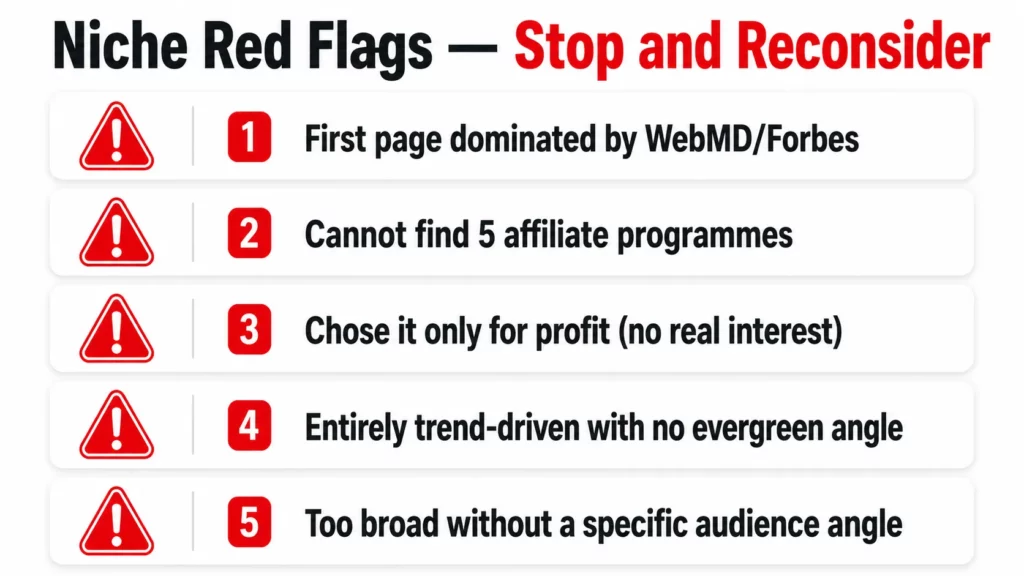
Some niches are profitable but can be risky if you make strong claims:
- health conditions and medical advice
- financial advice and investing
- legal advice
You can still write in these areas, but keep it safe:
- Focus on general education
- Recommend tools and resources
- encourage readers to consult professionals
If you prefer low stress, choose niches that don’t require careful disclaimers.
Step 14: The “good niche” checklist (copy/paste)
A niche is usually a good fit if:
- I can picture the exact person I’m helping.
- I can list 10 problems they face.
- People buy solutions for those problems.
- I can find communities where they ask questions.
- I can create 30 post ideas without struggling.
- The topic feels sustainable for me.
- I feel comfortable recommending products in it.
Your next step (keep it simple)
Pick one niche idea and do this today:
- Write your niche sentence: “I help ___ with ___ so they can ___.”
- Narrow it into a micro‑niche.
- List 10 products people buy.
- Write 30 post ideas.
- Outline your first beginner guide.
And if you want printable checklists that make this easier, grab the free Starter Kit:
FAQ (2026)
How do I know if a niche is profitable in 2026?
Look for proof signals: search demand, active communities, real products people buy, and affiliate programs. If at least three are strong, it’s a good sign.
Should I choose passion or profit?
Choose a niche you can stick with and that has buyer behavior. Consistent publishing matters more than chasing the highest payouts.
How narrow should my niche be at the start?
Start with a micro‑niche so your content feels specific and easier to rank. You can expand later once you gain traction.
What if I choose the wrong niche?
Test for 30 days. You can pivot, narrow, or adjust — your skills and content structure carry over.
How many posts do I need before I can earn?
Some niches earn with 5–10 posts if they target buyer-intent topics, but most sites grow over a few months with steady publishing.
Bonus: The Niche Research Workbook (printable-style)
If you want to make this decision calmly, use this workbook. Copy it into a notebook or a document and fill it out. The goal is to move from “ideas” to “evidence.”
Part 1 — Reader snapshot
- My reader is (age/life stage): ____________________________
- Their situation is (example: limited mobility, limited time, beginner): ____________________________
- Their #1 frustration is: ____________________________
- The outcome they want is: ____________________________
- The tone they prefer is: calm/simple/step-by-step / no jargon
Now write a short sentence you can use on your Home page:
“I help ___________________ with ___________________ so they can ___________________.”
Part 2 — Problem list (this becomes your content)
Write at least 15 problems/questions your reader has. If you get stuck, think of:
- What they ask in forums
- What they ask family/friends
- What they search at 2 a.m.
- What makes them feel overwhelmed
Examples of problem-style topics:
- “I don’t know what to buy first.”
- “I tried this, and it didn’t work.”
- “I’m worried I’ll do it wrong.”
- “What is the safest option?”
- “Which one is best for beginners?”
- “How do I avoid scams/mistakes / wasted money?”
Part 3 — Product universe (so you don’t feel salesy)
List products in three levels. This makes monetization feel natural instead of pushy.
Starter (low cost):
- __________ 2) __________ 3) __________ 4) __________ 5) __________
- __________ 7) __________ 8) __________ 9) __________ 10) __________
Upgrades (mid-range):
- __________ 2) __________ 3) __________ 4) __________ 5) __________
- __________ 7) __________ 8) __________ 9) __________ 10) __________
Premium (high value):
- __________ 2) __________ 3) __________ 4) __________ 5) __________
If you can fill these lists, your niche is monetizable in a calm, ethical way.
Part 4 — Proof signals checklist
Check what you found:
- I found autocomplete suggestions in Google.
- I found People Also Ask questions.
- I found at least one active community.
- I found 20+ products that people buy.
- I found at least one affiliate program option.
- I found content gaps I could improve.
If you check at least 3–4 boxes, you’re in good shape.
Bonus: Where to place your Starter Kit offer (so it feels consistent)
Since your offer is the Starter Kit, keep it consistent across your site. In 2026, consistency increases trust.
Best places to place the Starter Kit link:
- Your Start Here page (top and near the end)
- Near the end of beginner guides (after you helped the reader)
- Your sidebar (optional, simple button)
- Your resources page (as the “first step”)
How to describe it (simple wording):
“Want the printable checklist? Download the free Starter Kit.”
Avoid changing the name or wording across posts. Repetition is good. It makes your site feel organized.
Bonus: Your first 12 weeks of content (a calm publishing schedule)
If you publish one post per week, here is a simple 12‑week plan you can use in almost any niche. This is how small sites build traction without burnout.
Week 1: Beginner guide (your cornerstone)
Week 2: Checklist post (step-by-step)
Week 3: Mistakes to avoid (and fixes)
Week 4: Best for beginners (product picks)
Week 5: How‑to tutorial (one clear task)
Week 6: Troubleshooting post (“why this isn’t working”)
Week 7: Buyer guide (“what to look for”)
Week 8: Comparison post (A vs B, beginner pick)
Week 9: FAQ post (top questions)
Week 10: Resources page (your recommended tools)
Week 11: “What I wish I knew” post (trust builder)
Week 12: Case study/story post (your 30‑day or 90‑day experience)
This schedule works because it mixes:
- informational content (traffic)
- practical content (trust)
- buyer-intent content (income)
Bonus: How to know you’re ready to commit (the final decision)
You’re ready to commit to a niche for 30 days if:
- You can write the niche sentence clearly
- You can list 15 problems/questions
- You can list 20+ products
- You can outline your first 5 posts
- The niche feels calm enough to stick with
Perfection is not required. Momentum is.
Bonus: The micro‑niche expansion ladder (how to grow without losing focus)
A smart way to grow is to start narrow, then expand in “rings” around your core topic. This prevents your site from becoming scattered.
Ring 1 — Your exact micro‑niche (first 10–20 posts)
This is your core audience and core problem. You become the “go‑to” guide here.
Example:
Micro‑niche: “low-impact home fitness for beginners over 60.”
Ring 2 — Closely related subtopics (next 20 posts)
These are topics your reader naturally needs next.
Examples:
- warm-up and stretching routines
- balance equipment
- walking routines and footwear
- recovery and soreness basics
Ring 3 — Lifestyle support (after you have traction)
These topics support the main goal but are one step broader.
Examples:
- simple habit tracking
- comfortable home setup
- beginner motivation tips
- gentle progression plans
This ladder keeps your content focused while still giving you room to grow.
Bonus: Content clusters and internal links (simple SEO that works)
Once you choose your niche, organize your posts into clusters. A cluster is a group of posts around one pillar topic. Clusters make your site easier for readers and easier for search engines to understand.
A simple cluster has:
- one pillar page (big guide)
- 5–10 supporting posts (specific questions)
- internal links between them
Example cluster (iPhone safety):
- Pillar: iPhone safety for seniors (2026 guide)
- Supporting posts:
- Stop scam calls and texts
- best security settings checklist
– What to do after clicking a bad link
– How to report spam calls
- How to protect your Apple ID
– How to make text larger and easier to read
Internal linking rule (easy):
Every new post links to 2–5 older related posts, and you update 1–2 older posts to link back. Over time, your site becomes a connected “web” of helpful pages instead of isolated articles.
Common niche mistakes (and the calm fixes)
Mistake: I picked a niche, but I keep changing it.
Fix: Commit for 30 days. No switching during the test. Switching kills momentum.
Mistake: I picked a niche, but I don’t know what to write.
Fix: Go back to the problem list. Write one post per problem. Problems are content.
Mistake: I’m worried the niche is “too small.”
Fix: Start small. Expand with the micro‑niche ladder. Small is a feature at the beginning.
Mistake: I’m worried the niche is “too competitive.”
Fix: Narrow the angle and write for a specific reader (retirees over 60). Clarity beats size.
Mistake: I don’t want to be salesy.
Fix: Help first, recommend second. Use calm language and explain who a product is for.
Final encouragement (2026)
Choosing a niche is not a one-time “forever” decision. It’s a starting decision. You are allowed to refine your angle as you learn what your readers respond to.
The goal is simple: pick one niche, publish consistently for 30 days, and learn from real feedback. That’s how you build an online business after 60 — calmly, steadily, and one helpful post at a time.
Mini case study: picking a niche without overthinking
Imagine a retiree named Linda who wants to start an affiliate site but feels stuck between three ideas: gardening, travel, and “making money online.” Linda does the calm process instead of guessing.
First, she writes her niche sentences:
- Gardening: “I help retirees grow herbs in containers so they can garden in small spaces.”
- Travel: “I help older adults travel comfortably so they can enjoy trips without pain and hassle.”
- Online business: “I help retirees start affiliate marketing so they can build extra income with a calm routine.”
Next, she uses the 5 Filters scorecard. Gardening scores high on enjoyment and content runway, travel scores high on buyer behavior, and online business scores high on demand but feels more stressful for her. Then she checks proof signals. Container gardening has tons of People Also Ask questions, active Facebook groups, and a huge product universe. That gives her confidence.
Linda commits to a 30-day test for “container herb gardening for small patios.” In week one, she publishes a beginner’s guide. In week two, she publishes a checklist and a mistakes post. In week three, she creates a “best containers for herbs” post. She links everything together. She doesn’t worry about perfection — she focuses on being helpful.
At the end of 30 days, Linda notices something important: writing about gardening feels enjoyable, content ideas keep coming, and readers are asking for “what to buy first.” That is buyer intent. Now she has evidence, not guesswork. She decides to continue for 90 days, expand the micro‑niche to include vegetables, and build a resources page. That’s how a niche becomes profitable over time: one calm decision, one helpful post at a time.
Your Next Step
Pick one niche idea and do this today: write your niche sentence, narrow it into a micro-niche, list 10 products people buy, write 30 post ideas, and outline your first beginner guide.
For the shorter, quick-start version of this process, see How to Choose and Validate Your Affiliate Niche. For everything else on getting started, read Getting Started With Affiliate Marketing as a Retiree.
This post may contain affiliate links. If you click and purchase, I may earn a commission at no extra cost to you.