
Last Updated on 3 days ago by Gila

If you are starting an online business in retirement, the idea of writing a “business plan” might feel like something from a business school textbook — long, formal, and full of jargon you never use.
It does not have to be that way. A good online business plan for retirees is simply a one-page map that keeps you from guessing. With it, you know who you help, what you offer, how people will find you, and what you will measure. You can fill it out in under an hour and improve it every few months as you learn.
This guide gives you both: the six pillars every solid online business plan needs, plus a complete fill-in template, a worked example, a 30/60/90-day roadmap, and niche-specific ideas you can borrow. Everything is written for retirees who want to build income online without overwhelm.
TL;DR
- You do not need a long formal document. A one-page outline updated every few months is enough to guide your next steps.
- Every solid online business plan covers six pillars: business overview, market research, products or services, marketing and sales, operations, and finances.
- Start with one clear audience and one simple offer, then choose one or two traffic channels you can show up on every week.
- Set 30/60/90-day milestones you can control — posts written, emails sent, tests run — rather than stressing about sales numbers too early.
- Track one simple funnel: clicks to subscribers to sales. Adjust the step where people get stuck.
- Revisit your plan monthly, keep what is working, and calmly drop what never moves the needle.
Why an Online Business Plan Really Matters
A short, clear plan turns ideas into action. It helps you decide who you serve, what you will offer, and how you will reach people — without wasting time or money.
With a written plan, you can set priorities, measure progress, and adjust calmly when trends or tools change. Think of it as a simple map: you will not follow it perfectly, but it keeps you moving in the right direction.
The goal is not to predict everything correctly. The goal is to choose a clear direction, launch a simple version, and improve as you learn. That approach works especially well for retirees who want a calm, sustainable pace rather than a frantic launch.
If you are still deciding what type of online business fits you best, read my guide on affiliate marketing 101 for retirees before filling in your plan — it will help you pick the right model for your situation.
The Six Pillars of a Strong Online Business Plan
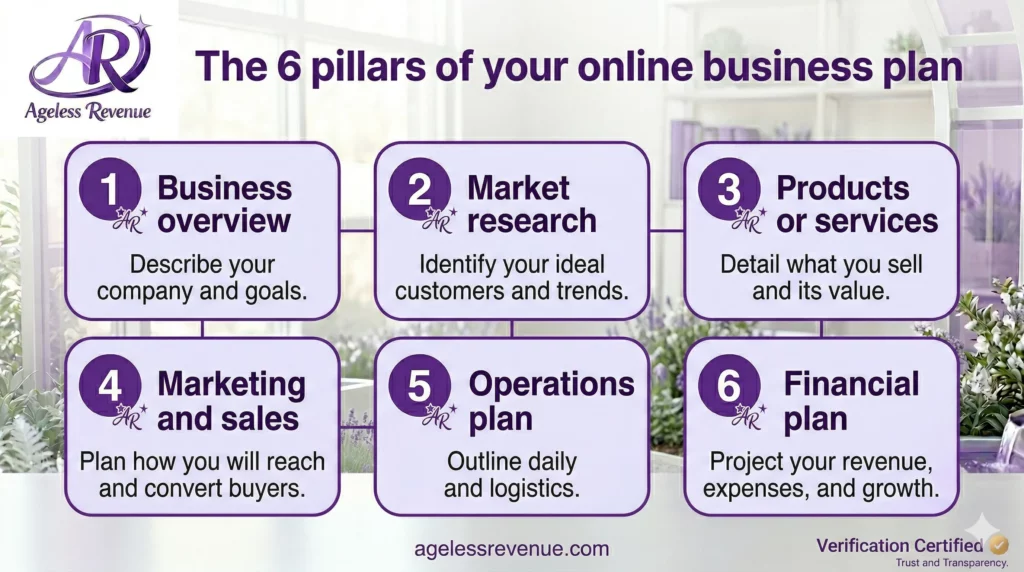
Planning does not have to be complicated. You will make better, faster decisions if you cover these six basics: who you help, what you sell, how people find you, how you deliver, and what it costs to run. Revisit these pillars every few months and tighten them as you learn.
Pillar 1: Business Overview
Summarise your business in one or two sentences that someone else could repeat back to you. Add a short mission statement explaining why you exist, a few values that guide how you work, and your 90-day goals so you always know what to focus on next.
Example: “I help retirees in their 60s set up simple affiliate blogs around topics they already love, earning their first commissions within 90 days — without tech overwhelm.”
That one sentence tells you who you serve, what you do, and the outcome you deliver. Keep it that short.
Pillar 2: Market Research
Know your audience and the landscape before you build anything. Sketch a simple reader persona — their age range, interests, habits, and biggest frustrations. List three to five websites or blogs already covering your topic and note where they are strong or weak. Note a few trends you see in Facebook groups, Google search suggestions, or product reviews.
This step prevents you from building something nobody wants and reveals quick wins you can act on immediately. For a deeper guide to beginner-friendly market research, read the best ways to conduct market research for your online business.
Pillar 3: Products or Services
List what you will offer, how it is different from what already exists, and how people will receive it — a download, affiliate link, course access, or direct service. If you are still testing, keep it lean: start with one core offer and a clear outcome. Add pricing so you can talk about value with confidence from day one.
For retirees starting with affiliate marketing, your first “product” is simply your recommended resources page — a curated list of tools and programs you genuinely use, all with affiliate links. That is a valid and profitable starting point.
Pillar 4: Marketing and Sales Strategy
Choose two channels to start with — for example: SEO plus email, or Pinterest plus a Facebook group. Decide how you will move visitors toward becoming customers: a helpful article, then a relevant lead magnet, then a simple email sequence, then a clear offer. Keep your message consistent across your posts, pages, and emails so people instantly recognise what you do.
For retirees, the calmest marketing combination is usually search engine optimised blog posts (which bring in traffic while you sleep) combined with a simple weekly email to your list. Social media is optional in the early stages.
Pillar 5: Operations Plan
List the tools and routines that keep your business running: your website platform, backup schedule, update routine, delivery method for any products, and how you handle questions from readers. Add one or two small automations early — a welcome email sequence and a basic FAQ page save a lot of repeated effort.
If a task repeats often and drains your energy, either document it so you can do it faster, or consider outsourcing a small part of it when your income allows.
Pillar 6: Financial Plan
Estimate your startup and monthly costs, then sketch how many sales or commissions you need to break even. Track just a few numbers at first — website traffic, email subscribers, conversion rate, and revenue. A simple spreadsheet is enough. Review these monthly so you can double down on what is working and cut what is not.
For most retiree bloggers, startup costs are very low: domain registration ($10–$15 per year), hosting ($5–$15 per month), and one email tool ($0–$10 per month on the free tier). You can be profitable with as few as two to six affiliate sales per month at the very beginning.
The One-Page Online Business Plan Template
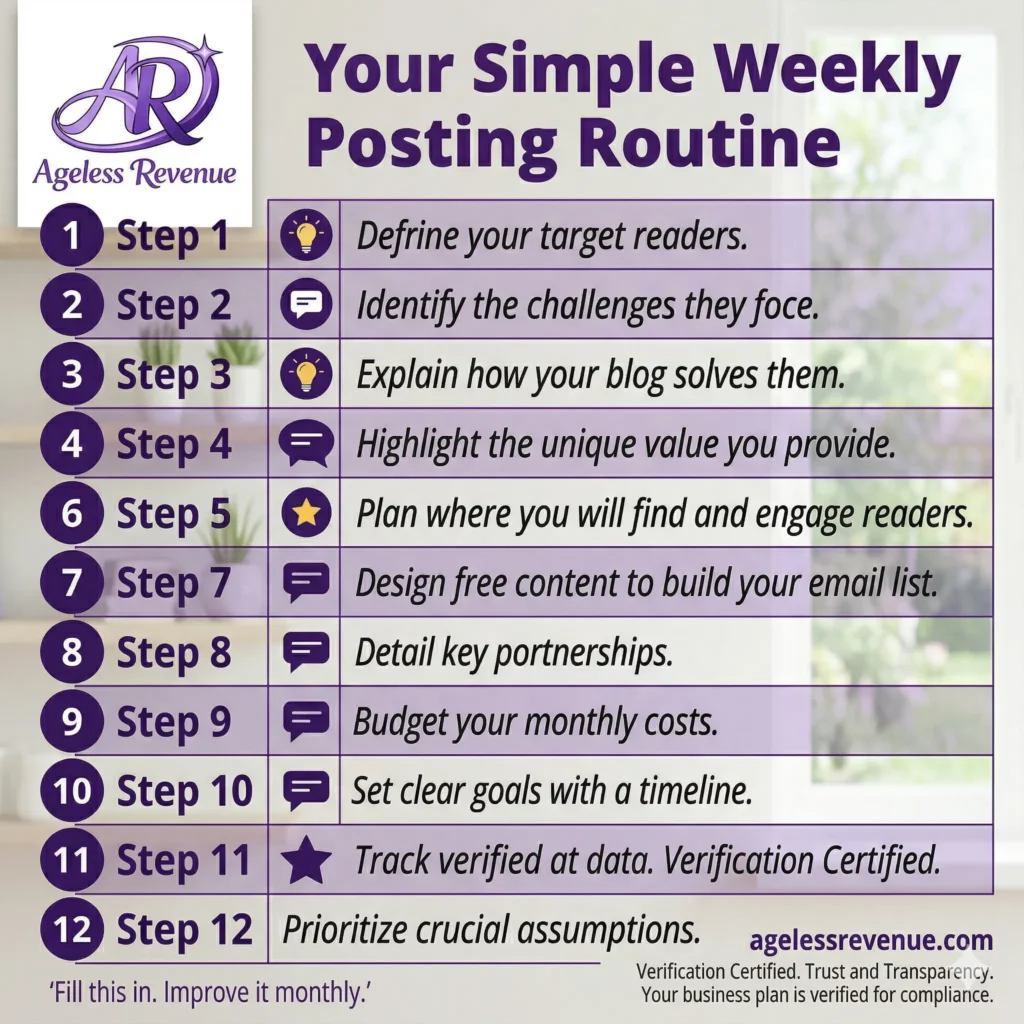
Here is the complete one-page template. Copy these prompts into a Google Doc and answer each one in one or two sentences. Do not overthink it — a rough first answer you can improve next month is far better than a perfect answer you never write.
- Audience: Who exactly are you helping? (Be specific — “retirees in their 60s who want extra income” is better than “anyone who wants to make money online”)
- Problem: What is the main frustration or challenge they have?
- Offer: What will you sell or recommend? (affiliate links, a digital product, a service)
- Price: How much does it cost, or what commission will you earn?
- Value proposition: Why is your solution faster, easier, or safer than what they could find elsewhere?
- Traffic channels (1–2): Where will people discover you? (Google search, Pinterest, Facebook groups, YouTube)
- Lead magnet: What free resource will you offer to build your email list? (checklist, template, mini-guide)
- Primary affiliate program or product: What is your main income source to start?
- Monthly budget: What are your total monthly costs to run the business?
- Milestones: What will you complete in your first 30 days, 60 days, and 90 days?
- Metrics: Which three numbers will you track each week?
- Biggest risk to test: What is the riskiest assumption your plan depends on, and how will you test it in the next 14 days?
How to Fill Out Each Section
Audience and problem: Pick a specific group you genuinely understand — for example, “new retirees who want extra income from home without tech overwhelm.” Write their top three problems in their own words. Read forums, Facebook groups, and product reviews to find the exact phrases they use. When your content uses their language, they immediately feel understood.
Offer and pricing: Choose one starter offer and keep it simple so you can launch fast. Examples for retirees: an affiliate resources page with your favourite tools, a $9 printable checklist, or a 30-minute setup call at $29. You can always add more offers later.
Value proposition: State clearly whether your solution is faster, easier, or safer than alternatives. Example: “Easier — I break down every step into plain English so you never feel lost.” Pick one of the three and make it your consistent promise.
Traffic channels: Pick one primary channel you can show up on every single week without burning out. For most retirees, SEO-optimised blog posts combined with Pinterest is the calmest and most sustainable combination. Social media is optional.
Content and conversion: Plan one pillar guide (a long, comprehensive article on your main topic), one lead magnet (a checklist or template readers can download), and a clear call to action on every page pointing toward your lead magnet or affiliate offer.
Monetisation: Begin with affiliate programs for products you already use. Add a simple digital product later — a template, planner, or short guide — once your blog has steady traffic.
Budget and tools: Keep costs lean. Aim for $15–$30 per month to start: domain, hosting, and a free email tool like MailerLite. Upgrade only when the free version genuinely holds you back.
Milestones: Set milestones you control, not outcomes you cannot guarantee. “Publish 4 blog posts” is a milestone you control. “Earn $500” is an outcome that depends on too many variables early on. Focus on actions first, and results will follow.
Metrics: Track one simple spreadsheet with three weekly numbers: website visits, email subscribers, and affiliate clicks. Adjust the step that is not growing.
Risks to test: List the riskiest assumption your plan depends on — for example, “enough people are searching for this topic.” Design one small test to check it within the next seven to fourteen days before investing more time or money.
Worked Example: Retiree Skill to Online Income
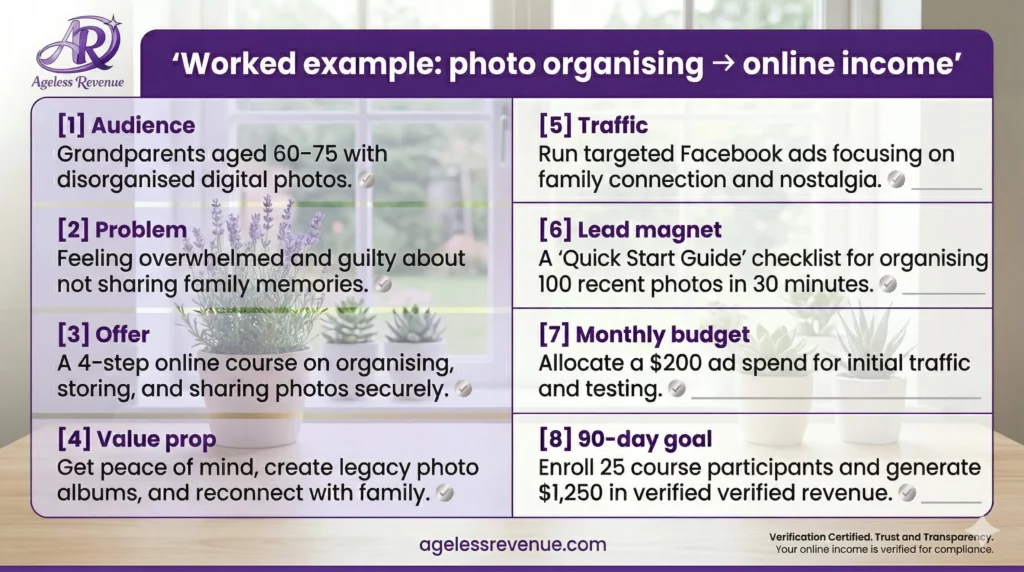
Here is how a complete one-page plan looks in practice.
Scenario: You have spent years organising family photos and helping friends do the same. You want to turn that into a simple online income stream.
Audience: Grandparents aged 60 to 75 who have thousands of disorganised digital photos and feel overwhelmed about how to back them up safely.
Problem: They are worried about losing precious family memories if their phone or computer dies, but they do not know which backup service to trust or how to set it up.
Offer: Affiliate links to cloud backup services (Google Photos, iCloud, Amazon Photos) plus a 30-minute “photo backup setup call” at $29 for readers who want hands-on help.
Value proposition: Easier — “I walk you through the exact steps, in plain English, in under 15 minutes.”
Traffic: One SEO blog post per week (“How to back up your phone photos in 15 minutes”), three Pinterest pins per week, and a simple newsletter every other week.
Lead magnet: A free one-page checklist: “The Grandparent’s Photo Backup Checklist — 5 steps to never lose a memory.”
Goal for 90 days: 10 setup calls booked or 20 affiliate programme trials activated.
Monthly budget: $20 (hosting + free MailerLite account).
This scenario works because it solves a real, emotionally meaningful problem for a specific audience using skills the person already has. The affiliate income comes from tools people genuinely need, and the service offer is simple to fulfil with a video call.
Your 30/60/90-Day Roadmap
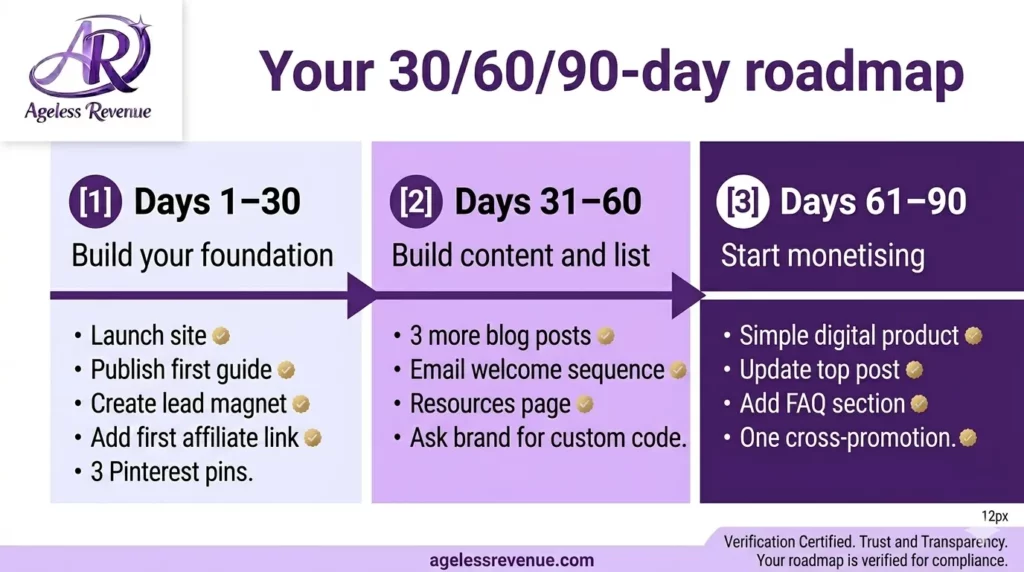
Rather than trying to do everything at once, use this calm phased approach for your first three months.
Days 1 to 30 — Build your foundation: Get your website live. Publish your first pillar guide. Create your lead magnet. Add one affiliate link in context. Publish three Pinterest pins. Record one short demo video if you are comfortable on camera.
Days 31 to 60 — Build your content and list: Publish three more blog posts. Set up a simple email welcome sequence (two to three emails). Create a resources page on your site listing your top recommended tools. Ask one affiliate brand if they offer a custom discount code for your readers.
Days 61 to 90 — Start monetising more intentionally: Create and publish a simple digital product — a $7 to $9 printable template or checklist. Update your top-performing post to improve its call to action. Add an FAQ section to your main pillar guide. Reach out to one complementary blogger about a simple cross-promotion or guest post.
Budget and Simple Maths
Starting lean keeps the pressure off and lets you focus on learning rather than recovering costs. Here is a realistic starter budget for a retiree blogger:
- Domain name: $10 to $15 per year (about $1 per month)
- Website hosting: $5 to $15 per month, depending on the provider
- Email marketing: $0 per month on MailerLite or Kit free tier (up to 1,000 subscribers)
- Graphics: $0 on Canva free tier
- Total: approximately $15 to $30 per month to run a professional affiliate blog
If an affiliate program pays you $3 to $10 per signup, your break-even point is just two to six affiliate sales per month — very achievable once a few blog posts rank on Google and your Pinterest pins start circulating.
Practical Steps to Launch Effectively
- Define your offer and audience: write one sentence for each before you build anything else.
- Research quickly: spend one hour scanning competitor sites, Facebook groups, and product reviews for the questions your audience asks most often.
- Pick your platform and tools: choose what matches your offer and stick with it. Tool-hopping wastes time.
- Ship a simple version: publish your core pages (Home, About, Start Here, Contact), three to five helpful posts, and one opt-in offer.
- Promote lightly but consistently: one new article per week and one email to your list is plenty for the first three months.
- Measure and adjust: review your three key numbers monthly and refine one thing at a time. Small, consistent improvements compound into significant results.
Niche Examples to Borrow From
Not sure how your specific niche translates into a business plan? Here are three concrete examples.
Gardening on small patios: Offer = affiliate links to raised bed kits and container gardening tools. Lead magnet = soil and spacing cheat sheet. Traffic = Pinterest seasonal pins and SEO posts answering “how to grow tomatoes on a balcony.” Digital product later = printable planting planner at $7.
Healthy cooking for one: Offer = affiliate links to cookware and meal delivery services plus a weekly meal plan template. Traffic = 60-second recipe shorts and SEO guide posts. Digital product later = a four-week batch cooking plan at $9.
Budget tech help for grandparents: Offer = affiliate links to simple tech products plus optional setup calls. Traffic = problem-and-solution blog posts and a simple fortnightly newsletter. Digital product later = a printable phone setup checklist at $5.
Common Mistakes and Quick Fixes
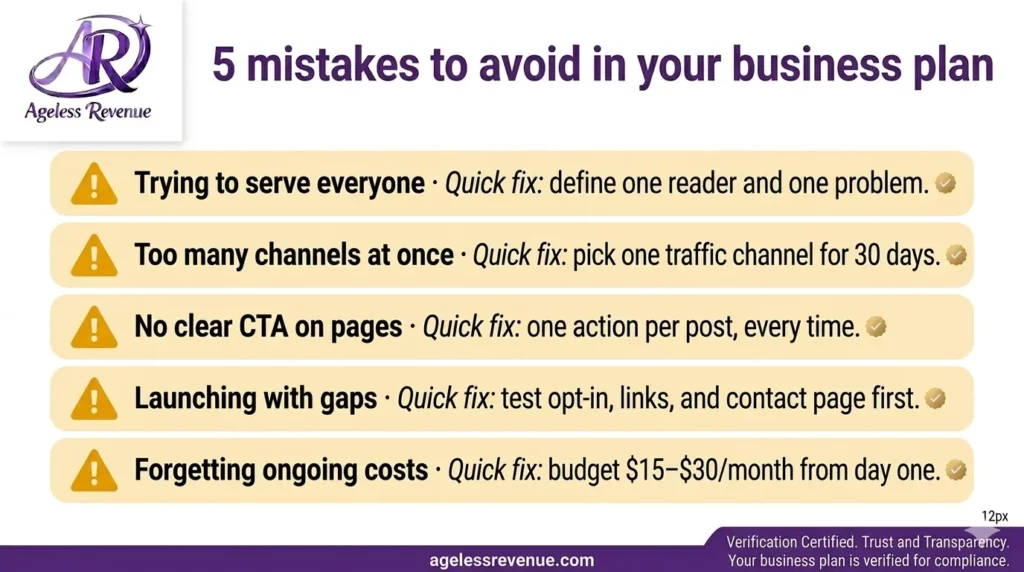
Trying to serve everyone: define one specific reader and one specific problem before you write a single post. The more specific you are, the more your ideal readers feel like you are speaking directly to them.
Too many channels at once: pick one traffic channel and one conversion habit for the first 30 days. Add a second channel only when the first is consistent.
No clear call to action on pages: every blog post should have one action you want the reader to take next — download your checklist, read the next article, or visit your resources page. One CTA per page, not five.
Launching with gaps: before you tell anyone about your site, test your opt-in form, check your affiliate links actually work, and make sure your contact page is live. Small broken things undermine trust.
Forgetting ongoing costs: free tools have limits. Budget a small monthly amount for the tools you will eventually need to upgrade. Surprises are more stressful than planned expenses.
A Simple Weekly Routine to Keep Things Calm
Once your plan is written and your site is live, this weekly routine keeps things moving without overwhelm.
Monday: Write or finish one blog post. Even 400 words of a draft is progress.
Wednesday: Create two or three Pinterest pins for your most recent post and schedule them.
Thursday: Send a short email to your list — share your new post, one helpful tip, or one genuine product recommendation.
Friday: Check your three weekly numbers (traffic, subscribers, affiliate clicks) and note one thing to improve next week.
That is it. Four focused sessions per week, each under an hour, are enough to build a growing affiliate blog over the course of a year. Consistency matters far more than intensity.
Useful Tools for Building Your Plan
Keep your toolkit simple and free to start. Use Google Docs to write and store your one-page plan, where you can access it from any device. Use Canva (free) for any graphics or infographics you want to add to your posts. Use Ubersuggest (free searches daily) to check that people are actually searching for your topic before you write about it. Use a simple Google Sheet to track your three weekly numbers.
Upgrade only when the free version genuinely holds you back — and that day is usually several months away from where you are right now.
Frequently Asked Questions
Do I need a long, formal business plan?
No. A one-page outline is genuinely enough to guide your first 90 days. Long formal plans are for businesses seeking investors or bank loans. As a retiree building an online income stream, your plan should fit on a single page and take less than an hour to write.
How often should I update my plan?
Every two to three months, or whenever your goals, offers, or audience understanding change significantly. Treat it as a living document — a rough draft you improve over time, not a finished report you file away.
What is different about an online business plan compared to a traditional one?
An online plan puts much more emphasis on digital marketing, website operations, and how you deliver value without a physical location. You also do not need sections on inventory, staffing, or commercial premises. The six pillars in this guide are specifically chosen for online businesses run by one person.
Do I need to validate my idea before writing a plan?
Yes — always validate before you build. A plan written around an unvalidated idea is just organised guesswork. Read my guide on how to validate an affiliate niche after retirement before finalising your plan, especially the audience and offer sections.
What if I change my mind about my niche after I have started?
That is completely normal and far more common than most people admit. Update your one-page plan, redirect your content focus gradually, and do not delete anything — older posts can often be updated rather than replaced. The skills you build are transferable regardless of which niche you end up in.
How long before I earn my first income?
Most consistent beginner bloggers see their first affiliate clicks within two to four weeks of publishing and their first commission within one to three months. Building a reliable monthly income takes six to twelve months of consistent effort. This is not a get-rich-quick model — it is a build-trust-over-time model that rewards patience and consistency. For a realistic timeline, read how long affiliate marketing takes to make money.
Conclusion
A good online business plan for retirees does not need to be long, formal, or intimidating. It needs to be honest, specific, and simple enough that you will actually use it.
Fill in the one-page template in this guide. Write one sentence for your audience, one for your offer, and one for your value proposition. Pick one traffic channel and one lead magnet. Set three milestones for your first 90 days. That is your plan.
Review it every few months. Keep what is working. Adjust what is not. And give yourself credit for every small step forward — because consistent small steps are exactly what build a meaningful online income in retirement.
If you are ready to dig into the affiliate marketing side of your plan, start with the complete affiliate marketing guide for retirees, or explore the top 10 online business ideas for retirees to make sure you are building in the right direction.
Your Next Step
Open a Google Doc right now and copy the twelve template prompts from the section above. Answer each one in one sentence. Do not worry about getting it perfect — a rough first draft of your plan today is worth more than a polished version you write six months from now.
When you are ready for a structured training platform that walks you through every part of building your affiliate business — including the website, the content, and the traffic — start your free Wealthy Affiliate account here. It is the platform I recommend to every retiree who asks me where to begin.
Hey a great post you have here!
Learning about making money online is something with many want to learn about, I mean who doesn’t want to be able to work from the comfort of their own home.
Running a successful business requires a lot of patience as well as dedication. There are also a few elements which need some practicing such as social media marketing along with others.
Thanks again and have a great day!
Hi Sariya,
Thank you so much for your kind words—I’m really glad you enjoyed the post! You’re absolutely right: making money online is a dream many people share, but as you pointed out, it definitely takes patience, dedication, and a willingness to keep learning.
Social media marketing is a great example—it can be powerful, but it takes time to find your voice and build real connections. The good news is, with consistent effort and the right strategy, it gets easier and more effective over time.
Wishing you all the best on your journey—thanks again for stopping by!
Warmly,
Gila
What I have come to discover over the years is you can have a business plan which is the first step in the right direction because a business plan is your map or blue print for you to have and idea that will lead to a clearer understanding of where you are going but a business plan though sound will change along the way because adjustment will be needed in oder words all business plans have to make some reajustements and this only happens as the plan is being worked which is good because these adjustment are eye openers that will lead to success.
Hi Norman,
Thank you for sharing your insights—you’re absolutely right. A business plan is a powerful starting point, but it’s not set in stone. I love how you described it as a map that evolves with the journey. That flexibility and willingness to make adjustments along the way are key to long-term success.
It’s those real-world experiences and “eye openers,” as you put it, that help refine our direction and make our businesses stronger. I really appreciate you adding that perspective to the conversation—great advice for anyone getting started!
Wishing you continued success on your path,
Gila