
How to Use AI Tools for Your Affiliate Blog: The Complete Guide for Retirees (2026)
Artificial intelligence tools have changed what is possible for a one-person affiliate blog. Tasks that used to take hours — drafting a blog post, generating image ideas, editing for clarity, researching keywords — now take minutes. For retirees building an affiliate blog at their own pace, this is genuinely useful.
Learning how to use AI for affiliate blogging can transform the way you manage content creation and marketing efforts.
Understanding how to use AI for affiliate blogging is essential to differentiate your content in a saturated market.
In this guide, we will explore how to use AI for affiliate blogging tools that enhance productivity while maintaining your voice.
But the promise of AI comes with a real risk. Content that reads like it was written by a machine does not convert. Readers can feel the difference between a post written by someone with genuine experience and a post that sounds like a chatbot summarising a Wikipedia article. Google can tell the difference, too.
For retirees, mastering how to use AI for affiliate blogging can lead to more efficient workflows.
This guide shows you how to use AI for affiliate blogging tools to speed up your blogging workflow without losing the personal voice and real expertise that make your content worth reading.
Affiliate disclosure: This post contains affiliate links. If you buy through them, I may earn a small commission at no extra cost to you.
TL;DR
- AI tools save time on drafting, editing, image creation, and keyword research — not on thinking and expertise.
- ChatGPT and Claude are the best starting points for writing assistance — both are free to start.
- Canva’s AI features handle image creation without any design experience
- Grammarly catches grammar and clarity issues before you publish
- Always add your own experience, opinions, and specific details to any AI-generated draft
- The goal is AI-assisted content, not AI-generated content
Understanding how to use AI for affiliate blogging will allow you to optimize your efficiency.
Why AI Tools Suit Retiree Bloggers Particularly Well
Identifying your goals is part of how to use AI for affiliate blogging effectively.
Embrace the learning curve of how to use AI for affiliate blogging and see it as an opportunity for growth.
Remember that in how to use AI for affiliate blogging, your unique voice must always shine through.
Retiree bloggers have one significant advantage over younger content creators: decades of genuine expertise in a specific topic. A retired physiotherapist writing about joint health, a lifelong gardener writing about accessible raised beds, a former teacher writing about educational software — this depth of real knowledge is exactly what AI cannot replicate.
What AI can do is handle the parts of blogging that are time-consuming without being intellectually interesting. Formatting a draft. Suggesting alternative headlines. Checking grammar. Creating a Pinterest pin template. Resizing an image. These tasks used to take hours. With the right AI tools, they take minutes.
The result: you spend more time on the parts only you can do — sharing your experience, making specific recommendations, writing in your own voice — and less time on the mechanics that anyone (or any tool) could handle.
Many retirees are discovering how to use AI for affiliate blogging to leverage their unique insights and experiences.
One of the keys in how to use AI for affiliate blogging lies in selecting the right tools that match your blogging style.
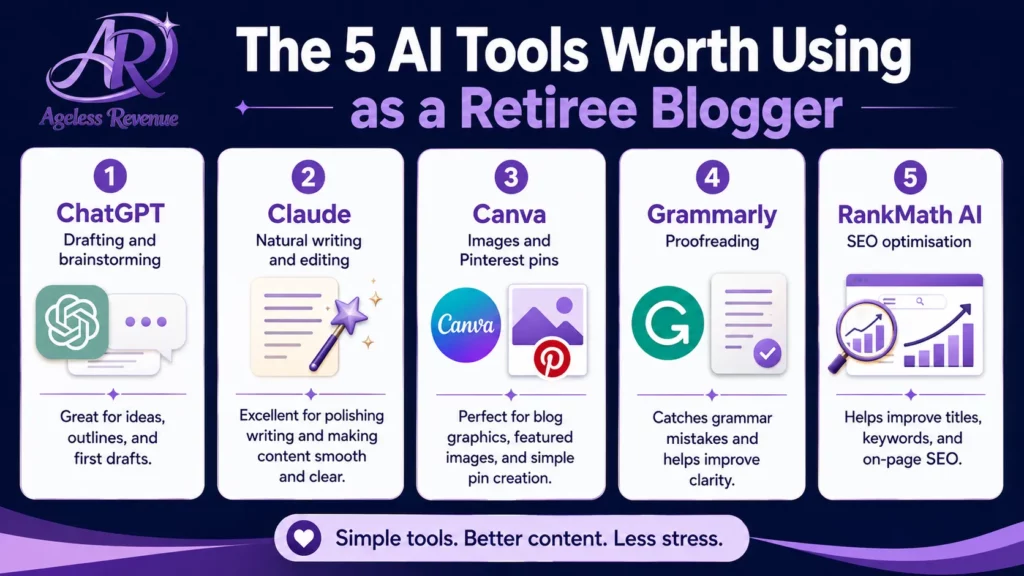
The 5 AI Tools Worth Using as a Retiree Blogger
Utilizing tools effectively is a crucial part of how to use AI for affiliate blogging.
1. ChatGPT — Best for Drafting and Brainstorming
Cost: Free (GPT-4o); Plus plan $20/month for more features. Best for: Blog post outlines, draft paragraphs, FAQ sections, email ideas
When you learn how to use AI for affiliate blogging, keep in mind the importance of personal touch in your content.
ChatGPT is the most widely used AI writing tool and the right starting point for most bloggers. You give it a prompt — a topic, a keyword, a set of questions — and it produces a draft you can work from.
As you navigate how to use AI for affiliate blogging, remember that results may vary based on your approach.
Effective planning is key to how to use AI for affiliate blogging, so always outline your content goals.
Incorporating your experiences into how to use AI for affiliate blogging will build trust with your audience.
Sharing stories of how to use AI for affiliate blogging will resonate with readers looking for authentic content.
Using examples of how to use AI for affiliate blogging can illustrate its effectiveness to your audience.
The keyword is “draft.” What ChatGPT produces is a starting point, not a finished article. It does not know your specific experience, your particular audience, or the specific products you have personally tested. That knowledge comes from you.
Practical use for affiliate bloggers:
Discussing how to use AI for affiliate blogging can provide insights that appeal to both novices and veterans alike.
- “Write an outline for a blog post about the best garden kneelers for adults with arthritic knees”
- “Write a FAQ section for a post about starting affiliate marketing after 60.”
- “Suggest 10 blog post titles for a retiree affiliate blog about accessible gardening.”
- “Rewrite this paragraph to be clearer and shorter: [paste your text].”
Many bloggers are curious about how to use AI for affiliate blogging and its potential impact on their work.
Mastering how to use AI for affiliate blogging can lead to increased engagement on your posts.
Always review and rewrite what ChatGPT produces. Add your specific experience. Change anything that does not sound like you. Remove anything generic that a reader could find anywhere.
2. Claude — Best for Longer, More Natural Writing
Implementing how to use AI for affiliate blogging will enhance your creative process significantly.
Ultimately, knowing how to use AI for affiliate blogging is about finding the right balance between technology and personal input.
Tracking your progress in how to use AI for affiliate blogging can help refine your techniques.
Cost: Free; Pro plan $20/month. Best for: Longer drafts, editing existing content, nuanced rewrites
Many find experimenting with how to use AI for affiliate blogging to be a rewarding experience.
Finding your unique angle in how to use AI for affiliate blogging will set you apart from competitors.
So, if you seek to understand how to use AI for affiliate blogging, start small and scale up over time.
Claude (made by Anthropic) tends to produce more natural-sounding prose than ChatGPT, particularly for longer pieces. It is especially good at editing — paste in a section you have written and ask it to improve the flow, shorten it, or adjust the tone.
Many bloggers use both ChatGPT for brainstorming and outlines, and Claude for longer drafts and editing passes.
Practical use: “Here is a section I wrote about raised bed gardening. Edit it to be clearer and more conversational without changing my meaning or removing specific details: [paste text].”
3. Canva — Best for Images and Pinterest Pins
Cost: Free (generous); Pro plan $15/month. Best for: Featured images, Pinterest pins, infographics, social graphics
Canva is not purely an AI tool, but its AI features (Magic Design, text-to-image, background remover) make image creation straightforward without any design experience. For affiliate bloggers, this means professional-looking featured images and Pinterest pins in 10–15 minutes rather than hours.
Canva’s Pinterest pin templates are particularly useful — they are already sized correctly (1000×1500px), and you can batch-create several pin variations for the same blog post in one session.
Practical use: Open a Pinterest pin template, swap the background image using Canva’s AI image generation, change the text overlay to your pin title, and download. Repeat with two variations per post.
4. Grammarly — Best for Editing and Proofreading
Cost: Free (basic); Premium $12/month. Best for: Grammar checking, clarity suggestions, tone adjustment
Grammarly catches the grammar errors, run-on sentences, and unclear phrasing that everyone misses when editing their own work. The free version handles grammar and spelling. The Premium version adds suggestions for clarity, conciseness, and engagement.
For retiree bloggers writing in a second language or those who want a final check before publishing, Grammarly is the most reliable proofreading tool available.
Practical use: Paste your finished post into Grammarly before publishing. Accept the changes that improve clarity, ignore the ones that make your writing sound less like you.
5. RankMath’s AI Features — Best for SEO Optimisation
Cost: Included with RankMath Pro (which Ageless Revenue uses). Best for: Meta description suggestions, content analysis, SEO scoring
If you are already using RankMath for SEO (as Ageless Revenue does), its built-in AI features can suggest meta descriptions, analyse your content against your focus keyword, and flag SEO issues before you publish. This is the most practical AI SEO tool for WordPress bloggers because it is built directly into your existing workflow.
How to Use AI Without Losing Your Voice
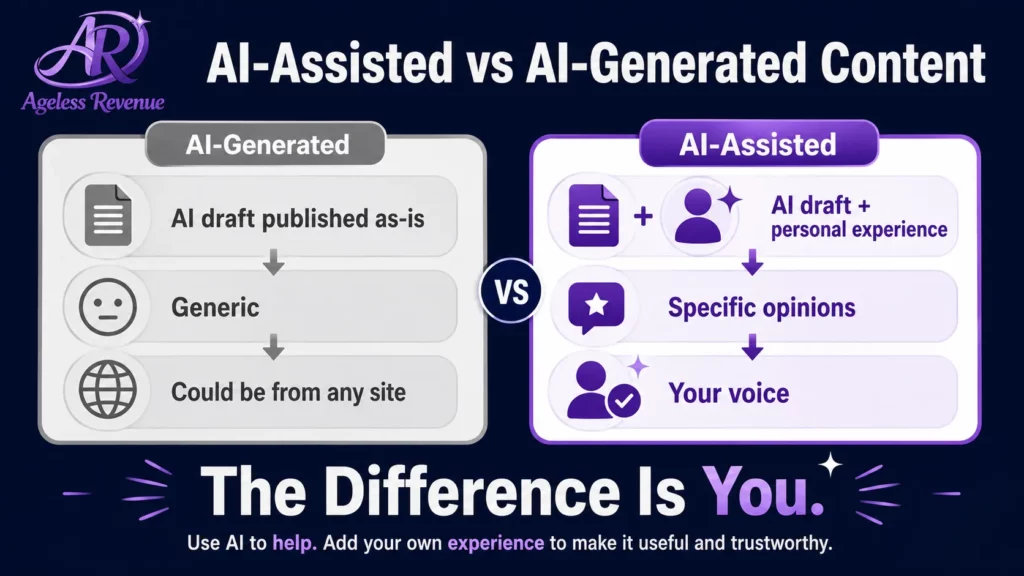
The bloggers who get the best results from AI tools follow a consistent process:
Ultimately, learning how to use AI for affiliate blogging will enhance your overall blogging experience.
How to Use AI for Affiliate Blogging Effectively
Step 1 — Start with your own knowledge. Before opening any AI tool, write down the specific points you want to make, the personal experiences you want to include, and the specific products or approaches you want to recommend. This is the material that makes your content valuable. AI cannot generate it.
Step 2 — Use AI for structure and drafting. Give ChatGPT or Claude your topic, your key points, and your target keyword. Ask for an outline or a first draft. This gives you a skeleton to work from rather than a blank page.
Step 3 — Rewrite in your own voice. Go through the AI draft section by section. Add your specific experience. Replace generic examples with real ones from your life. Change any sentence that does not sound like you. A good test: read a paragraph aloud. If it sounds stiff or corporate, rewrite it.
Step 4 — Add specific product details. If you are recommending affiliate products, the specific detail that earns trust — and clicks — must come from your actual experience with the product. “I have been using this trowel for eight months, and here is exactly what works about it” is something only you can write.
Step 5 — Edit with Grammarly. Run the finished post through Grammarly for a final check. Accept grammar corrections; ignore style suggestions that change your voice.
Step 6 — Create visuals in Canva. Use your post title as the text overlay on a branded Canva template. Create one featured image and two Pinterest pin variations.
The entire process — from blank page to publishable post — takes most retiree bloggers 2–3 hours rather than the 5–6 hours it took without AI tools. The time saving is in the drafting and editing mechanics, not in the thinking and expertise.
What AI Cannot Do for Your Affiliate Blog?
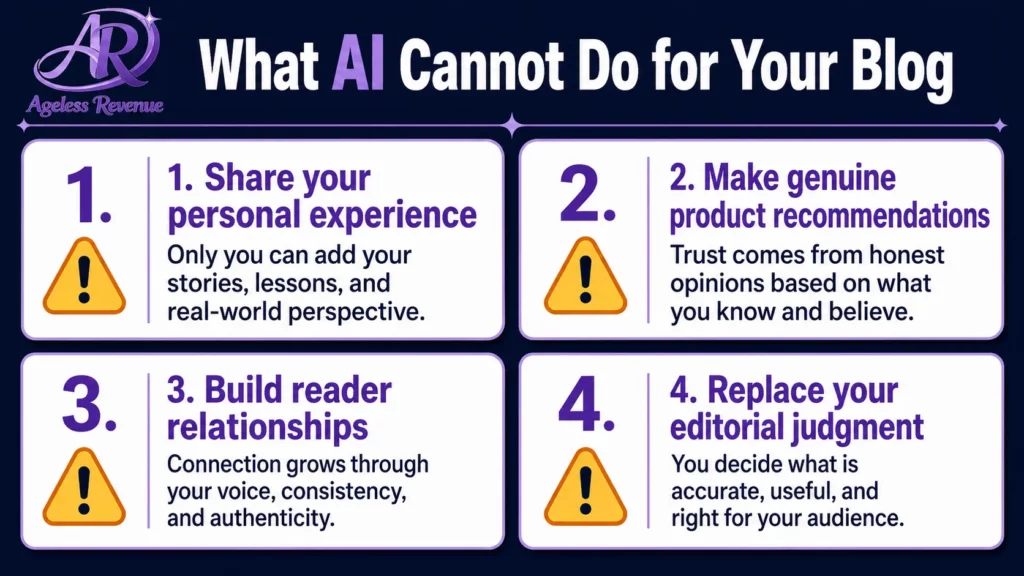
Understanding what AI tools cannot do is as important as knowing what they can.
AI cannot share your personal experience. The most converting affiliate content is specific and personal. “I tried three raised bed kits and here is what actually happened” is something only you can write. AI produces the average of what everyone has written about raised bed kits — which is why AI content tends to feel generic.
AI cannot make genuine product recommendations. Affiliate commissions depend on reader trust. Readers trust recommendations from someone who has genuinely used a product. They do not trust recommendations that clearly came from a tool that has never held a trowel.
AI cannot build reader relationships. The email subscribers and repeat visitors who generate the most affiliate income over time are people who trust you specifically. That trust comes from your consistent voice, your honest opinions, and your genuine experience — not from polished prose that could have been written by anyone.
AI cannot replace your editorial judgment. What to include, what to cut, what your specific audience actually needs — these decisions require your knowledge of your readers. AI does not know your readers.
A Practical Weekly AI Workflow for Retiree Bloggers
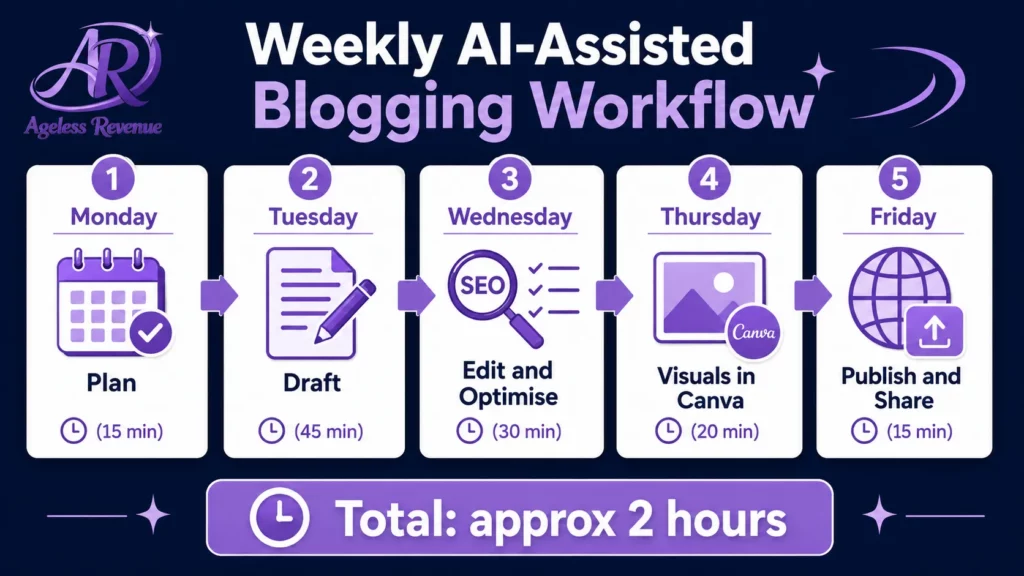
Monday — plan (15 minutes): Ask ChatGPT to suggest five blog post ideas based on your niche and target keyword. Choose one. Write down three specific personal experiences or opinions you want to include in the post.
Tuesday — draft (45 minutes): Give Claude or ChatGPT your topic, your key points, and your keyword. Ask for a 1,200-word draft. Spend 30 minutes rewriting it in your voice, adding your specific experience and product details.
Wednesday — edit and optimise (30 minutes): Run through Grammarly. Set your focus keyword in RankMath. Write your own meta description. Check your internal links.
Thursday — visuals (20 minutes): Create one featured image and two Pinterest pin variations in Canva using your post title.
Friday — publish and share (15 minutes): Publish the post. Share to Pinterest and any other social platforms. Submit to Google Search Console.
Total time: approximately 2 hours per post. Without AI tools, the same quality post typically takes 4–5 hours.
Frequently Asked Questions
Will Google penalise AI-written content?
Google’s guidance is that it rewards helpful, people-first content regardless of how it was produced. The issue is not whether AI was used but whether the content is genuinely helpful and demonstrates real experience and expertise. AI-assisted content written by a knowledgeable human and reviewed for accuracy performs well. Pure AI-generated content with no human expertise or original perspective does not.
Which AI tool should a complete beginner start with?
Start with the free version of ChatGPT. Use it for one task only at first — generating blog post outlines. Once you are comfortable with that, add Canva for images. Add other tools one at a time as you identify where you are losing the most time.
Can I use AI to write product reviews?
Use AI to draft the structure — introduction, pros, cons, verdict — but write the actual review content yourself. A product review that converts must contain a specific personal experience with the product. AI can provide the framework; your experience must fill it.
Do I need to disclose that I used AI tools?
There is currently no legal requirement to disclose AI tool use in blog content (unlike affiliate links, which must be disclosed). However, being transparent with your audience about your process — if they ask — is always the better choice. The FTC’s disclosure requirements apply to material connections to products, not to tools used in the writing process.
Your Next Step
If you are not yet using any AI tools, start with ChatGPT’s free plan this week. Give it your next blog post topic and ask for an outline on how to use AI for affiliate blogging. Spend 15 minutes reviewing and adjusting it to match your actual expertise and experience. Then use that outline to write the post.
For a guide on how to use AI for affiliate blogging and choosing which AI tool suits your specific blogging situation, read How to Choose the Best AI Tool for Blogging.
For a complete structured path to building your affiliate blog with the right tools and training, try Wealthy Affiliate free →
This post contains affiliate links. If you buy through them, I may earn a small commission at no extra cost to you. This information is vital when considering how to use AI for affiliate blogging.