
Social Media Affiliate Marketing Best Practices — What Actually Works in 2026
Social media affiliate marketing is simpler than most guides make it sound. You share helpful content on a platform you already use, include a tracked link to a product you genuinely recommend, and earn a commission when someone buys. No inventory, no shipping, no customer service. Following social media affiliate marketing best practices will enhance your success. To thrive, mastering social media affiliate marketing best practices is essential in today’s landscape.
But there is a gap between doing this and doing it well. The practices in this guide are the ones that actually move the needle — not theories, but specific habits that determine whether your affiliate content earns trust and commissions or gets ignored. Understanding social media affiliate marketing best practices is crucial for success.
Adhering to social media affiliate marketing best practices can significantly improve your performance and results. By implementing social media affiliate marketing best practices, you will build a trustworthy brand.
If you are new to social media affiliate marketing and want the complete beginner overview first, start with the Social Media Affiliate Marketing Guide for Retirees.
Affiliate disclosure: This post contains affiliate links. If you buy through them, I may earn a small commission at no extra cost to you.
TL;DR
- Always disclose affiliate links upfront — it is a legal requirement and a trust builder.
- Lead with genuinely helpful content before placing any link
- Post three times per week consistently rather than sporadically
- Master one platform before adding a second
- Track results monthly, not daily
- Pair your social media with a blog for far better long-term results
Best Practice 1: Choose One Platform and Learn It Properly

The most common mistake among new affiliate marketers on social media is trying to be present on every platform simultaneously. The result is thin, inconsistent content on five platforms instead of strong, trusted content on one.
Pick one platform before the end of your first week and commit to it for a minimum of three months. Pinterest suits retirees who prefer writing and visual content over video — pins surface in search results for months after posting. Facebook Groups suit those who prefer conversation and community. YouTube suits those comfortable on camera.
Incorporating feedback from your audience can help you enhance your application of social media affiliate marketing best practices.
Three focused months on one platform produce more meaningful results than three months scattered across five.
Best Practice 2: Disclose Every Single Time — Upfront
Understanding social media affiliate marketing best practices allows you to create content that resonates with your audience.
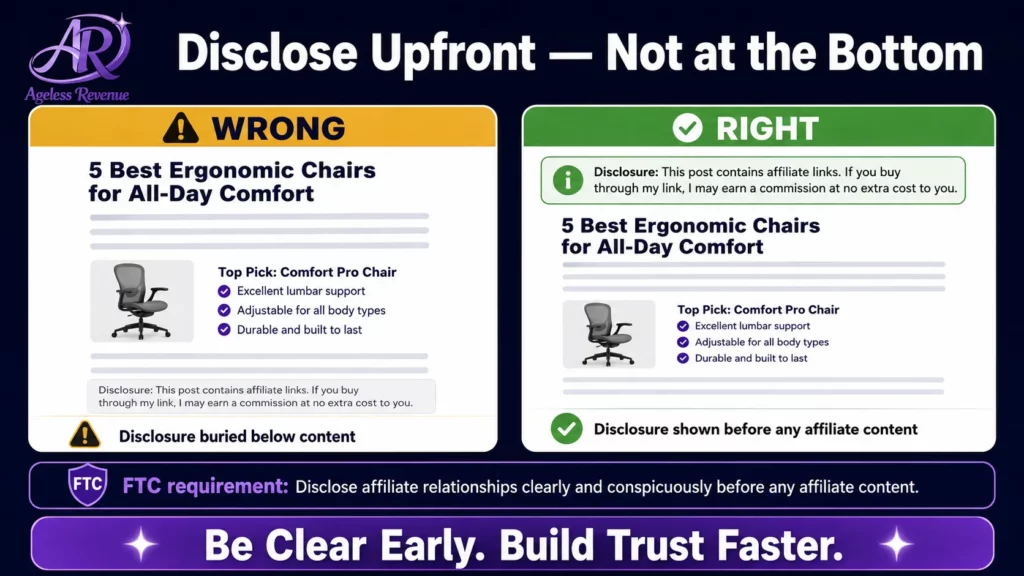
The FTC requires clear disclosure whenever you have a material connection to a product you are recommending. A commission qualifies. This is not optional.
The disclosure must be upfront — at the start of a post or pin description, not buried at the bottom. The simplest wording: “This post contains affiliate links. I may earn a small commission at no extra cost to you.”
Beyond the legal requirement, transparent disclosure consistently increases reader trust rather than breaking it. When you tell people clearly that you earn a commission, they appreciate your honesty and are more likely to click through.
For a full breakdown of what goes wrong when this step is skipped, read Avoiding Common Mistakes in Social Media Affiliate Campaigns.
Best Practice 3: Lead With Value — Link Last
When you follow social media affiliate marketing best practices, you ensure compliance with regulations while fostering trust.
Understanding Social Media Affiliate Marketing Best Practices
The content that converts is content that genuinely helps people. Not content that exists primarily to place a link.
A post that says “Here is the lightweight garden trowel I use, here is why it works for arthritic hands, and here is the one drawback I noticed” will outperform a post that says “Buy this amazing trowel!” every time. The recommendation earns the click. The click earns the commission.
To fully reap the benefits, commit to learning social media affiliate marketing best practices and adapting them to your brand.
A rough content ratio that works: for every post with an affiliate link, publish two purely helpful posts with no links at all. Audiences who see nothing but affiliate links stop engaging. Audiences who consistently receive useful, specific advice trust your recommendations when you make them.
Best Practice 4: Post Consistently — Three Times Per Week
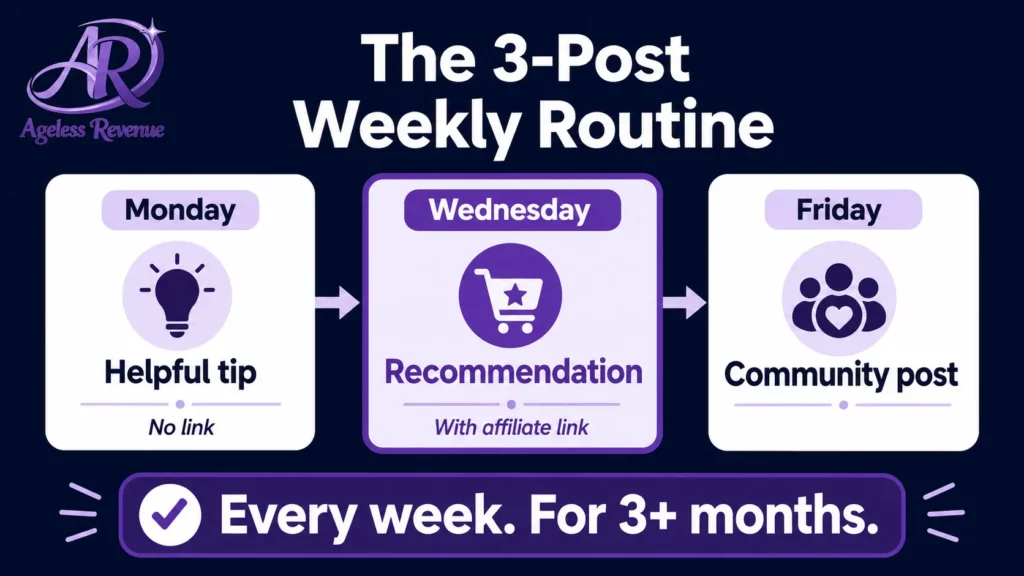
Consistency matters more than volume. Three posts per week, every week, for three months, produces significantly better results than daily posting for three weeks followed by nothing.
A simple sustainable routine:
- Monday: One helpful tip or how-to post — no affiliate link needed
- Wednesday: One product recommendation or review with a contextual affiliate link
- Friday: One community post — a question, a response, something that invites conversation
That is it. Protect those three sessions the way you would a medical appointment. Show up every week for three months before drawing conclusions.
Best Practice 5: Build a Niche Audience, Not a Large One
Three hundred followers who follow you specifically for accessible gardening advice will generate more affiliate income than three thousand generic followers who followed you for an unrelated viral post.
Platform algorithms reward niche-specific engagement. Affiliate programmes convert when recommendations are relevant and trusted. Both outcomes depend on having a focused, specific audience — not a large, unfocused one.
Keep your content tightly focused on one topic. If your account covers accessible gardening, every post should serve someone interested in accessible gardening. Resist the temptation to post off-topic content for engagement. It attracts the wrong audience and dilutes the trust you are building with the right one.
Best Practice 6: Only Recommend Products You Have Actually Used
Readers and viewers detect inauthenticity immediately, especially on platforms where comments are visible. A recommendation from someone who clearly uses and believes in a product converts. A recommendation from someone reading from a spec sheet does not.
The rule is simple: do not promote products you have not personally used. Your credibility is your only real asset in affiliate marketing. One dishonest recommendation that readers see through costs more in lost trust than the commission it generates.
When you do recommend a product, be specific. Not “this is a great garden trowel” but “I have been using this for raised bed gardening for three months and here is exactly what works about it and what I would change.”
Best Practice 7: Use Pinterest as a Search Engine, Not a Social Feed
Pinterest behaves differently from every other platform on this list. It is a visual search engine — users search for specific things, and Pinterest surfaces content that matches, regardless of how many followers the pinner has.
This means a new account with fifty followers but strong keyword-targeted pins will reach more people than an established account posting generic content. Keywords in your pin titles and descriptions matter more than follower count.
Pins also last far longer than posts on other platforms. A well-optimised Pinterest pin can drive traffic and affiliate commissions for months or years after it is posted. This compound effect makes Pinterest especially well suited to the patient, with a consistent approach that suits retirement life.
For a complete Pinterest setup guide, read Pinterest for Affiliate Marketing Beginners.
Best Practice 8: Use Facebook Groups Over Pages
Facebook Pages have seen a significant decline in organic reach — a Page with one thousand followers might reach fifty people per post. Facebook Groups, by contrast, show content to members much more reliably, especially when it generates genuine conversation.
If you are using Facebook for affiliate marketing, prioritise participating in relevant Groups over building a Page from scratch. Find two or three active Groups in your niche. Spend fifteen minutes per day answering questions helpfully. When a product recommendation fits naturally, include your affiliate link with a clear disclosure.
Best Practice 9: Track Results Monthly — Not Daily
Remember that social media affiliate marketing best practices evolve; stay updated with the latest trends.
Daily checking of affiliate dashboards generates anxiety without useful information. Monthly checking gives you enough data to identify patterns: which content types convert, which platforms perform, which products earn the most per click.
The most useful single metric is earnings per click (EPC) — your total commissions divided by your total link clicks. This tells you which posts are actually profitable, not just which ones get traffic.
Check your dashboards once a month. Identify your three best-performing posts. Create more content similar to that. Update or retire content that generates clicks but no conversions.
For a full guide to tracking tools and what to measure, read How to Track Social Media Affiliate Performance.
Social media affiliate marketing best practices can also guide you in selecting the right products to recommend.
By applying social media affiliate marketing best practices, you can enhance your brand’s reputation and grow your audience.
Best Practice 10: Pair Social Media With a Blog
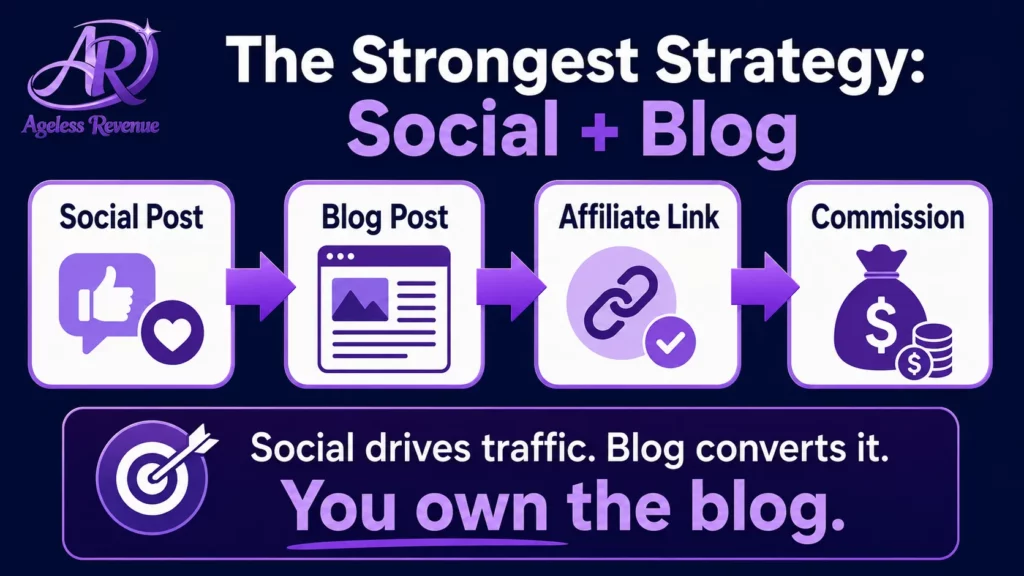
Social media alone is a fragile affiliate marketing strategy. Platform algorithms change. Accounts get restricted. Reach collapses without warning. A blog is an asset you own and control completely — algorithm changes cannot take it away from you.
The right strategy incorporates social media affiliate marketing best practices for achieving sustainable growth.
The most effective long-term approach uses social media to drive traffic to your blog, where readers find more depth, more detail, and more affiliate link opportunities than any social post can contain. A Pinterest pin drives traffic to a blog post. The blog post converts the reader. The commission lands in your dashboard.
For a structured path to building a blog that makes social media affiliate marketing work long-term, Wealthy Affiliate combines training, hosting, and keyword tools in one place.
Ultimately, the goal is to embody social media affiliate marketing best practices that genuinely serve your audience’s interests.
Success in affiliate marketing hinges on adhering to social media affiliate marketing best practices.
By consistently applying social media affiliate marketing best practices, you can create a positive impact on your affiliate earnings.
In conclusion, mastering social media affiliate marketing best practices is essential for anyone aiming to succeed in this field.
What the Best Practice Actually Is
Behind all ten of these practices is one principle: be the most genuinely helpful resource your specific audience can find on your specific topic.
Platforms reward that. Affiliate programmes convert from that. Reader trust compounds from that.
The retirees who build reliable affiliate income from social media are not the ones who post the most or follow the most trends. They are the ones who show up consistently, recommend honestly, and give their specific audience real value week after week.
Frequently Asked Questions
How many affiliate links should I include per post?
One is usually enough. A single well-placed contextual link — inside a genuine recommendation with specific detail — converts better than multiple links scattered through a post. Readers who see three or four affiliate links in one post tend to trust none of them.
Do I need a website to do affiliate marketing on social media?
For maximum effectiveness, align your goals with social media affiliate marketing best practices.
Not strictly, but it improves your results significantly. Pinterest and YouTube allow affiliate links directly. Facebook and Instagram are more restrictive. A blog post linked from your social content converts at a higher rate than a direct affiliate link because it provides the depth and context that builds purchase confidence.
Building a strategy around social media affiliate marketing best practices will give you a competitive edge.
How long before social media affiliate marketing produces income?
With consistent posting in a specific niche, most retirees see their first affiliate clicks within two to four weeks and their first commission within one to three months. Building a reliable monthly income typically takes six to twelve months of consistent effort.
Should I promote products from multiple affiliate programmes at once?
Make it a point to review and refine your approach based on social media affiliate marketing best practices regularly.
Start with two — Amazon Associates and one network, such as ShareASale or Impact. Add more as you identify which products your specific audience responds to. Joining dozens of programmes simultaneously is a distraction from the content work that actually builds income.
Your Next Step
Choose one platform. Commit to three posts per week for three months. Disclose clearly. Recommend only what you have used. Track monthly.
That is the entire practice in five sentences.
As you engage with your audience using social media affiliate marketing best practices, you will likely see increased engagement and higher conversion rates.
For a complete list of the best affiliate programmes to use alongside social media, read Best Social Media Affiliate Programs for Beginners.
For a structured path with training, hosting, and community support all in one place, try Wealthy Affiliate free →
This post contains affiliate links. If you buy through them, I may earn a small commission at no extra cost to you.
Incorporating social media affiliate marketing best practices into your campaigns is vital for long-term success.