

How to Choose and Validate Your Affiliate Niche (2026)
Choosing a niche is the decision that everything else in your affiliate blog depends on. Get it right, and writing feels natural and traffic builds steadily on a foundation of real expertise. Get it wrong, and you will find yourself forcing content about a topic you do not care about, for an audience you cannot quite picture, with no clear products to recommend. This guide focuses on how to choose and validate your affiliate niche.
This guide walks through how to choose a niche that fits your actual life, and then how to validate it in about an hour before you invest months of effort in learning how to choose and validate your affiliate niche.
Affiliate disclosure: This post contains affiliate links. If you buy through them, I may earn a small commission at no extra cost to you.
TL;DR
- The best niche sits at the intersection of genuine personal experience, real search demand, and available affiliate products
- Profitability matters less than whether you will still want to write about it in month eight
- Validate any niche idea in under an hour using three simple checks before committing
- Long-tail, specific niches (“garden tools for arthritic hands”) beat broad ones (“gardening”) for a new site
- Your decades of real-world experience are the advantage a 25-year-old blogger does not have
What Makes a Niche Worth Choosing

A niche is simply the main subject of your blog. The strongest niches for retiree affiliate bloggers sit at the overlap of three things:
Something you genuinely know. Not something you researched for an afternoon — something you have lived. A career, a long-running hobby, a health condition you have managed, a life stage you are currently navigating. This is where your decades of experience become a real competitive advantage rather than something to work around.
Something people are actively searching for. Real search volume, real ongoing demand. A niche nobody searches for, no matter how passionate you are about it, will not produce traffic.
Something with products you can honestly recommend. Physical products, software, courses, services — anything with an active affiliate program and genuine alternatives worth comparing.
How to Choose and Validate Your Affiliate Niche
Profitability in the abstract — “which niche pays the highest commissions” — matters far less than fit. The retiree bloggers who succeed are not the ones who picked the theoretically most lucrative topic. They are the ones who picked something they will still be enthusiastic about writing in month eight, when the initial excitement has faded and the only thing keeping them going is genuine interest.
Niches That Work Particularly Well for Retirees
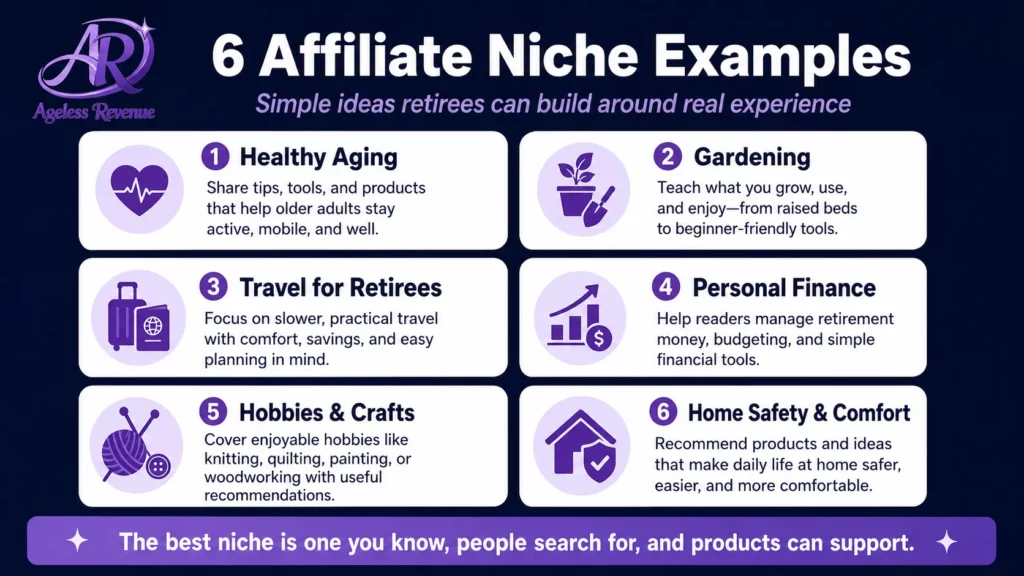
These are starting points, not a complete list:
Accessible gardening — raised beds, ergonomic tools, container gardening for limited mobility.
Gentle fitness and mobility — exercises for joint health, equipment for low-impact movement, recovery after injury or surgery.
Simple cooking for one or two — portion-appropriate recipes, kitchen tools that reduce physical strain, meal planning for changing dietary needs.
Travel comfort and accessibility — mobility-friendly destinations, travel gear for joint pain or limited stamina, planning trips around health considerations.
Technology help for beginners — demystifying smartphones, tablets, and apps for people who did not grow up with them, including for use with grandchildren.
Healthy aging and wellness — sleep, supplements, low-impact exercise, navigating health information without overwhelm.
Crafts and hobbies — knitting, woodworking, painting — anything with a genuine following and a market for supplies and instruction.
The common thread: each of these has obvious affiliate products (Amazon has thousands of relevant items), genuine search demand, and room for the specific, lived-experience content that converts.
The Three-Question Validation Test
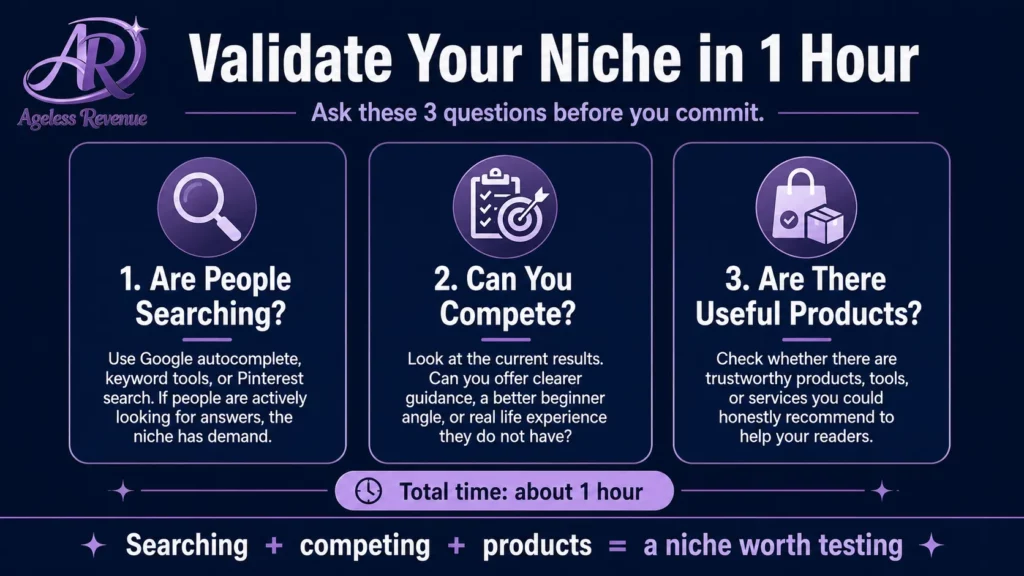
Before committing to a niche, spend about an hour running it through three checks.
Question 1: Is anyone searching for this?
Type your topic into Google’s search bar and look at the autocomplete suggestions — these reflect real searches happening right now. Then check Google’s free Keyword Planner (no need to run ads, just create a free account) for specific phrases within your niche. You are looking for keywords with roughly 100-1,000 monthly searches and low-to-medium competition. Lower volume with lower competition is a better starting point for a new site than high volume with high competition.
Question 2: Can a new site realistically compete here?
Search Google for your most important target keyword and look at who currently ranks on page one. If the results are dominated by major established sites — large retailers, national health organisations, big media outlets — that specific keyword is too competitive for a brand-new blog. If you see smaller independent blogs and niche sites in the results, there is room for you to compete.
This does not mean abandoning the niche entirely — it means starting with more specific, longer-tail keywords within it rather than the broadest, most competitive terms.
Question 3: Are there products to recommend?
Search Amazon and a couple of specialty retailers for products in your niche. Are there options with meaningful numbers of reviews? Check whether an affiliate program exists — Amazon Associates covers almost everything, and many specialty brands run their own programs through networks like ShareASale or Impact. If you find products you would genuinely want to use and recommend, this question is answered.
If your niche idea passes all three checks, you have a validated niche. If it fails one, it usually means narrowing the focus rather than abandoning the idea — “gardening” might be too broad and competitive, but “raised bed gardening for limited mobility” often passes easily.
Narrow Beats Broad for a New Site
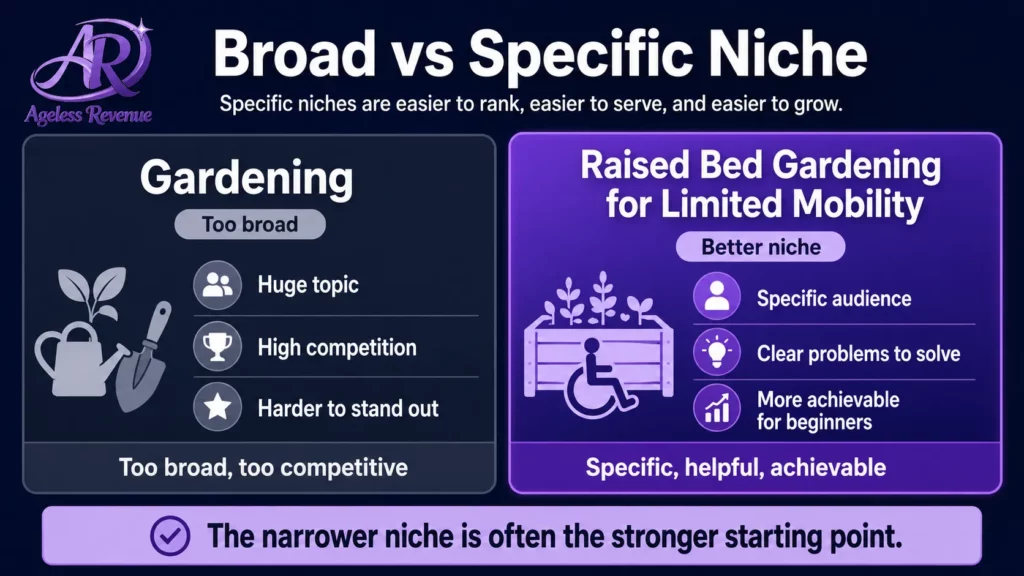
The instinct when choosing a niche is often to go broad, to maximise the potential audience. For a brand-new site, this instinct works against you.
“Gardening” is enormous, ferociously competitive, and impossible for a new blog to meaningfully rank for. “Raised bed gardening for retirees with limited mobility” is specific, has dramatically less competition, and attracts a reader who is exactly the right fit for your content and your affiliate recommendations.
Start narrow. You can always expand into adjacent subtopics once your initial focus is established and ranking. Going the other direction — narrowing down from a broad, unfocused site — is much harder, because you will have already built content and authority around topics that do not convert as well.
What to Do Once You Have Chosen
Write down three to five potential blog post topics within your niche and run each one through the same search-volume check. If several pass, you likely have a viable niche with enough depth to sustain months of content.
Then move on to setting up the website itself. For the complete step-by-step process, read How to Build Your First Affiliate Website.
Frequently Asked Questions
What if I cannot think of anything I am specifically an expert in?
Most people underestimate their own knowledge because it feels ordinary to them. Decades spent gardening, decades managing a household budget, decades navigating a health condition, decades in any career — these all produce real expertise. The question is not whether you have expertise; it is which area of it has a genuine audience searching for help.
Should I choose a niche based purely on commission rates?
No. A niche with mediocre commission rates that you write about consistently for two years will outearn a higher-commission niche you abandon after two months out of boredom or burnout. Fit and sustained interest matter more than the commission percentage on any individual product.
Can I change my niche later if I choose wrong?
Yes, though it costs time and momentum. This is exactly why the validation step matters — an hour of research before you commit is far cheaper than discovering the mismatch after three months of writing.
How specific should my niche be?
Specific enough that you could describe your ideal reader in one sentence. “People interested in gardening” is too broad. “Retirees managing arthritis who want to keep gardening” is specific enough to write directly to and specific enough to rank for.
Your Next Step
Write down your top two or three niche ideas right now. Spend the next hour running each through the three-question test above. Choose the one that passes most clearly and feels genuinely sustainable for you.
For the complete guide to getting started with affiliate marketing as a retiree, read Getting Started With Affiliate Marketing as a Retiree.
For the complete guide, read Finding Your Profitable Niche (2026)
For a structured path with niche selection guidance, training, and keyword tools built in, try Wealthy Affiliate free →
This post contains affiliate links. If you buy through them, I may earn a small commission at no extra cost to you.