

How to Write Affiliate Product Reviews That Actually Convert
Most affiliate product reviews on the internet are useless. They are lists of specs copied from a manufacturer’s website, peppered with vague praise — “great quality,” “highly recommended” — and concluded with an affiliate link the reader has no reason to trust. Understanding how to write affiliate product reviews can set you apart.
Readers know the difference. They have been reading online content long enough to recognise a review written by someone who has genuinely used a product, rather than one assembled from a product page and a few competitor reviews. When they sense the latter, they leave — without clicking anything.
This is actually good news. Because the bar for a genuinely useful affiliate review is not high. It requires honesty, specificity, and a clear structure — things you already have access to, particularly if you are writing about products you have real experience with.
For the Ageless Revenue audience, this is worth stating directly: a 62-year-old gardener reviewing raised bed kits for people with limited mobility has a credibility advantage that no amount of keyword research gives a young generalist blogger. The lived experience is the differentiator. This guide shows you how to structure it so that credibility converts into commissions.
This guide outlines how to write affiliate product reviews effectively to engage readers and enhance conversions.
Affiliate disclosure: This post contains affiliate links. If you buy through them, I may earn a small commission at no extra cost to you.
TL;DR – How to Write Affiliate Product Reviews
- Specificity, balance, and relevance are the three elements that determine whether a review converts.
- Use an 8-part structure: hook, who it’s for, quick verdict, product overview, hands-on experience, pros and cons, who should not buy, final CT.A.
- Include honest cons — they increase trust and therefore increase conversions.
- Always say clearly who the product is NOT right for
- FTC disclosure must appear before any affiliate links — not at the bottom
- You can review products you have not personally used, but you must be transparent about it
What Makes an Affiliate Product Review Actually Convert?
Three elements determine whether a review generates clicks.
Specificity. Real details that only someone who has used the product would know. Not “the build quality is excellent” but “the locking mechanism on the left hinge started to feel slightly loose after three months of daily use — not enough to affect function, but worth noting.” Specificity signals to the reader: this person actually used this thing. That trust is what earns the click.
Balance. Genuine cons included alongside the pros. A uniformly positive review feels like an advertisement — because that is exactly what it is. A review that honestly acknowledges limitations tells the reader: this person is not just trying to sell me something. Including real drawbacks counterintuitively increases conversions because it increases trust.
Relevance. The right product for the right reader at the right moment. A review that clearly defines who the product is for — and who it is not for — does the reader’s decision-making work for them. When a reader reaches the end of your review and thinks, “yes, that is exactly me,” the affiliate click is almost certain.
What kills conversions: vague superlatives with no supporting evidence, walls of technical specifications with no human context, no clear recommendation, and an affiliate link buried at the bottom with no reason to click it.
The 8-Part Structure of a High-Converting Affiliate Review
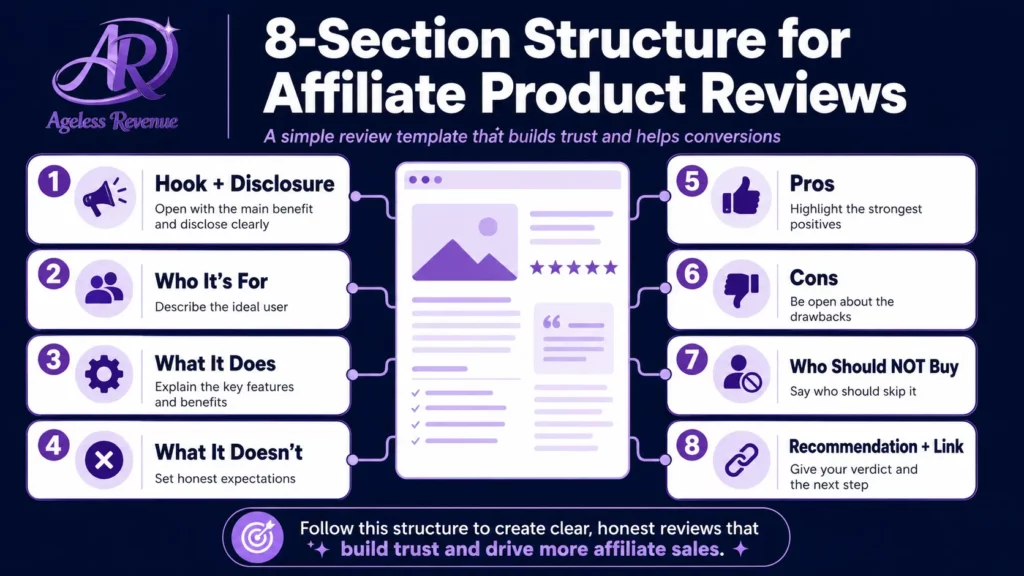
Part 1: The Opening Hook — What Problem Does This Product Solve?
Start with the reader’s problem, not the product. The reader arrived at your review because they have a specific need. Acknowledge it immediately.
“If you love gardening but find that bending and kneeling are becoming increasingly difficult, you have probably been looking at raised bed kits for a while.”
This opening does three things: it confirms the reader is in the right place, it demonstrates you understand their situation, and it creates forward momentum into the review itself.
Part 2: Who This Review Is For
Before the affiliate link and before the detailed assessment, tell the reader whether this review is relevant to their situation.
“This review is for adults over 60 who want a raised bed solution they can manage independently, without requiring assembly assistance or ongoing physical strain. If you are looking for a large production garden setup, a different solution will serve you better.”
This is the filtering step. A reader who is not your target customer will leave — which is fine. The reader who recognises themselves in that description will stay and trust what follows.
Part 3: The Quick Verdict
Give your overall recommendation immediately. Many readers scroll straight to this section. Do not make them hunt for your conclusion.
“In short, this is the most practical raised bed kit I have found for gardeners managing joint pain or limited reach. The assembly is genuinely manageable alone, the height eliminates most bending, and the quality justifies the price. The main limitation is drainage in heavy rainfall — more on that below.”
A quick verdict should be two to four sentences: overall stance, strongest benefit, honest limitation, and a pointer to the detail sections below.
Part 4: Product Overview — What You Get
A brief, factual description of the product — dimensions, materials, what is included, price range. Keep this section short. The reader can find specifications on the manufacturer’s page. What they cannot find anywhere else is your experience.
Part 5: Hands-On Experience — Specific Observations
This is the most important section of any affiliate review and the one that most bloggers get wrong.
Do not describe what the product is supposed to do. Describe what it actually did for you, in specific terms, based on your real use.
Weak: “The assembly process was straightforward.”
Strong: “Assembly took me 47 minutes working alone. The instructions are illustrated but assume a level of physical dexterity that not everyone will have — the corner brackets require holding three pieces simultaneously while inserting a bolt. I got around this by using a rubber band to hold two pieces in position while I worked on the third.”
The second version is useful. It tells the reader something they will not find in the manufacturer’s description, in a review that was clearly written by someone who has done this. That is the version that converts.
Cover the aspects that matter most to your specific audience — in this example, ease of assembly for someone working alone, physical demands, durability over time, and whether it delivers what it promises.
Part 6: Honest Pros and Cons
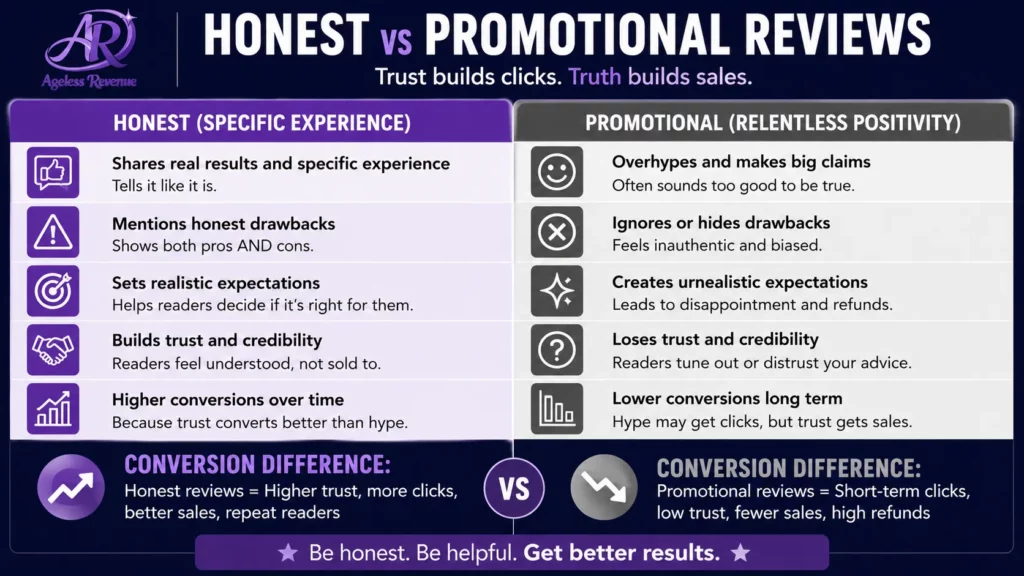
A structured list works well here. Three to six items on each side. Be specific — “sturdy construction” is not a pro; “the cedar boards showed no warping after 18 months outdoors in a wet climate” is.
For cons, be equally specific. “Drainage issues in heavy rain” is a useful con. It is honest, it is something the reader needs to know, and it does not prevent a sale — it just helps the right buyer make an informed decision.
The cons section is where most bloggers lose their nerve. Do not. A review with no meaningful cons is not trusted.
Part 7: Who Should and Should Not Buy This Product
This is the most trust-building section in the entire review and the one most frequently skipped.
“This kit is a good fit for: solo gardeners over 60 managing joint pain or limited mobility, anyone who wants a permanent raised bed solution they can maintain independently, gardeners with a small to medium growing space.
This kit is not the right choice for: anyone needing very large growing volumes, gardeners on a tight budget (there are cheaper options, though with trade-offs in quality), or anyone who wants a portable or seasonal setup.”
When you tell a reader this product is not for them, they trust everything else you have written. They know you are not just trying to earn a commission.
Part 8: Final Verdict and Affiliate CTA
Return to your overall recommendation and make the call to action clear and specific.
“For a gardener over 60 who wants to continue growing independently without the physical strain of ground-level gardening, this is the best option I have found at this price point. The durability justifies the cost. [Check the current price and availability →](your affiliate link)”
The link text should describe the action — not “click here” but “check the current price,” or “see it on Amazon,” or “read more reviews.” Descriptive anchor text converts better than generic text.
A Fill-in-the-Blank Review Template
Use this as a starting framework and replace every placeholder with your specific experience:
[Product Name] Review: [One-sentence honest verdict]
Affiliate disclosure: This post contains affiliate links.
Who this is for: [one sentence describing the ideal buyer]
Quick verdict: [2-3 sentences — overall recommendation, top benefit, honest limitation]
Product overview: [brief factual description — dimensions, materials, price range]
My experience: [specific observations from actual use — what worked, what didn’t, workarounds you found]
Pros:
- [specific benefit with evidence]
- [specific benefit with evidence]
- [specific benefit with evidence]
Cons:
- [specific limitation with context]
- [specific limitation with context]
Best for: [specific buyer description] Not for: [specific buyer description]
Final verdict: [clear recommendation + affiliate link with descriptive anchor text]
Before and After: What Good Specificity Looks Like
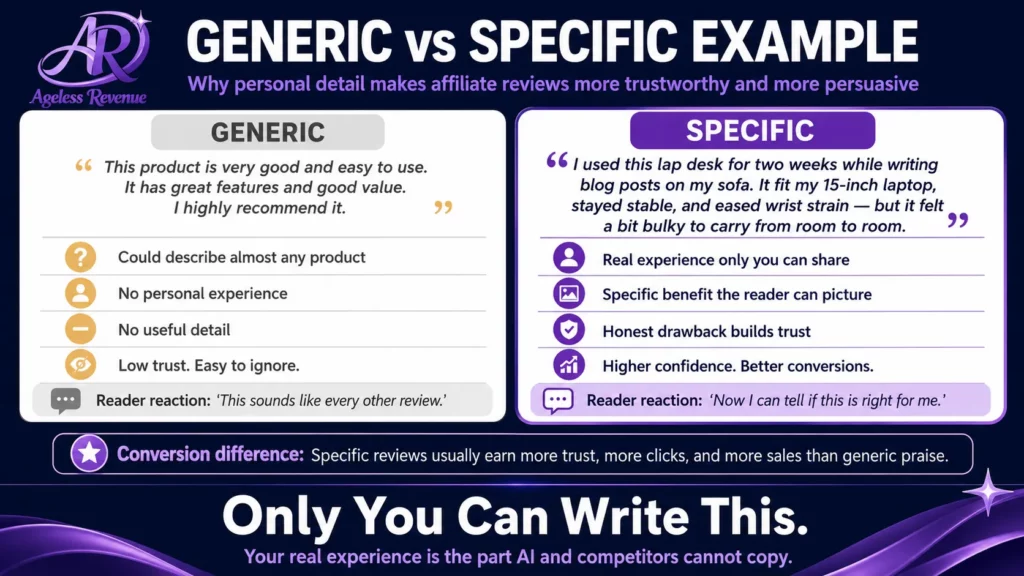
Before (does not convert): “The Greenfields Raised Bed Kit is a high-quality product that garden enthusiasts will love. The assembly is easy, and the materials are durable. This is a great choice for anyone looking to start a raised bed garden.”
After (converts): “The Greenfields kit took me 47 minutes to assemble alone, using the workaround I describe below for the corner brackets. After 18 months in a wet Scottish climate, the cedar boards show no warping or significant weathering. The height — 76cm — eliminates bending entirely for most adults. The one thing I would change is the drainage holes: in heavy summer rainfall, the beds pool slightly before draining. I have since drilled two additional holes in each corner, which fixed it completely.”
The second version is three times longer, but every additional word earns its place. It answers questions the reader was going to have. It demonstrates genuine use. It includes a practical fix for the main problem. This is the version that earns affiliate clicks.
Comparison Posts: The Highest-Converting Affiliate Format
A comparison post — “Product A vs Product B: Which Is Right for You?” — is often even higher converting than a single product review, because it reaches readers who have already narrowed their choice and need help making the final decision.
The structure is similar to a single review, but with a clear focus on the specific differences that matter to your audience. Not a feature-by-feature spec comparison, but a decision framework: “If your priority is X, choose A. If your priority is Y, choose B.”
Always end a comparison post with a clear recommendation for each buyer type rather than an inconclusive “both are good options” conclusion. Readers came to a decision. Make one.
Writing About Products You Have Not Personally Used
Ideally, every product you review is one you have personally tested. But there are legitimate reasons to review products you have not used yourself — a product in your niche that your readers frequently ask about, a product you researched thoroughly before deciding not to buy.
If you have not used the product, say so clearly:
“I have not personally used this product, but I have spent several hours researching user reviews across multiple platforms, consulted with [two other gardeners in my network who have used it for 12+ months], and compared it thoroughly against the alternatives I have used directly.”
This transparency is more trustworthy than pretending to have used something you have not. Readers who discover a reviewer fabricated a personal experience do not come back.
FTC Disclosure: What You Are Legally Required to Say
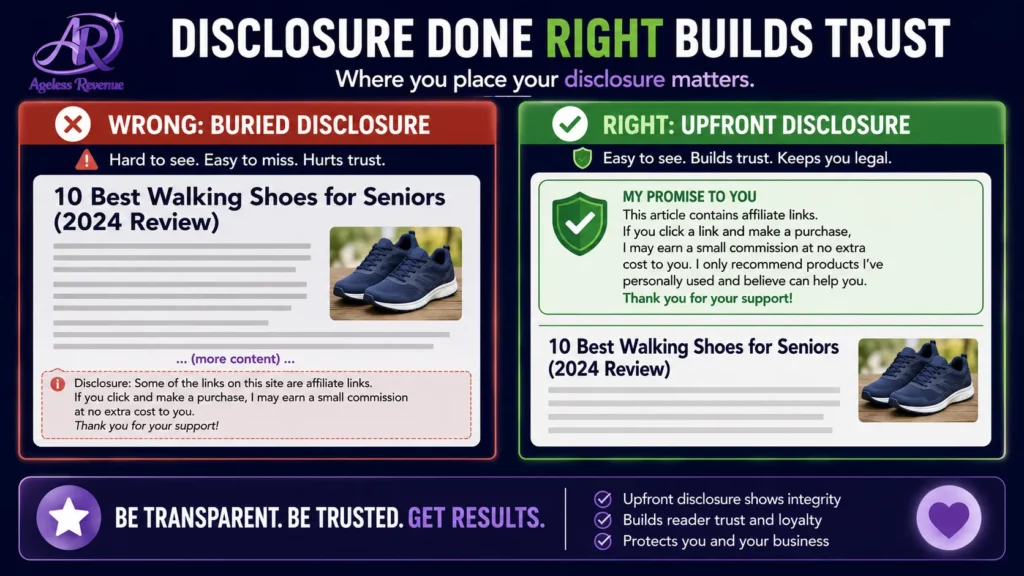
The FTC requires clear disclosure whenever you have a material connection to a product you are recommending. A commission qualifies.
The disclosure must be:
Clear — it must actually say that you may earn a commission, not just that the post “contains affiliate links” (though both together is best practice)
Prominent — placed before any affiliate links, not buried at the bottom of the post
Understandable — written in plain language, not buried in legalese
Recommended wording near the top of every review: “This post contains affiliate links. If you buy through them, I may earn a small commission at no extra cost to you.”
Transparent disclosure consistently increases rather than decreases reader trust. Readers appreciate honesty about how the blog earns income. It is not something to hide or minimise.
SEO Basics for Affiliate Review Posts
Review posts are naturally well-suited to search engine traffic because they match high-intent search queries — people searching for “[product name] review” or “best [product type] for [specific need]” are typically close to a purchase decision.
A few practical points:
Use the product name in your title and URL. “Greenfields Raised Bed Kit Review: Honest Assessment After 18 Months” is a better title than “My Favourite Garden Product.” The product name in the URL helps Google match your post to direct product searches.
Target the long-tail query. “Best raised bed kit for seniors with limited mobility” will outperform “best raised bed kit” for a new blog. The more specific query has less competition and reaches a reader closer to your target audience.
Internal links. Link your review to related posts on your site — your general guide to raised bed gardening, your roundup of garden tools for seniors, your comparison of raised bed materials. Internal links keep readers on your site and signal to Google that your content is part of a coherent, authoritative topic area.
For a complete guide to building the content strategy that makes individual reviews more effective, read Content Marketing for Retiree Bloggers.
Frequently Asked Questions
How long should an affiliate product review be?
Long enough to fully answer the questions a buyer would have before purchasing — typically 800–1,500 words for a single product review. The length should be determined by the complexity of the purchasing decision, not by an arbitrary word count target. A simple product with a clear use case needs fewer words than a complex product with multiple competing options.
Should I only review products I have personally used?
Ideally, yes, and this should be your default approach. When you write from genuine personal experience, the specificity and authority that converts readers is natural rather than manufactured. If you review products you have not used, be transparent about your research methodology.
Can I write negative affiliate reviews?
Yes, and you should when they are warranted. A review that concludes “this product is not the right choice for most readers in my audience, and here is why” is more trustworthy than one that recommends every product it covers. You do not earn a commission on that particular product, but you build the credibility that earns commissions on everything else you recommend.
How many affiliate links should a review contain?
For a single product review: one primary affiliate link in the quick verdict, one in the final CTA, and optionally one in the product overview section. Three is typically the right maximum. For a comparison post, one link per product compared. Adding more links than this can feel aggressive and actually reduce the click rate on any individual link.
Your Next Step
Write your next affiliate review using the 8-part structure above. Before you start, write down three specific observations from your personal experience with the product that no spec sheet would contain. Build your review around those three observations. Everything else — the structure, the template, the SEO basics — supports those moments of genuine experience.
For a complete guide to building the affiliate blog that these reviews live on, read Content Marketing for Retiree Bloggers.
For a structured training path that covers review writing, SEO, and affiliate programme selection in one place, try Wealthy Affiliate free →
This post contains affiliate links. If you buy through them, I may earn a small commission at no extra cost to you.