

Beginner-friendly niche validation for retirees and late starters
Introduction
Choosing a niche can feel bigger than it really is.
If you are starting affiliate marketing after retirement, it is easy to get stuck wondering whether your idea is too broad, too small, or not profitable enough. The good news is that you do not need a perfect niche before you start. You need a niche you can validate calmly before you spend weeks building content around it.
In this guide, I will walk you through a simple retiree-friendly validation process so you can test an idea before you build a site around it. If you are brand new to the big picture, start with my Affiliate Marketing for Retirees guide first, then come back here and pressure-test your idea.TL;DR: The Simple Answer
A good affiliate niche after retirement usually has five things: a clear reader, a real problem to solve, products or services that fit naturally, enough questions to write about for months, and a topic you would still enjoy six months from now.
If your niche has all five, it is usually strong enough to move forward. If it only has one or two, slow down and test it more before you invest time in a website.
Why Niche Validation Matters More Than Picking the “Perfect” Topic
Many beginners think niche selection is about finding the smartest or most profitable topic on the internet. It is not. For retirees, the best niche usually sits in the middle of three things: something you understand or enjoy, something people actively need help with, and something connected to products, tools, or programs people already buy.
Validation protects you from two common mistakes. The first is choosing a topic that is too broad, like health, travel, or technology. The second is choosing a topic that feels fun but has no real buying intent, no ongoing questions, or no clear reader.
A validated niche gives you direction. It also makes your writing easier because you know who you are helping and what kind of questions they are likely to ask.
The 7-Step Retiree-Friendly Niche Validation Process
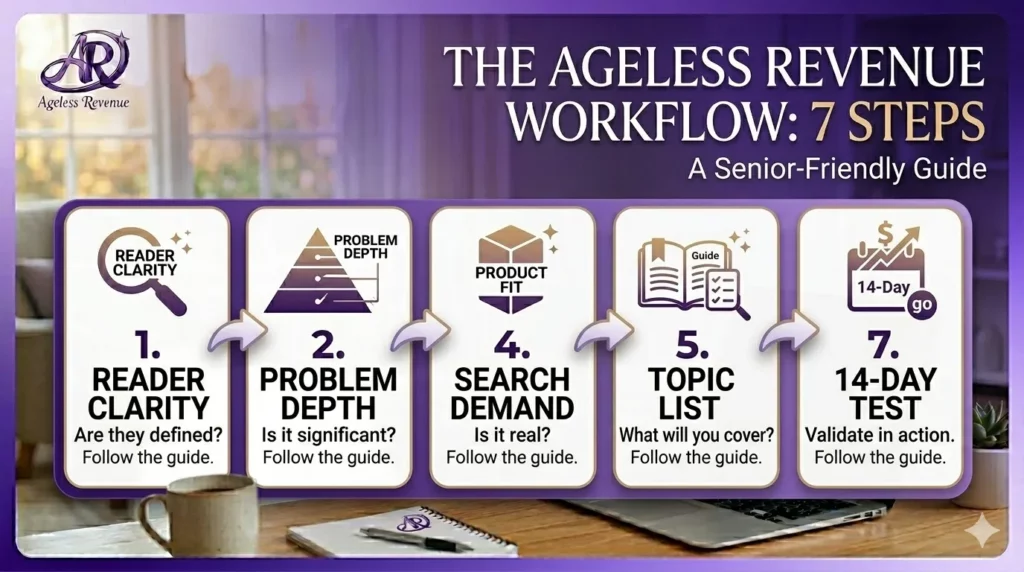
Use these seven steps in order. Your goal is not to prove your niche is perfect. Your goal is to see whether it is strong enough to move forward with confidence.
Step 1: Name One Specific Reader
Before you test the niche, test the audience. Ask yourself: Who exactly am I writing for?
Not everyone is over 50. Not everyone likes gardening. Get more specific. Better examples include retirees with stiff knees who want gentle home exercise, beginners who want easy container gardening, late starters who want to learn affiliate marketing without tech overwhelm, or older travelers who want comfort gear for long flights.
Use this sentence starter: “I help ________ do ________ without ________.” If you can complete that sentence clearly, you are off to a good start.
Step 2: Identify the Problem They Want Solved
A niche is not just a topic. It is a topic connected to problems, goals, and questions. Look for things your reader wants to improve, avoid, simplify, compare, or buy with less risk.
If your niche produces lots of real-world how, which, what, and best questions, that is a great sign.
Step 3: Check for Natural Product Fit
Affiliate marketing is not only about traffic. It is also about recommendations. Ask yourself what people in this niche naturally buy.
You are looking for products, services, software, memberships, subscriptions, books, tools, supplies, or programs that honestly fit the topic. A healthy niche usually has product variety at more than one price point so you can create tutorials, reviews, comparisons, checklists, and buyer guides later.
Step 4: Look for Real Questions and Search Demand
You do not need expensive keyword tools to do this. Use simple places where people reveal what they already want help with: Google autocomplete, People Also Ask, YouTube suggestions, Pinterest search, Amazon reviews, Reddit, or niche forums.
Write down at least 15 to 20 questions, comparisons, or beginner problems. If you struggle to find 10, the niche may be too thin. If you quickly find 20 to 30, you probably have enough depth for a real site.
If you want a calmer understanding of how question-based content turns into traffic and clicks, read my Affiliate Marketing for Retirees guide before you build your content list.Step 5: Build a 20-Topic List Before You Commit
Before you build a website, list 20 article ideas you could realistically write over the next few months. Your list does not need to be fancy. It just needs to prove you have enough runway.
A balanced list might include beginner how-to posts, product roundups, comparisons, mistake-avoidance posts, checklists, and FAQ-style posts. If you cannot get to 20 without repeating yourself, your niche may still be too narrow.
Step 6: Run the Calm Profit Test
Profitability does not mean asking whether somebody somewhere can make money in this niche. It means asking whether you can realistically publish helpful content in this niche that leads naturally to useful recommendations.
Score your niche on five checks: reader clarity, problem strength, product fit, content depth, and personal staying power. A niche scoring 20 or above is usually strong enough to move forward. A niche scoring under 15 needs more work before you build on it.
A good niche does not need to be complicated. It needs to be clear, useful, and realistic for the time and energy you have. Before you invest in extra tools, read my small-budget affiliate marketing guide.Step 7: Do a 14-Day Mini-Test
If you are still unsure, do not guess. Test. For 14 days, pretend the niche is already chosen and draft 3 article outlines, save 10 product ideas, collect 15 real audience questions, write one short sample introduction, and bookmark 5 related sites.
At the end of those 14 days, ask whether the topic felt easier or harder than expected, whether you could still see yourself writing about it next week, whether ideas came naturally, and whether the products felt useful.
A Simple Niche Scorecard You Can Use Today
Use this quick scorecard: reader clarity, problem depth, product fit, content runway, and staying power. Score each one from 1 to 5.
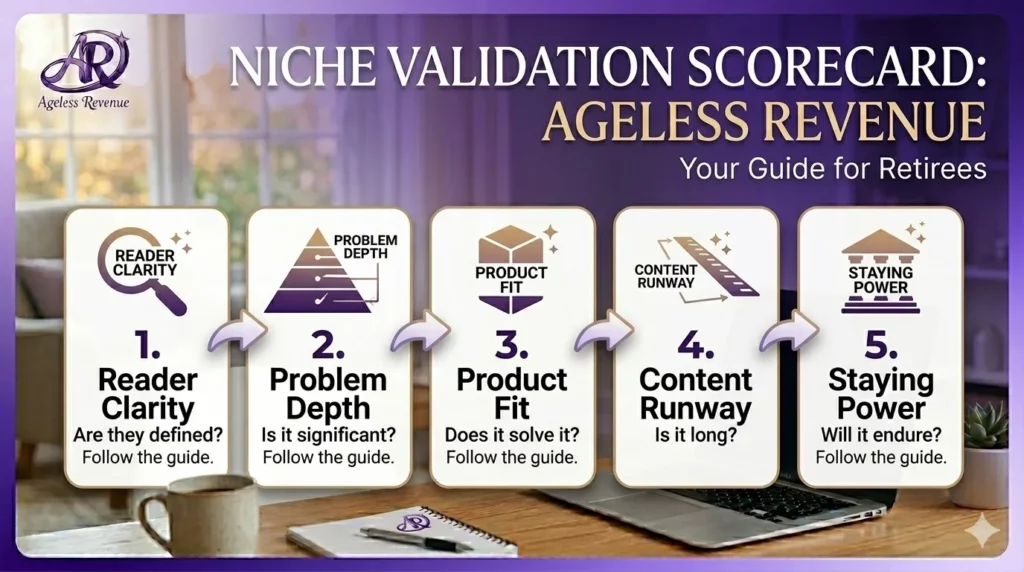
Scoring guide: 22–25 means strong niche, 18–21 means good but narrow it a little more, 14–17 means test before committing, and under 14 means rethink or refine.
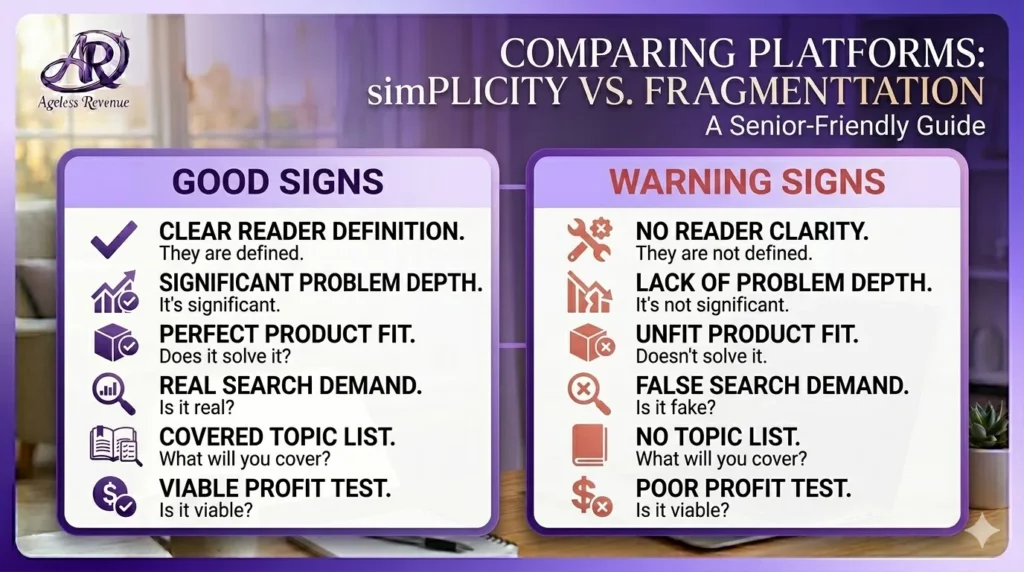
Good Signs vs. Warning Signs
Good signs: you know exactly who the content is for, the niche solves practical problems, you can picture helpful articles right away, there are multiple product angles, and the topic feels calm enough to stick with.
Warning signs: the niche is too broad, you only want to write one kind of post, the topic depends on hype, you cannot think of what readers would buy, or you already feel bored before you start.
Three Niche Examples for Retirees
Example 1: “Gardening” is too broad, but “easy container gardening for retirees with limited mobility” is clearer and easier to validate.
Example 2: “Travel” is too broad, but “comfort travel gear for older adults on long flights” points to a very specific reader, problem, and product fit.
Example 3: “Make money online” is too broad, but “affiliate marketing for retirees who want a simple website business” is focused enough to build around.
What to Do Next
Once your niche passes the validation test, do not stay in research mode forever. Move into action. Build a simple site, write the first few helpful posts, and let the niche prove itself in the real world.
If you need help setting up the site itself, read Start Your First Affiliate Site Step-by-Step Guide to Building Your Website next. Once your niche is clear, your next job is getting your content in front of the right people. My guide to Pinterest for affiliate marketing beginners shows one simple traffic path you can start using without a complicated setup. If you want an all-in-one beginner platform, Getting Started With Wealthy Affiliate: A Step-by-Step Guide will show you what the setup looks like.Conclusion
You do not need a perfect niche. You need a niche that is clear enough, useful enough, and practical enough to serve a real reader. That is what validation does. It lowers the risk, calms the guessing, and helps you move forward with more confidence.
Take one niche idea, run it through the seven steps, and be honest with the results. A simple, validated niche will carry you much farther than a vague “profitable” idea ever will.
FAQs
Q: How do I know if my niche is too broad? A: If your topic could branch into dozens of unrelated directions or your reader is hard to picture, it is probably too broad and needs narrowing.
Q: Do I need keyword tools before I choose a niche? A: No. You can do a strong first validation pass with Google autocomplete, People Also Ask, Pinterest search, YouTube suggestions, and Amazon reviews.
Q: What if I like more than one niche idea? A: Score each idea with the same checklist, then run a 14-day mini-test on the top one or two to see which one feels most practical and sustainable.
Q: Can a retiree choose a niche in affiliate marketing without being an expert? A: Yes. You do not need to be the world’s top expert. You need enough knowledge and curiosity to help someone one or two steps behind you.
Q: What should I do after I validate a niche? A: Move into action by planning your first 20 topics, building a simple website, and publishing your first helpful articles.
Next Step
If you are still at the beginning, visit Start Here. If you already want to compare a beginner platform, read Wealthy Affiliate Review 2026: Honest Pros, Cons & Pricing for Retirees.
Leave a Reply