

Last Updated on 3 months ago by Gila
Successful Social Media Marketing Strategies
Social media isn’t just a fun distraction anymore. It’s one of the most powerful tools available for marketing your business, building your brand, and connecting with your audience in real time.
Whether you’re a solo creator, small business owner, or growing brand, social platforms give you something traditional advertising rarely offers: the chance to talk with your audience, not just at them.
From quick Instagram Stories to long-form YouTube tutorials and interactive polls on Facebook or LinkedIn, social media lets you mix creativity, data, and human connection in a way that can seriously move the needle for your business.
If you’d also like to use social platforms to recommend tools and programs, you may want to read Best Practices for Social Media Affiliate Marketing as a companion guide.
In this guide, we’ll break down:
- Why social media matters for modern marketing
- The 7 Cs of social media marketing
- Popular content rules (like the 5–3–2 and 70/20/10 rules)
- How to build a clear, effective social media strategy
- Ways to maximize engagement and build community
- FAQs and a practical conclusion you can act on right away
Why Social Media Matters for Modern Marketing
If your customers are on social media, that’s where your brand should be too.
Social platforms give you:
- Reach – Access to large, global audiences without huge ad budgets.
- Speed – You can share updates, launches, and news instantly.
- Feedback – Comments, reactions, and messages show you what people actually think.
- Targeting – Ads and boosted posts can reach very specific segments of your audience.
Instead of relying only on search engines or word of mouth, you can actively:
- Introduce new people to your brand
- Stay visible to existing followers
- Guide them from casual interest to loyal customers
Best of all, social media supports different styles: playful, educational, aspirational, or highly professional. There’s room to show your personality while still being strategic.
The 7 Cs of Social Media Marketing (Explained)
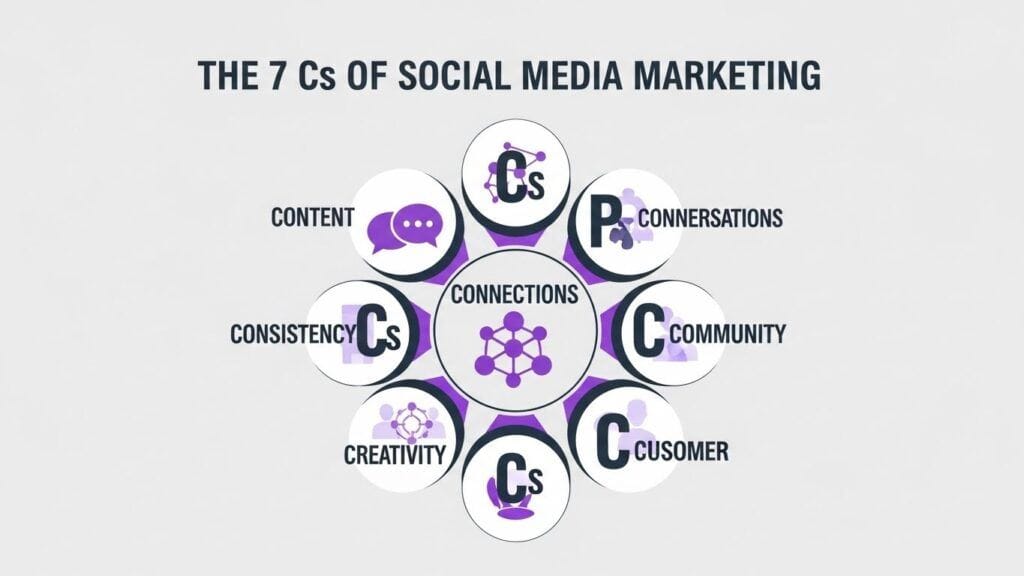
The 7 Cs give you a simple framework to keep your social media efforts balanced and effective:
- Compelling Content
- Connections
- Conversations
- Community
- Consistency
- Creativity
- Customer Care
1. Compelling Content
Everything starts with content that makes people stop scrolling.
Compelling content is:
- Relevant to your audience’s interests and needs
- Clear, not confusing or overloaded with jargon
- Visually appealing, especially on image-first platforms like Instagram and Pinterest
- Actionable, with tips, steps, or ideas people can use
Examples of compelling content include:
- “Before and after” transformations
- Short how-to videos
- Carousel posts with step-by-step micro-lessons
- Story posts that walk through a problem and solution
If your content feels useful, entertaining, or inspiring, people will keep coming back.
2. Connections
Social media is built on relationships, not one-way broadcasts.
You build connections by:
- Showing up with a recognizable voice and style
- Sharing bits of your story or “behind the scenes” moments
- Highlighting your values and what your brand stands for
- Responding to comments and DMs instead of ignoring them
Think of each follower as a real person, not just a number. The stronger your connection, the easier it becomes for them to trust and buy from you.
3. Conversations
Conversations turn passive scrollers into engaged followers.
Encourage conversations by:
- Asking questions in your captions (“Which do you prefer?”, “What’s your biggest struggle with…?”)
- Using polls and question stickers in Stories
- Hosting live Q&As or Ask-Me-Anything sessions
- Replying thoughtfully to comments rather than just liking them
The more conversations you spark, the more the algorithm tends to reward your content with visibility.
4. Community
Community is what happens when your audience starts interacting with each other—not just with you.
You can nurture community by:
- Creating a branded hashtag and encouraging followers to use it
- Featuring user-generated content (UGC), such as customer photos or testimonials
- Hosting challenges, themed weeks, or group discussions
- Creating or participating in niche groups (e.g., Facebook or LinkedIn groups)
When people feel like they’re part of something, they’re more likely to stay engaged and loyal.
5. Consistency
Random bursts of activity followed by long silence confuse your audience and hurt your reach.
Consistency means:
- Showing up regularly (e.g., 3–5 times per week on your main platform)
- Keeping visual branding and tone of voice recognisable
- Following through on what you say you’ll do (like weekly tips or monthly live sessions)
A simple content calendar makes consistency much easier. You don’t need to post every day; you just need to show up predictably.
6. Creativity
Standing out in crowded feeds requires creativity.
You can be creative by:
- Testing new formats (Reels, Shorts, carousels, Lives, Stories, polls)
- Combining education with entertainment (edutainment)
- Showing your unique angle or perspective on a common topic
- Using stories, metaphors, or mini case studies to explain ideas
Creativity doesn’t mean being outrageous. It means presenting value in fresh, memorable ways.
7. Customer Care
Customer care is often the difference between a one-time buyer and a loyal advocate.
On social media, customer care looks like:
- Responding promptly to questions and concerns
- Handling complaints politely and transparently
- Providing extra helpful information, even when you’re not making a sale
- Thanking people for positive reviews, shares, or shout-outs
When people see you treat others well, they trust you more.
Diving Into Popular Social Media Rules
Frameworks and “rules” help you structure your content so it doesn’t turn into constant self-promotion.
Here are four popular ones:
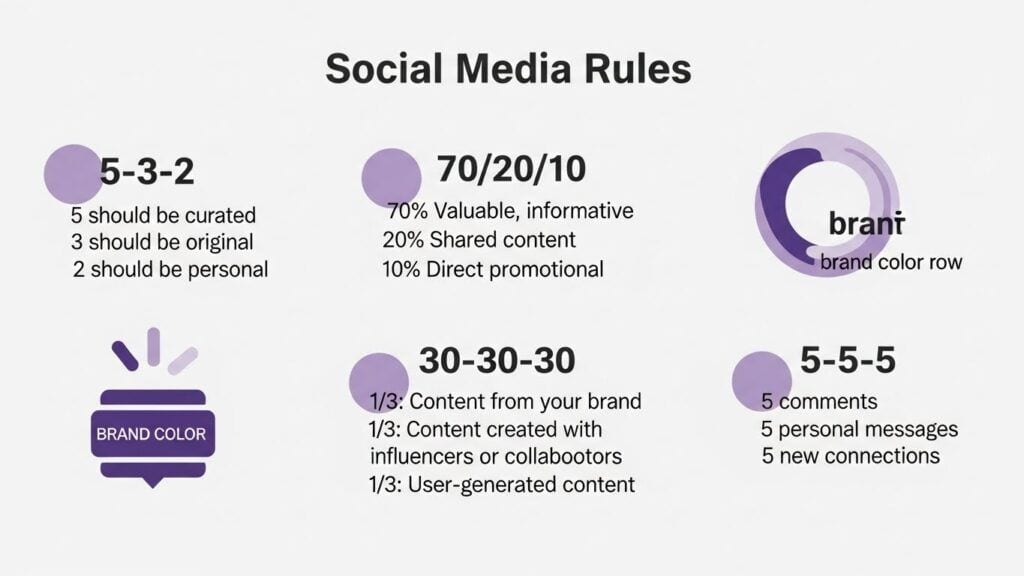
The 5–3–2 Rule
For every 10 posts:
- 5 should be curated content from others (useful, relevant resources)
- 3 should be original content from you (tips, stories, tutorials)
- 2 should be personal or human posts (behind the scenes, values, life updates)
This keeps your feed:
- Helpful, not pushy
- Community-focused, not just brand-focused
- Relatable, not robotic
The 70/20/10 Rule
Think of this as your content “recipe”:
- 70%: Valuable, informative, or entertaining content for your audience
- 20%: Shared content from others that complements your message
- 10%: Direct promotional content (offers, launches, discounts)
This helps you avoid being “sell, sell, sell” all the time while still leaving room for clear calls to action.
The 30–30–30 Rule
This rule focuses on where your content comes from:
- ⅓: Content from your brand (tips, features, updates)
- ⅓: Content created with partners/influencers or collaborators
- ⅓: User-generated content (testimonials, customer stories, tagged photos)
This creates a healthy mix of voices and perspectives, which builds authenticity and trust.
The 5–5–5 Engagement Rule
This one is about what you do, not what you post:
- 5 comments on other people’s posts
- 5 personal messages (DMs or replies)
- 5 new connections or follows per day
It’s a simple habit that keeps you actively involved in your niche, visible in conversations, and consistently growing your network.
Crafting an Effective Social Media Strategy
Throwing random posts into the void is not a strategy. Here’s how to build a thoughtful plan.
1. Know Your Audience
Start by asking:
- Who are they? (age, interests, stage of life, role, etc.)
- What problems do they want solved?
- Which platforms do they actually use?
- What type of content do they already engage with?

Use tools like:
- Platform insights (Facebook, Instagram, TikTok analytics)
- Simple polls or questions in your stories
- Customer surveys or email questions
The more you understand your audience, the easier it is to create content that resonates. If you’re brand new to online marketing, you can also review foundational concepts in Affiliate Marketing 101: Beginner’s Guide for Retirees and apply those ideas to your social media strategy.
2. Set Clear, Measurable Goals
Decide what success looks like:
- Brand awareness? (reach, impressions, followers)
- Traffic? (link clicks, website visits)
- Leads? (email signups, inquiries)
- Sales? (conversions from social media campaigns)
Use SMART goals (Specific, Measurable, Achievable, Relevant, Time-bound), such as:
- “Grow our Instagram engagement rate from 2% to 4% in 90 days.”
- “Drive 500 website visits from Facebook per month.”
For a deeper dive into building a platform-specific plan, you can compare your approach with the Hootsuite guide to social media marketing strategy and adapt any frameworks that fit your business.
3. Choose the Right Platforms
You don’t need to be everywhere.
Choose 1–3 primary platforms by considering:
- Where your audience spends time
- What format fits your strengths (writing, video, visuals, live chat)
- How much time and energy you can realistically maintain
For example:
- Visual tutorials and lifestyle content → Instagram, Pinterest
- Professional or B2B content → LinkedIn, X (Twitter), YouTube
- Short, energetic videos → TikTok, Instagram Reels, YouTube Shorts
4. Build a Content Calendar
A content calendar helps you stay organized and consistent.
Include:
- Posting days and times
- Content themes (e.g., “Motivation Monday,” “Tip Tuesday,” “Behind-the-Scenes Friday”)
- Formats (reel, story, carousel, single image, live, poll)
- CTAs (follow, save, click, comment, share)
Batching content creation once or twice a week often saves time and reduces stress.
5. Use Analytics to Refine Your Strategy
Data is your friend.
Track metrics such as:
- Reach and impressions
- Engagement rate (likes, comments, shares, saves)
- Link clicks and website traffic
- Conversions or leads from social media
Look for patterns:
- Which topics perform best?
- Which formats get the most saves or clicks?
- What time of day works for your audience?
To better understand which numbers matter most and how to interpret them, you can compare your data with benchmarks in the Sprout Social guide to social media metrics.
Use this information to do more of what works and less of what doesn’t.
Maximizing Engagement Through Targeted Strategies
Once you have the basics in place, focus on deeper engagement.
1. Create Emotionally Resonant Content
Content that taps into emotion is more likely to be shared.
Consider content that:
- Inspires (success stories, transformations)
- Educates (step-by-step guides, quick tips, checklists)
- Entertains (humor, relatable moments, light-hearted stories)
- Empathizes (acknowledges your audience’s struggles and fears)
Ask yourself: What do I want people to feel when they see this?
2. Partner with the Right Influencers
Influencers don’t have to be celebrities. Micro-influencers with smaller but loyal audiences often provide better engagement.
Look for partners who:
- Share similar values and tone
- Have an audience that overlaps with your target market
- Create content that looks and feels genuine
Collaboration ideas:
- Joint live sessions or Q&As
- Product reviews or tutorials
- Co-branded challenges or giveaways
3. Run Interactive Campaigns
Don’t just talk at people. Invite participation.
Examples:
- Polls and quizzes in Stories
- “Ask me anything” sessions
- Hashtag challenges (e.g., “Share your workspace with #YourBrandTag”)
- Contests where followers submit photos, stories, or ideas
Interactive content:
- Signals to algorithms that your content is engaging
- Gives people a reason to come back
- Provides ideas for future content based on what people share
4. Manage Feedback and Customer Care Publicly and Privately
Your comment section and inbox are part of your brand.
Best practices:
- Respond promptly and respectfully to questions, praise, and complaints
- Move sensitive issues to private messages when needed
- Thank people for positive reviews, recommendations, and tags
- Use feedback to improve your products, services, and content
Done well, even a complaint can become an opportunity to show professionalism and care.
Measuring Success and Adjusting Over Time
Social media strategies evolve. What worked last year may not work next year.
Keep improving by:
- Reviewing analytics monthly or quarterly
- Updating your goals as your business grows
- Testing new content formats or platforms in small experiments
- Asking your audience directly what they’d like more of
Remember: long-term success comes from consistent improvement, not one viral post.
Common Social Media Marketing Mistakes to Avoid
Avoid these traps:
- Being wildly inconsistent: Posting a lot one week and disappearing for a month.
- Only talking about yourself: Constant self-promotion turns people off.
- Ignoring comments and messages: It feels like you’re not listening.
- Copying competitors without your own twist: You lose your unique voice.
- Chasing trends that don’t fit your brand: It can look inauthentic or confusing.
- Trying to be on every platform at once: It spreads your energy too thin.
Focus on doing a few things well rather than many things poorly.
FAQs: Successful Social Media Marketing Strategies
The 7 Cs of successful social media marketing are compelling content, connections, conversations, community, consistency, creativity, and customer care. Together, they help you attract the right audience, keep people engaged, and build long-term loyalty around your brand.
There’s no perfect universal number, but most businesses do well posting a few times per week on each main platform. The key is to choose a schedule you can maintain consistently, focus on quality over quantity, and adjust based on engagement data from your own audience.
The 5–3–2 rule suggests that out of every ten posts, five should be valuable content from others, three should be your own original content, and two should be more personal or human posts. This mix keeps your feed balanced, community-focused, and less heavy on sales.
Track metrics such as reach, engagement rate, link clicks, and conversions. If you see growth in meaningful interactions, more website visits, and progress toward your goals like leads or sales, your strategy is working. Review your analytics regularly and refine your approach based on what you learn.
No, small businesses do not have to work with influencers to succeed on social media, but strategic collaborations can help you reach new audiences faster. If you choose to work with influencers, look for those whose values, audience, and style align with your brand rather than just chasing follower counts.
Conclusion: Build Real Relationships, Not Just Reach
Successful social media marketing isn’t about chasing every trend or posting 20 times a day. It’s about:
- Understanding who you’re talking to
- Sharing content that genuinely helps or inspires them
- Showing up consistently with your own voice
- Nurturing conversations, community, and customer care
- Using simple rules and frameworks to stay balanced and strategic
If you focus on relationships first and metrics second, your social media presence will naturally become a powerful engine for awareness, engagement, and long-term growth.
Pick one or two ideas from this guide—maybe the 5–3–2 rule and a basic content calendar—and start applying them this week. Small, consistent improvements add up quickly. And if you’re also building income streams from your online presence, don’t forget to explore Affiliate Marketing 101: Beginner’s Guide for Retirees and Best Practices for Social Media Affiliate Marketing for next steps.