
Product Review Writing Beginner Guide: Create Honest Reviews That Convert
When I started affiliate marketing, I was worried about one thing: Would recommending products feel like “selling out”?
I didn’t want to be pushy. I didn’t want to recommend bad products just for commission. Most importantly, I wanted to help people, not trick them into buying things they’d regret.
Here’s what I learned after writing over 100 product reviews: The best product reviews are honest, helpful, and genuinely serve your readers—and those are exactly the ones that earn the most.
In 2026, consumers are smarter and more skeptical than ever. They can smell fake enthusiasm from a mile away. They cross-check claims. They read dozens of reviews before making decisions. If you try to hide problems or oversell products, you’ll lose their trust instantly—and you’ll never get a second chance.
But here’s the beautiful part: when you write balanced, honest reviews that truly help people make informed decisions, something magical happens. Readers trust you. They come back for more recommendations. They click your links. They buy. And they thank you for saving them from making expensive mistakes.
In this product review writing beginner guide for retirees, I’ll show you the exact 5-part review formula I use for every product. It builds trust, serves your readers, and yes—it earns consistent affiliate commissions. No hype required.
Ready to learn how to write reviews that feel good AND perform well? Let’s dive in.
Contents
- 1 TL;DR – Quick Takeaways
- 2 Why Honest Reviews Outperform Hype Every Time
- 3 The 5-Part Review Formula That Builds Trust and Earns Commissions
- 4 Quick Review Writing Checklist: Before You Hit Publish
- 5 Common Review Writing Pitfalls to Avoid
- 6 Advanced Tips: Taking Your Reviews to the Next Level
- 7 Frequently Asked Questions (FAQ)
- 8 Conclusion: Reviews That Serve Your Readers Win Long-Term
TL;DR – Quick Takeaways
Don’t have time to read the full guide? Here’s what you need to know:
- Honest product reviews that build trust earn significantly more than hype-filled sales pitches
- The 5-part review formula: Introduction → Pros → Cons → Comparison → Recommendation
- ALWAYS include at least one con—perfection is unbelievable, and admitting flaws increases credibility
- Wealthy Affiliate’s review writing training teaches conversion-focused review structures with templates and examples
- Personal experience beats generic spec lists every single time
- Disclose affiliate relationships clearly (required by FTC law, builds reader trust)
- Best length: 1,500-2,500 words with clear structure, visuals, and real examples
- Write for your reader’s needs, not for the sale—commissions follow naturally
Bottom line: Help people make good decisions, be honest about flaws, and the commissions will follow. Your decades of life experience make your reviews uniquely valuable.
Why Honest Reviews Outperform Hype Every Time
Let me ask you a question: When was the last time you believed a 5-star review that gushed about how “ABSOLUTELY PERFECT” a product was?
Never, right? Because perfect doesn’t exist. And when someone tells you everything is amazing with zero downsides, your BS detector goes off immediately.
Readers in 2026 are sophisticated. They’re skeptical. They’ve been burned by fake reviews and over-hyped products. They know to look for balanced, authentic perspectives—and they reward reviewers who provide them.
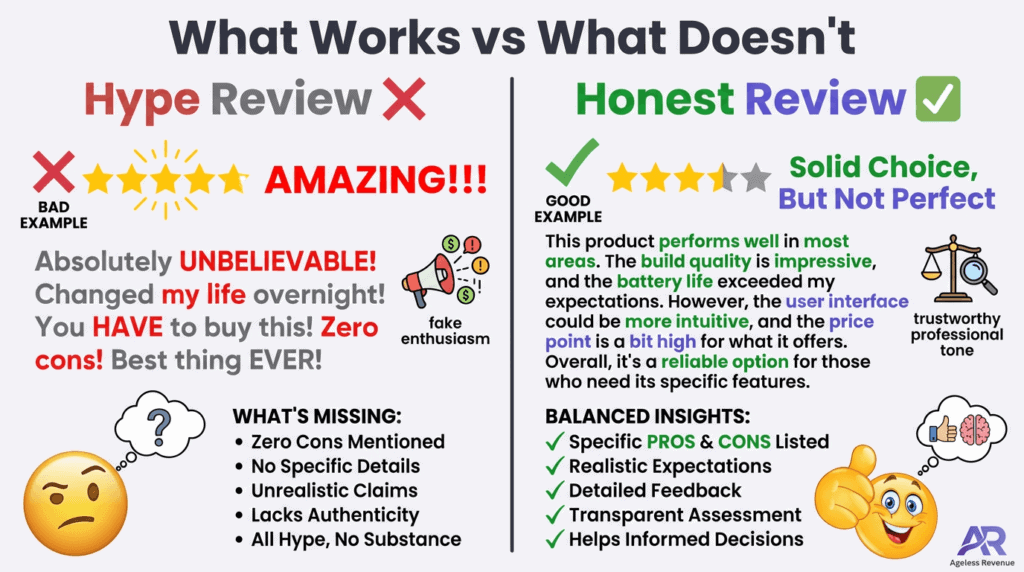
Here’s what studies show: balanced reviews increase purchase confidence by 67%: when you mention specific downsides alongside genuine benefits, readers trust you more. And trust converts better than any sales pitch ever could.
The Trust Equation:
Hype-Filled Review (Old Way):
- “THIS IS THE BEST PRODUCT EVER!”
- No mention of any downsides whatsoever
- Over-the-top enthusiasm that feels fake
- Reader thinks: “They’re just trying to sell me something.”
- Result: Visitor leaves, never returns, zero commission
Honest Review (New Way):
- “This product solved my specific problem, but it’s not perfect.”
- Specific pros AND cons clearly laid out
- Balanced perspective with real examples
- Reader thinks: “This person actually tested this and is being straight with me.”
- Result: Visitor clicks, buys, returns for more recommendations, and ongoing commissions
Real Example from My Experience:
I reviewed a gardening tool I genuinely love—but I mentioned it’s too heavy for people with arthritis. That honest con led to dozens of comments from readers thanking me for the warning. Many said they bought a different, lighter product I recommended instead.
Those thank-yous felt better than any commission check. But here’s the thing: those readers came back for more recommendations because they trusted me. That single honest review has generated thousands in commissions from repeat visitors over two years.
That’s the power of honest reviews. You’re not just making a sale—you’re building a relationship. And relationships are what create sustainable income in affiliate marketing.
Want to master building trust with your audience? It starts with reviews that prioritize helping over selling.
The 5-Part Review Formula That Builds Trust and Earns Commissions
I’ve written product reviews for everything from $10 books to $1,000 cameras. And I use the exact same formula every single time—because it works.
This formula isn’t about manipulation or sales tricks. It’s about answering the questions every reader has when considering a purchase, in a logical order that builds confidence and clarity.
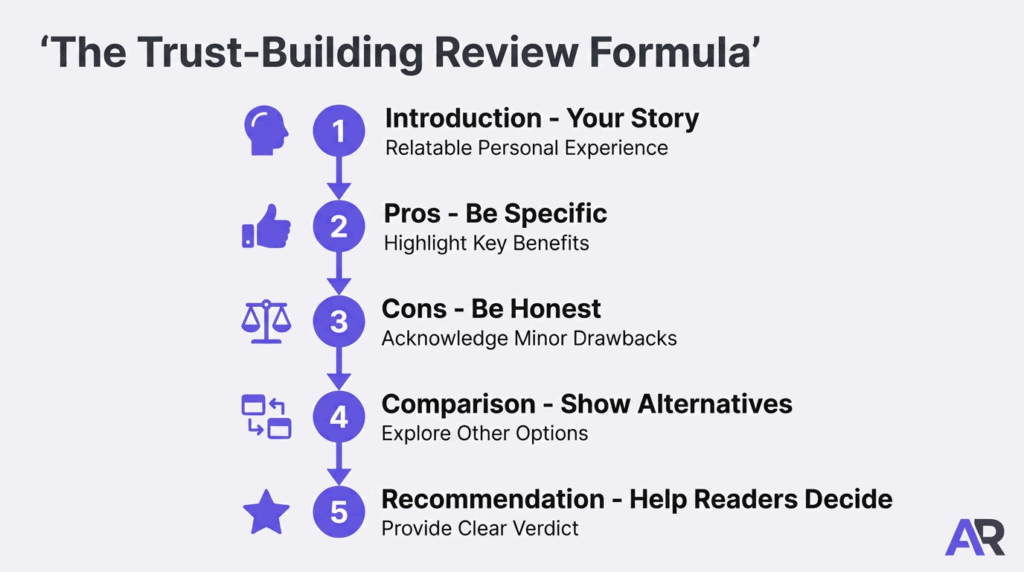
Here’s the structure:
- Introduction: Your Personal Connection (Why are YOU reviewing this?)
- The Pros: Be Specific and Detailed (What works well?)
- The Cons: Be Honest (What doesn’t work well?)
- Comparison: How does it stack up against alternatives?
- Your Clear Recommendation: Who should buy, who should skip?
Follow this structure and your reviews will sound professional without being salesy. Each part serves a specific purpose in helping your reader make a confident decision.
Whether you’re reviewing a gardening tool, a book, a travel accessory, or a kitchen gadget, this formula adapts perfectly. Let me walk you through each part in detail.
Part 1: Introduction (Your Personal Connection)
Your introduction isn’t about the product—it’s about YOU and why you’re qualified to review it. This is where your decades of life experience become your competitive advantage.
Younger affiliate marketers often write generic introductions: “Today I’m reviewing Product X. It’s great. Here’s why.” Boring. Unconvincing. Forgettable.
You can do better. Much better.
What to Include in Your Introduction:
Your Background and Expertise:
- “I’ve been gardening for 30 years, but I’d never tried vertical gardening until…”
- “As someone with arthritis in both hands, I’ve tested dozens of kitchen tools looking for…”
- Your expertise makes your opinion valuable
Why You Bought/Tested This Product:
- “I was frustrated with [specific problem]…”
- “My grandkids needed [specific solution], and I couldn’t find…”
- Real situations are relatable; generic “I reviewed this because…” is not
What You’re NOT Claiming:
- “I’m not saying this is perfect for everyone…”
- “This worked for my small patio garden—if you have acreage, you might need something different…”
- Setting boundaries prevents negative feedback later
Your Testing Period:
- “I’ve been using this daily for 3 months…”
- “I tested this on a two-week trip through…”
- Time investment shows thoroughness
Good Introduction Example:
“After 25 years of traditional in-ground gardening, I downsized to a condo with only a small balcony. I needed to rethink everything about how I grow vegetables. That’s when I discovered the GreenStalk Vertical Planter—and honestly, I was skeptical. Could I really grow the same amount of produce in 4 square feet?
Here’s what I learned after two full growing seasons: it works, but it’s not magic, and it’s definitely not for everyone. Let me walk you through exactly what you need to know before investing $200+ in vertical gardening.”
This introduction works because:
- Establishes credibility (25 years of gardening experience)
- Shares a specific situation (downsized, needs a solution)
- Sets realistic expectations (works, but not magic)
- Name the product clearly
- Promises honest, practical assessment
Notice there’s no hype. No “amazing” or “life-changing” nonsense. Just authentic experience from someone who’s lived through a problem and found a solution.
That’s what readers trust.
Part 2: The Pros (Be Specific and Detailed)
This is where you explain what works well—but here’s the key: specifics beat generalities every single time.
Don’t tell me it’s “good quality.” Tell me the food-grade plastic withstood two harsh winters in Zone 6 without cracking, while cheaper planters you tried split after one season.
Don’t tell me it’s “easy to use.” Tell me the assembly took 20 minutes following the video instructions, and your 70-year-old hands had no trouble with the tool-free connections.
See the difference? Specific details are believable. Vague praise sounds like you’re reading from the product’s sales page.
How to Write Compelling Pros:
List 3-5 concrete benefits, and for each one, include:
- Specific numbers, measurements, or timeframes
- Real examples from your personal experience
- Context that helps readers relate
Categories of Pros to Consider:
Performance/Results:
- What did it actually accomplish?
- Measurable outcomes (grew 15 tomato plants in 4 sq ft)
- Time saved or efficiency gained
Quality/Durability:
- How is it built? Materials used?
- How long has it lasted for you?
- Comparison to previous products you’ve owned
Ease of Use:
- Learning curve (none, moderate, steep?)
- Physical requirements or limitations
- Quality of instructions or support
Value for Money:
- Price compared to the results delivered
- Longevity versus cost
- Money saved compared to other solutions
Unique Features:
- What makes this different from alternatives?
- Innovations or clever design elements
- Features your target audience specifically cares about
Support/Warranty:
- Customer service experience
- Return policy generosity
- Warranty coverage and claim process
Pro Tip for Retiree Audiences:
Include at least one pro that your target audience specifically cares about:
- “Lightweight enough that I can move it myself—no help needed.”
- “Large, readable text on the display—no squinting required”
- “Grandkids can help with this without making a mess.”
Your readers want to know if this product will work for THEM, in THEIR situation, with THEIR limitations and needs.
Part 3: The Cons (Be Honest—This Builds Credibility)
Here’s where most beginner affiliate marketers panic: “If I mention problems, won’t people NOT buy?”
Actually, the opposite is true. Cons increase conversions when presented correctly.
Think about it from the reader’s perspective. They KNOW nothing is perfect. If you claim something has zero downsides, they assume:
- You haven’t actually used it long enough
- You’re hiding something
- You care more about commission than helping them
But when you honestly say, “Here’s what doesn’t work well, and here’s who this won’t suit,” something powerful happens: readers trust you. And trust converts.
Why Cons Actually Increase Conversions:
Psychological Principle:
- Readers expect some downsides
- If you mention none, they assume you’re lying
- Balanced reviews feel authentic and trustworthy
- Minor cons make major pros more believable
How to Present Cons Honestly Without Killing the Sale:
Frame Cons as Fit Issues (Not Product Failures):
- Bad: “This product is terrible because…”
- Good: “This isn’t ideal if you have [specific situation]…”
Example: “If you have limited hand strength, the water reservoir is challenging to lift when full (about 15 lbs). I use a small pump to fill it in place instead of lifting, which adds 2 minutes but saves my back.”
See how that works? I acknowledged the real limitation, didn’t dismiss it, but offered a practical workaround. That’s helpful, not salesy.
Be Specific About WHO the Con Affects:
- “This won’t work for you if…”
- “People with [specific need] should consider…”
- “You’ll be frustrated if you expect…”
Categories of Common Cons:
Price/Value:
- “At $200, this is an investment—there are $50 alternatives if you’re just experimenting.”
- “Replacement parts run pricey ($30 for the watering kit).”
Physical Limitations:
- “The assembled unit stands 4 feet tall—not suitable for apartments with low ceilings.”
- “Assembly requires lifting 25lb sections—you might need hel.p”
Learning Curve:
- “Took me two seasons to figure out optimal watering—first season I overwatered everything.”
- “Instructions assume you understand basic gardening—total beginners might struggle initially.”
Limited Use Cases:
- “Works beautifully for leafy greens and herbs, but root vegetables don’t thrive in shallow pockets.”
- “Not designed for extreme climates—rated for hardiness zones 4-9 only.”
Availability/Support:
- “Only available online—you can’t see it in person before buying.”
- “Customer service response time averages 48 hours, not immediate.”
IMPORTANT: Always suggest solutions or alternatives for the cons you mention
Example: “CON: The water reservoir holds 6 gallons, which is heavy (about 50 lbs when full).
SOLUTION: I bought a $15 hand pump from Amazon and filled it in place instead of lifting. Takes an extra 2 minutes but completely solved the problem.”
This approach:
- Acknowledges the real con honestly
- Doesn’t dismiss or minimize it
- Offers a practical, tested workaround
- Shows you’ve thought through challenges
Avoid common affiliate marketing mistakes like hiding cons or overpromising results—honesty always wins long-term.
Part 4: Comparison with Similar Products
Readers are always comparing options before buying. If you don’t provide comparisons, they’ll leave your site to find them elsewhere—and you lose the commission.
But when you say, “I’ve also tested Products B and C, and here’s how they compare,” you become a trusted advisor. You’re saving readers time and effort. They appreciate that.
Comparison Approaches:
Direct Competitor Comparison:
“I tested the GreenStalk, the Tower Garden, and the Mr. Stacky vertical planters. Here’s how they compare:
GreenStalk (my pick):
- Best build quality, lasts 5+ years
- Tool-free assembly
- Priciest at $200
Tower Garden:
- Requires a pump and electricity
- Grows bigger plants
- Much more expensive ($300+)
Mr. Stacky:
- Most affordable ($50)
- Flimsy plastic lasted one season
- Fine for experimenting, not long-term use.”
Notice I didn’t trash the alternatives. I explained when they might be better choices (Tower Garden for larger plants, Mr. Stacky for budget experimentation).
Feature-by-Feature Comparison:
Create a simple comparison showing:
- Price point
- Key features
- Which product suits best
When Alternatives Are Better:
Sometimes the product you’re reviewing ISN’T the best choice for everyone—and saying so builds massive trust.
“If you have a tiny balcony (under 10 sq ft), the GreenStalk might be overkill. The Mr. Stacky tier system is more space-efficient for extremely limited areas. Here’s the link to that one: [affiliate link].”
Guess what? Readers who need the smaller option will buy it through your link and thank you for the guidance. Those who have more space will appreciate your honesty and buy the GreenStalk.
Either way, you earn commission—and you genuinely helped someone make the right choice.
Part 5: Your Clear Recommendation
This is where you tie everything together and tell readers exactly what to do next.
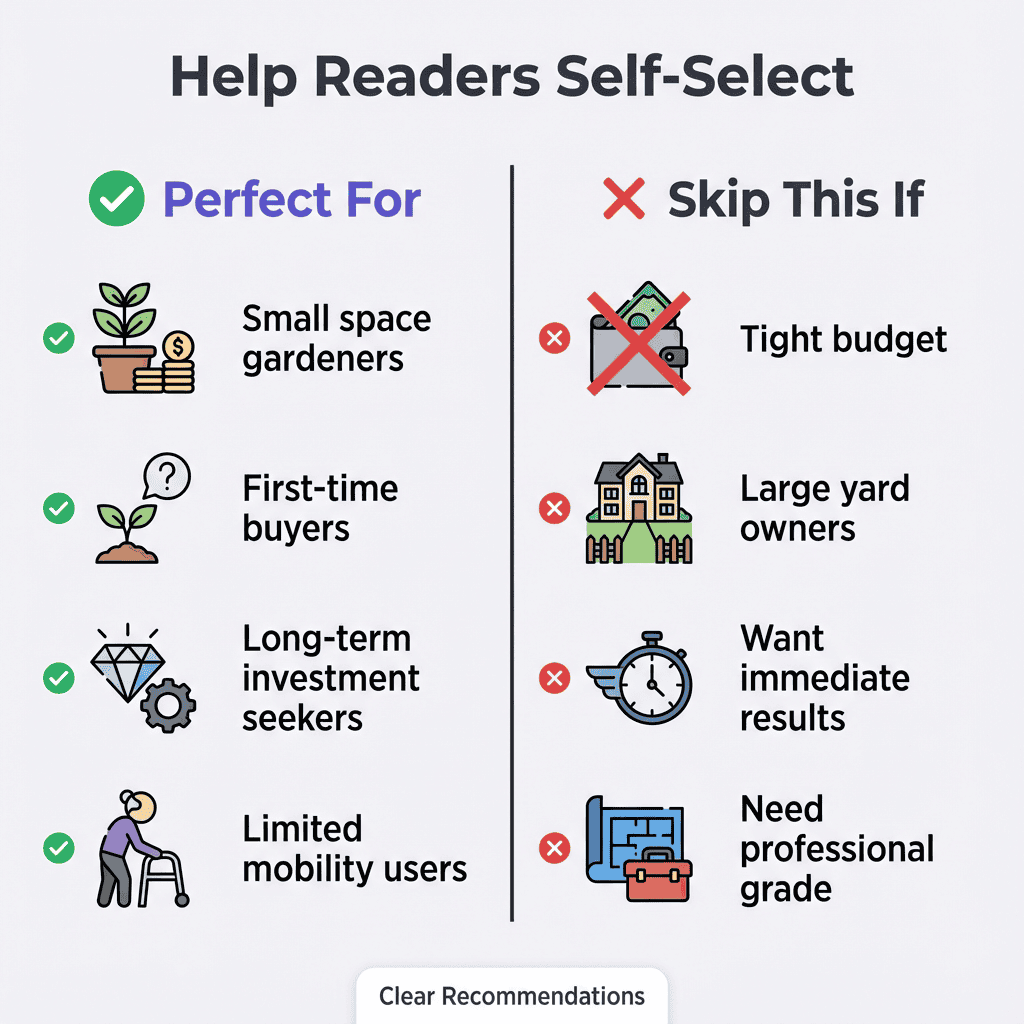
But here’s the secret: Your recommendation should help readers self-select, not push everyone to buy.

Who Should Buy This:
- “Perfect for you if you have a small outdoor space (balcony, patio, small yard) and want to grow vegetables vertically.”
- “Ideal if you’re willing to invest in quality that lasts 5+ years.”
- “Great for seniors who want easy-access gardening without bending to ground level.”
Who Should Skip This:
- “Skip this if you’re on a tight budget—the $50 tier systems work fine for experimenting.”
- “Not for you if you live in extreme climates (zones below 4 or above 9).”
- “Pass if you want to grow root vegetables like carrots or potatoes—this is designed for leafy greens and compact plants.”
Your Final Verdict:
“After two growing seasons, I’d buy this again in a heartbeat. Yes, it’s expensive upfront. Yes, there’s a learning curve. But the convenience of vertical gardening, the quality construction, and the sheer joy of growing 30+ plants in 4 square feet have completely changed how I garden in my small space.
If you’re serious about container gardening and want something that’ll last, this is worth every penny. If you’re just curious, start cheaper and upgrade later if you love it.”
Call to Action:
“Ready to start vertical gardening? Click here to check current pricing and availability on Amazon. Ships free with Prime, and there’s a full money-back guarantee if it doesn’t work for your space.”
Notice:
- Clear, specific recommendation
- Helps readers decide
- Includes an affiliate link naturally
- Mentions practical details (free shipping, guarantee)
If you’re using Wealthy Affiliate’s review writing training, you’ll learn advanced techniques like using comparison tables, adding product images strategically, and optimizing your affiliate links for maximum conversions—all while keeping your reviews authentic and helpful.
Quick Review Writing Checklist: Before You Hit Publish
Before publishing any product review, run through this quality checklist:
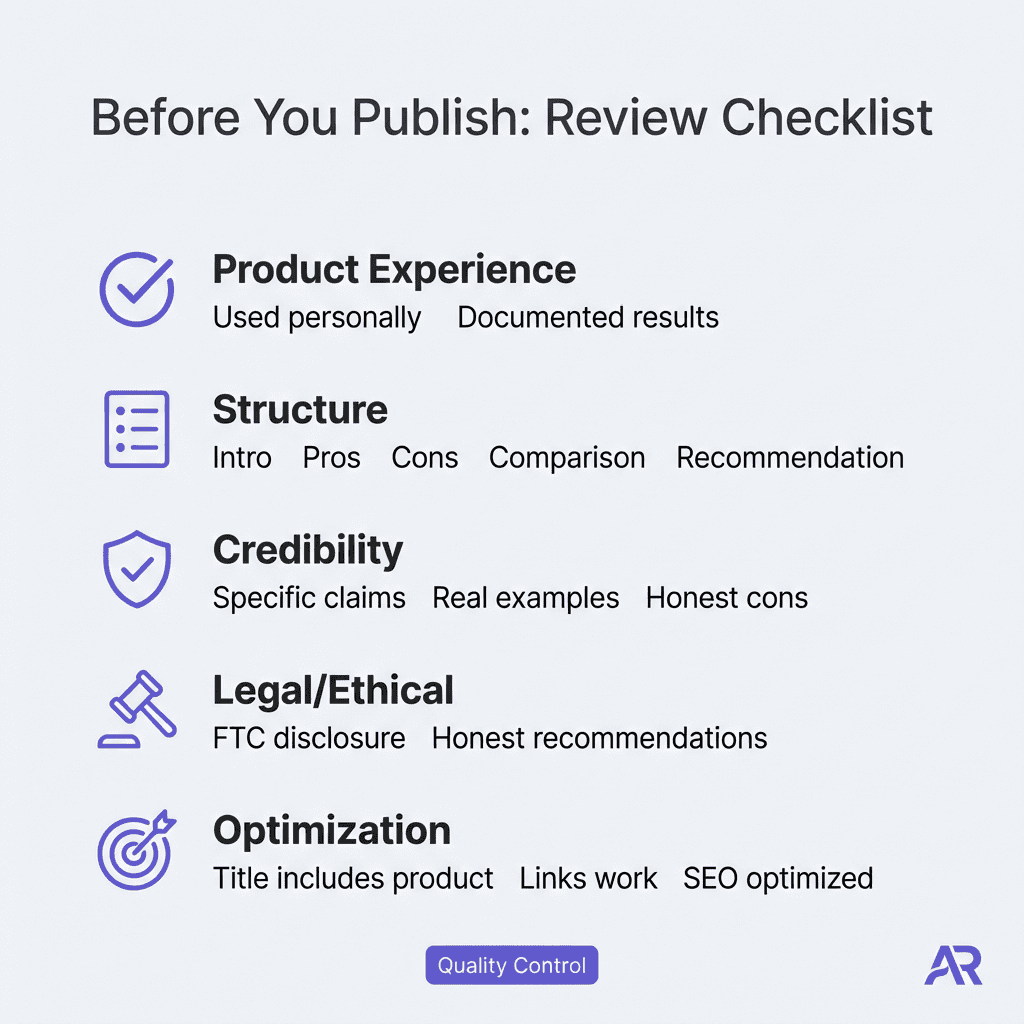
✓ Product Experience:
- I’ve personally used/tested this product for a meaningful period
- I can speak from direct experience, not just research
- I’ve documented specific results, measurements, or outcomes
✓ Structure:
- Introduction explains my background and why I’m reviewing this
- I’ve listed 3-5 specific pros with real examples
- I’ve included at least one honest con
- I’ve compared this to at least one alternative
- My recommendation helps readers self-select
✓ Credibility:
- All claims are specific, not vague (“lasted 2 years”, not “very durable”)
- I’ve included real examples from my experience
- Photos or screenshots show the product in actual use
- Cons are honest and balanced, not nitpicky
✓ Legal & Ethical:
- I’ve disclosed affiliate relationships clearly (required by FTC)
- I’m only recommending products I genuinely believe help readers
- I’ve set realistic expectations, not overpromised
- Readers can trust this review even if they don’t buy
✓ Optimization:
- Title includes the product name + “review”
- The first paragraph names the product and my verdict
- Headings break up text and guide readers
- Affiliate links are clearly labeled and functional
- I’ve linked to my affiliate disclosure page
If you can check every box, you’ve written a review that serves your readers, builds trust, and earns commissions naturally.
Common Review Writing Pitfalls to Avoid
Even with the best intentions, beginners make predictable mistakes. Here are the big ones to avoid:
❌ Reviewing Products You Haven’t Actually Used
Never, ever review something based solely on research. Readers can tell. Your review will lack specific details, real examples, and an authentic perspective. If you haven’t used it, don’t review it.
❌ Hiding All the Negatives
If your review mentions zero cons, readers won’t trust you. Every product has limitations, trade-offs, or situations where it’s not ideal. Find them and share them honestly.
❌ Using Generic, Vague Language
“This is great quality and very durable” tells readers nothing. “The stainless steel body has survived 2 years of daily use with no rust, unlike the cheaper model I tried first” is specific and believable.
❌ Writing for SEO Instead of Humans
Yes, you want your review to rank in Google. But stuffing keywords and writing awkward sentences kills trust faster than anything. Write for humans first. SEO second.
❌ Forgetting to Disclose Affiliate Relationships
This isn’t just unethical—it’s illegal. The FTC requires clear disclosure. Add a simple statement at the top: “This post contains affiliate links. If you buy through my links, I may earn a commission at no extra cost to you.”
❌ Pushing Too Hard for the Sale
Your job isn’t to sell. Your job is to help readers decide. When you focus on serving them honestly, sales happen naturally. Push too hard, and you’ll scare people away.
❌ Ignoring Your Audience’s Specific Needs
A review written for 25-year-olds won’t resonate with retirees. Mention things your specific audience cares about: ease of use, readability, physical requirements, customer support quality, etc.
Learn more about creating engaging content that converts by avoiding these common traps and focusing on genuine helpfulness.
Advanced Tips: Taking Your Reviews to the Next Level
Once you’ve mastered the basic 5-part formula, here are some advanced techniques to make your reviews even more effective:
Include Comparison Tables
Visual comparisons help readers absorb information quickly. Create simple tables showing:
- Feature comparisons across 3-4 products
- Price breakdowns
- Pros/cons side-by-side
Add Real Photos or Videos
Stock photos from the manufacturer are fine, but nothing beats real photos showing:
- The product in your actual use environment
- Size comparisons (next to common objects)
- Unboxing and assembly steps
- Results after weeks/months of use
Create “Update” Sections
Come back to popular reviews after 6 months or a year and add:
- “6-Month Update: Here’s how it’s holding up…”
- Long-term durability insights
- New pros/cons discovered over time
This shows readers you genuinely use products long-term, not just for initial reviews.
Interview Other Users
Reach out to other owners (Facebook groups, forums) and ask:
- What they love most
- What surprised them (good or bad)
- Who they’d recommend it to
Including diverse perspectives strengthens your review’s credibility.
Answer Common Questions
At the end of your review, add a section addressing frequent questions:
- “How long does assembly take?”
- “Can I use this indoors?”
- “Is it suitable for beginners?”
This captures readers who are scanning for specific answers.
Frequently Asked Questions (FAQ)
Q: How long should my product reviews be?
A: Aim for 1,500-2,500 words for most products. Shorter reviews (800-1,200 words) work for simple, inexpensive items. Longer reviews (2,500-4,000 words) suit complex, expensive products where buyers need more information before committing. Focus on thoroughness, not hitting a specific word count.
Q: Can I review products I received for free from companies?
A: Yes, but you MUST disclose this prominently. Say something like: “The company provided this product free for review, but all opinions are my own, and I wasn’t compensated for a positive review.” Be even more rigorous about honesty when reviewing free products—readers are rightfully skeptical.
Q: What if I genuinely can’t find any cons for a product I love?
A: There are always trade-offs, even for excellent products. Consider: price (is it expensive for some budgets?), availability (hard to find locally?), alternatives (other products do specific things better?), use cases (situations where it’s not ideal?). Frame limitations as “who shouldn’t buy this” rather than flaws.
Q: Should I include affiliate links to products I recommend against?
A: Generally, no. If you’re telling readers “don’t buy Product X, buy Product Y instead,” only link to Product Y. However, if you’re saying “Product X is great for [specific use case A], but Product Y is better for [use case B],” you can link to both since you’re recommending both for different audiences.
Q: How do I handle negative reviews for products I don’t like?
A: Focus your time on reviewing products you can genuinely recommend for at least some audience. Writing negative reviews rarely converts well and can attract legal trouble if claims aren’t well-documented. If you must write a negative review, be factual, specific, and suggest better alternatives. Never trash products just for attention or traffic.
Q: Can I write reviews for products in multiple niches on the same website?
A: It’s better to stay focused on one niche or closely related categories. A website that reviews gardening tools, kitchen gadgets AND travel gear confuses visitors and hurts your authority. If you want to cover multiple unrelated niches, consider creating separate websites for each. Check out the Wealthy Affiliate review and training overview to learn how to efficiently manage multiple niche sites.
Conclusion: Reviews That Serve Your Readers Win Long-Term
Let’s recap the 5-part review formula that builds trust and earns commissions:
✅ Part 1: Introduction – Share your background and why you’re reviewing this product
✅ Part 2: Pros – List 3-5 specific benefits with real examples
✅ Part 3: Cons – Be honest about limitations and who this won’t suit
✅ Part 4: Comparison – Show how it stacks up against alternatives
✅ Part 5: Recommendation – Help readers self-select with clear guidance
The best product review you’ll ever write is about something you genuinely use and believe in. Your decades of life experience mean you can spot quality, understand value, and write from a place of authentic wisdom that younger marketers simply cannot match.
That’s infinitely more valuable than any sales pitch a 22-year-old marketer can manufacture.
Here’s what I want you to understand: You’re not in the business of making one-time sales. You’re in the business of building relationships with readers who trust your recommendations for years to come. Every honest review strengthens that relationship. Every product you genuinely help them choose right reinforces their loyalty.
And that loyalty—that trust—is what generates sustainable affiliate income month after month, year after year.
Start with products you already own and love. Write your first review this week. Use the 5-part formula. Be specific. Be honest. Include cons. Help readers decide whether this product is right for them or not.
That passion and knowledge will shine through. And your readers will reward you for it.
Ready to master review writing with proven templates and expert feedback?
Join Wealthy Affiliate and get access to:
- Complete review writing training (video lessons with templates)
- Affiliate link management tools (Pretty Links for clean, trackable URLs)
- Conversion optimization techniques (where to place links, how to use call-to-actions)
- A community of retirees (earning consistent commissions through honest, helpful product recommendations in 2026)
No credit card required to start the free membership. Just your willingness to write reviews that help people make smart buying decisions.
Your voice matters. Your experience is valuable. Let’s turn that into content that serves readers and earns income.
Last updated: January 2026