
Last Updated on 1 month ago by Gila
Beginner-Friendly Guide
Affiliate disclosure: Some links in this article may be affiliate links. If you click and make a purchase, I may earn a commission at no extra cost to you. I only recommend tools and resources I genuinely believe can help beginners.
Introduction: Social Media Can Work—If You Avoid the “Silent Mistakes”
Social media is a huge opportunity for affiliate marketing—especially for retirees who want extra income without inventory, customer service, or complicated tech. Platforms like Facebook, Instagram, and TikTok give you something that used to be expensive: attention.
But the same thing that makes social media powerful also makes it tricky. Posts move fast. Trends come and go. And beginners often feel pressure to “sell” quickly—when what actually builds income is trust.
Here’s the good news: you don’t need to be flashy, young, or highly technical to succeed. You need a simple, repeatable plan and a few guardrails that keep you from wasting time.
In this guide, you’ll learn the most common Social Media Affiliate Marketing Mistakes beginners make in social media affiliate campaigns—and exactly how to fix them in a calm, retiree-friendly way.
TL;DR (Quick Summary)
- Promote only what fits your audience—relevance beats “high commissions.”
- Stop sounding like an ad—teach first, recommend second.
- Disclose clearly (and use platform tools where available)—it protects you and builds trust.
- Don’t rely on one platform—build an email list + a blog to “own” your audience.
- Track a few simple numbers—posts, clicks, saves, and email signups.
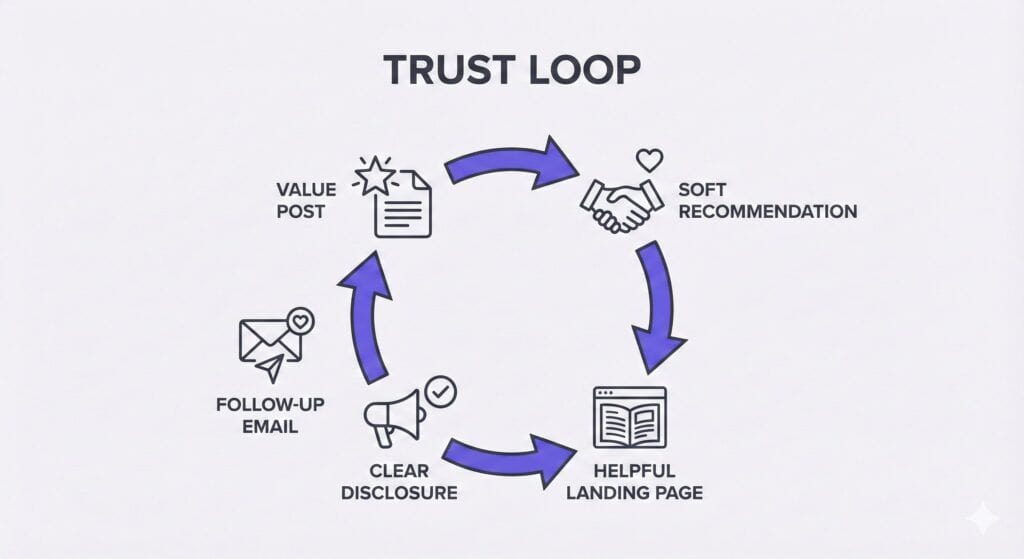
- Use one simple routine: Value Post → Soft Recommendation → Clear Disclosure → Helpful Page → Follow-up.
The Real Goal of Social Media Affiliate Marketing (It’s Not “Going Viral”)
Many beginners think success means getting thousands of followers or going viral. But affiliate marketing works best when you build a small audience that trusts you.
Here’s a healthier goal:
- Help a specific type of person
- Answer a specific problem
- Recommend a specific solution
- Repeat consistently
This is the same calm approach I teach across Ageless Revenue, including in Affiliate Marketing 101 for Retirees and my beginner roadmap, From Zero to First Affiliate Sale (90-Day Guide).
Mistake #1: Promoting Irrelevant Products (The Fastest Way to Lose Trust)
This is the “fish tank to desert hikers” problem. If your content attracts one type of person, but your offers belong to a completely different world, your audience feels confused—and trust drops.
How to fix it (simple relevance test)
Before you promote anything, ask:
- Who is this for? (beginner, retiree, busy parent, etc.)
- What problem does it solve? (time, money, confidence, clarity)
- Does it match what I post about weekly?
- Would I recommend it to a friend?
Beginner tip: Your first affiliate promotions should be “starter-friendly.” If your audience is retirees who are not techy, avoid tools that require complicated setup.
Best practice: choose a “home base” offer
Many successful beginners do best when they have one primary offer they can mention naturally over time (without forcing it).
For example, if your audience wants to learn affiliate marketing step-by-step, it’s logical to recommend beginner training + community support. That’s why I often point beginners to Wealthy Affiliate—it’s a structured way to learn and practice without feeling alone.
If you want the full breakdown, see my review: Wealthy Affiliate Review 2025.
Mistake #2: Sounding Too Salesy (People Don’t Scroll to Be “Pitched”)
Most people don’t open Instagram or Facebook hoping to see a sales pitch. They scroll to relax, learn, laugh, or feel inspired.
If your feed becomes “Buy now! Limited time! Don’t miss out!” your audience naturally tunes out.
How to fix it: the 80/20 content mix
A simple rule that works well for beginners:
- 80% value (tips, lessons, stories, checklists, comparisons)
- 20% promotion (recommendations, links, soft CTAs)
Want help writing value-driven content that still converts? Use this guide: How to Create Engaging Content That Converts for Affiliate Sales.
Examples of “value first” affiliate posts
- Mini tutorial: “3 mistakes beginners make when joining affiliate programs” → recommend a beginner training tool
- Personal story: “What I wish I knew before posting daily” → recommend a planner, tool, or course
- Checklist: “Before you post, check these 9 items” → recommend your favorite tracking method or platform

Mistake #3: Skipping Clear Disclosures (Or Hiding Them Where No One Sees)
This is important. When you earn money from a recommendation, you must disclose it clearly. This protects you, it protects your audience, and it increases trust.
How to fix it: use “clear and simple” disclosures
Use plain language that your audience understands. Here are safe, simple examples:
- Short: “(Affiliate link) If you buy through this link, I may earn a commission at no extra cost to you.”
- Even shorter: “Affiliate link—thank you for supporting my work.”
For official FTC guidance, review Disclosures 101 for Social Media Influencers and the FTC overview on endorsements, influencers, and reviews.
Platform-specific note (TikTok)
TikTok also provides a disclosure setting for commercial content. If you post promotional content there, use TikTok’s disclosure tools and settings: Commercial Content Disclosure setting (TikTok help).

Mistake #4: Relying on One Platform (It Can Change Overnight)
Platforms change. Algorithms change. Accounts can be limited or flagged by mistake. If all your traffic and income depend on one platform, you’re taking an unnecessary risk.
How to fix it: build an “owned” asset (email + blog)
Social media is great for discovery. But your blog and email list are where your content becomes long-term “assets.” A post can disappear in hours, but a good blog article can bring traffic for years.
If you’re building an email strategy, this article is a helpful companion: Email Marketing Trends 2025: Automation & AI Personalization.
A beginner-friendly funnel (simple version)
- Post a helpful tip on Facebook/Instagram
- Offer a deeper guide on your blog
- Offer a free checklist/lead magnet for email signup
- Send a calm welcome email sequence
- Recommend your best beginner solution
Mistake #5: Posting Without a Plan (Then Quitting Because “It Doesn’t Work”)
Many beginners post randomly for a week, see little response, and conclude social media “doesn’t work.” Usually, the issue is not the platform—it’s the inconsistency and unclear messaging.
How to fix it: pick 3 content pillars
Choose 3 simple themes you will repeat:
- Pillar 1: Beginner education (simple tips)
- Pillar 2: Progress stories (your journey, lessons learned)
- Pillar 3: Tools and recommendations (soft promotion)
Then rotate them weekly. This makes content creation easier and builds “familiar trust.”
Mistake #6: Sending People to the Wrong Place (Bad Landing Pages Kill Conversions)
Even if your social post is great, people won’t buy if they land somewhere confusing.
How to fix it: match the post to the destination
If your post is “3 beginner mistakes,” don’t send people to a generic homepage. Send them to the most relevant page—like a beginner guide, a review, or a simple checklist.
For example:
- Beginner overview → Affiliate Marketing 101 for Retirees
- Comparison/decision → Wealthy Affiliate Review 2025
- Step-by-step plan → 90-Day First Sale Guide
Mistake #7: Not Tracking Anything (You Can’t Improve What You Don’t Measure)

Tracking doesn’t have to be complicated. Beginners don’t need 20 metrics. You need a few simple numbers that tell you what’s working.
What to track (beginner level)
- Posts per week: consistency
- Clicks: Are people interested?
- Saves/shares: Is your content useful?
- Email signups: Are you building an asset?
- Affiliate conversions: what creates sales?
How to improve using tracking (simple loop)
- If clicks are low: improve the hook and CTA
- If clicks are high but sales are low: improve the landing page or offer match
- If saves are high, create more content on that topic
Mistake #8: Trying to Be Everywhere at Once (Overwhelm = Burnout)
If you are retired and building a calm business, you don’t need to be on every platform. The goal is sustainable progress.
How to fix it: pick one primary platform + one backup
Examples:
- Primary: Facebook (great for community + older audiences)
- Backup: Pinterest or a blog (great for long-term traffic)
Then add more later—only after your routine feels easy.
A Simple “Calm Campaign” Blueprint You Can Reuse
Use this repeatable structure for almost any affiliate campaign:
- Start with a helpful post (tip, checklist, story)
- Add a soft recommendation (what helped you)
- Include a clear disclosure (simple and visible)
- Send to a helpful page (review, guide, comparison)
- Follow up (email list or next post)
Example post you can copy (Facebook)
Post text:
“Beginner tip: If you’re promoting affiliate products on social media, don’t post links too soon. First, share 2–3 helpful tips so people trust you. Then recommend one beginner-friendly resource that actually solves the problem.
If you want the training platform I use to learn and organize my affiliate business, it’s here: [Affiliate link]. (Affiliate link—if you buy through this link I may earn a commission at no extra cost to you.)”
Replace [Affiliate link] with your tracked affiliate link (and always keep the disclosure visible).
FAQ: Avoiding Common Mistakes in Social Media Affiliate Campaigns
1) Do I need thousands of followers to make affiliate sales?
No. A small audience that trusts you can outperform a large audience that doesn’t. Focus on helpful content and consistency.
2) How often should I post as a retiree (without burnout)?
A sustainable goal is 3 posts per week. Consistency matters more than daily posting.
Usually yes, but results vary by platform and niche. Many beginners do better sending people to a helpful blog post first, then including affiliate links there.
4) What’s the easiest way to avoid sounding salesy?
Teach first. Share a tip, story, or checklist—then recommend one tool that fits what you just taught.
5) What disclosure wording is “safe” for beginners?
Use plain language like: “Affiliate link—if you buy through this link, I may earn a commission at no extra cost to you.” Keep it close to the recommendation.
6) What if I’m promoting more than one affiliate program?
That’s fine—just keep your recommendations relevant, avoid promoting too many offers at once, and always disclose.
Conclusion: Slow, Trust-Based Marketing Wins (Especially for Retirees)
Social media affiliate marketing isn’t about tricks. It’s about becoming a helpful guide for a specific group of people—then recommending solutions that genuinely fit.

If you remember nothing else, remember this: trust beats hype. When you promote relevant products, keep your tone friendly, disclose clearly, and track a few simple numbers, you build a system that can grow steadily over time.
If you’re ready to learn affiliate marketing step-by-step with tools and community support, you can explore the platform I use here: Wealthy Affiliate (affiliate link).