

Last Updated on 3 months ago by Gila

The AI-Powered Blogger: Best Tools to Revolutionize Your Content Workflow
Blogging has evolved dramatically from simple online diaries to powerful engines for education, communication, and commerce. Today, the most successful blogs leverage Artificial Intelligence (AI) not as a replacement for human creativity, but as an indispensable partner. AI handles the tedious, repetitive, and analytically heavy lifting, allowing bloggers to focus on what they do best: storytelling and connecting with their audience.

This updated guide explores the best AI tools for blogging available today, providing specific examples to help you integrate them into a seamless, high-efficiency blogging workflow.
TL;DR: AI tools for blogging help you plan topics, draft posts, optimize for SEO, polish your writing, and repurpose content into multimedia—so you publish more in less time without burning out.
- Create & plan faster: Use AI to brainstorm ideas, outlines, and first drafts.
- Improve SEO: Let AI-driven tools suggest keywords, headings, and content gaps.
- Polish & proofread: Fix grammar, tone, and readability with AI editors.
- Repurpose content: Turn one article into images, audio, or short-form video.
- Stay in control: Always edit, fact-check, and add your personal experience.
Before You Dive Into AI Tools, Build Strong Foundations
AI works best when it supports a clear blogging and affiliate strategy. If you’re still setting up your online income system, these guides will help:
- Affiliate Marketing 101: Beginner’s Guide for Retirees (Step-by-Step) – Understand how affiliate income actually works and where content fits in.
- How To Conduct Keyword Research For Maximum SEO Impact: The Definitive 2025 Guide – Find the right topics so your AI-assisted content attracts the right readers.
- Affiliate Marketing Starter Kit for Beginners – Downloadable checklist to plan your first simple, profitable content system.
1. Revolutionize Your Content Creation & Ideation
The blank page is the ultimate enemy of content creators. AI tools specializing in content generation and ideation can help you break through writer’s block, structure your articles, and ensure your draft is optimized for search engines right from the start.
| AI Category | Function | Specific Tool Examples |
| Generative Writing | Drafting articles, generating outlines, paraphrasing content, and creating compelling headlines. | Jasper, Copy.ai, Writesonic |
| SEO Content Optimization | Analyzing top-ranking articles, suggesting ideal keyword density, and ensuring content depth and structure. | Surfer SEO, Frase, Clearscope |
| Ideation & Brainstorming | Suggesting trending topics, fresh angles, and identifying content gaps in your niche. | ChatGPT (for brainstorming), Ahrefs/SEMrush (Topic Explorer) |
Example in Action: Instead of spending hours outlining a “how-to” guide, you could use Jasper to generate three different outlines in minutes. You could then take the best outline into Frase, which analyzes the top 10 search results for your target keyword and provides a list of essential headings and talking points you must include to compete.
Plan High-Impact Posts Before You Hit “Generate”
AI can draft quickly, but your results improve dramatically when you choose smart topics and validate them first:
- Top 10 Online Business Ideas Perfect For Retirees (2025) – Get a big-picture view of online business models that AI can support.
- How To Validate Your Online Business Idea: A Step-by-step Guide – Make sure your niche and offers have real demand before scaling content with AI.
- From “What’s a Niche?” to First Sale: A 90-Day Step-by-Step Guide – See how consistent content, simple tools, and patience work together in real life.
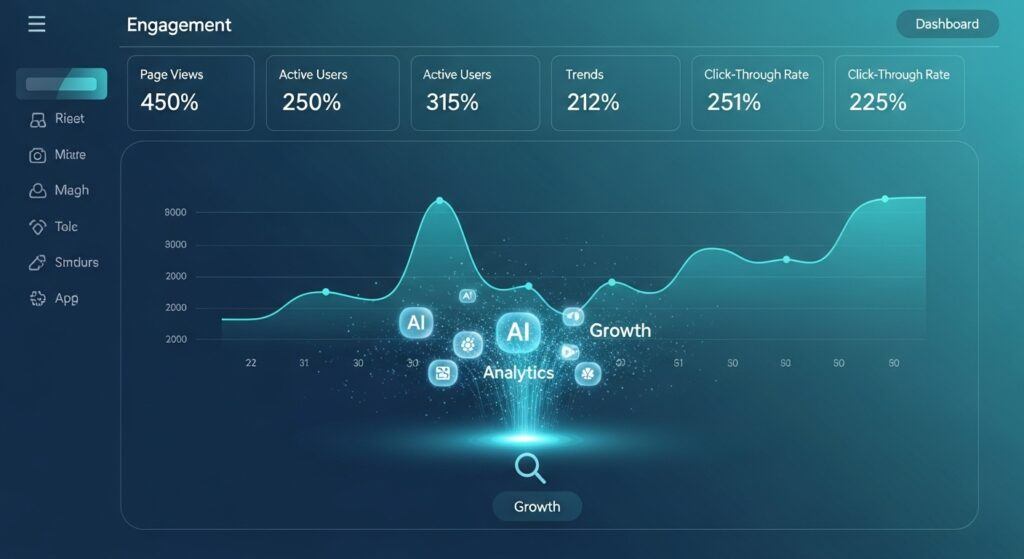
2. Improve Audience Engagement with AI-Driven Analytics
Understanding your audience’s behavior is crucial, but manually sifting through data can be overwhelming. AI-driven analytics tools transform mountains of data into clear, actionable insights, helping you personalize content and predict future trends.
| AI Category | Function | Specific Tool Examples |
| SEO Data Analysis | Identifying hidden keyword opportunities, analyzing competitor content gaps, and auditing your site for technical SEO issues. | SEMrush, Ahrefs |
| Behavioral Insights | Pinpointing user journey patterns, showing which sections of an article users read most, and predicting churn rates. | Google Analytics 4 (GA4), Mixpanel |
| Content Personalization | Dynamically adjusting headlines, calls-to-action (CTAs), or recommended content based on individual user history or demographics. | Optimizely, HubSpot AI |
Example in Action: You notice a high bounce rate on mobile devices. GA4’s AI insights might flag that users are dropping off immediately after the first paragraph. You could then use SEMrush to see if competitor mobile pages load faster or use shorter introductions, prompting you to optimize your introductory section’s length and media load time.
3. Streamline Your Workflow with AI-Powered Editing and Proofreading
Publishing clean, professional content is non-negotiable. AI editing tools go far beyond basic spelling and grammar checks; they elevate your prose by analyzing tone, suggesting stylistic improvements, and improving overall readability.
| AI Category | Function | Specific Tool Examples |
| Grammar & Style Correction | Catching complex grammar errors, identifying passive voice, and suggesting vocabulary enhancements. | Grammarly Premium, ProWritingAid |
| Plagiarism Checking | Ensuring the originality of your content by comparing it against billions of web pages and publications. | Quetext, Turnitin (often integrated into writing suites) |
| Readability & Tone Analysis | Calculating readability scores (e.g., Flesch-Kincaid) and helping you maintain a consistent brand voice (e.g., professional, friendly, instructional). | Hemingway Editor, ProWritingAid |
Example in Action: After finishing a first draft in your generative AI tool, you run it through Grammarly Premium. It highlights a run-on sentence and suggests a more concise, impactful phrasing, ensuring your authoritative tone remains intact and your message is clear to a global audience.
Turn Polished Content Into Steady Affiliate Income
Once AI has helped you create clear, clean content, the next step is turning that content into meaningful income:
- How To Create Engaging Content That Converts for Affiliate Sales – Structure posts so readers actually click and buy from your recommendations.
- Affiliate Marketing Mistakes: 10 Costly Errors Beginners Must Avoid (2025) – Avoid the common pitfalls that undo even well-written content.
- Social Media Affiliate Marketing: 5 Proven Steps (Beginner) – Repurpose AI-assisted blog content into simple social posts that drive extra traffic.

4. Integrating Multimedia and Accessibility with AI
Content consumption habits are shifting. Integrating audio and visuals is key, and AI makes this easier while significantly boosting accessibility for a wider audience.
| AI Category | Function | Specific Tool Examples |
| Image Generation | Creating unique, royalty-free images, illustrations, or conceptual visuals from simple text prompts (ideal for feature images). | Midjourney, DALL-E 3, Adobe Firefly |
| Text-to-Speech (TTS) | Converting blog text into natural-sounding audio versions provides an alternative for auditory learners or commuters. | Murf.ai, WellSaid Labs |
| Video & Audio Editing | Transcribing video/audio content and editing the media by simply editing the text transcript. | Descript |
Example in Action: To illustrate a complex concept in your article, you provide the prompt “An abstract depiction of data flowing into a brain” to DALL-E 3 to create a stunning header image in seconds. Simultaneously, you input your final article text into Murf.ai to generate a realistic audio narration, which you embed at the top of the post, turning your article into a podcast-like experience.
Frequently Asked Questions (FAQ)
Q: Will AI replace human bloggers?
A: No. AI is a powerful assistant, not a replacement. AI excels at generating drafts, optimizing keywords, and fixing grammar, but it lacks the unique human experience, emotional depth, personal voice, and ethical judgment necessary for truly engaging and authoritative content. Successful bloggers use AI to automate 80% of the mechanical work, freeing up time to focus on the 20% of creative, personal content that builds reader loyalty.
Q: How can I ensure AI-generated content is original and not plagiarized?
A: You should always run AI-generated drafts through a reliable plagiarism checker (like Quetext or Copyscape) before publishing. Furthermore, most modern generative AI tools (like Jasper) are trained on massive datasets and tend to produce unique outputs, but the final responsibility for originality rests with the author. Always edit, fact-check, and infuse your unique voice into the text.
Q: Which AI tool is best for beginners?
A: For general content creation and basic SEO, Jasper or Copy.ai are excellent starting points due to their user-friendly interfaces and diverse template libraries. For essential proofreading, Grammarly is a must-have free tool for every blogger.
Q: How does using FAQs impact the user experience on a blog?
A: FAQs enhance user experience by providing quick, direct answers to common questions. This satisfies user intent immediately, increases time on page, and reduces the need for users to search elsewhere, which is positive for engagement metrics.
Helpful External AI & SEO Tools
Here are some of the AI tools and SEO platforms mentioned in this guide (or similar to those discussed) so you can explore them directly:
- Jasper – AI writing assistant for outlines, drafts, and content ideas.
- Copy.ai – Templates for headlines, blog intros, and social posts.
- Surfer SEO – Content optimization based on top-ranking pages.
- Semrush – Keyword research, competitor analysis, and SEO audits.
- Grammarly – Grammar, tone, and clarity checker for clean, professional writing.
- Murf.ai – Turn your blog posts into natural-sounding audio versions.
- Descript – Edit podcasts and videos by editing the transcript text.
Always review pricing and features carefully before committing to any paid plan, and choose only the tools that genuinely simplify your workflow.
Conclusion
The integration of AI into blogging is no longer optional—it’s a requirement for efficiency and success in a competitive digital landscape. By strategically adopting tools for content creation, SEO analytics, editing, and multimedia, you can dramatically reduce the time spent on administrative tasks and amplify your creative output. Embrace these technologies to refine your voice, expand your reach, and secure your blog’s future success.
As a retiree or beginner blogger, the goal isn’t to use every AI tool—it’s to pick a few calm, reliable helpers that make your publishing rhythm feel lighter. Start with one tool for writing, one for SEO checks, and one for editing. Add more only when you clearly feel the bottleneck.
If you’d like a simple, printable overview of what to do first, second, and third, my free Affiliate Marketing Starter Kit for Beginners walks you through setting up your site, planning content, and tracking your early results. It pairs beautifully with the AI tools in this article.
And if you want structured training, community support, and built-in tools for building a long-term affiliate business, I highly recommend Wealthy Affiliate. It’s a beginner-friendly platform where you can learn SEO, practice content creation, and plug AI tools into a complete system—step by step.
Take one tiny step this week: choose one AI tool from this list, apply it to a single blog post, and notice how much lighter the process feels. Then keep going, one calm improvement at a time.