
Last Updated on 3 months ago by Gila
Introduction: The New Workflow for High-Quality Content
The era of merely asking an AI to “write a blog post about X” is over. To truly leverage the power of automation and answer the core question—How do I use AI to improve my blog content—you need a structured, human-led process.
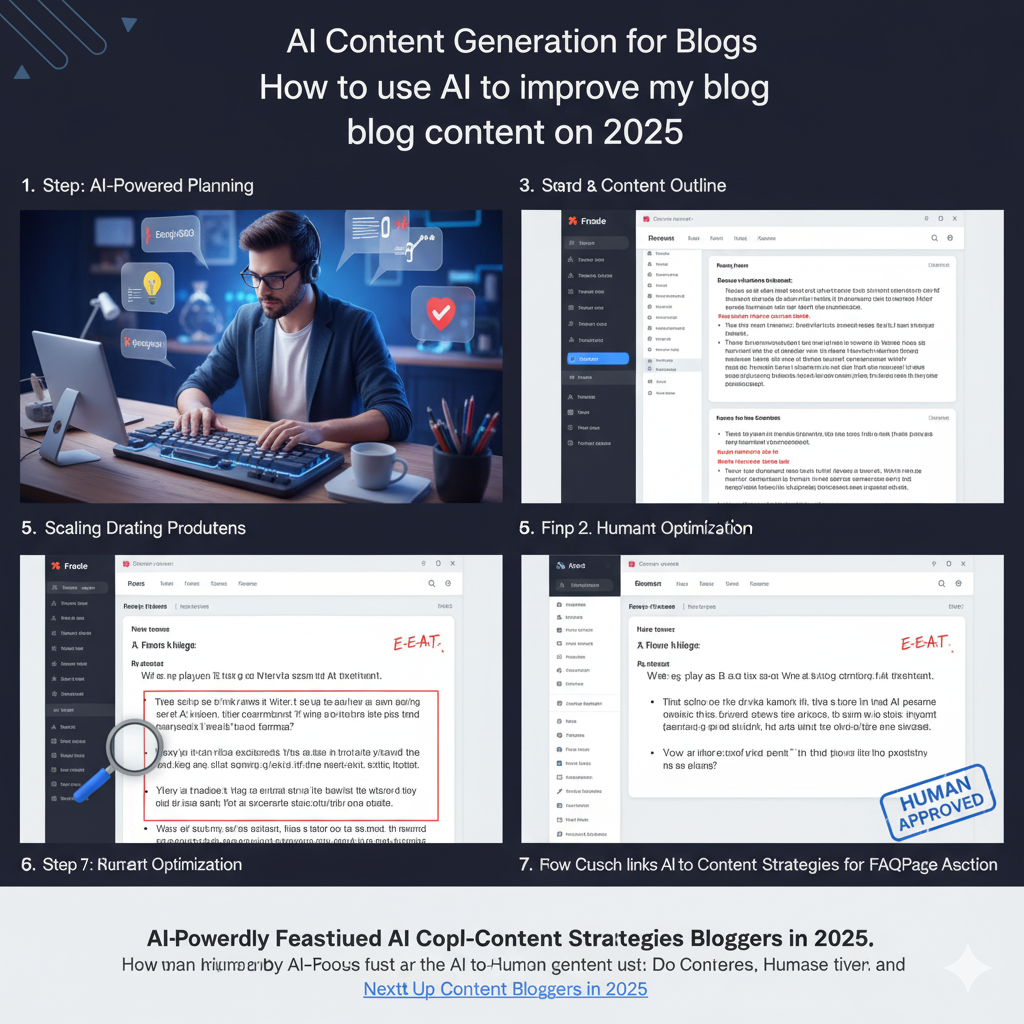
AI Content Generation for blogs is not about replacing the writer; it’s about shifting the writer’s role from draftsman to editor-in-chief. It’s a 7-step collaborative workflow that ensures speed, SEO performance, and most importantly, the high E-E-A-T (Expertise, Experience, Authoritativeness, and Trustworthiness) that Google rewards.
Follow this complete step-by-step guide to integrate AI into your content creation process and turn generic drafts into authoritative, traffic-driving articles.
TL;DR: AI content generation for blogs is a 7-step workflow where you stay in charge of ideas, structure, and final edits—AI just speeds up the middle.
- Plan first: choose topics and keywords before you open any AI tool.
- Outline with AI: let AI suggest structure, then simplify it for readers.
- Draft in passes: intro → sections → examples, instead of one giant prompt.
- Edit for voice: keep your calm, human tone and real experience.
- Optimize & publish: add SEO, images, links, and track what performs best.
The 7-Step AI Content Generation Workflow
This workflow is designed to ensure human insight guides the AI at every critical juncture, maximizing both efficiency and quality.
1. AI-Powered Planning and Keyword Cluster Strategy
Before writing a single word, AI must inform your strategy. This step answers: What should I write about, and how should it be structured to rank?
- Instruction: Use tools like Frase, Surfer SEO, or AI-powered keyword generators (like Semrush’s content tools) to perform SERP analysis, identify low-competition keywords, and generate a content cluster plan to build topical authority.
- The AI’s Role: Generate topic ideas, identify long-tail keywords, and map out content clusters (Pillar Page + supporting articles).
- Pro-Tip: Don’t target a single keyword. Ask your AI tool: “Based on the topic [X], create 5 supporting sub-topic article titles that can be internally linked to this pillar post.”
Need Help Choosing What to Write Before You Use AI?
AI works best when you already know your niche, audience, and topics. Use these guides to decide what your blog should focus on first:
- Top 10 Online Business Ideas Perfect For Retirees (2025) – Pick a calm, realistic direction for your online business.
- Business Idea Questions: 25 Essential Checks for Beginners (2025) – Pressure-test your idea before you generate dozens of AI posts.
- The Do’s and Don’ts of Niching Down Online Business – Make sure your niche is focused enough for your content to stand out.
2. Generate a Data-Driven, Optimized Outline
The outline is your blueprint. A weak outline leads to a generic article; a strong, data-driven outline ensures you cover all of the user’s intent.
- Instruction: Feed your chosen target keyword into an AI tool (like Frase or Jasper’s outline generator). The AI will analyze the top 10 ranking articles and automatically generate a comprehensive outline (H2s and H3s) based on what the competition is covering.
- The AI’s Role: Produce a comprehensive outline ready for drafting.
- The Human’s Role: CRITICAL! Review the AI’s outline. Remove redundant headings, inject a unique section based on your personal experience, and reorganize the flow to ensure a compelling narrative, not just a list of facts.

3. Rapid Drafting and Content Generation (The 80%)
This is where the AI does the heavy lifting, generating the bulk of the raw content.
- Instruction: Provide the AI with your finalized outline, the target audience, the desired tone (e.g., authoritative, casual, humorous), and your core thesis. Generate the content section by section, or use a tool’s “one-click article” feature.
- The AI’s Role: Produce a clean, coherent first draft (the 80%). The goal is speed—getting text on the page.
- Best Practice: Prompt Engineering: Be specific. Instead of, “Write about benefits of AI,” try: “Role-play as a CMO of a SaaS startup. Write a convincing 300-word section for the H2 ‘Scaling Content Production’ using short, punchy sentences and a problem-solution format.“
Turn AI Drafts Into Helpful, High-Converting Blog Posts
Once you’ve got a rough AI draft, these articles show you how to shape it into calm, useful content that can actually rank and earn:
- Engaging Content that Converts for Affiliate Sales: Step-by-Step Guide (2025) – Structure posts so they teach first and recommend second.
- How To Conduct Keyword Research For Maximum SEO Impact: The Definitive 2025 Guide – Match each AI draft to a clear search intent and keyword.
- Best AI Tools for Blogging: Boost Efficiency, SEO, and Engagement (2025) – See which tools fit each part of your AI content workflow.
4. Fact-Check and Inject E-E-A-T (The Human Veto)
This is the most critical step to answer the question: How do I use AI to improve my blog content quality, not just speed. This step separates generic, low-ranking AI content from authoritative, high-ranking posts.
- Instruction: Read every sentence of the AI draft. Assume all statistics and claims are false until verified. Integrate original examples, case studies, proprietary data, or personal anecdotes that only you have.
- The Human’s Role (E-E-A-T):
- Fact-Checking: Verify all numerical data, names, and industry claims with external, credible sources.
- Experience & Expertise: Integrate original examples, case studies, proprietary data, or personal anecdotes (e.g., “In my 5 years of using Writesonic…”)
- Tone: Rewrite clunky sentences, eliminate AI buzzwords (“paradigm shift,” “synergy,” “delve”), and adjust the pacing for a natural, human flow.
5. Content Enhancement and Humanization
Refine the style and readability of the human-edited draft.
- Instruction: Run the refined draft through editing tools like Grammarly or Hemingway Editor to check for passive voice, excessive complexity, and clarity. Use a paraphrasing tool like QuillBot to rephrase sentences that still sound too generic.
- AI’s Role (Secondary): Check for passive voice and complexity.
- Humanization Techniques:
- Vary Sentence Structure: Break up the repetitive, short sentences the AI loves.
- Add Controversy: Introduce a mild, defensible opinion or counter-argument that sparks engagement.
- Refine the Hook: Manually craft a compelling, highly personalized introduction that hooks the reader instantly.

6. Final On-Page SEO Optimization
Ensure the finalized, humanized content is technically optimized to rank.
- Instruction: Utilize SEO scoring tools (like Surfer or Frase) or your CMS plugin (Yoast/Rank Math) one final time. Manually add internal links to relevant posts (especially Articles 1 and 2), write descriptive ALT text for all images, and ensure the target keyword is present in the H1, URL, and first 100 words.
- The AI’s Role: Check content against its target score and suggest LSI keywords.
7. Visuals, Schema, and Publication
The final touches that enhance user experience (UX) and boost technical SEO signals.
- Instruction: Generate or acquire images, add Schema markup, and publish. Use AI image generators (e.g., Midjourney, Canva) to create original, non-stock featured images and graphics for internal sections.
- Technical Implementation: Add your
HowTo(for this guide) andFAQPageSchema to maximize rich snippet visibility in search results.
Connect Your AI Workflow to a Real Blogging & Income System
Your 7-step AI content process becomes far more powerful when it’s tied to a simple monetization and tracking system:
- Affiliate Marketing 101: Beginner’s Guide for Retirees – See how AI-assisted posts fit into a full affiliate marketing setup.
- Mastering Google Analytics for SEO: The Definitive 2025 Performance Guide – Track what your AI-generated posts actually achieve.
- From “What’s a Niche?” to First Sale: A 90-Day Step-by-Step Guide – Turn your AI workflow into calm, consistent income-building steps.

Frequently Asked Questions
Will AI content hurt my SEO?
AI content by itself doesn’t hurt SEO. What matters is whether the content is helpful, original, accurate, and clearly edited by a human. Use AI for drafts and ideas, then add your experience, examples, and unique angle before you publish.
How much of a blog post can be written by AI?
Many bloggers use AI for 40–70% of the initial draft and then spend time editing, restructuring, adding stories, and checking facts. The more you rely on AI, the more important it is that you review everything before it goes live.
Do I need a special “AI SEO tool” to follow this 7-step workflow?
No. You can start with a general AI like ChatGPT plus a basic SEO plugin such as Rank Math. As your needs grow, specialist tools like Frase, Surfer, or Clearscope can plug into the same workflow.
What’s the biggest mistake beginners make with AI content?
The biggest mistake is publishing AI drafts without editing or fact-checking. That can lead to thin content,
Helpful External Resources on AI Content Generation
- Google Search Central – Creating Helpful, Reliable, People-First Content
- OpenAI – Safety and Responsible Use of AI
- Originality.ai – Best Practices for AI Content Detection & Originality
- Content at Scale – Example AI Blogging Workflows
Use these as neutral reference points while you build your own AI-assisted workflow that stays ethical and reader-first.
Conclusion: Mastering the Art of the AI-Human Hybrid
Adopting a robust AI workflow is the fastest path to high-quality content at scale. By meticulously following these 7 steps, you ensure that AI content generation for blogs serves its true purpose: accelerating production while simultaneously elevating the quality, authority, and ranking potential of every article you publish.
Remember, the goal is not to produce content by the machine, but to produce exceptional content with the machine. By embracing your role as the strategic editor and subject-matter expert, you will successfully use AI to improve your blog content and build lasting authority in 2025 and beyond.
Next Up: You’ve mastered the tools and the workflow. Now, let’s look at the big picture. Read our next guide: [AI-Powered Content Strategies for Bloggers in 2025 (Article 4 Title)] to build a long-term plan for success.
Conclusion: One Calm Workflow, Many Published Posts
AI content generation for blogs is not about replacing you. It’s about giving you a repeatable 7-step workflow that turns “blank page panic” into calm, structured progress. You stay in charge of ideas, stories, and judgment—AI simply helps you move faster through outlines, drafts, and edits.
If you’d like printable checklists and gentle prompts to keep beside you while you write, grab my free Affiliate Marketing Starter Kit for Beginners. It walks you through choosing a niche, planning helpful content, and placing affiliate links in a way that feels natural—not pushy.
And if you’d like structured training, hosting, and built-in AI tools all in one place, you’re welcome to explore Wealthy Affiliate. It’s a beginner-friendly platform where you can learn SEO, content strategy, and AI-assisted blogging at a calm, realistic pace.
Pick one AI tool, run your very next post through this 7-step workflow, and publish. Then review what worked, tweak the prompts, and repeat. Calm consistency will beat sporadic “AI marathons” every time.
Frequently Asked Questions (FAQ)
| Question | Answer |
| Does Google penalize content generated by AI? | No. Google’s guidance focuses on content quality, usefulness, and E-E-A-T, regardless of how it was created. Content that is unedited, factually incorrect, or lacks unique insight (pure AI output) will struggle to rank, while high-quality, human-refined AI content can rank successfully. |
| What is the most important human role in the AI content generation workflow? | The most important human role is E-E-A-T infusion. This involves strategic editing, fact-checking, and adding personal experience, proprietary data, and unique insights that a machine cannot generate. This step is critical for building authority and trust. |
| Which AI tools should I use for outlining and SEO research? | For outlining and SEO research, the best tools are those that integrate SERP analysis, such as Frase, Surfer SEO, or Jasper’s SEO modes. These tools analyze top-ranking pages to help you structure your content for maximum search engine coverage. |
| How can I prevent AI-generated content from sounding generic? | To prevent generic content, always provide highly specific prompts (prompt engineering). After generation, focus heavily on human editing in Steps 4 and 5: inject your unique voice, add personal anecdotes, vary sentence structure, and rigorously fact-check to make the content distinct and valuable. |