

Last Updated on 3 weeks ago by Gila

When I first heard the word “niche” in affiliate marketing, I had no idea what it meant. Was it pronounced “nitch” or “neesh”? More importantly, why did everyone say it was so crucial to my success? I felt overwhelmed by advice: “Follow trending topics!” “Find low-competition niches!” “Choose something profitable!”
The truth? I was overthinking it. And if you’re feeling confused right now about choosing a niche, you’re not alone.
Here’s what I wish someone had told me from the start: Your biggest advantage isn’t youth, tech skills, or following trends. It’s the decades of life experience you bring to the table. You’ve already solved problems, developed expertise, and built knowledge in areas younger marketers can only read about.
In this beginner guide (niche selection beginner guide for retirees), I’m going to show you a simple 3-question approach to finding your perfect affiliate marketing niche in 2026—one that combines what you love, what you know, and what people are actually searching for online.
No guesswork. No complicated research. Just a straightforward path to discovering the niche where your authentic voice will shine.
TL;DR – Quick Takeaways (2026)
Don’t have time to read the full guide? Here’s what you need to know:
- Your life experience is your competitive advantage in 2026—you can’t fake decades of authentic knowledge
- Three simple questions help you find your perfect niche: What do you love? What problems have you solved? Who do you want to help?
- Wealthy Affiliate’s Niche Finder tool simplifies research and validation with automated insights
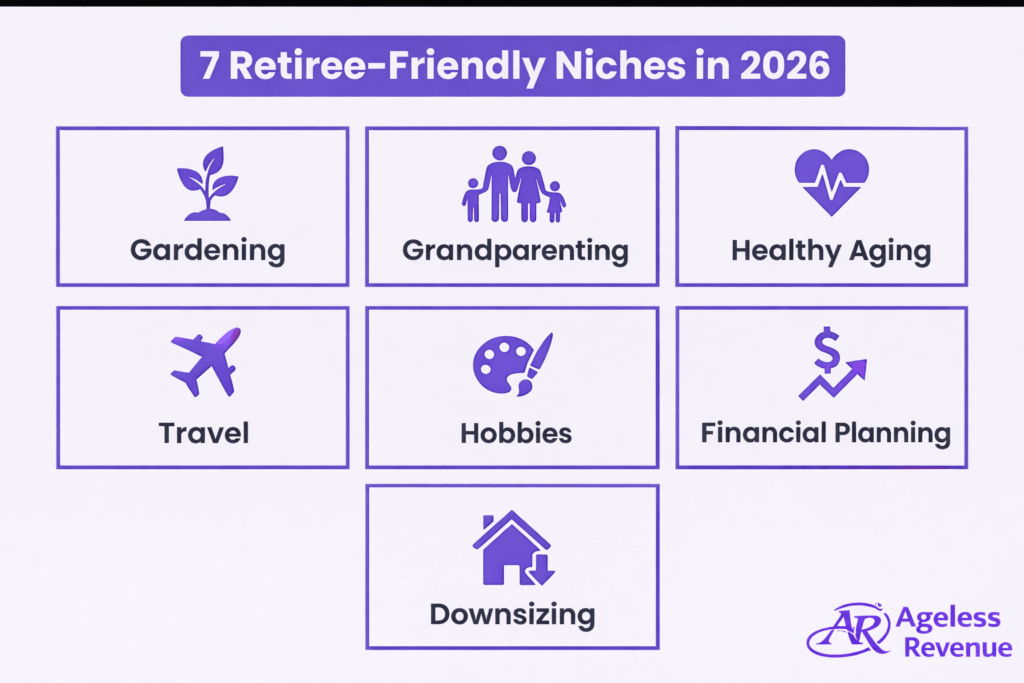
- 7 retiree-friendly niches are thriving: gardening, grandparenting, healthy aging, travel, hobbies, financial planning, and downsizing
- Niche validation takes just 30 minutes using free tools (Google, Amazon, Facebook, YouTube)
- You can pivot or expand your niche as you learn and grow—nothing is permanent
- Start with what you know best, then expand from there
Bottom line: The best niche combines your passion, proven experience, and real market demand. Let’s find yours together.
Why Your Life Experience is Your Biggest Advantage in 2026
Let me tell you something that might surprise you: Some of the most successful affiliate marketers I know are in their 60s, 70s, and even 80s. They didn’t start with any special technical skills or marketing backgrounds. But they had something infinitely more valuable—decades of authentic life experience.
Think about it this way: If you’re looking for gardening advice, who would you trust more? A 22-year-old who’s read gardening books and watched YouTube videos, or someone who’s been growing vegetables for 40 years and can tell you exactly what works in harsh winters, how to deal with persistent pests, and which tools are worth the investment versus which ones break after one season?
The answer is obvious.
Here’s why your life experience creates an unfair advantage in 2026:
Authenticity beats everything. Readers are more skeptical than ever of generic, AI-generated content. They’re hungry for real stories, genuine recommendations, and advice from people who’ve actually lived through the challenges they’re facing. You can provide that in ways younger marketers simply cannot.
You’ve already solved valuable problems. Every challenge you’ve overcome—whether it’s downsizing from a family home, managing retirement finances, maintaining health after 60, or keeping grandkids engaged during visits—is content gold. People are actively searching for solutions to these exact problems right now.
Trust matters more than hype. Younger marketers often rely on excitement and trends. You bring something better: wisdom, perspective, and credibility. When you recommend a product, readers know it’s coming from someone who values quality, understands value, and wouldn’t waste their time on junk.
Real stories beat templated content every time. You have 20, 30, 40+ years of stories, experiences, and insights that can’t be replicated by someone who’s been alive for 25 years. That depth of knowledge shows in every piece of content you create.
I’ve seen it firsthand: A retiree who downsized successfully writes about home organization with a depth and authenticity that no 28-year-old minimalism blogger can match. A grandparent who’s raised three generations of children writes toy reviews that parents actually trust. A 70-year-old traveler writes destination guides that consider mobility, comfort, and realistic budgets.
This is your competitive edge. And when you combine it with the right niche, you become genuinely valuable to your audience—which translates directly into affiliate income.
Ready to turn your passion into profit? Let’s identify exactly where your experience can serve people best.
The 3-Question Formula for Retiree Niche Success
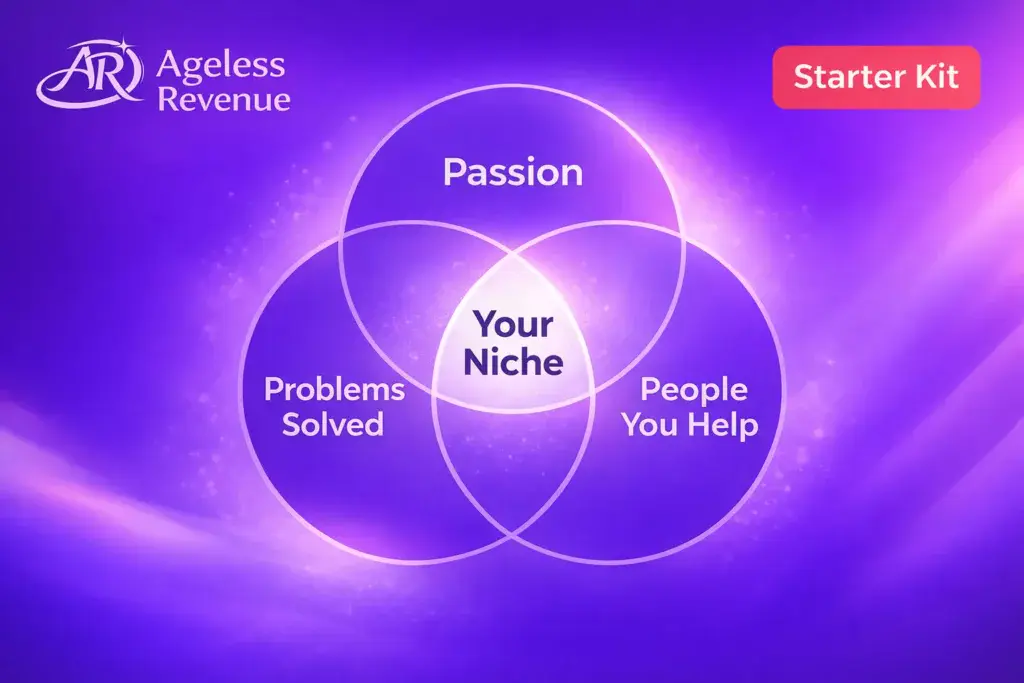
I’m going to make niche selection simple. Forget complicated market analysis and trend forecasting. Instead, answer three straightforward questions:
- What do you love talking about for hours?
- What problems have you solved in your life?
- Who do you want to help?
These aren’t just brainstorming questions—they’re your roadmap to a profitable, sustainable niche you’ll actually enjoy working in. Because here’s the truth: if you’re bored by your niche after three months, you’ll quit. But if you’re genuinely passionate about helping people in an area you know well, you’ll stick with it long enough to see real results.
Let me walk you through each question and show you how to find your answers.
Question 1: What Do You Love Talking About for Hours?
Passion fuels consistency. You’re going to be creating content regularly—blog posts, product reviews, guides, videos. If you find your topic boring, your audience will feel it. But if you’re genuinely excited about your subject, that enthusiasm shines through and keeps you motivated during the challenging early months.
Think about the conversations that energize you rather than drain you. What topics make you lose track of time? What do friends and family come to you for advice about?
Here are some brainstorming prompts to get you started:
- What do friends and family ask your advice about?
- What topics make you lose track of time when researching or discussing them?
- What sections of bookstores, libraries, or YouTube do you naturally gravitate toward?
- What hobbies have you pursued for years and still find fascinating?
- What would you talk about on a podcast for an hour without notes?
15 examples from real retirees I’ve worked with:
- Gardening tips and techniques learned over 40 years
- Travel experiences and destination recommendations from around the world
- Grandparenting wisdom, activities, and toy recommendations
- Woodworking projects, tools, and techniques
- Photography skills, equipment reviews, and location tips
- Cooking, recipe development, and kitchen tool reviews
- Fitness routines and equipment for older adults
- Pet care, training, and product recommendations
- Home organization strategies for downsizing
- Vintage collecting, restoration, and valuation
- Genealogy research and family history methods
- Knitting, quilting, or other crafting techniques
- Local history and cultural heritage preservation
- Retirement planning and financial strategies
- Book reviews and reading recommendations for specific genres
Take a few minutes right now. Write down 3-5 topics that genuinely excite you. Don’t worry about whether they’re “profitable” yet—we’ll validate that later. For now, just capture the things you could happily write about week after week.
Question 2: What Problems Have You Solved in Your Life?
This question is pure gold. Every problem you’ve successfully solved is a potential content goldmine, because thousands of other people are facing that same challenge right now and actively searching for solutions.
You might think, “But my life is pretty ordinary—I haven’t done anything special.” That’s exactly the wrong way to think about it. Your “ordinary” life experiences are extraordinary to someone who’s just starting to face those challenges.
Problem categories to consider:
Health Challenges You’ve Overcome:
- Managing chronic conditions (arthritis, diabetes, heart health)
- Recovering from injuries or surgeries
- Mental health and stress management
- Weight loss or fitness transformations after 50
- Adapting exercises for physical limitations
Financial Situations You’ve Navigated:
- Retirement planning on a budget
- Debt elimination strategies
- Downsizing and living comfortably on less
- Estate planning and legacy decisions
- Supplementing retirement income
Life Transitions You’ve Managed:
- Career changes or retirement adjustment
- Moving to new cities, states, or countries
- Caring for aging parents while managing your own life
- Becoming a grandparent and building those relationships
- Adjusting to an empty nest
Relationship Wisdom You’ve Gained:
- Maintaining a long-lasting marriage (30+ years)
- Navigating blended families
- Building friendships after retirement
- Maintaining family connections across distances
- Dating and relationships as a senior
Skills You’ve Developed Later in Life:
- Learning technology as an older adult
- Starting a business after 50
- Pursuing education or certifications as a senior
- Picking up new hobbies and mastering them
Here’s a powerful exercise: List 3 significant problems you’ve successfully overcome. For each one, ask yourself: “Would someone pay $20 for a guide on how I solved this?” If the answer is yes, you’ve found potential niche territory.
And remember: you don’t need to have completely solved a problem to help others. Sometimes your journey—including the mistakes and lessons learned—is exactly what people need to hear. Your honesty about what worked and what didn’t builds trust.
Want to make sure your idea has real potential? Here’s how to validate your online business idea before investing significant time.
Question 3: Who Do You Want to Help?
Knowing your audience shapes everything—your content style, the products you recommend, the problems you focus on, and even the tone of your writing.
The best niches serve specific people with specific needs. “Everyone” is not a target audience. But “recent retirees adjusting to life without work structure” is incredibly specific and valuable.
Questions to define your ideal audience:
- What age group do you relate to most?
- What life stage are they in?
- What keeps them up at night?
- What are their goals and aspirations?
- Where do they hang out online?
- What’s their approximate budget for solutions?
Examples of specific, valuable audiences:
- New grandparents wanting to stay connected with grandkids who live far away
- Recent retirees are struggling to adjust to life without a work structure
- Empty nesters downsizing from family homes to condos or apartments
- Active seniors planning adventure travel on modest budgets
- Hobby enthusiasts wanting to monetize their skills in retirement
- People in their 50s-60s caring for aging parents while managing their own retirement planning
- First-time grandparents are unsure about age-appropriate activities and gifts
Notice how specific these are? Each audience has unique concerns, questions, and purchasing power. When you know exactly who you’re talking to, your content becomes infinitely more valuable.
The Sweet Spot: Your perfect niche lives where all three questions intersect:
- You’re passionate about the topic (Question 1)
- You’ve solved relevant problems (Question 2)
- You know exactly who you’re helping (Question 3)
When you find that intersection, you’ve discovered your niche. But before you commit, there’s one more critical step: validation.
Before we go further, take a moment to think about the questions to ask yourself before choosing a business idea—it’ll help clarify your direction.
The Retiree’s Niche Validation Checklist (Takes 30 Minutes)
You’ve identified potential niches that combine your passion, problem-solving experience, and target audience. That’s fantastic. But here’s the reality check: passion without market demand equals a hobby, not a business.
Niche validation ensures people are actually searching for this content and willing to buy products in this space. It takes about 30 minutes and uses completely free tools. Let me walk you through it.
Validation Step 1: Google Search Volume Check
You need to know if people are actually searching for your niche topic. Here’s the simple way to check:
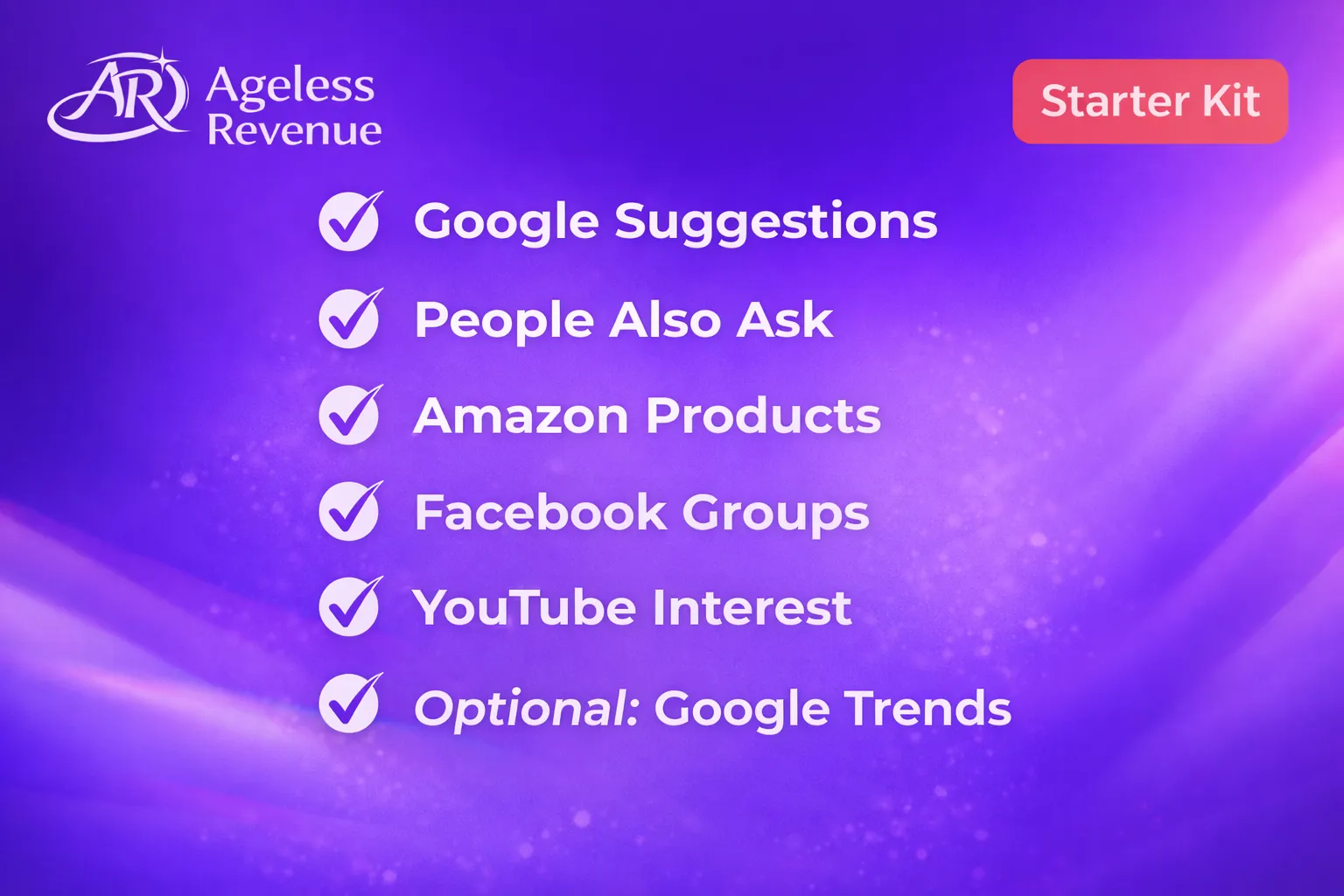
Use Google Keyword Planner (Free):
- Go to ads.google.com/keywordplanner
- Click “Discover new keywords.”
- Enter your main niche keyword (e.g., “container gardening for beginners”)
- Look for 1,000+ monthly searches for your main topic
Google Keyword Planner is Google’s own tool that shows actual search volume data from their search engine. It’s designed for advertisers, but it’s incredibly valuable for content creators. You’ll need a free Google Ads account to access it, but no payment is required.
Even Simpler: Google Autosuggest
- Type your niche keyword into Google
- Look at the suggestions that pop up
- If Google suggests it, people are searching for it
- More suggestions = more interest
What you’re looking for: If your niche topic gets 1,000+ monthly searches and Google suggests multiple related terms, that’s a good sign there’s audience interest.
Validation Step 2: Amazon Product Availability
Amazon is the world’s largest product marketplace. If there are lots of products in your niche with healthy review counts, that means:
- People are buying these products
- You can earn affiliate commissions promoting them
Amazon’s Best Sellers page shows you exactly what’s popular right now, giving you instant insight into buying demand.
How to check:
- Go to Amazon.com
- Search for products related to your niche
- Look for 50+ different products with reviews
- Check for variety: books, tools, equipment, courses
- Note higher-priced items ($50-$500 = better commission potential)
Good signs:
- Multiple products with 500+ reviews
- New products are released regularly
- Various price points ($10-$500+)
- Mix of physical products and digital resources
Red flags:
- Fewer than 20 products total
- Most products have fewer than 50 reviews
- Everything is low-priced (under $20)
- No new products in the past year
Validation Step 3: Facebook Group Activity
Active Facebook groups indicate an engaged community willing to discuss, share, and buy products in your niche. With over 1.8 billion Facebook Group users monthly, these communities are goldmines for understanding what your audience truly wants.
How to check:
- Search Facebook for groups related to your niche
- Look for groups with 1,000+ members
- Check recent activity: Posts from today, this week
- Read member questions—what are people asking about?
- Join 2-3 relevant groups to understand the community
Healthy group indicators:
- Daily posts and discussions
- Members actively asking questions
- Product recommendations are being shared
- Respectful, helpful community tone
Validation Step 4: YouTube Video Views
YouTube success shows sustained interest and ongoing content opportunities.
How to check:
- Search your niche topic on YouTube
- Look at the top 10-20 videos
- Check view counts, upload dates, and comments
- Note what types of content perform best
Positive indicators:
- Videos with 10,000+ views
- Channels posting regularly (weekly or monthly)
- Active comments asking questions
- Mix of how-to tutorials, reviews, and informational content
The easiest way to validate your niche in 2026? Use Wealthy Affiliate’s Niche Finder tool. Here’s why it’s perfect for retirees:
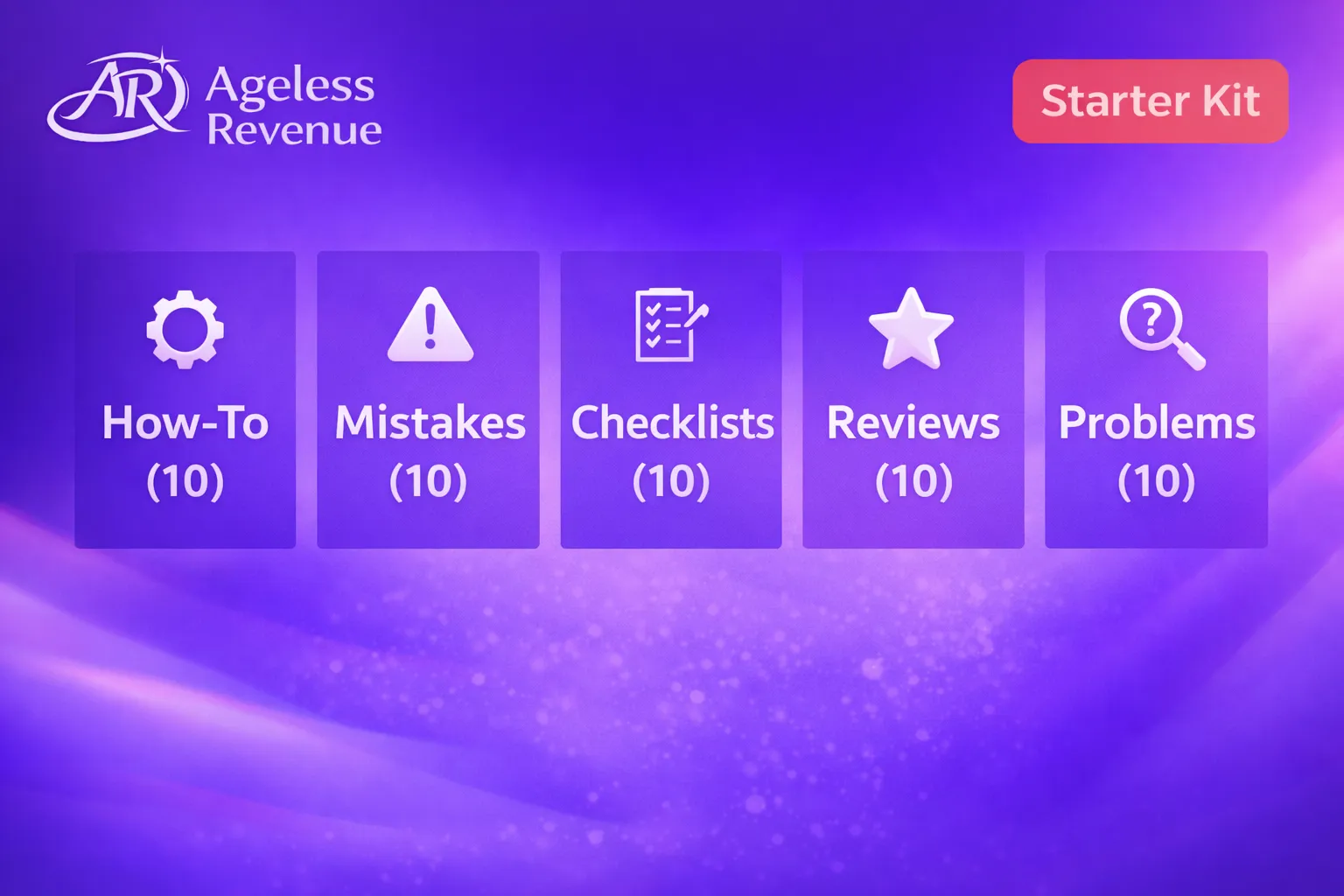
Automated research: One tool combines Google Trends, keyword data, and competition analysis. No jumping between platforms or wondering if you’re interpreting data correctly.
Beginner-friendly interface: No technical knowledge required. Just enter your niche idea and get clear, color-coded feedback (green = good opportunity, yellow = possible, red = too competitive).
Instant feedback: See immediately if your niche has potential. No spending hours researching only to discover there’s no audience.
Training included: Step-by-step video lessons on niche research and validation, designed specifically for beginners who’ve never done this before.
Community feedback: Get input from thousands of experienced affiliates who can spot opportunities and red flags you might miss.
The Niche Finder has helped thousands of retirees discover profitable niches they never would have considered on their own. It takes the guesswork out of validation—perfect if you’re not confident in your technical skills yet.
I use it every time I’m considering a new niche or sub-niche to explore. It’s saved me from wasting months on ideas that looked good but had no real traffic potential.
7 Retiree-Friendly Niches Thriving in 2026
These niches consistently perform well for retiree affiliates because they combine authentic life experience with strong, sustained market demand. Let me break down each one so you can see which might align with your interests and expertise.
1. Gardening and Urban Farming
Why retirees excel here: Decades of hands-on gardening experience, understanding of seasonal cycles, knowledge of what actually works versus trendy gimmicks, and patience to test methods over multiple seasons.
Affiliate opportunities:
- Seeds and plant starts ($5-$50)
- Garden tools and equipment ($20-$300)
- Raised beds and container systems ($50-$500)
- Composting systems ($30-$200)
- Gardening books and courses ($10-$100)
Sub-niches to consider:
- Container gardening for small spaces (balconies, patios)
- Organic and sustainable methods
- Native plant gardening
- Vegetable gardening for beginners
- Square foot gardening
- Indoor herb gardens
Target audience: Homeowners, apartment dwellers with balconies, sustainability enthusiasts, people seeking fresh produce, therapeutic gardeners.
2. Grandparenting and Family Life
Why retirees excel here: You’ve raised children, you understand child development stages, you have current experience with grandkids, you know what toys last and what’s overpriced junk.
Affiliate opportunities:
- Toys and games ($10-$100)
- Children’s books ($5-$30)
- Educational resources ($10-$200)
- Craft supplies and activity kits ($15-$75)
- Family travel products ($20-$500)
- Video calling equipment ($50-$300)
Sub-niches to consider:
- Long-distance grandparenting (staying connected when grandkids live far away)
- Grandparents raising grandchildren
- Age-appropriate activities and crafts
- Educational gift guides
- Summer activities for visiting grandkids
- Building traditions and memories
Target audience: Grandparents of all ages seeking connection, advice, and thoughtful gift ideas.
3. Healthy Aging and Wellness
Why retirees excel here: You’re living it. You understand the challenges firsthand—joint pain, maintaining energy, managing medications, staying active despite limitations. Your peer credibility is unmatched.
Affiliate opportunities:
- Supplements and vitamins ($15-$100)
- Fitness equipment ($25-$500)
- Health monitoring devices ($30-$300)
- Wellness programs and apps ($10-$50/month subscriptions)
- Mobility aids ($20-$400)
- Pain management tools ($25-$200)
Sub-niches to consider:
- Joint health and arthritis management
- Brain fitness and memory support
- Low-impact fitness routines
- Nutrition for older adults
- Balance and fall prevention
- Chronic condition management
- Energy and vitality after 60
Target audience: Adults 50+ focused on maintaining health, independence, and quality of life.
4. Travel for Active Seniors
Why retirees excel here: You have the time to travel extensively, understand what makes destinations truly senior-friendly (not just “accessible”), know how to stretch travel budgets, and have realistic perspectives on comfort versus adventure.
Affiliate opportunities:
- Travel gear and luggage ($30-$500)
- Travel booking sites (commissions on hotels, flights)
- Travel insurance ($50-$300)
- Guidebooks and travel courses ($10-$100)
- Photography equipment ($50-$2,000)
- Comfort travel accessories ($10-$150)
Sub-niches to consider:
- Solo senior travel (safety, logistics, destinations)
- Budget travel for retirees
- Accessible travel for limited mobility
- RV living and nomadic retirement
- International retirement destinations
- Cruise reviews for first-timers
- Travel with grandkids
Target audience: Retirees with time, curiosity, and varying budgets seeking adventure and meaningful experiences.
5. Hobbies: Crafting, Woodworking, Photography, Art
Why retirees excel here: Years of skill development, extensive project portfolios, teaching experience (even informal), understanding of what tools are worth the investment, and patience to create detailed tutorials.
Affiliate opportunities:
- Craft supplies and materials ($10-$200)
- Tools and equipment ($20-$1,000+)
- Online courses and tutorials ($20-$300)
- Books and pattern collections ($10-$75)
- Software and apps ($10-$50/month)
- Storage and organization systems ($25-$300)
Sub-niches to consider:
- Specific crafts (quilting, pottery, watercolor, woodturning)
- Beginner tutorials and skill-building
- Advanced techniques for experienced hobbyists
- Tool reviews and comparisons
- Project ideas and inspiration
- Turning hobbies into income streams
Target audience: Fellow hobbyists at all skill levels, people seeking creative outlets in retirement, gift-makers.
6. Financial Planning for Retirees
Why retirees excel here: You’re managing retirement finances in real-time, you understand the emotional challenges of living on a fixed income, you’ve made both good and bad financial decisions and learned from them.
Affiliate opportunities:
- Financial planning tools and software ($10-$50/month)
- Books on retirement finance ($10-$40)
- Online courses ($50-$500)
- Budgeting apps and subscriptions ($5-$20/month)
- Financial consultation services (referral fees)
Sub-niches to consider:
- Social Security optimization strategies
- Budget living and frugal retirement
- Investment strategies for retirees
- Estate planning basics
- Supplementing retirement income
- Downsizing financial implications
- Managing healthcare costs
Target audience: Pre-retirees and retirees managing fixed incomes, people seeking to maximize retirement savings.
7. Home Organization and Downsizing
Why retirees excel here: You’ve likely downsized yourself or helped parents downsize, you understand the emotional attachment to possessions, you know practical strategies that actually work versus Pinterest-perfect theories.
Affiliate opportunities:
- Organization products and storage ($10-$200)
- Decluttering courses and guides ($20-$150)
- Moving and packing supplies ($10-$100)
- Estate sale resources ($20-$100)
- Donation and disposal services (referral fees)
- Storage solutions ($25-$500)
Sub-niches to consider:
- Downsizing from a family home to a condo/apartment
- Minimalist living for seniors
- Room-by-room organization systems
- Managing sentimental items
- Estate sale preparation
- Senior-friendly home modifications
Target audience: People preparing to downsize (50s-70s), adult children helping parents, and anyone seeking simpler living.
Which of these resonates with your experience and interests? You don’t need to commit forever—many successful affiliates start in one niche and gradually expand into related areas. The key is choosing something specific enough to establish authority, but broad enough for 50+ content ideas.
For more ideas aligned with your lifestyle, check out these top 10 online business ideas perfect for retirees.
Common Niche Selection Mistakes Retirees Make (and How to Avoid Them)
I’ve watched hundreds of retirees start their affiliate marketing journey. Some thrive, some struggle, and some quit within months. The difference usually comes down to niche selection. Let me save you from the most common mistakes.
Mistake #1: Choosing Based on Money Alone
The problem: You research “most profitable affiliate niches,” find something like “cryptocurrency” or “make money online,” and jump in—despite having zero interest or experience in the topic.
Why it fails: You’ll burn out. Creating consistent content about something you don’t care about is torture. After 10 articles, you’ll dread opening your laptop.
The solution: Pick something profitable AND interesting to you. The sweet spot is where passion meets proven demand.
Mistake #2: Picking Too Broad a Niche
The problem: You choose “health” or “travel” thinking bigger = more opportunity. But these are impossibly broad categories dominated by massive authority sites with hundreds of thousands of dollars in budgets.
Why it fails: You’re competing with WebMD, the Mayo Clinic, CNN Travel, and Lonely Planet. Good luck ranking on page one of Google.
The solution: Narrow down dramatically. Not “health”—try “joint health for active seniors over 60.” Not “travel”—try “budget solo travel for retired women.” Specificity is your competitive advantage.
Mistake #3: Ignoring Market Validation
The problem: You’re passionate about a topic, assume everyone else must be too, and skip the validation research. Six months later, you discover almost nobody is searching for your content.
Why it fails: Passion without an audience = a hobby, not a business. You need people actively looking for solutions you can provide.
The solution: Always spend 30 minutes validating before committing. Check Google search volume, Amazon products, Facebook groups, and YouTube activity. Data beats assumptions every time.
Mistake #4: Choosing Something You Know Nothing About
The problem: You read that “keto diet” or “cryptocurrency” are profitable, so you start a site in those niches despite having zero personal experience or knowledge.
Why it fails: Your content lacks authenticity and depth. Readers can tell you’re regurgitating information from other sources rather than speaking from experience. Plus, you’ll struggle to create unique, valuable content.
The solution: Start with adjacent knowledge. If you’re interested in a topic you don’t know well yet, be transparent about your learning journey—people love following along with authentic beginners. Or combine it with your existing expertise (e.g., “healthy aging through keto for seniors with diabetes”).
Mistake #5: Trying to Please Everyone
The problem: You write generic content that could apply to anyone, afraid of being too narrow and “excluding” potential readers.
Why it fails: Generic content doesn’t resonate with anyone. When you try to speak to everyone, you connect with no one.
The solution: Pick your ideal reader and write specifically for them. A 68-year-old woman downsizing from her family home has very different concerns than a 35-year-old minimalist. Speak directly to one person—the right people will find you.
Mistake #6: Giving Up Too Soon
The problem: You publish 5 articles, don’t see immediate traffic or income, and assume your niche isn’t working. You start a new site in a different niche, repeat the cycle.
Why it fails: Every new site starts with zero authority. It takes Google 3-6 months to start trusting and ranking your content. Jumping between niches resets your progress to zero each time.
The solution: Commit to at least 20-30 substantial posts (1,500+ words each) before evaluating your niche. Track your progress—you should see gradual traffic increases over months, not overnight success.
Many of these mistakes are part of broader affiliate marketing pitfalls. Learn more about common affiliate marketing mistakes and how to avoid them before you invest too much time.
Your Niche Action Plan: Next Steps
You’ve learned the theory—now let’s put it into practice. Here’s your step-by-step action plan for finding and validating your niche, broken into manageable timeframes.
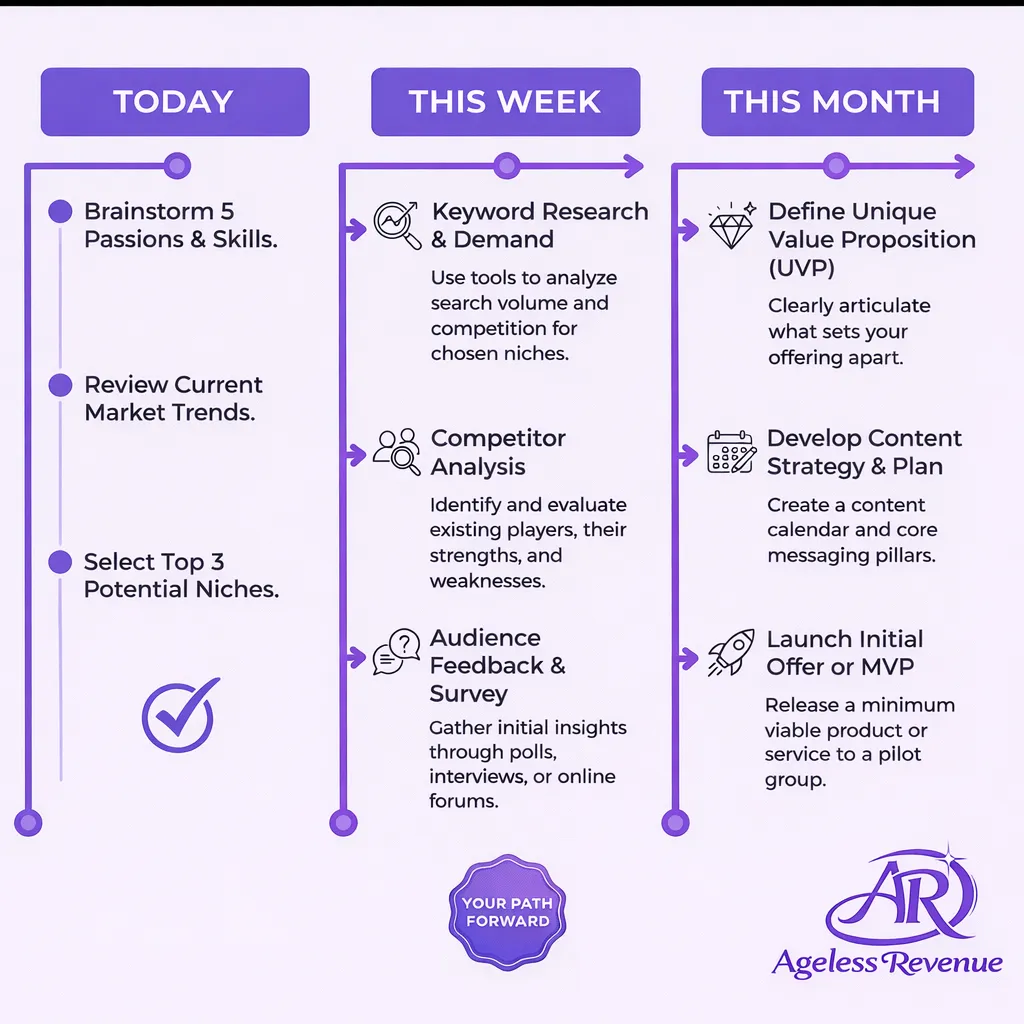
Today (Takes 30 minutes):
- Answer the 3 questions:
- What do you love talking about? (Write 3-5 topics)
- What problems have you solved? (List 3-5 challenges overcome)
- Who do you want to help? (Describe your ideal reader)
- Identify 2-3 potential niche ideas where these three answers overlap
- Join 1-2 Facebook groups in your top niche idea just to observe and learn what people are discussing
This Week (1-2 hours total):
- Complete the 30-minute validation checklist for your top 2 niche ideas:
- Check Google search volume (Google Keyword Planner or Autosuggest)
- Browse Amazon for relevant products (look for 50+ products with reviews)
- Find active Facebook groups (1,000+ members, daily posts)
- Check YouTube video views (10K+ views on popular videos)
- Compare your top 2 niches based on:
- Which has stronger market validation?
- Which feels more authentic to your experience?
- Which has better affiliate product opportunities?
- Choose your starting niche—pick one to focus on for the next 3-6 months
This Month (3-5 hours total):
- Join Wealthy Affiliate’s free starter membership to access:
- The Niche Finder tool for deeper research
- Complete niche selection training
- Community feedback on your niche choice
- Complete the niche research training to gain confidence in your choice
- Get community feedback on your niche—experienced affiliates can spot opportunities and potential challenges you might miss
- Write your first 3 blog post titles to prove to yourself you have plenty of content ideas
- Set up your website (if you haven’t already) and create your About page explaining your niche focus
Remember: You can always expand or pivot your niche as you learn and grow. The goal right now isn’t perfection—it’s making a thoughtful decision based on your unique strengths and starting to create content.
The best niche is the one you actually start working in rather than the “perfect” one you endlessly research but never launch.
FAQ (2026): Niche Selection for Retirees
Q: How narrow should my niche be?
A: Start narrow enough to establish authority but broad enough for 50+ content ideas. Example: Instead of “gardening” (too broad), try “organic vegetable gardening for beginners in small spaces” (specific but still allows plenty of content). You can always broaden later once you’ve established expertise—it’s much harder to narrow down after you’ve built a broad site.
Q: What if I have multiple interests and can’t choose just one?
A: Pick ONE to start with—the one you’re most passionate about or that has the strongest market validation. Build that site for 3-6 months until you have 20-30 solid posts and steady traffic. Then, if you still want to, you can start a second site in a different niche. Trying to manage multiple niches from day one spreads your energy too thin and usually leads to multiple half-finished sites rather than one successful one.
Q: Can I make money in a competitive niche as a beginner?
A: Yes, but you need to find your specific angle within that niche. “Weight loss” is incredibly competitive, but “strength training for women over 60 with osteoporosis” is much more specific. Competition usually means there’s money to be made—you just need to carve out your unique corner. Your life experience and authentic voice are differentiators that younger marketers can’t replicate.
Q: What if my niche idea seems too small or obscure?
A: “Small” niches can still have passionate audiences willing to buy. The validation checklist will tell you if there’s sufficient demand—if there are products on Amazon, active Facebook groups, and YouTube videos getting views, there’s an audience. Sometimes “obscure” niches are goldmines precisely because larger marketers overlook them.
Q: How long before I should see results in my chosen niche?
A: Realistic timeline with consistent effort (2-3 posts per week):
- Months 1-3: Building foundation, minimal traffic (mostly your family and friends)
- Months 3-6: Google starts ranking some posts, traffic grows to 100-500 visitors/month
- Months 6-12: Traffic accelerates as more posts rank, first meaningful affiliate commissions
- Year 2+: Compound growth as older content gains authority and new content ranks faster
Wealthy Affiliate’s training and community can accelerate this timeline because you’re learning proven strategies rather than figuring everything out through trial and error.
Q: What if I choose the wrong niche?
A: Nothing is permanent online. Many successful affiliates started in one niche and pivoted to another. The skills you learn—content creation, SEO, affiliate marketing fundamentals—transfer completely. Consider your first niche a learning laboratory. You’re building skills and understanding how affiliate marketing works. If after 20-30 posts you’re genuinely miserable or discover there’s no market, you can start fresh with much more knowledge.
Plus, if you’re part of Wealthy Affiliate’s community, you can get early feedback on whether your niche has real potential before investing months of work.
Conclusion: Your Perfect Niche is Waiting
Let’s recap what makes a perfect niche for retiree affiliate marketers:
✅ It combines your passion (so you’ll enjoy creating content)
✅ It leverages your life experience (so your content is authentic and valuable)
✅ It has proven market demand (so people are actively searching for solutions)
✅ It has affiliate product opportunities (so you can earn commissions)
✅ It serves a specific audience (so you can build trust and authority)
The best niche isn’t necessarily the most profitable one in some guru’s list. It’s the one that fits YOU—the one you’ll actually stick with for 6-12 months while you build momentum.
Here’s what I want you to understand: Your decades of life experience are genuinely valuable. The challenges you’ve overcome, the skills you’ve developed, the wisdom you’ve gained—these aren’t ordinary. They’re exactly what someone else desperately needs right now. When you share that knowledge in a niche you care about, you’re not just building a business. You’re genuinely helping people make better decisions, solve real problems, and improve their lives.
That’s what sustainable affiliate marketing looks like in 2026. Not tricks, not hype, not chasing trends—just authentic expertise shared generously with people who need it.
Your perfect niche exists at the intersection of what you love, what you know, and what people are searching for. You’ve learned how to find it. Now it’s time to validate your idea and start creating.
Ready to validate your niche with professional tools and get expert feedback?
Join Wealthy Affiliate’s free starter membership and get instant access to:
- The Niche Finder tool (automated research and validation)
- Complete niche selection training (video lessons for beginners)
- A supportive community of retirees (who’ve successfully chosen and built profitable niches in 2026)
- Website setup tools (so you can start creating content immediately)
No credit card required to start. Just your willingness to leverage your life experience into a meaningful online business.
Ready to choose your niche and start calmly?
https://agelessrevenue.com/starter-kit/
Your niche is waiting. Let’s find it together.