Best Social Media Affiliate Programs for 2026 (Beginner-Friendly Guide for Retirees)
Disclosure: This article contains affiliate links. If you buy through them, I may earn a commission at no extra cost to you.
Contents
- 1 Introduction
- 2 TL;DR
- 3 What counts as a “social media affiliate program”?
- 4 Why social media works so well for affiliate marketing (especially in 2026)
- 5 The 2026 mindset: E‑E‑A‑T on social media (without trying to be an “influencer”)
- 6 Choosing the right platform (pick ONE to start)
- 7 The best niches for retirees in 2026 (and why they work on social)
- 8 Best social media affiliate programs for 2026 (ranked by beginner-friendliness)
- 8.1 1) Wealthy Affiliate (training + tools + recurring referrals)
- 8.2 2) Amazon (Associates or Influencer)
- 8.3 3) TikTok Shop Affiliate (creator product commissions)
- 8.4 4) Impact (affiliate network)
- 8.5 5) CJ Affiliate (affiliate network)
- 8.6 6) Awin / ShareASale (affiliate network)
- 8.7 7) Rakuten Advertising (affiliate network)
- 8.8 8) eBay Partner Network
- 8.9 9) Walmart / Target / major retail programs (varies by region)
- 8.10 10) Niche brand programs (the hidden gem category)
- 9 How to choose the right affiliate program (a simple checklist)
- 10 A calm “starter system” for social affiliate marketing in 2026 (step-by-step)
- 11 Content ideas that don’t feel “salesy” (but still convert)
- 12 Common beginner mistakes (and how to avoid them)
- 13 FAQ: Best Social Media Affiliate Programs for 2026
- 13.1 1) Do I need a big following to make affiliate commissions?
- 13.2 2) Which platform is easiest for retirees?
- 13.3 3) Can I do this without showing my face?
- 13.4 4) Should I start with Amazon?
- 13.5 5) What is the fastest way to get results?
- 13.6 6) Is affiliate marketing still worth it in 2026?
- 13.7 7) How do I stay compliant?
- 13.8 8) What if I feel overwhelmed by the tech?
- 14 Conclusion: A simple, realistic path to social affiliate income
Introduction
If you’re a retiree who wants a little extra income (without a second job), affiliate marketing on social media can be a surprisingly good fit in 2026. Why? Because you don’t need to be “techy,” you don’t need a massive audience, and you don’t need to post all day. You do need a simple system: share helpful content, recommend trustworthy products, and make it easy for people to take the next step. So this article about Best Social Media Affiliate Programs 2026 (Beginners) will guide you through it.
Social media has become a shopping mall disguised as entertainment. People watch a short video, save a post, click a link, and buy—often without leaving the app. And with billions of people using social platforms globally, your potential reach is massive (for context, DataReportal reported 5.66 billion social media “user identities” in October 2025: Global social media users (DataReportal)).
In this guide, I’ll show you:
what “social media affiliate programs” actually are,
- Which programs tend to work best for beginners in 2026?
- How to choose offers that match your audience, and a calm, step-by-step plan you can follow even if you’re starting from scratch.
Along the way, I’ll keep things retiree-friendly: no jargon overload, no “hustle culture,” and no pressure to be on camera if you don’t want to.
TL;DR
Pick one main platform (YouTube, Facebook, Pinterest, Instagram, or TikTok) and learn it well.
Choose affiliate programs you can explain in plain language and products you’d recommend to a friend.
Start with 3–5 “easy-to-talk-about” products, not 25 random links.
Build trust first (real stories, real tips, clear disclosures).
Use a simple routine: 2 helpful posts + 1 recommendation post per week.
If you want training + tools in one place, consider Wealthy Affiliate (affiliate link).
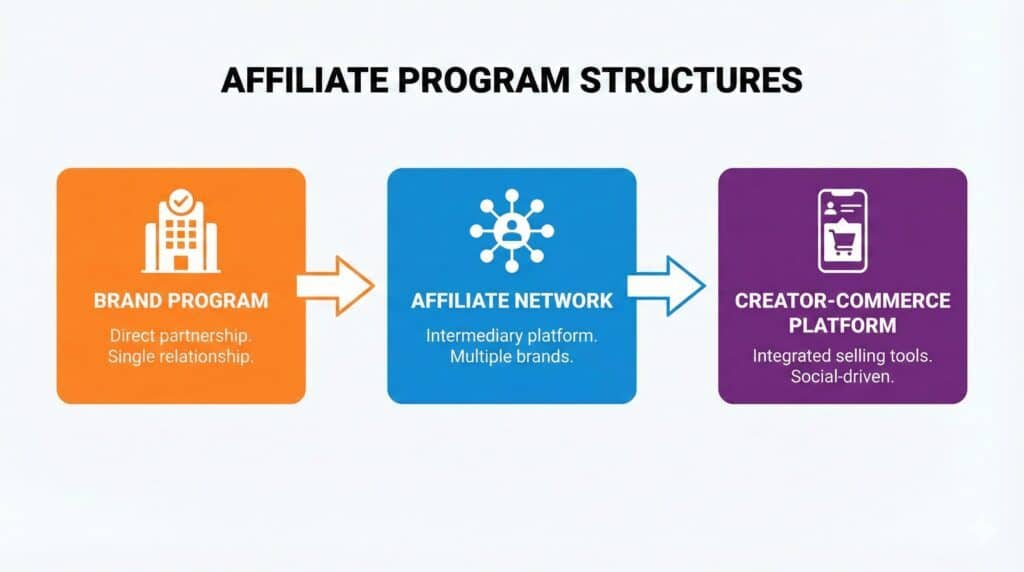
When people say “social media affiliate program,” they usually mean one of three things:
A brand’s own affiliate program
Example: a software company, a course platform, or a retailer that pays you a commission when someone buys through your link.An affiliate network that connects you to many brands
Instead of applying to 20 brands one by one, you apply to a network (like Impact, CJ, Awin/ShareASale, or Rakuten Advertising) and then apply to individual merchants inside the network.A creator-commerce platform designed for social posts
These are built for linking from social media (think “link-in-bio” style shopping). Some have storefronts or shoppable galleries and can be very beginner-friendly once you’re accepted.
In 2026, all three models can work. The “best” choice depends on your audience, your comfort level, and the kind of content you like creating.
Social media is a natural match for affiliate marketing because it’s built on two things that sell well: attention and trust.
Quick numbers (for context)
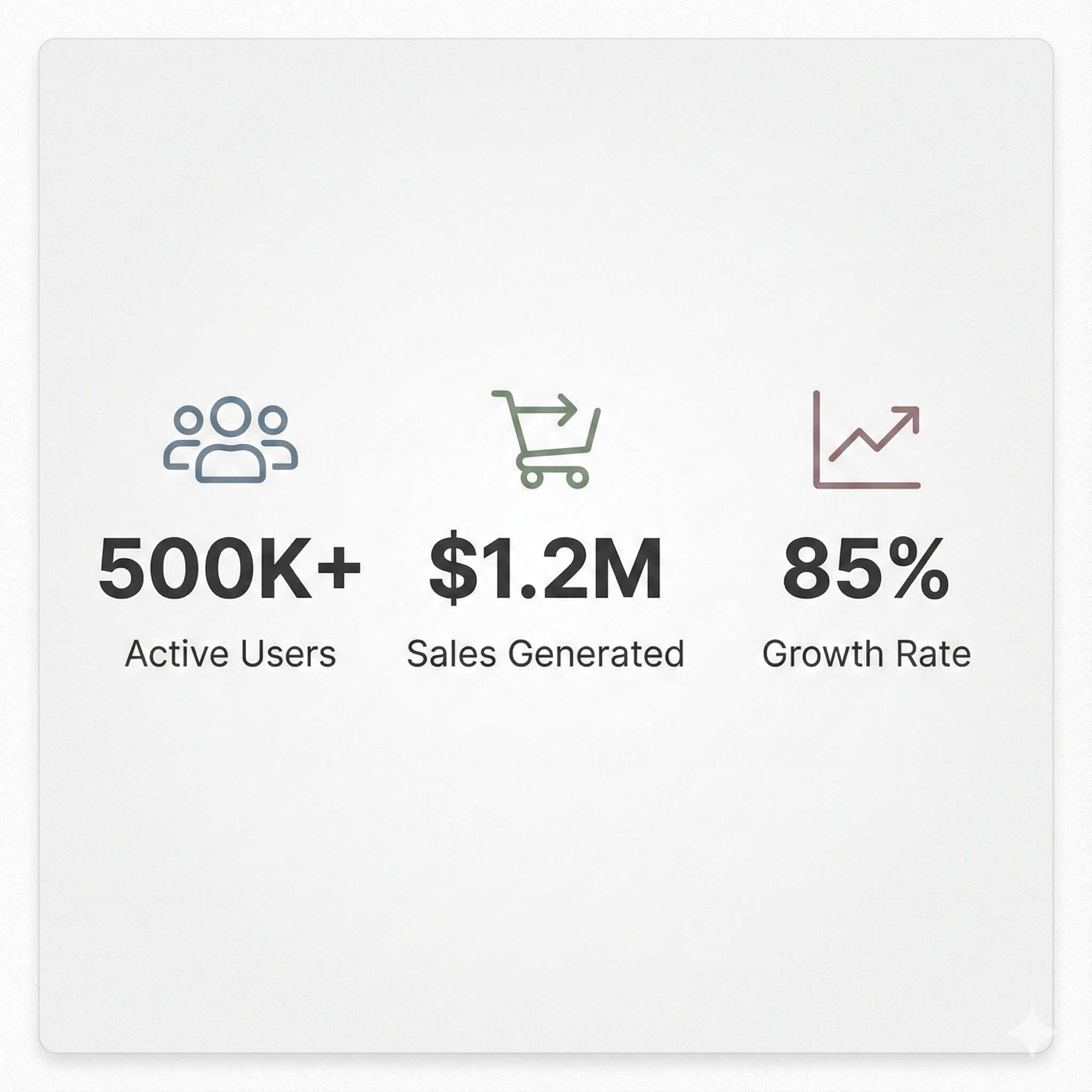
DataReportal reported 5.66 billion social media “user identities” worldwide as of October 2025.
eMarketer forecasts that U.S. social commerce sales will surpass $100 billion in 2026.
The Performance Marketing Association reported affiliate marketing spending grew from $9.1B (2021) to $13.62B (2024) in its study.
1) Visibility without a big budget
With a blog, you often wait for Google rankings. With social media, you can start reaching people immediately—especially on platforms that recommend content to non-followers (like TikTok, YouTube Shorts, Pinterest, and Reels).
2) Niche communities are everywhere
Retirees have niche superpowers: decades of experience, real opinions, and practical wisdom. Social platforms make it easy to gather around specific interests like:
travel after retirement,
ow-impact fitness,
simple home organization,
healthy cooking,
tech made easy for seniors,
budgeting and “second income” planning.
3) Social proof reduces hesitation
A short “here’s how I use this” post can outperform a polished sales page because it feels real. That’s the heart of E‑E‑A‑T (Experience, Expertise, Authoritativeness, Trust): people want evidence you’ve actually tried the thing.
If you’re brand new, start here first: Affiliate Marketing 101: Beginner’s Guide for Retirees.
Let’s make E‑E‑A‑T practical and stress-free:
Experience: “I tried this, here’s what happened.”
Even a simple before/after photo, a short story, or a quick demo builds confidence.Expertise: “Here’s the simple way to do it.”
You don’t need credentials—just clarity and usefulness.Authoritativeness: “Others recognize my guidance.”
This can be as small as thoughtful comments, saves, shares, or people asking follow-up questions.Trust: “I’m honest, consistent, and I disclose.”
Disclosures matter. The FTC’s plain-language guidance is worth skimming: Endorsements, Influencers, and Reviews (FTC).
A beginner-friendly rule: If you earn money from a recommendation, say so clearly and early. (No tiny hashtags buried at the bottom.)
Choosing the right platform (pick ONE to start)
You can absolutely do affiliate marketing on multiple platforms—but not at the beginning. Most beginners burn out because they try to learn everything at once.
Here’s a simple guide for retirees:
YouTube (best for “how-to” and reviews)
Great for product demos, tutorials, and “what I wish I knew” videos.
You can talk to the camera, do a voiceover, or just show your hands.
One video can keep bringing clicks for years.
Facebook (best for community + trust)
Great for groups, personal profiles, and pages.
Works well if your audience is already there (many retirees are).
Strong for conversations and relationship-building.
Pinterest (best for calm, evergreen traffic)
Think of Pinterest like a visual search engine.
Great for “checklists,” “best of” lists, and step-by-step pins.
Works beautifully when you have blog posts to link to.
Instagram (best for simple, visual tips)
Great for short reels, carousels, and saved posts.
Works well for lifestyle niches (travel, wellness, hobbies).
TikTok (best for reach—if you like quick videos)
Strong discovery; small accounts can get big reach.
Great for short demos and “quick tips.”
If you’d like a gentle, beginner routine for social, read: Social Media Affiliate Marketing: 5 Proven Beginner Steps.
“Best niche” doesn’t mean “most competitive.” It means something you can talk about naturally and something people buy.
Here are retiree-friendly niches that tend to perform well on social:
Health & wellness (low-impact, realistic)
Examples: walking routines, mobility tools, healthy cooking, sleep support.- Hobbies and “empty-nest” life
Gardening, RV travel, crafts, photography, birding, cooking, andhome organizing.
Practical tech for everyday life
Simple apps, beginner devices, tools for photo storage, password managers, and budget trackers.Money, planning, and “second income.”
Budgeting systems, simple side-income tools, beginner courses, and printable planners.Eco-friendly and “buy once” products
Durable goods, reusable household swaps, and minimalist organization tools.
If niche selection is where you feel stuck, this helps: Choosing a Profitable Niche With Wealthy Affiliate.
Below are programs and networks that tend to work well for social-media-driven affiliates. I’m not listing these as “the only good options”—I’m listing them because they’re commonly used, broadly available, and practical for beginners who want to promote through social posts.
1) Wealthy Affiliate (training + tools + recurring referrals)
Best for: retirees who want a structured learning path
Why it’s social-friendly: you can share your “learning journey,” tips, and progress milestones.
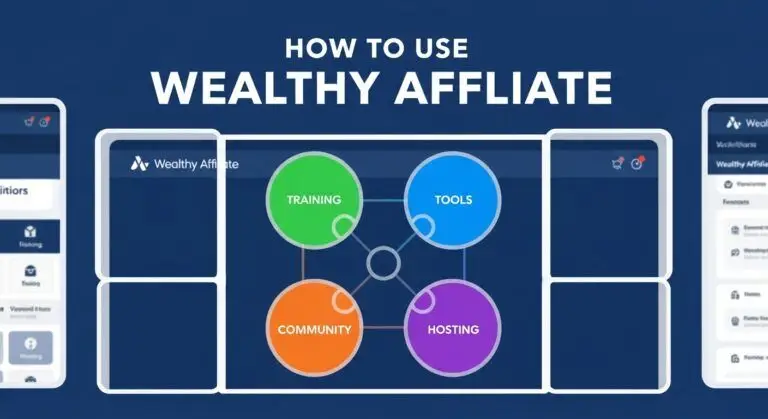
Wealthy Affiliate isn’t just an affiliate program—it’s also a training platform that teaches you the fundamentals of building a real affiliate business (website + content + traffic). If you want a guided place to learn at your own pace, take a look at Wealthy Affiliate (affiliate link).
Tip: If you want a deeper breakdown first, read: Wealthy Affiliate Review 2025: Honest Pros, Cons & Verdict.
2) Amazon (Associates or Influencer)
Best for: “starter” product recommendations and curated lists
Why it’s social-friendly: people already trust Amazon, and you can recommend almost anything.
Two common paths:
Amazon Associates (classic affiliate links)
Amazon Influencer Program (a storefront-style approach for creators)
You can learn the basics straight from Amazon here: Amazon Influencer Program.
3) TikTok Shop Affiliate (creator product commissions)
Best for: short demos of simple products
Why it’s social-friendly: the shopping experience is built into the platform.
This can be powerful if you enjoy quick videos or live demos. Even if you don’t want to “perform,” simple hands-only demos work well.
4) Impact (affiliate network)
Best for: finding reputable brands in many categories
Why it’s social-friendly: many brands allow social traffic, and you can build a clean portfolio of offers.
5) CJ Affiliate (affiliate network)
Best for: well-known retailers and larger brands
Why it’s social-friendly: great for lifestyle niches (travel, home, wellness, tech).
Best for: broad merchant selection and beginner-friendly brand applications
Why it’s social-friendly: many merchants provide creatives and tracking tools.
7) Rakuten Advertising (affiliate network)
Best for: established brands and retail offers
Why it’s social-friendly: strong for coupon-style and “deal” content (if that matches your audience).
8) eBay Partner Network
Best for: vintage, collectibles, and deal-hunting niches
Why it’s social-friendly: great for “finds” content (tools, hobby gear, collectibles).
9) Walmart / Target / major retail programs (varies by region)
Best for: practical household items and everyday needs
Why it’s social-friendly: great for “retirement life hacks” content.
Best for: higher commissions and more passionate audiences
Why it’s social-friendly: your content can feel less “salesy” because you’re recommending something specific and meaningful.
Examples: hobby subscriptions, specialty wellness brands, travel memberships, or tools that solve one clear problem.
How to choose the right affiliate program (a simple checklist)
Before you apply, check these five areas:
Does it match your audience’s needs?
A retiree audience often prefers simplicity, trust, and practicality over flashy trends.Can you explain it in 30 seconds?
If you can’t explain it simply, it will be hard to promote on social.What’s the commission structure?
One-time commission (paid once per sale)
Recurring commission (paid monthly as long as the customer stays)
Recurring programs can be especially helpful for retirees aiming for steadier income.
What are the rules for social media traffic?
Some programs require you to list your social accounts, prohibit certain link placements, or restrict paid ads.How reliable is the program?
Look for clear terms, consistent tracking, and a reasonable payout threshold.
Here’s a beginner system that works well for retirees because it’s consistent, not chaotic.
Step 1: Choose one small problem to solve
Examples:
“low-impact fitness for stiff knees”
“simple travel planning for retirees”
“beginner-friendly online income tools”
“Decluttering
a home after retirement.”
Step 2: Pick one primary platform
Choose where you’ll show up consistently for the next 90 days.
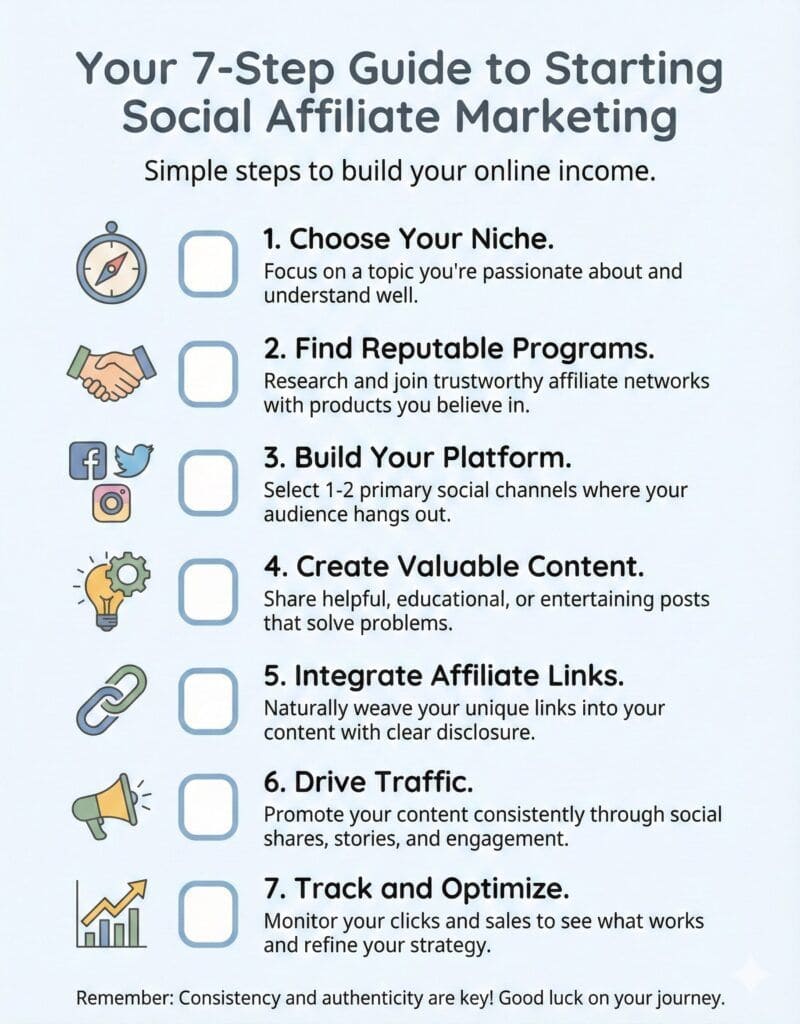
Step 3: Pick 3–5 products to recommend (only)
Start with items you know, use, or can research well enough to give an honest recommendation.
Step 4: Create a simple link plan
Instead of posting raw affiliate links everywhere, do this:
Create one helpful blog post (or resource page) for each product category.
Use social posts to send people to that page.
If you’re brand new to building a site, this is a gentle on-ramp: Starting Affiliate Marketing With No Experience (2025).
Step 5: Use a weekly posting routine
Try this simple schedule:
2 helpful posts (tips, how-to, checklist, story, mistake to avoid)
1 recommendation post (product + why + who it’s for)
1 “soft” reminder to visit your link hub or blog resource
Step 6: Add disclosures every time
Keep it simple:
“This post contains affiliate links. If you buy through them, I may earn a commission at no extra cost to you.”
Step 7: Track only 3 numbers
link clicks,
email signups (if you use email)
and affiliate conversions.
That’s enough to see what’s working without drowning in analytics.
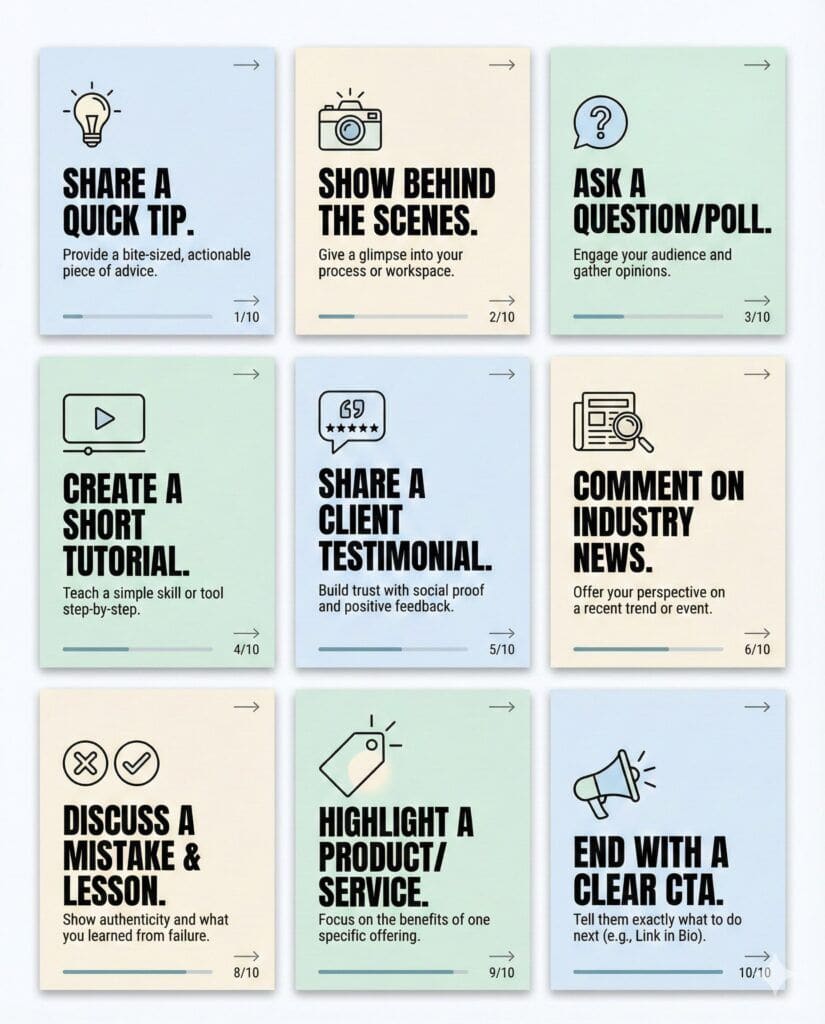
Content ideas that don’t feel “salesy” (but still convert)
If you’re worried about sounding pushy, use content that helps first:
“My 3 biggest mistakes when I started…”
“What I’d buy again (and what I wouldn’t)”
“Beginner checklist: start here.”
“Before/after: the simple change that helped”
“The one feature that makes this easier for older hands/eyes”
“Budget option vs. best option (honest comparison)”
“FAQ: what people always ask me about this”
Common beginner mistakes (and how to avoid them)
Joining too many programs at once
Fix: choose one network + one core offer.Posting links without context
Fix: lead with a helpful tip or story.Promoting products you don’t understand
Fix: if you can’t explain it simply, skip it.Skipping disclosures
Fix: make it a habit from day one (it builds trust).Giving up too soon
Fix: commit to 90 days of consistent posting before you judge results.
FAQ: Best Social Media Affiliate Programs for 2026
1) Do I need a big following to make affiliate commissions?
No. A small audience that trusts you can outperform a large audience that doesn’t care. Focus on usefulness and consistency.
2) Which platform is easiest for retirees?
Facebook and Pinterest often feel easiest for many retirees, while YouTube is fantastic if you like teaching. The best platform is the one you’ll actually use.
3) Can I do this without showing my face?
Yes. You can do voiceovers, screen recordings, slides, photos, or “hands-only” demos.
4) Should I start with Amazon?
Amazon is a common beginner choice because the products are familiar, but it’s rarely the highest commission. It can be a good starter while you add higher-paying niche programs later.
5) What is the fastest way to get results?
Fastest doesn’t mean best. The most reliable path is a simple routine: helpful posts + consistent recommendations + clear next steps.
6) Is affiliate marketing still worth it in 2026?
Yes—especially when you focus on trust and long-term content. Platforms and rules change, but helpful recommendations remain valuable.
7) How do I stay compliant?
Use clear disclosures, follow each program’s rules, and avoid making unrealistic income promises.
8) What if I feel overwhelmed by the tech?
Start smaller. One platform, one niche, one weekly routine. If you want structured training and tools, Wealthy Affiliate can be a good starting point (affiliate link).
In 2026, social media affiliate marketing can be a calm, practical way for retirees to create extra income—if you keep it simple. Pick one platform. Choose a niche you genuinely enjoy. Recommend products you trust. Disclose clearly. Repeat a small routine long enough for momentum to build.
And remember: you’re not competing with flashy influencers—you’re serving a specific audience that wants honesty, clarity, and real-world guidance.
If you want a step-by-step training path (plus tools and community support) as you build, you can explore Wealthy Affiliate (affiliate link).